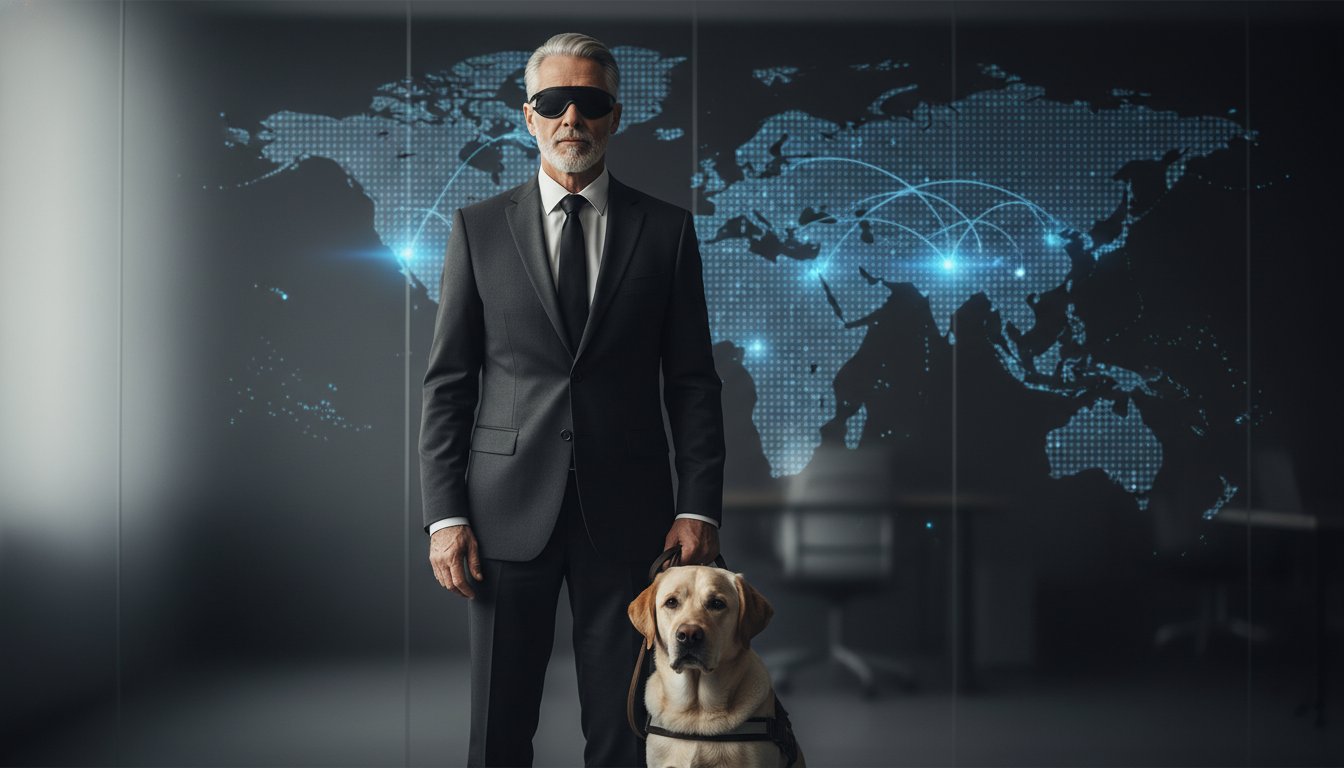
How to Build Trust in a Remote Team: Leadership Lessons from a 9/11 Survivor
Imagine standing on the 78th floor of the World Trade Center while the world shifts beneath your feet. In that moment, I couldn’t see the exit, but I had to trust my guide dog, Roselle, and my colleagues to navigate the descent. Today, many leaders feel a similar sense of blindness as they manage distributed workforces. While 77% of employees report higher productivity at home, a staggering 85% of business leaders still struggle to believe their teams are actually getting the work done. If you’re wondering how to build trust in a remote team, the answer doesn’t lie in more surveillance software or mandatory office days. It starts with a fundamental shift in perception.
You likely feel the weight of this disconnect every time a message goes unanswered or a company culture feels like it’s fading into the background. It’s exhausting to manage by “line of sight” when your team is scattered across time zones. This article will show you how to transform that isolation into resilient interdependence using the same high-stakes leadership principles that saved my life. We’ll examine a framework for measuring trust through results instead of hours and explore strategies to lead with clarity even when the future feels uncertain. By the end, you’ll have the tools to move beyond physical visibility and into a culture of true accountability.
Key Takeaways
- Shift your management focus from visual surveillance to “predictable interdependence,” ensuring that productivity is measured by results rather than active status icons.
- Discover how to build trust in a remote team by applying the “Thunder Dog” principle, where effective leadership requires being humble enough to be led by your team’s expertise.
- Implement the framework of “Blind Trust” to foster a culture where team members feel empowered to execute their roles with high-stakes precision, regardless of physical proximity.
- Use the “Art of Living with No Limits” to help your organization transcend the perceived barriers of remote work and build a resilient culture that thrives through uncertainty.
The Visibility Trap: Why Remote Trust Requires a New Vision
For many years, I’ve navigated a world where physical sight isn’t the primary source of information. In leadership, we often rely on what we can see to feel secure. When we move to a remote environment, that visual safety net disappears. This is where many managers fall into the Visibility Trap, which is a frantic urge to equate a green “active” icon on a chat app with actual work. To truly understand what are virtual teams and how they function, we must stop looking for digital footprints and start looking for results.
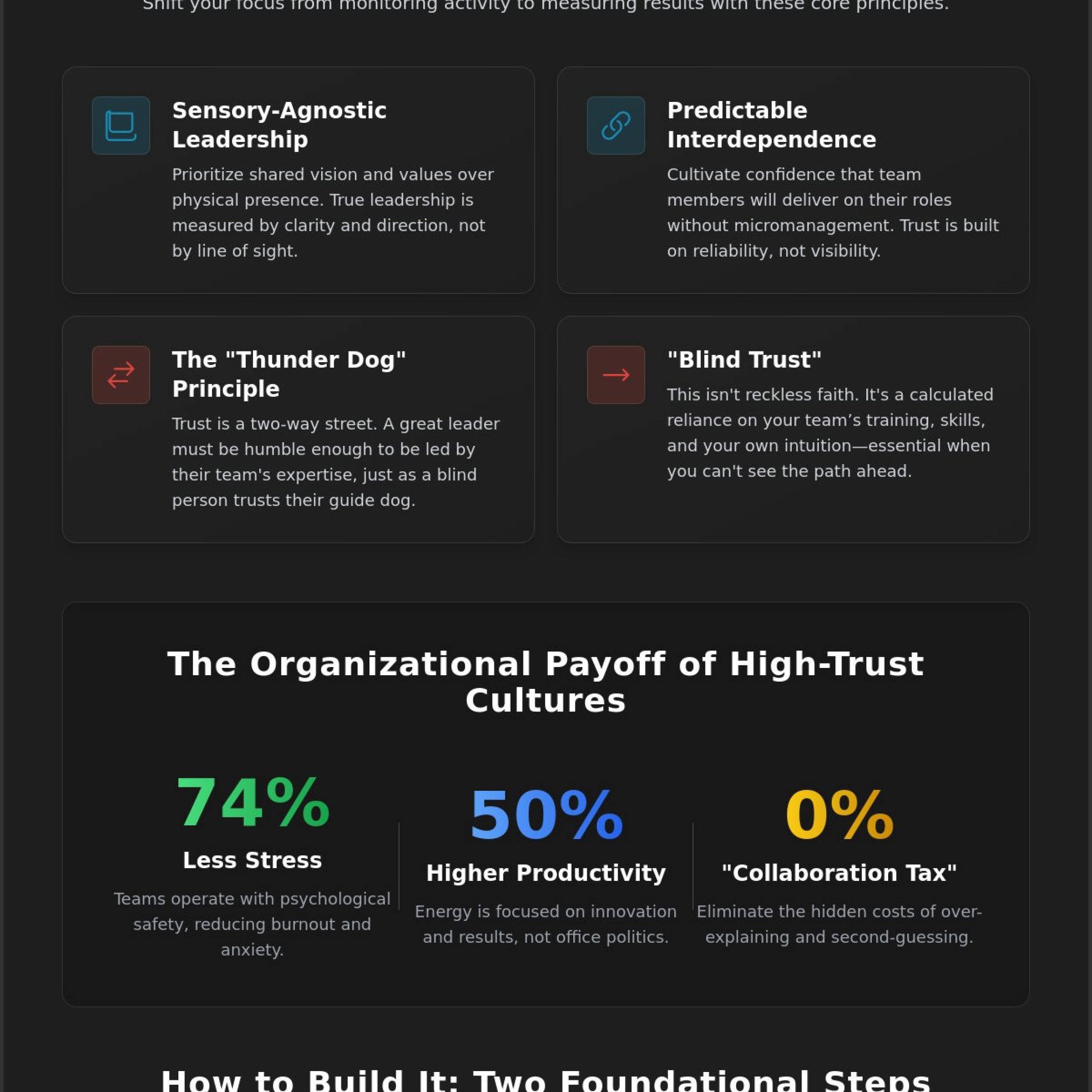
Real trust in a distributed world isn’t about surveillance; it’s about predictable interdependence. It’s the quiet confidence that your partner will perform their role even when you aren’t standing over their shoulder. I call this Sensory-Agnostic Leadership. This approach prioritizes vision and shared values over physical presence. Remote trust is a commitment to shared outcomes that remains unshakable regardless of physical distance.
Key Takeaways for Modern Remote Leaders
Learning how to build trust in a remote team requires a deliberate shift in how we measure success. It’s about moving from a culture of checking in to a culture of checking results.
- Stop monitoring hours and start measuring milestones and reliability.
- Prioritize psychological safety as the primary engine of remote innovation.
- Understand that trust is a perishable asset that requires daily reinforcement through clear, empathetic communication.
Why This Matters for Organizations
When you master the art of remote trust, you eliminate the “collaboration tax.” This is the hidden cost of over-explaining, second-guessing, and constant check-ins that drain energy. High-trust remote teams report 74% less stress and 50% higher productivity compared to their low-trust counterparts. Leadership and trust are the twin pillars of any crisis-ready team, allowing you to move forward with speed even when the path ahead is obscured.
Strategies for Building Trust: Lessons from a Guide Dog Partnership
On September 11, 2001, as my guide dog Roselle led me down 1,463 stairs in Tower One, I practiced what I call “Blind Trust.” This wasn’t a reckless leap into the unknown. It was a calculated reliance on her specialized training and my own intuition. In a remote setting, you are often “in the dark” regarding your team’s minute-by-minute actions. Learning how to build trust in a remote team requires this same level of partnership. You must trust their expertise just as they trust your vision. When you can’t see the work happening, you must rely on the bond you’ve built.
This leads to the “Thunder Dog” principle, which suggests that trust is a two-way street where the leader must also be leadable. During the descent, I had to listen to Roselle’s cues; she was the one with the sensory data I lacked. If you aren’t willing to follow your team’s lead in their areas of strength, the bond of trust breaks. Adopting best practices for building trust means moving away from rigid hierarchy and toward radical clarity. In a remote world, ambiguity is the enemy. When expectations are vague, anxiety fills the gap and productivity suffers.
Step 1: Establish the ‘Rules of Engagement’
To prevent “anxiety-based” checking, you must define clear communication channels. Decide which platforms are for urgent matters and which are for asynchronous updates. Set explicit expectations for response times so team members don’t feel pressured to be “always on.” Crafting a formal Team Agreement helps document these norms, ensuring trust is measured by reliability rather than availability.
Step 2: Cultivate Interdependent Accountability
We must move from individual silos to systems of interdependent accountability. Just as Roselle and I functioned as a unit, remote teams thrive when they use “buddy systems” for high-stakes projects. This fosters an inclusive workplace culture where vulnerability is seen as a strength. When team members feel safe admitting mistakes early, you can navigate obstacles before they become crises. If you’re looking for a keynote speaker who can help your team navigate these shifts, I would be honored to share more about these resilient strategies.
Leading Through Uncertainty: Building an Unstoppable Remote Culture
In high-stakes moments, trust isn’t just a “nice-to-have” cultural element; it’s the only currency that matters. When the world shifts, whether due to a global crisis or a corporate merger, teams need a guide who perceives the path ahead even when they cannot. This is where learning how to build trust in a remote team becomes a vital survival skill. My framework, the “Art of Living with No Limits,” provides a roadmap for teams to overcome perceived barriers. It teaches that physical distance is merely a characteristic of the work, not a limitation of the collective potential. Leaders must transition from being task overseers to visionary guides. A task overseer monitors the “how,” but a visionary guide clarifies the “why,” allowing the team to navigate the “how” with autonomy. Michael Hingson’s keynote speaking programs dive deep into building these high-trust environments by shifting focus from control to connection.
The Resilience Factor in Remote Teams
Remote trust acts as a critical buffer against burnout and turnover. When employees feel trusted, they’re less likely to experience the “always-on” fatigue that stems from feeling watched. In Tower One, clear direction and mutual trust between myself, Roselle, and my colleagues saved our lives. We didn’t have time to second-guess intentions; we had to move as one. In a digital space, this means encouraging teams to see “beyond the screen” to the human being on the other side. This human-centric approach is a cornerstone of any effective guide to managing remote teams, ensuring that empathy remains at the heart of every interaction.
Final Steps: Booking Your Path to Resilience
Invite your leaders to assess their current trust levels using a simple “interdependence audit.” Ask yourself: Do my team members feel empowered to make decisions in my absence? If the answer is no, it’s time to rethink your strategy on how to build trust in a remote team. If you’re looking for a keynote speaker who can help your team navigate uncertainty, build trust, and lead through change, Michael Hingson brings a perspective that few others can offer. Explore more insights on building a resilient mindset for your organization today.
From Digital Distance to Resilient Interdependence
Building a high-trust remote culture isn’t about finding better ways to watch your employees; it’s about finding better ways to empower them. We’ve explored how shifting from visual surveillance to predictable interdependence allows your team to move with speed and confidence. By embracing the “Thunder Dog” principle and prioritizing radical clarity, you can turn the perceived barriers of physical distance into opportunities for deeper connection and growth.
As a 9/11 survivor and the New York Times Bestselling Author of Thunder Dog, I’ve seen firsthand how trust saves lives in the most extreme conditions. Whether I’m hosting the Unstoppable Mindset Podcast or speaking to executive teams, my mission is to show leaders how to build trust in a remote team by perceiving beyond physical limitations. If you’re ready to transform your organization’s culture and lead through uncertainty with quiet strength, I invite you to book Michael Hingson for your next leadership event. Together, we can build a team that remains unstoppable, no matter where they are located.
Frequently Asked Questions
How do I build trust in a remote team if I can’t see what they’re doing?
You build trust by shifting your focus from visual surveillance to results-oriented reliability. To master how to build trust in a remote team, you must prioritize predictable interdependence over “active” status icons. Just as I relied on Roselle’s consistent movements in the dark, you must rely on your team’s consistent delivery of milestones. When outcomes become the primary measure of success, the need for constant digital oversight naturally fades away.
What are the biggest barriers to trust in virtual leadership?
The primary barriers are ambiguity and the “Visibility Trap,” where managers equate physical presence with productivity. Without clear communication channels, anxiety often fills the void; this leads to micromanagement. This creates a “collaboration tax” that slows down every project and drains team energy. To overcome this, leaders must replace vague expectations with radical clarity, ensuring every team member understands their role and the collective vision without needing constant check-ins.
Can a remote team be as cohesive as an in-person team?
A remote team can be even more cohesive than an in-person team because cohesion in a virtual space requires deliberate intentionality. While 67% of remote workers report feeling less connected to colleagues, this gap is bridged through interdependent accountability. By fostering a “buddy system” similar to a guide dog partnership, you encourage team members to rely on one another’s strengths. This shared reliance creates a bond that transcends physical proximity and builds a resilient, unstoppable culture.
How do I handle a breach of trust in a remote environment?
Addressing a breach of trust requires immediate, empathetic dialogue and a re-evaluation of your “Rules of Engagement.” Start by identifying if the breakdown occurred due to a lack of clarity or a genuine lack of commitment. If you are refining how to build trust in a remote team, treat these moments as opportunities for realignment. Openly discussing the failure restores psychological safety and reinforces the shared vision that keeps your team resilient during any corporate crisis.
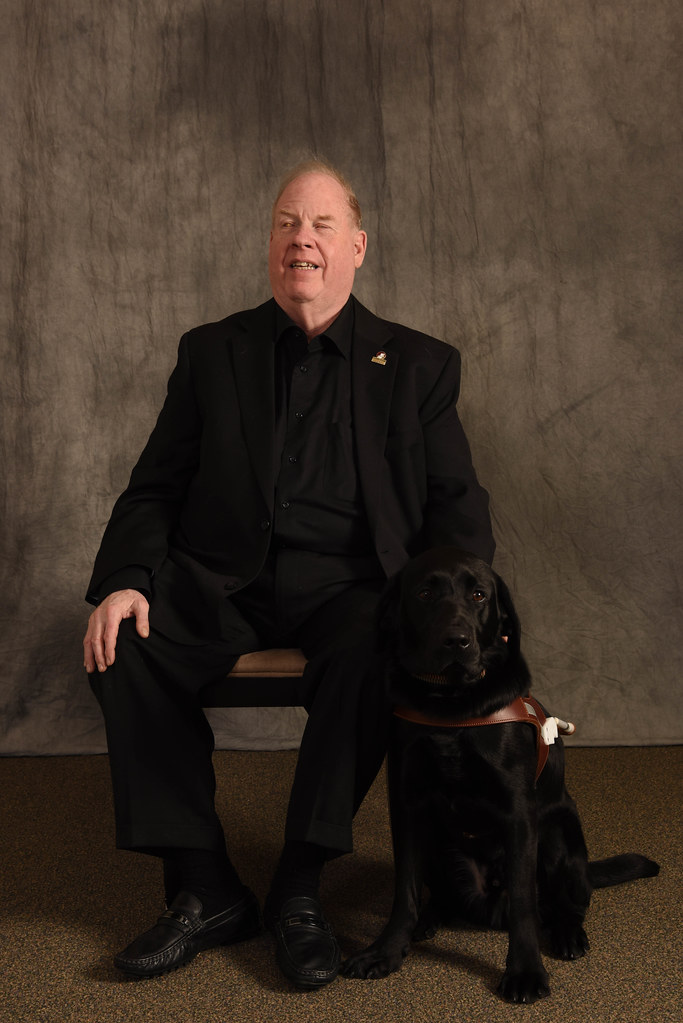
Article by
Michael Hingson
Michael Hingson is a keynote speaker, bestselling author of Thunder Dog, and a survivor of the September 11 World Trade Center attacks. Blind since birth, he brings a powerful and unique perspective on leadership, trust, and resilience in times of uncertainty.
He has spoken to organizations around the world, helping leaders and teams navigate change, build trust, and perform under pressure. His message combines real-world experience with practical insight that audiences remember long after the event ends.
👉 Book Michael Hingson for your next event.