
Unstoppable Mindset Training for Leaders: Building Trust and Resilience in 2026
What if the greatest asset your leadership team possesses isn’t their vision, but their ability to move as one when the lights go out? In a world where 82% of managers enter their roles without formal training, the pressure to perform amidst rapid change can feel suffocating. You’ve likely seen the cracks: siloed departments, burnout, and a hesitant culture that fears the next disruption. This is where unstoppable mindset training for leaders becomes more than just a development goal; it’s a survival strategy. It’s about moving beyond the exhaustion of survival and stepping into a state of radical trust.
We understand that the obstacles you face aren’t just external market shifts; they’re the internal frictions that stop a team from truly connecting. This article will show you how to transform your leadership through the ‘No Limits’ framework, a philosophy born from the high-stakes reality of navigating the World Trade Center on 9/11. You’ll learn to see obstacles as mere characteristics rather than barriers. We’ll explore a tactical framework for crisis management and the shift toward team interdependence that turns uncertainty into a shared competitive advantage.
Key Takeaways
- Redefine organizational limitations as mere characteristics using the “No Limits” philosophy to unlock hidden potential within your team.
- Discover how unstoppable mindset training for leaders builds radical trust and interdependence, enabling teams to function with the precision of a guide dog partnership.
- Develop adaptive perception to maintain clarity and identify strategic opportunities during times of rapid market evolution or crisis.
- Integrate the “Seeing Beyond the Blindness” framework into your DEI initiatives to foster a culture where diverse perspectives drive collective resilience.
- Transition from temporary training sessions to permanent organizational habits that ensure your leadership remains steady and optimistic under pressure.
What is an Unstoppable Mindset for Leaders?
On September 11, 2001, Michael Hingson sat on the 78th floor of Tower One when the world changed in an instant. In that moment of extreme crisis, survival did not depend on individual sight; it depended on a foundation of trust built long before the first alarm sounded. This lived experience forms the bedrock of unstoppable mindset training for leaders. It’s not about individual heroics or simply “powering through” a difficult quarter. Instead, it represents a fundamental shift from a state of constant survival to a state of thriving through radical interdependence.
When we explore the “No Limits” philosophy, we aren’t suggesting that challenges don’t exist. We are redefining them. A limitation, such as blindness, is simply a characteristic, much like the color of one’s hair or the height of a building. It only becomes a barrier when our perception allows it to be. Leaders who master this mindset understand that they must first master their internal perception before they can hope to master the shifting market environment around them. It is the clarity of the mind, not the physical surroundings, that dictates the path forward.
Key Takeaways: The Foundation of No-Limits Thinking
Mindset is a deliberate choice of perception rather than a passive reaction to external circumstances. In a corporate setting, we must distinguish between blind optimism, which ignores reality, and informed resilience, which acknowledges the gravity of a situation while remaining focused on the solution. This is closely related to developing a growth mindset, where every obstacle is viewed as an opportunity for refinement. True resilience is fueled by preparation; when you’ve prepared for the “what-ifs,” fear loses its grip on your decision-making process.
Why This Matters for Leaders and Organizations
A stagnant mindset is the silent killer of innovation. When leaders operate from a place of fear, they build silos to protect their territory, effectively blinding the entire organization to new opportunities. The ROI of trust-based leadership is measurable. Organizations that prioritize interdependence see higher employee retention and a significantly faster crisis response speed. If you’re looking for a keynote speaker who can bridge the gap between abstract resilience and tactical trust, Michael Hingson offers a roadmap forged in the most extreme conditions imaginable.
The Three Pillars of Unstoppable Leadership Training
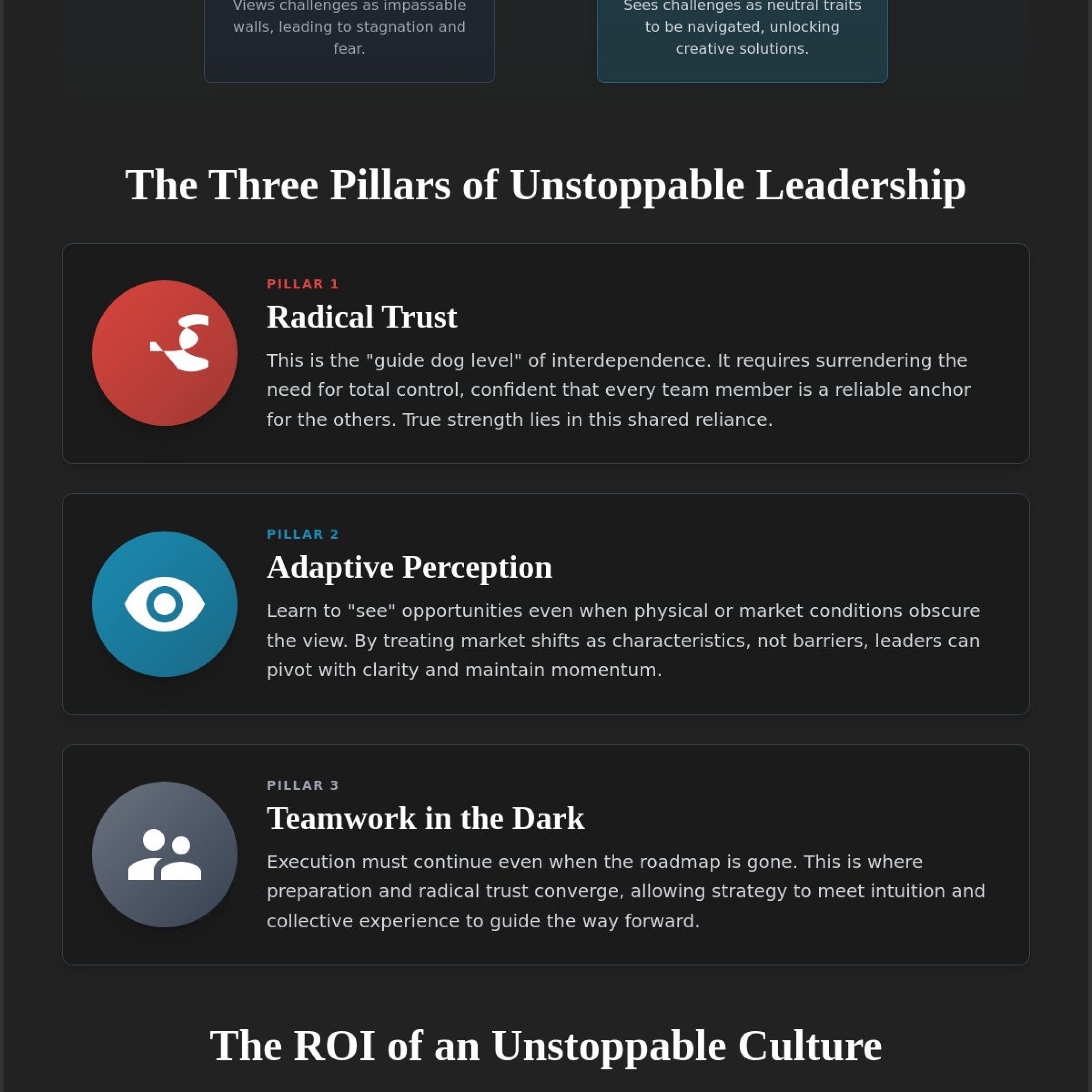
Transformation begins when we move from theoretical concepts to actionable frameworks. To truly equip an executive team, unstoppable mindset training for leaders must be anchored in three foundational pillars that support radical trust and collective resilience. Michael Hingson, a blind 9/11 survivor and bestselling author, developed these pillars to provide the clarity needed to lead when the path forward is obscured by smoke or market volatility.
- Pillar 1: Radical Trust. This is the guide dog level of interdependence. It requires a complete surrender of the need for total control in exchange for the certainty that your partner will do their part.
- Pillar 2: Adaptive Perception. This involves learning to “see” opportunities even when physical or market conditions shift. It’s the ability to pivot without losing momentum.
- Pillar 3: Teamwork in the Dark. Execution must continue even when the roadmap is gone. This is where strategy meets intuition and collective experience.
Building Radical Trust in High-Stakes Environments
Many organizations prize independence, yet true strength lies in interdependence. In a high-functioning leadership development program, the focus shifts from individual achievement to the invisible bonds that hold a team together. To identify trust gaps, leaders should conduct a simple audit: where does communication stop when the pressure increases? If your team stops sharing information during a crisis, you have a trust gap that requires immediate attention. It’s about moving toward a state where every team member is a reliable anchor for the others.
Adaptive Living as a Corporate Strategy
We often view market shifts as limitations, but they are merely characteristics of the business environment. Just as someone might use specialized tools to navigate a digital space, leaders can use adaptive principles to solve complex organizational problems. When you treat a sudden change as a characteristic rather than a barrier, you remove the emotional weight of the obstacle. This allows for a more logical, rhythmic progression toward a solution. If you’re ready to bring these lessons to your organization, Michael Hingson’s keynote speaker sessions offer the tactical tools needed to build this resilience.
By mastering these pillars, your team moves from reacting to the world to actively shaping it. It’s a journey that requires humility and a willingness to see beyond the obvious.
Cultivating an Unstoppable Culture: Implementation and Next Steps
A mindset is a spark, but a culture is a flame. While unstoppable mindset training for leaders provides the initial illumination, the true challenge lies in turning those insights into permanent organizational habits. It’s the difference between a team that survives a storm and a team that builds a lighthouse together. To move beyond survival, we must integrate the “Seeing Beyond the Blindness” philosophy into the very fabric of our corporate identity, ensuring that resilience isn’t just a reaction, but a baseline for how we operate every day.
Inclusion as a Catalyst for Resilience
Diversity is often treated as a compliance metric, but in high-stakes environments, it’s a tactical advantage. When a team is composed of individuals with varied life experiences, they bring a wider spectrum of perception to the table. This cognitive diversity allows a group to “see” around corners that a homogeneous group might miss. By prioritizing Diversity and Inclusion in the Workplace, you’re effectively building a sonar system for your business. You’re ensuring that no matter which way the market turns, someone on your team has the unique perspective needed to navigate the dark. Inclusive leadership isn’t just about being fair; it’s about being prepared.
Next Steps: Bringing the ‘No Limits’ Vision to Your Team
Transitioning from individual awareness to collective action requires a deliberate shift in daily operations. This often begins with a unifying experience, such as a keynote event that aligns the entire organization around a shared language of trust. From there, leaders can look toward formal leadership development training to reinforce these principles. This transition ensures that unstoppable mindset training for leaders becomes a lived reality rather than a forgotten seminar. To keep the conversation alive, encourage your teams to explore the Unstoppable Mindset Podcast, where we dive deeper into the intersection of adaptive living and executive excellence.
If you’re looking for a keynote speaker who can help your team navigate uncertainty, build trust, and lead through change, Michael Hingson brings a perspective that few others can offer. An unstoppable mindset is a journey of trust that begins with a single step of vulnerability. It’s a commitment to moving forward together, even when the path isn’t perfectly clear.
Master Your Perception to Lead Your Team Forward
True leadership isn’t a solo performance; it’s a symphony of trust. We’ve explored how redefining limitations as mere characteristics allows your team to move beyond the exhaustion of survival. By anchoring your organization in radical trust and adaptive perception, you create a culture that doesn’t just endure change but thrives within it. This shift from independence to interdependence is the core of effective unstoppable mindset training for leaders. It turns the unknown into a shared journey where every obstacle becomes a catalyst for growth.
Michael Hingson brings a perspective forged in the heat of Tower One and sharpened by over 30 years of corporate leadership experience. As a New York Times Bestselling Author of “Thunder Dog” and host of the Unstoppable Mindset Podcast, he offers more than just a narrative of survival. He provides a tactical blueprint for high-level resilience and inclusive leadership. If you’re looking for a keynote speaker who can help your team navigate uncertainty, build trust, and lead through change, Michael Hingson brings a perspective that few others can offer. Your team has the potential to be truly limitless. The journey begins when you choose to see beyond the barriers.
Frequently Asked Questions
What is the core difference between resilience training and unstoppable mindset training?
Resilience training typically focuses on the ability to bounce back to a previous baseline after a setback. In contrast, unstoppable mindset training for leaders teaches teams to move forward through challenges by redefining obstacles as mere characteristics of the landscape. It’s a shift from recovery to continuous adaptation. This approach ensures that a crisis doesn’t just end; it becomes a catalyst for reaching a higher level of performance and trust.
How can leaders build trust in a remote or hybrid work environment?
Building trust in hybrid settings requires a deliberate shift from monitoring physical presence to valuing transparent outcomes and human connection. Leaders must cultivate a “guide dog” level of interdependence by setting clear, shared goals and then trusting their team to execute them. This radical trust is reinforced through consistent communication that prioritizes clarity over micromanagement. When team members feel empowered to own their roles from a distance, the collective resilience of the organization grows.
Is an unstoppable mindset something that can be taught, or is it an innate trait?
An unstoppable mindset is a skill that can be developed through a structured choice of perception rather than an innate personality trait. While some people are naturally optimistic, unstoppable mindset training for leaders provides a tactical framework that anyone can master with practice and preparation. By learning to identify fear-based reactions and replacing them with informed resilience, leaders can transform their internal perception. This training helps turn temporary mindset shifts into permanent organizational habits.
How does Michael Hingson’s experience as a 9/11 survivor apply to modern corporate challenges?
Michael’s experience in Tower One provides a blueprint for maintaining clarity and trust during high-stakes corporate disruptions. While modern business challenges are rarely a matter of physical survival, they often carry the same weight of uncertainty and rapid change. By applying the lessons of teamwork and preparation learned during the World Trade Center evacuation, leaders can navigate market volatility with calm confidence. This perspective helps executive teams move past the paralysis of fear to focus on strategic execution.
Article by
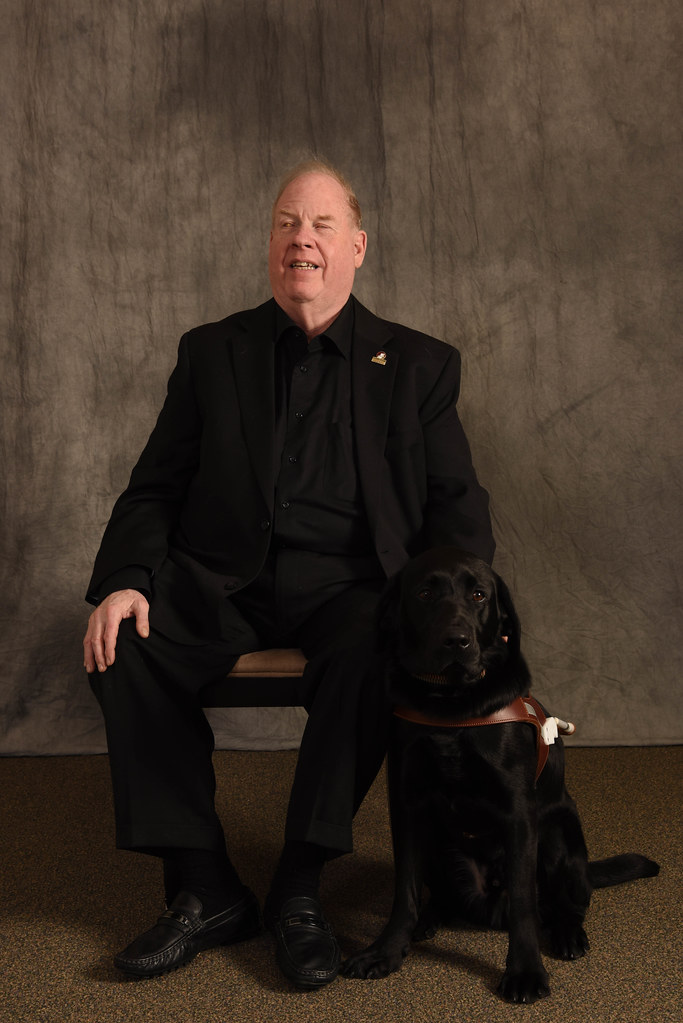
Michael Hingson
Michael Hingson is a keynote speaker, bestselling author of Thunder Dog, and a survivor of the September 11 World Trade Center attacks. Blind since birth, he brings a powerful and unique perspective on leadership, trust, and resilience in times of uncertainty.
He has spoken to organizations around the world, helping leaders and teams navigate change, build trust, and perform under pressure. His message combines real-world experience with practical insight that audiences remember long after the event ends.
👉 Book Michael Hingson for your next event.