Crisis Management Keynote Speaker: Leading Through Uncertainty with Vision and Trust
What if the most effective tool for surviving a disaster isn’t a complex software suite, but the invisible bond of trust established long before the lights go out? While the global crisis management software market is projected to reach $156.78 billion in 2026, technology alone cannot bridge a gap in human connection. You’ve likely seen teams freeze when the pressure mounts, paralyzed by the fragmentation of information that leaves 61% of people doubting the truth according to FGS Global. It’s a common struggle; generic motivational speeches often fail to provide the grounding your team needs when the world starts to shake.
As you search for a crisis management keynote speaker, you aren’t just looking for a story of survival; you’re looking for a blueprint for resilience. I’ve learned that navigating the descent of the North Tower with my guide dog, Roselle, wasn’t about physical sight. It was about the power of interdependence. In this article, you’ll discover how the intersection of trust, preparation, and an Unstoppable Mindset transforms crisis management from a reactive struggle into a strategic advantage. We’ll explore practical frameworks for trust-based leadership that ensure your team views every crisis as a manageable challenge rather than a reason to panic.
Key Takeaways
- Shift your leadership perspective from reactive struggle to strategic advantage by cultivating an Unstoppable Mindset that treats uncertainty as a manageable challenge.
- Master the pillar of Radical Trust to foster the deep interdependence required for your team to move as one when external structures fail.
- Develop sensory awareness to “see” beyond your digital dashboard, allowing you to identify emerging threats and hidden opportunities before they escalate.
- Discover how a crisis management keynote speaker with a background in high-stakes resilience can transform your organization’s approach to change and leadership.
Crisis Management in 2026: Moving from Reaction to Resilience
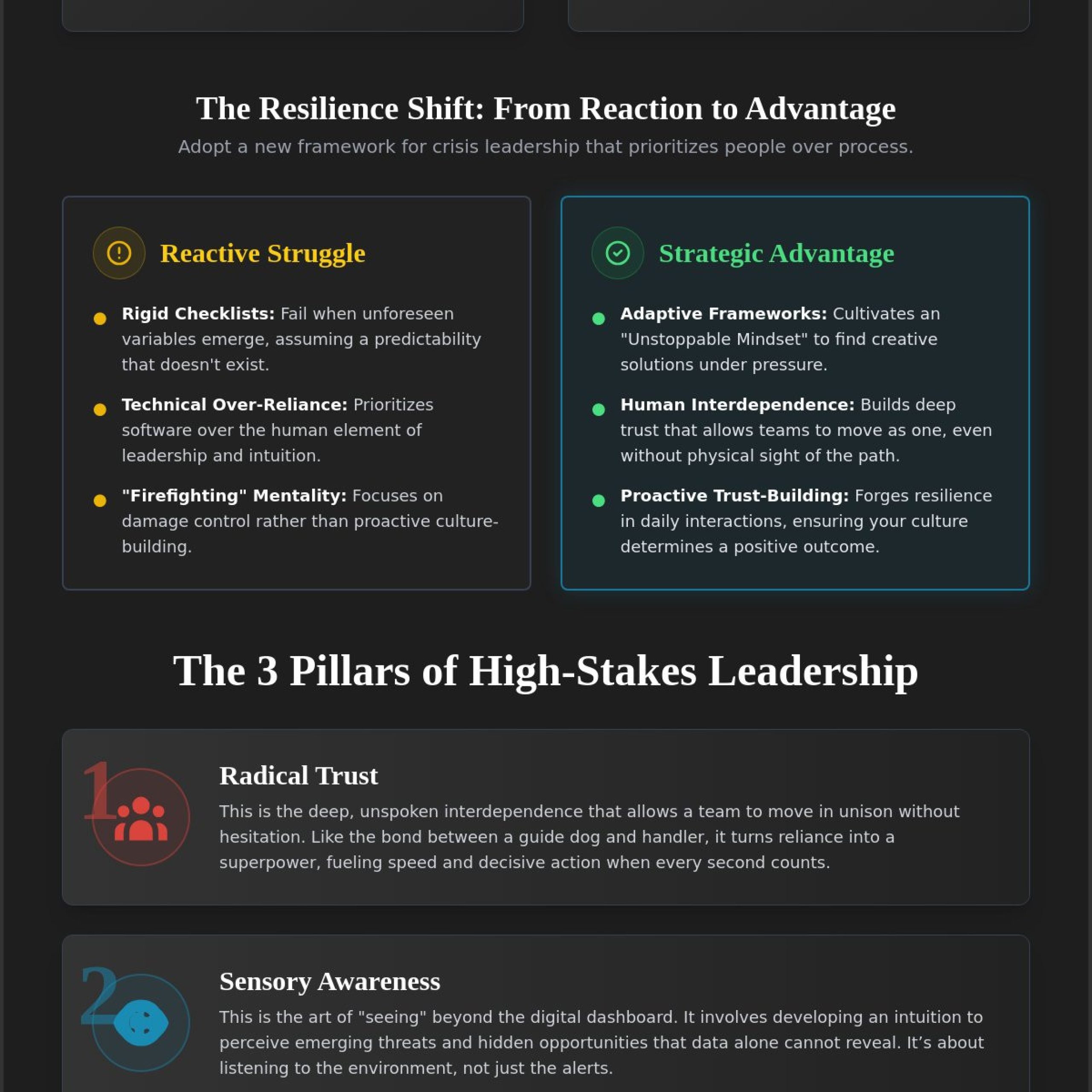
Crisis management isn’t just about damage control or following a manual when the sirens go off. In 2026, it’s the proactive cultivation of trust and adaptive leadership that happens long before a disruption occurs. Crisis management is the ability to lead when the path forward is not visible. True resilience isn’t found in a binder; it’s forged in the daily interactions between a leader and their team. By the time a crisis hits, your culture has already determined your outcome.
- Transition from reactive “firefighting” to proactive trust-building.
- Replace rigid checklists with adaptive, vision-based frameworks.
- Prioritize human interdependence over purely technical software solutions.
The landscape of 2026 requires leaders to look beyond traditional data sets and develop a visionary intuition. While the global crisis management software market is valued at $156.78 billion, technical tools can’t replace the human element of trust. Leading effectively means seeing the opportunities hidden within the chaos, even when the data remains unclear.
Why Traditional Crisis Models Fail in High-Stakes Environments
Rigid checklists often crumble when unforeseen variables emerge. They assume a level of predictability that simply doesn’t exist in a true emergency. When a situation evolves rapidly, you need a framework that allows for agility. A crisis management keynote speaker helps your team adopt the Art of Living with No Limits. This mindset, advocated by the Michael Hingson Group, focuses on rejecting perceived boundaries to find creative solutions under pressure.
The Business Case for “Unseen” Leadership
Trust reduces the friction of decision-making. In a high-stakes environment, every second counts. If your team trusts your vision, they move without hesitation. This is the core of effective leadership and trust. It’s an investment in organizational health that pays dividends when speed becomes a survival requirement. When you build an infrastructure of trust, you ensure that your team remains focused on the mission rather than their own fear.
The Three Pillars of High-Stakes Crisis Leadership
True crisis leadership isn’t found in a spreadsheet or a software suite. It lives in the hearts and minds of people who’ve decided to trust one another. While most consultants focus on checklists, a world-class crisis management keynote speaker focuses on the human architecture of resilience. I’ve identified three pillars that allow organizations to stand firm when the ground begins to shift.
- Radical Trust: This is the interdependence required to move a team in one direction without hesitation. It’s the fuel for speed.
- Sensory Awareness: This involves learning to “see” opportunities and threats that aren’t on your digital dashboard. It requires looking beyond the obvious data.
- Adaptive Preparation: We must train for the “unknown unknowns” rather than rehearsing specific, static scenarios. It’s about training the mind to adapt, a skill I share as a crisis management keynote speaker who has lived these principles in the most extreme circumstances.
Trust as the Foundation of Rapid Decision-Making
Think of the bond between a guide dog and their handler. It’s the ultimate partnership. When Roselle and I stood on the 78th floor of the North Tower on September 11th, our survival depended on a trust so deep it didn’t require physical sight. Teams can develop this level of “blind” trust through consistent inclusion and radical transparency. As detailed in the Thunder Dog book, interdependence isn’t a weakness; it’s a superpower. When you are Leading Through the Crisis, you aren’t just managing a response. You’re guiding a community toward safety.
Developing an Unstoppable Mindset for Teams
Fear is a natural response to uncertainty, but it doesn’t have to be a paralyzing one. The goal is to move your team from a state of panic to a state of focused action. HR and DEI leaders can foster a resilient mindset across the workforce by treating every employee as a vital partner in the organization’s survival. This mindset shifts the internal narrative from “what if everything fails?” to “how will we overcome this together?” If you’re ready to redefine what’s possible for your organization, you might start by exploring how trust-based lessons can reshape your corporate culture.
Why Michael Hingson is the Definitive Voice on Crisis Leadership
On September 11, 2001, the world changed in an instant. For me, that change happened on the 78th floor of the North Tower. While many might see my descent with Roselle as a story of mere survival, it was actually a masterclass in corporate agility and trust. As a crisis management keynote speaker, I help organizations realize that the same principles that got us down those stairs apply to the “towers” of uncertainty your team faces today. Resilience isn’t a trait you’re born with; it’s a discipline you practice.
Being a blind professional has never been a limitation; it has been my greatest teacher in visionary leadership. I don’t rely on a dashboard of visual data to know where my team stands. Instead, I rely on the clarity of our shared mission and the strength of our interdependence. This unique perspective allows me to guide leaders in seeing beyond the immediate chaos to the opportunities waiting on the other side. You can explore these themes further by listening to the Unstoppable Mindset Podcast, where we dive deep into the mechanics of resilience and adaptive living.
Lessons from Tower One: Tactical Resilience for Executive Teams
In the stairwell of the North Tower, the choice was simple but profound: succumb to panic or commit to trust-based action. We chose trust. This wasn’t a military operation; it was a group of civilians working together under extreme pressure. My story serves as a catalyst for DEI and leadership development because it proves that inclusion isn’t a checkbox. It’s a survival strategy. When every voice is valued and every perspective is included, the team’s collective vision becomes sharp enough to cut through any fog. We move from being a group of individuals to a single, unstoppable force.
Booking a Speaker Who Transforms Culture
The most common concern leaders have is whether a speaker will provide more than just a temporary emotional lift. My focus is on moving your team from inspiration to implementation. We don’t just talk about being “unstoppable”; we build the practical frameworks that make it a reality. If you’re looking for a crisis management keynote speaker who can help your team navigate uncertainty with grace and precision, reach out to Michael Hingson to discuss your next event. Together, we’ll ensure your team is ready for whatever the future holds.
Forging Your Path Through the Unseen
Building a resilient organization isn’t a task you can delay until the next disruption arrives. It’s a daily commitment to radical trust and adaptive preparation. We’ve explored how moving from reaction to resilience requires more than just software; it requires a fundamental shift in how your team perceives uncertainty. By leaning into interdependence and developing sensory awareness, you transform fear into focused action. These aren’t just theories. They’re the lived lessons of a New York Times Bestselling Author of Thunder Dog and a survivor who navigated the North Tower on September 11, 2001.
As the host of the Unstoppable Mindset Podcast, I’ve seen how these principles empower leaders to thrive in even the most volatile environments. If you are looking for a crisis management keynote speaker who can help your team navigate uncertainty, build trust, and lead through change, Michael Hingson brings a perspective that few others can offer. You don’t have to face the unknown alone. With the right mindset and a foundation of trust, any challenge becomes an opportunity for growth. Your team has the potential to be unstoppable; it’s time to give them the tools to see it.
Frequently Asked Questions
What makes a crisis management keynote speaker effective for corporate audiences?
An effective crisis management keynote speaker translates extreme pressure into actionable corporate strategy. They don’t just inspire; they provide a roadmap for navigating the fragmentation of information that plagues modern institutions. By focusing on the human element of trust, these speakers help teams build the resilience necessary to withstand a global crisis management market that’s projected to grow to $310.12 billion by 2034. They bridge the gap between theory and reality.
How does Michael Hingson incorporate the lessons of 9/11 into modern business strategy?
My experience with Roselle in the North Tower proves that preparation and trust are the only ways to handle the unknown. In business strategy, this means moving beyond rigid checklists. I teach the Unstoppable Mindset, which emphasizes that blindness to a problem isn’t a limitation if you have a team built on interdependence. We focus on tactical resilience that allows executive teams to lead with vision even when the path forward isn’t visible.
Can a keynote on crisis management help with DEI initiatives?
Crisis management and DEI are deeply linked because inclusion is a survival requirement. On 9/11, our survival depended on the collective effort of everyone in that stairwell. I show organizations that “seeing beyond blindness” means valuing every contributor. When you foster a culture where everyone feels safe, you’ve built a team that can identify threats a homogeneous group might miss entirely. True resilience requires every voice to be heard and valued.
How much does it cost to hire a top-tier crisis management speaker in 2026?
As of January 26, 2026, fees for a crisis management keynote speaker depend on the delivery format and the speaker’s tier. Professional speakers charge between $10,000 and $25,000, while world-class inspirational leaders command between $25,000 and $100,000. Virtual rates remain steady at 60% to 80% of live event fees. Don’t forget travel stipends. These domestic costs for in-person bookings typically range from $1,500 to $2,500 per engagement.
Article by
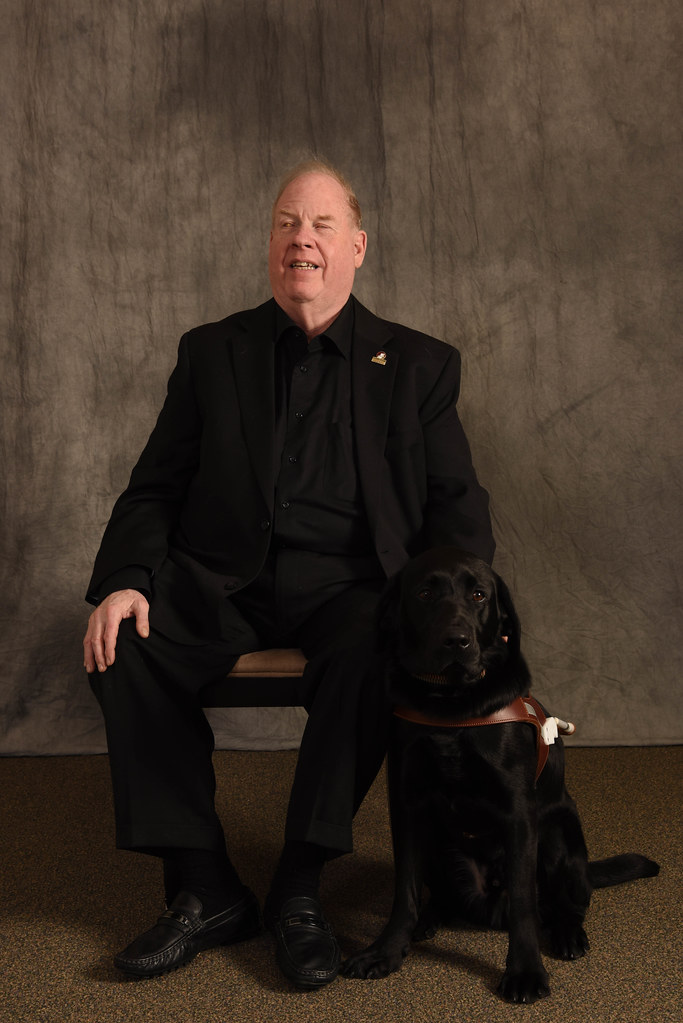
Michael Hingson
Michael Hingson is a keynote speaker, bestselling author of Thunder Dog, and a survivor of the September 11 World Trade Center attacks. Blind since birth, he brings a powerful and unique perspective on leadership, trust, and resilience in times of uncertainty.
He has spoken to organizations around the world, helping leaders and teams navigate change, build trust, and perform under pressure. His message combines real-world experience with practical insight that audiences remember long after the event ends.
👉 Book Michael Hingson for your next event.