
How to Build a Resilient Team: Leadership Lessons from High-Stakes Crisis
What if the greatest asset your team possesses isn’t their technical skill or their strategic plan, but their ability to trust one another when the lights literally go out? In a world where 66% of US employees report experiencing burnout and 91% of workers feel extreme pressure, it’s clear that traditional management isn’t enough to keep a business steady. You likely feel the weight of this shift as you try to lead through market disruptions and the rapid, often stressful rollout of new technologies. We all want a group of people who can pivot without panic, yet many leaders struggle with how to build a resilient team that doesn’t fracture under the weight of change.
This article provides the tactical and emotional framework for building teams that don’t just survive disruption but thrive through deep trust and interdependence. Drawing from lessons learned while navigating my guide dog, Roselle, and a group of colleagues down 78 flights of stairs during the 9/11 attacks, I’ll show you how to move beyond simple survival. We’ll explore how to replace fear with clarity and transform your workplace culture into one of quiet strength and unwavering optimism. You’ll learn how to foster the kind of psychological safety that allows every member to perform at their peak, even when the path forward is unclear.
Key Takeaways
- Learn why true team resilience is more than individual grit; it is a collective ecosystem built on shared vision and deep interdependence.
- Discover how to build a resilient team by establishing absolute trust, a lesson forged in the high-stakes descent of the World Trade Center.
- Understand the role of radical candor in identifying organizational weak spots before they become critical points of failure during a crisis.
- Gain a practical method for auditing trust levels within your staff to ensure transparency and psychological safety are standard practice.
- Shift your leadership perspective to a “No Limits” mindset where obstacles are reframed as valuable data points rather than barriers to success.
Defining Team Resilience: Moving Beyond Bouncing Back
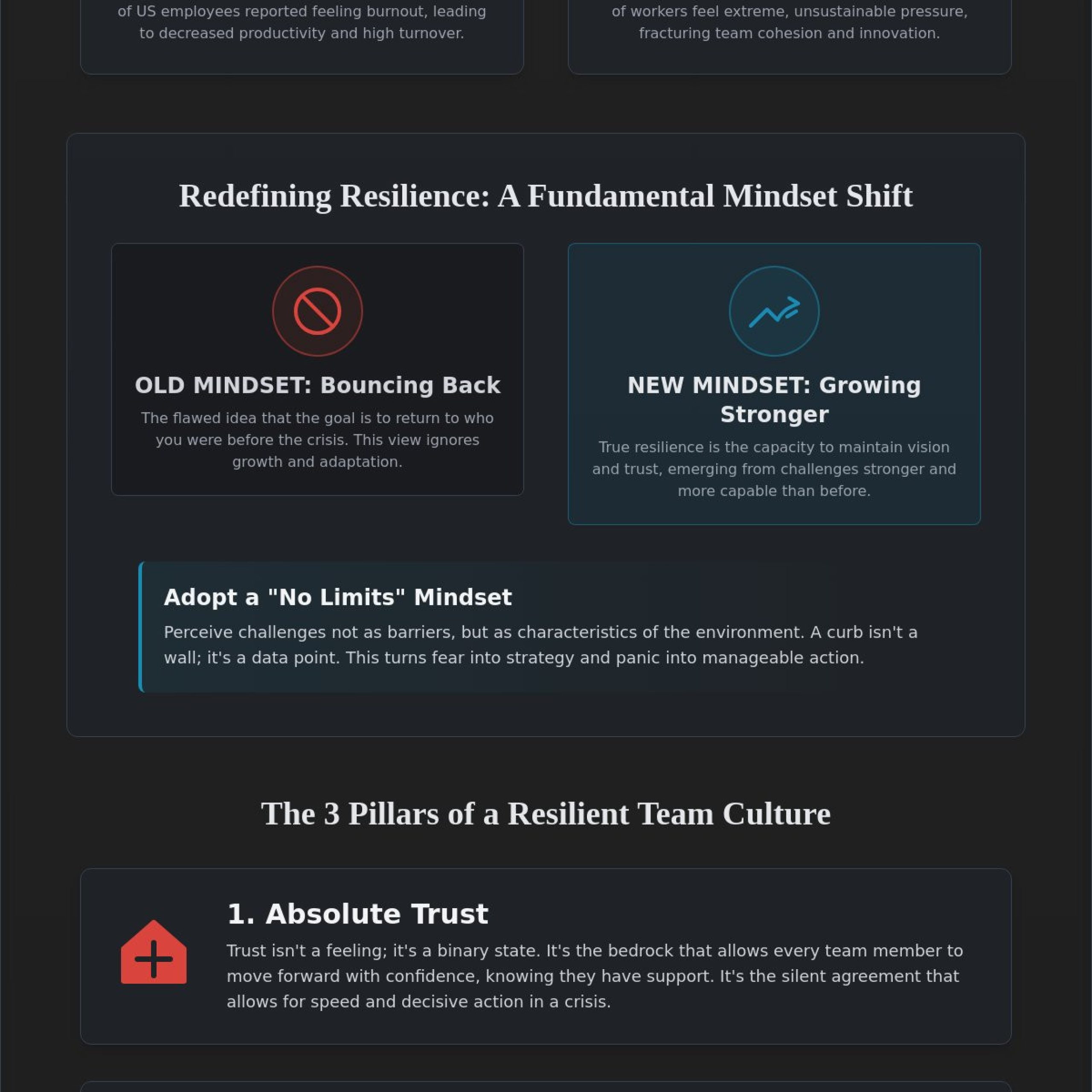
Many people think of resilience as the ability to snap back into shape like a rubber band. But when the world shifts beneath your feet, you don’t want to return to who you were; you want to have grown into something stronger. In my experience, true resilience is the capacity to maintain vision and trust even when physical certainty is stripped away. On September 11, 2001, as Roselle and I led my team down 78 floors, our “vision” wasn’t about sight. It was about a shared understanding of our goal and an unwavering trust in one another. This is the core of how to build a resilient team. It’s not just about individual grit. While grit is the personal determination to keep moving, resilience is the collective ecosystem that supports every member of the group.
We must adopt a “No Limits” mindset, where we perceive challenges as characteristics of our environment rather than barriers to our success. A curb is not a wall to a blind person; it’s simply a feature of the sidewalk that requires a specific movement. When teams view market disruptions or internal changes through this lens, they stop reacting with fear and start responding with strategy. It transforms the way we interact with the unknown, turning potential panic into a series of manageable data points.
Why This Matters for Leaders and Organizations
With burnout rates hitting 66% in 2026, the old “command and control” models of leadership are failing. Organizations that prioritize a “trust and empower” approach see significant benefits, including reduced turnover costs and a higher capacity for innovation during economic downturns. When you understand psychological resilience as a foundation, you can build structures that allow people to pivot quickly. Team resilience is a strategic asset that outlasts any market cycle.
The Role of Psychological Safety in Team Strength
For a team to remain effective under pressure, members must feel safe enough to express fear or uncertainty without judgment. This psychological safety is what allows a group to identify weak spots before they become points of failure. It’s about creating a culture where “I don’t know” is a valid starting point for a solution. If you’re looking for a keynote speaker who can help your team navigate uncertainty, I offer a roadmap for leading through change with trust and vision. When trust is the fuel and preparation is the foundation, your team becomes an unstoppable engine of progress.
Section Takeaways:
- Resilience is a muscle that must be trained before the crisis hits.
- Trust is the fuel that keeps a team moving when the path is dark.
- Preparation is the foundation that allows for calm, decisive action.
The Three Pillars of a Resilient Team Culture
Understanding how to build a resilient team requires us to look at three fundamental pillars that support a group when the environment becomes unstable. The first pillar is absolute trust. I learned this lesson most profoundly from Roselle on the 78th floor of Tower One. Trust isn’t a feeling; it’s a binary state. You either have it or you don’t. When the building shook, Roselle didn’t panic because she trusted my leadership, and I didn’t panic because I trusted her instincts. This mutual reliance allowed us to lead others to safety. In your organization, trust must be the bedrock that allows every employee to move forward without looking over their shoulder.
The second pillar is radical candor. Resilient teams don’t hide their mistakes. They use them as navigation points. If a team member is afraid to speak up about a failing project, that weakness will eventually become a point of total failure for the entire group. Finally, we must embrace interdependence. Many corporate cultures celebrate the “lone wolf” who can do it all, but true resilience is a collective ecosystem. We must move from an “I can do it” mentality to a “We support each other” framework. This shift ensures that when one person is overwhelmed, the structure of the team absorbs the pressure.
You might think, “We don’t have time for culture-building right now.” But consider the alternative. With 66% of employees reporting burnout in 2026, the cost of a team collapse far outweighs the investment in their connection. It’s faster to build a bridge than to swim through a storm after the bridge has fallen.
Building Trust Through Inclusive Leadership
Diversity and inclusion are often viewed as HR metrics, but they’re actually vital resilience tools. An inclusive team brings a wider range of perceptions to a problem, allowing you to see obstacles from angles you might otherwise miss. To build this bond, try a “vulnerability audit” in your next meeting. Share a specific challenge you’re facing and ask for genuine input. This simple act signals to your staff that it’s safe to be human and reinforces the kind of leadership and trust required to navigate the unknown.
Preparation as a Form of Resilience
My ability to remain calm during the 9/11 attacks wasn’t a lucky accident. It was the result of years of training and mental preparation. Leaders can build this same calm in their staff by creating “stress-test” scenarios. Don’t wait for a market disruption to see how your team reacts. Practice your response to change in a controlled environment. If you’re looking for a keynote speaker who can help your team practice these lessons, I invite you to explore my Unstoppable Mindset podcast for more insights on leading through adversity.
Section Takeaways:
- Absolute trust is binary; it must be established before the crisis hits.
- Interdependence is a team’s greatest defense against individual burnout.
- Preparation allows a team to respond with strategy rather than reacting with fear.
Tactical Steps for Leaders to Build Resilient Teams
Transformation requires more than theory; it demands a shift in daily action. To move from a group that merely reacts to one that anticipates, you must implement a structured approach to culture. Here is how to build a resilient team through four practical steps:
- Audit your current trust levels: Observe how your team handles failure. Are people hiding mistakes to avoid blame, or are they sharing them as lessons for the group? If errors are being swept under the rug, your foundation is brittle.
- Foster a “No Limits” mindset: Encourage your staff to reframe obstacles as data points. When a project hits a wall, don’t view it as a stop sign. View it as a characteristic of the current environment that requires a new strategy.
- Implement regular resilience check-ins: Move beyond project status updates. Dedicate time to discuss the human element of the work. Ask your team about their stress levels and their sense of connection to the mission.
- Model the behavior: You cannot demand adaptability if you remain rigid. Leaders must be the first to show they can pivot. When you show your own process for navigating change, you give your team permission to do the same.
Leading Through the Fog of Uncertainty
There will be moments when the path forward is obscured. I call this “blind trust.” It isn’t about ignoring the risks, but about trusting the process and the people around you when the final outcome is unclear. During these times, communication must remain constant. Even if you don’t have all the answers, being honest about what you do know creates a sense of safety. Clarity of intent is often more important than a perfect map.
The Path Forward: Sustaining Resilience
Resilience is sustained by celebrating the small wins along the way. These moments build the momentum necessary to tackle larger challenges. They serve as evidence that the team is capable of growth. If you need a keynote speaker to ignite this transformation in your team, Michael Hingson offers a perspective born from the ultimate test of resilience. By focusing on interdependence and trust, you ensure your organization doesn’t just survive the next crisis, but emerges from it with a clearer vision than ever before.
Section Takeaways:
- Trust audits reveal hidden vulnerabilities before they cause a collapse.
- Clear communication during uncertainty prevents the spread of fear.
- Sustained resilience is built on the foundation of small, celebrated victories.
Cultivating a Future of Unstoppable Strength
Building a team that can navigate the unknown isn’t a task you complete; it’s a culture you nurture every day. You’ve learned that resilience is more than a reaction to stress. It’s a collective ecosystem built on absolute trust, radical candor, and a shared vision that persists even when the path is dark. By moving beyond individual grit and focusing on how to build a resilient team through interdependence, you create an organization that doesn’t just survive change. It thrives because of it. Trust is the bedrock. Resilience is the result.
True leadership requires the courage to prepare before the crisis hits and the wisdom to see obstacles as mere characteristics of the journey rather than barriers to success. As a New York Times Bestselling Author of Thunder Dog, a 9/11 survivor, and host of the Unstoppable Mindset Podcast, I’ve seen firsthand what happens when people choose trust over fear. If you’re looking for a keynote speaker who can help your team navigate uncertainty, build trust, and lead through change, Michael Hingson brings a perspective that few others can offer. Your team’s potential is limitless when you have the right foundation in place. The future is bright for those who lead with vision.
Frequently Asked Questions
How do you build a resilient team in a remote or hybrid environment?
Building resilience in a remote setting starts with intentionality and the rejection of “out of sight, out of mind” thinking. You build trust by being consistently reliable and creating digital spaces for honest, non-project-related dialogue. Since you can’t see the body language of your colleagues, you must rely on clear, empathetic verbal communication. This digital interdependence ensures the team remains a cohesive unit even when working across different time zones.
What is the difference between team resilience and employee wellness?
Team resilience is the collective ability to maintain vision during a crisis, whereas employee wellness centers on individual health and balance. Wellness provides the energy needed to show up, but resilience is the bridge that connects that energy to a shared goal. A team might be physically well but still collapse under pressure if they haven’t practiced trusting one another. True strength comes from the intersection of personal health and group interdependence.
Can resilience be taught, or is it an innate trait of certain team members?
Resilience is absolutely a muscle that can be trained and strengthened through deliberate practice. While some people are naturally more adaptive, the tactical steps for how to build a resilient team can be taught to anyone willing to learn. By reframing obstacles as characteristics of the environment rather than barriers, you empower your staff to perceive challenges differently. This mindset shift is the foundation of turning potential panic into strategic action.
How can a leader rebuild trust after a significant organizational failure?
Rebuilding trust after a failure begins with a humble acknowledgment of the truth and a commitment to transparency. You cannot hide from a collapse; you must walk through it with your team. By showing vulnerability and inviting your staff to help design the recovery, you demonstrate that the failure is a data point, not a destination. Consistency in your actions over the following months will slowly repair the bond and restore the bedrock of trust.
Article by
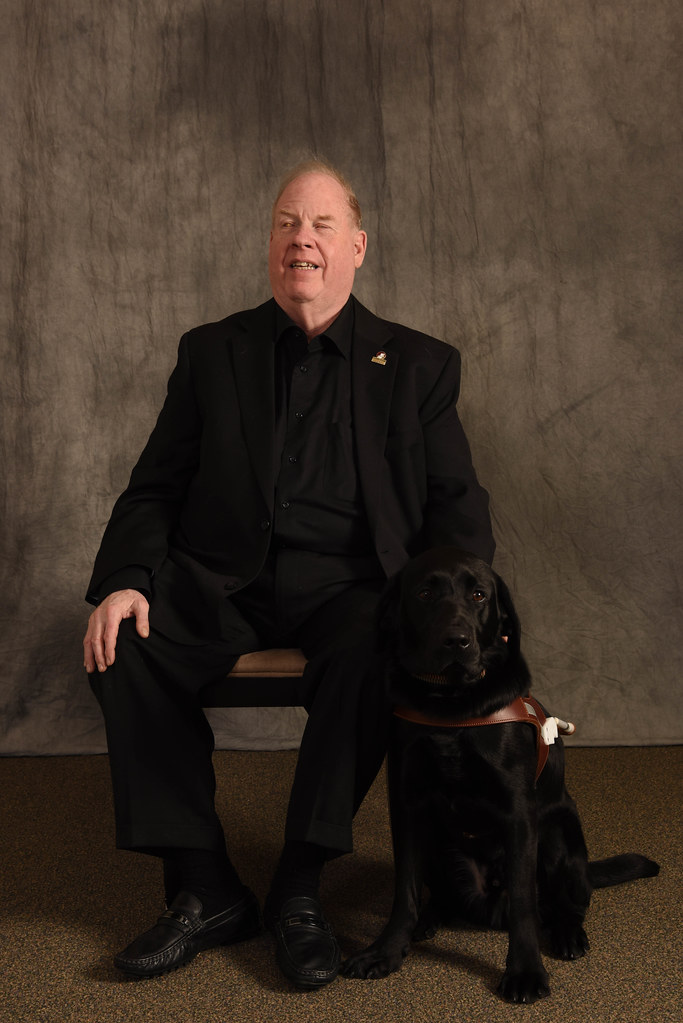
Michael Hingson
Michael Hingson is a keynote speaker, bestselling author of Thunder Dog, and a survivor of the September 11 World Trade Center attacks. Blind since birth, he brings a powerful and unique perspective on leadership, trust, and resilience in times of uncertainty.
He has spoken to organizations around the world, helping leaders and teams navigate change, build trust, and perform under pressure. His message combines real-world experience with practical insight that audiences remember long after the event ends.
👉 Book Michael Hingson for your next event.