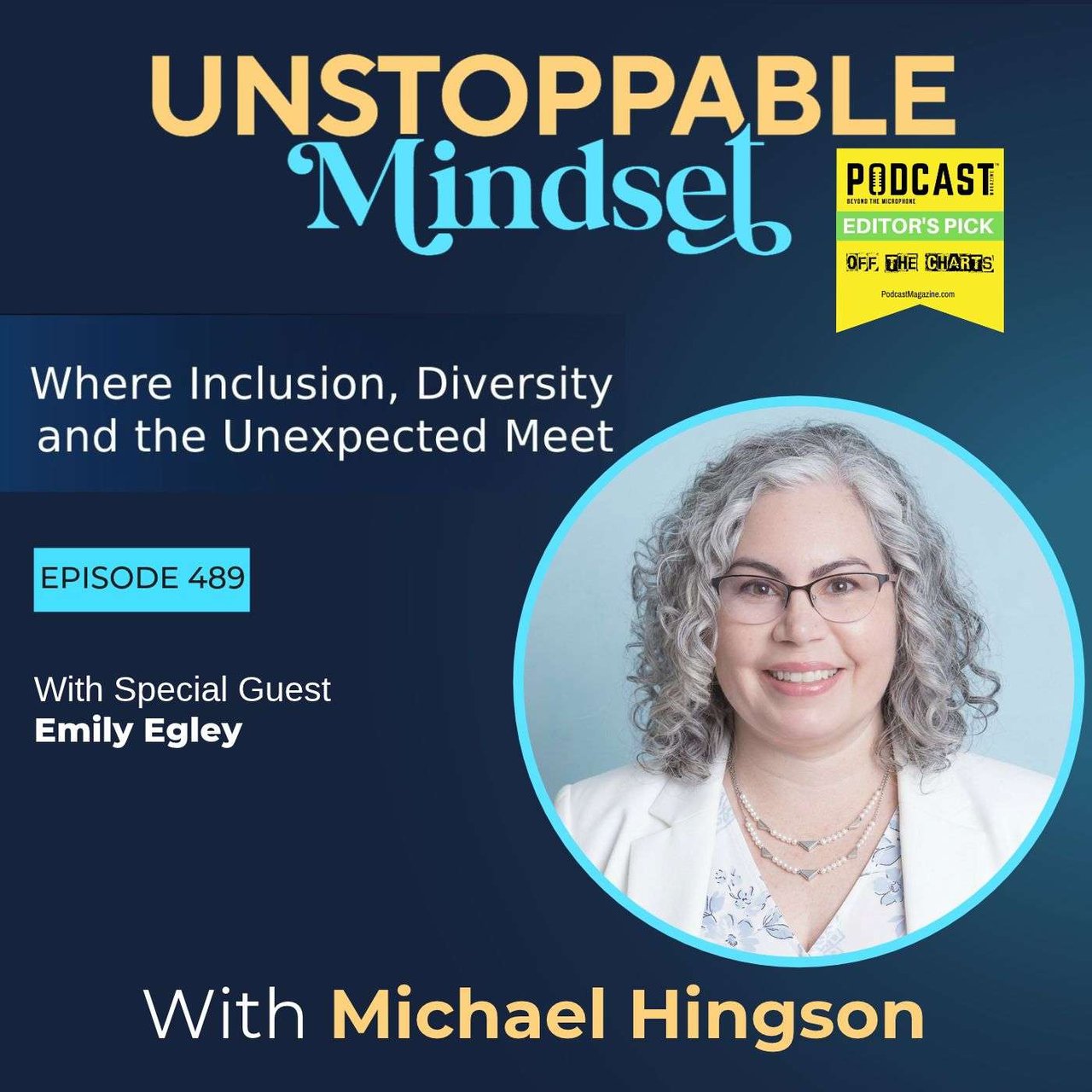
Episode 489 – From Caregiver to Patient Advocate: An Unstoppable Purpose with Emily Egley
What happens when navigating the healthcare system becomes a full-time job, and how can we make it easier? My guest, Emily Egley, knows this challenge from both sides. After a life-changing medical diagnosis ended her career plans, Emily spent years learning how to manage complex healthcare needs. That knowledge became vital when her husband, Jared, was diagnosed with colorectal cancer at just 35 years old. Emily shares their journey through cancer treatment, caregiving, and the loss of her husband, along with the love and laughter they found along the way. Before his passing, Jared encouraged her to use what she had learned to help others. Today, through Healthcare Uncomplicated, Emily teaches patients and caregivers how to understand health insurance, challenge medical billing errors, and advocate for better care. Her story reminds us that even through great loss, we can find new purpose and help others face life’s challenges with confidence.
Highlights:
4:10 How Emily’s early experiences shaped her life and career.
21:11 How a life-changing diagnosis forced Emily to rethink her future.
31:02 The unexpected love story that brought Emily and Jared together.
43:47 What Jared’s cancer journey revealed about caregiving and healthcare.
1:02:10 How love, laughter, and honest conversations helped them face life’s hardest moments.
1:03:57 How Emily turned personal loss into a mission to help others navigate healthcare.
About the Guest:
Healthcare is complicated. Emily Egley is here to uncomplicate it for you. She teaches new patients and first-time caregivers how to navigate the healthcare system, because everyone deserves the best care possible, and that starts with understanding how the system works.
Emily met her husband, Jarrod, at Tulane University. Their life together would later shape the work she does today.
In 2008, Emily was diagnosed with a life-altering medical condition and could no longer work. She became a full-time patient and learned to navigate the healthcare system out of necessity. That is where her expertise as a patient began, and she has been navigating her own conditions for 18 years.
In 2017, Emily’s husband, Jarrod, was diagnosed with colorectal cancer at thirty-five. For seven years, alongside her own care, Emily managed every part of his care: appointments, coordination, insurance denials and approvals, and billing, so Jarrod could focus on fighting the cancer and living life to the fullest.
Jarrod passed away on December 21, 2023, at forty-two. At the end of his life, he told Emily she needed to do for others what she had done for him. From that, Healthcare Uncomplicated was born. Emily became a Board-Certified Patient Advocate in March 2025.
Emily’s drive for health equity, not just health equality, has shaped her volunteer work with the NAACP, where she has served on the committee to end the school-to-prison pipeline and the events committee, and currently serves on the health committee.
Emily’s program, Decoding Healthcare, is self-paced. It teaches patients and caregivers to understand their insurance, check their medical bills before they pay them, and speak confidently with their medical team and insurance company. It is built to take people from unsure to informed.
When she is not working, Emily enjoys going to the beach and spending time with friends and family, including her ten nieces and nephews.
Ways to connect with Emily**:**
www.healthcareuncomplicated.com
Facebook- Healthcare Uncomplicated
Instagram: @healthcareuncomplicated,
LinkedIn: Emily Egley
About the Host:
Michael Hingson is a New York Times best-selling author, international lecturer, and Chief Vision Officer for accessiBe. Michael, blind since birth, survived the 9/11 attacks with the help of his guide dog Roselle. This story is the subject of his best-selling book, Thunder Dog.
Michael gives over 100 presentations around the world each year speaking to influential groups such as Exxon Mobile, AT&T, Federal Express, Scripps College, Rutgers University, Children’s Hospital, and the American Red Cross just to name a few. He is Ambassador for the National Braille Literacy Campaign for the National Federation of the Blind and also serves as Ambassador for the American Humane Association’s 2012 Hero Dog Awards.
https://www.facebook.com/michael.hingson.author.speaker/
https://www.youtube.com/user/mhingson
https://www.linkedin.com/in/michaelhingson/
Thanks for listening!
Thanks so much for listening to our podcast! If you enjoyed this episode and think that others could benefit from listening, please share it using the social media buttons on this page. Do you have some feedback or questions about this episode? Leave a comment in the section below!
Subscribe to the podcast
If you would like to get automatic updates of new podcast episodes, you can subscribe to the podcast on Apple Podcasts or Stitcher. You can subscribe in your favorite podcast app. You can also support our podcast through our tip jar https://tips.pinecast.com/jar/unstoppable-mindset .
Leave us an Apple Podcasts review
Ratings and reviews from our listeners are extremely valuable to us and greatly appreciated. They help our podcast rank higher on Apple Podcasts, which exposes our show to more awesome listeners like you. If you have a minute, please leave an honest review on Apple Podcasts.
Transcription Notes:
Michael Hingson 00:04
What if the biggest thing holding you back isn’t what’s in front of you, but rather what you believe? Welcome to Unstoppable Mindset, where inclusion, diversity, and the unexpected meet. I’m your host, Michael Hingson, speaker, author, and advocate for inclusion and possibilities. This podcast explores how the beliefs we carry shape the way we live, lead, and connect with others. Each week, I talk with people who challenge assumptions, face adversity head-on, and show what’s possible when we choose curiosity over fear. Together, we focus on mindset, resilience, and the small shifts that lead to meaningful change. Let’s get started. Hi, everyone. I am Michael Hingson, your host here on Unstoppable Mindset, and today we get to chat with Emily Egley, right?
Emily Egley 01:09
Yes.
Michael Hingson 01:10
And I want to make sure I pronounce it right. I should have asked you earlier, but anyway, Emily has a great story. Well, and a lot of interesting parts to it, but a great story to tell, and we’re glad to get her. I met Emily through Peggy Sproul, and Peggy and her now late husband Bill were the puppy raisers who raised my seventh guide dog, Africa, down in the San Diego area. And so we have that connection in common, and we’ll we’ll probably have lots more as we go forward. But I really am glad, Emily, that you’re here with us. Did did you ever meet Africa?
Emily Egley 01:51
I didn’t actually. I didn’t meet any. Actually, I didn’t meet any of the Sproles dogs. I yeah, because we met through church, Christ Presbyterian Church, and so when they had their dogs, they were already retired dogs, so they weren’t bringing them to church. So I didn’t actually get a chance to meet any of them.
Michael Hingson 02:15
Yeah, because Africa and I met in later in 2008. So she was born in 2007, and she was born to Fantasia, who was a breeder for Guide Dogs for the Blind, who my now late wife Karen and I adopted. So we took care of her, except for when she was at Guide Dogs doing her puppy things, and the second litter that Fantasia had was a litter that was assigned the A, as all the dogs in that litter would have names that began with the letter A, and we got to suggest some names. And one of the ones we suggested was Africa, and that was the name that they used because I guess it wasn’t in their book already. Or if it was, we got to you. They used it anyway, and so there’s a lot of connections back to to Bill and Peggy, and now to you, which is great.
Emily Egley 03:09
Yes, I I’m so grateful. She’s been both Peggy and Bill were you know are amazing people, and actually we were the first ones to meet Peggy and Bill, my husband Jared, and I, my late husband Jared and I, were the welcome greeters, and so we met Bill and Peggy, and we were actually one of the reasons that they decided to stay at Christ Presbyterian Church. So that’s a fun, that’s a fun little part of our story, and then Peggy and I, our our relationship definitely grew and deepened in our grief group for sure.
Michael Hingson 03:50
So, are you a quilter?
Emily Egley 03:53
I am not. I’m not a quilter. Of course,
Michael Hingson 03:56
Peggy is, and that was a relationship that Karen and Peggy sort of developed because they were both quilters, so that was kind of fun.
Emily Egley 04:04
Oh, I didn’t realize Karen was a quilter. That’s amazing. Oh
Michael Hingson 04:07
yeah, Karen was a significant quilter. In fact, in 2015, we rescued a cat because the people who owned her, the wife had died in December of 2014, and the husband moved to an assisted living facility and didn’t want anything to do with the cat. And we were living in an apartment next to them at the time and didn’t think we were going to really be able to take care of a cat. But we agreed that we would take the cat, and we would find a home for it. Then I asked what the name of the cat was, and they said the cat’s name was Stitch, and I knew that Stitch was not going anywhere, given the fact, yeah, with the whole quilting, right? So, so it’s kind of fun. Well, why don’t you tell us a little bit about kind of the early Emily growing up? Give us a little introduction into the the history of Emily.
Emily Egley 04:58
Sure, absolutely. So. I grew up in Oregon in the Willamette Valley, so right in the middle of the state, on a horse farm. Actually, we raised thoroughbred racehorses. So I, there is nothing I, I don’t know. Like it’s just, it’s in my blood. Just hearing the thundering of hooves is just something that’s just. It brings me such joy. But my feelings about the current thoroughbred race situation is a little bit conflicted because of of the number of injuries and deaths and all of that. But that’s a conversation for another time. And then just have a wonderful childhood of playing on a huge farm. I have two sisters. One of my sister is Lena. We grew up together, and then my sister Erica is much older. And we did not grow up in the same household. And then, when I was 11, we moved to a suburb of Portland and spent my middle school and high school years there, and I was a competitive gymnast for many many years, and I ended up getting injured and retiring. It’s interesting because with gymnastics, because of the number of hours and everything, I think with a lot of sports, it’s it’s considered retiring when you stop. I was working out 21 hours a week, not including competitions on the weekends. So, but I never got to that level where I was being homeschooled or that I was going to the Olympics. That was never in the picture for me. So, that was the the very early on, and then I went to Tulane University in New Orleans for college, and a part of my heart, you know, will always be in the city of New Orleans. Yeah, and then I studied my junior year of college in Madrid, Spain, and another piece of my heart is there. I’m fluent in Spanish, and I still have a lot of Spanish friends. I lived in a Spanish dorm, so it was a lot of fun. Had a lot of Spanish friends and international friends from other countries, and still keep in touch with them. That was an amazing experience. And then the next part gets into me meeting my husband. So I don’t know if you want me to go into that story now or say that for a little bit later. Before
Michael Hingson 07:31
you do that, what suburb of Portland did you move to?
Emily Egley 07:36
Tualatin.
Michael Hingson 07:38
Okay, my familiarity with the area is Boring and Gresham, guide dogs for the blind isn’t boring, and that’s where I got my current guide dog Alamo. And Alamo was another a litter dog, but has never been to San Antonio and has never seen the Alamo. And next month, I just learned for sure today, we’re going to be in San Antonio for a speech, and they have actually already organized for all the members of the the conference a mission tour to go see the various missions around in San Antonio, which includes, of course, the Alamo. So Alamo is going to get to visit the Alamo.
Emily Egley 08:18
Oh, that’s so cool! We’re gonna get some
Michael Hingson 08:21
pictures. That’ll be an important thing to do. I’m looking forward to it. There, there are a couple things this year I’ve been looking forward to. In August, we had a an opportunity to go to Australia. We couldn’t set it up in time for Alamo to be able to go to meet their quarantine standards, but that’s okay. But I went down and I said to the people who were bringing me down, if I’m coming down there, you better make sure that I have a chance to meet a kangaroo. And I got to meet a kangaroo. Yes. And now Alamo gets to go to the Alamo, and and I’ve never been to the Alamo. I’ve been to San Antonio once, but never been to the Alamo. So now I get to go there too.
Emily Egley 08:57
That’s exciting. I actually got to go to the Alamo In 2022, so Jared and I went to visit his youngest sister and her family. They had just had their son, and so we went to visit them, and then went and traveled and visited another friend in Corpus Christi. So all Texas, and then to Louisiana. But when we were going from West Texas to Corpus Christi, we went and we saw the Alamo. It was it was neat. It was neat.
Michael Hingson 09:30
I understand it’s not very large. Anything specific we should look for or look at there?
Emily Egley 09:36
No, it’s it’s it’s not as big as I thought it was going to be,
Michael Hingson 09:41
yeah,
Emily Egley 09:41
but it it is very the tour the the audio tour is worth doing for sure.
Michael Hingson 09:48
Well, I hope we’ll be able to to do that. I don’t know how long they’ll be there and what the process is because I’m going to go with the whole conference group, but at least we’ll get to the Alamo, so that’s good.
Emily Egley 09:58
Absolutely, I have a question. For you, you say that these litters are based on like they they’re a litters, or is every dog from the litter have the same first letter of their name?
Michael Hingson 10:10
Yeah. So the way it works is when every litter is born, they’re assigned a letter of the alphabet, and then they take names that the breeders, the breeder keepers, the people who house the breeders, because they don’t want them living in kennels, so they they allow them to stay at home. So the breeder keepers can suggest names. They’ve got a big book of names, and they go through the book and use the breeder keepers’ names if if they are available, and they will assign each dog a name with that begins with that initial, with that letter, whatever it is, and the the only name that I know of that’s been permanently retired is Roselle because of Roselle, of course, and I were in the World Trade Center. But the every every name, once a name is assigned to a dog, then no other dog will have that name until that dog retires, or if it goes into becoming a breeder when it’s adopted out and leaves the school. So that’s kind of the way it works.
Emily Egley 11:13
Yeah, and a cousin of mine I just found out just went I believe last week and is getting Seeing Eye Dog, so she is in just north of L.A. Oh, she’s just north of L.A.
Michael Hingson 11:30
Guide Dogs of America.
Emily Egley 11:32
Oh, okay. I didn’t know specific Guide Dog.
Michael Hingson 11:34
Yeah, Seeing Eye is a brand. Actually, it’s the Seeing Eye in New Jersey, sort of like Coke is a brand, so when you hear seeing eye dogs, you’re actually referring to the dogs that come from the school in New Jersey.
Emily Egley 11:46
Oh well, thank you for educating me about that.
Michael Hingson 11:49
There’s a factoid for the world.
Emily Egley 11:51
Factoid for the world.
Michael Hingson 11:52
Well, there you go. Well, so you have you’ve you’ve been all over. What what caused you to be in in Madrid for a year. How did that all work out?
Emily Egley 12:02
So I always knew that I wanted to study abroad, and I had been taking Spanish since sixth grade, and so I really wanted an opportunity to become fluent in Spanish. And I was looking at there was a six month program in Argentina, but with my scholarship, I had to go to a school that I had to be gone for the full year. Otherwise, my scholarship didn’t carry over, and so the only place that I could go that was a full year in Spanish was Madrid. So that’s how I ended up in Madrid. I didn’t know very much about Spain, and I. I got. It was the most amazing experience. It it really was. It was life changing, and I became such a better person. The people that I met just incredible. Just incredible.
Michael Hingson 12:56
Wow. Well, what did you? What was your major in college?
Emily Egley 13:02
I majored in international relations, international development, and I minored in Spanish. So when I was actually when I was in Madrid, I had some classes that were all of my classes were in Spanish. Some of my classes were with Americans, and then some of my classes were actually with Spaniards, so I had Spanish professors, but then some of my classes were actually taken at the university with other Spanish students, and that was intense. That was very intense. But you had to learn
Michael Hingson 13:34
Spanish.
Emily Egley 13:35
I did. I had to learn Spanish, and I had to learn how to really what they did in order to be successful in their classes, and it was actually interesting because they would take really full class loads and then get notes from other people. They wouldn’t go to all of their classes, so I found that very interesting. They don’t do that anymore; it’s a different setup now. But I was able to take a couple of classes in the political science department. One of them was international development, and the other one was on the Maghreb countries, so the Arab countries in northern Africa, and that was really interesting because learning, I didn’t. You, we got to learn about Islam. We got to learn about the different countries. So it was it was really interesting. And then for extra credit, I did a 20-page paper, and then did a 20-minute presentation on Saudi Arabia. And I got. I actually ended up getting the highest grade that you can get in a Spanish university, and if I it was my second semester, otherwise I would have gotten a free class for having that high of a grade. So wow, it was really an honor.
Michael Hingson 14:58
Karen, my late wife. Had some very close friends. Actually, her teacher’s aide when she was teaching, and her husband before they were living and working in the I think Irvine School District with Karen. They spent time in Iran, and he worked for Hughes, and they spent, and in fact, they had a, of course, a major challenge getting out because after the Shah was overthrown and so on, and the new regime took over, it was kind of a challenge in terms of both for her as a woman, but for both of them in terms of what they did and all that. But they were eventually able to get their way out, and they they left Iran, but we we learned a fair amount about Arab countries and so on from the Rudy’s, which is kind of cool.
Emily Egley 15:48
Yeah, that is cool. That’s always it’s it’s always better, I think, to be able to learn about culture from the people who are actually living it or who have lived it. And one of my close friends is from Morocco, and so I I really wish that I had been able to go and visit Morocco with him. However, my mother had said, “You can like just make me one promise: you can travel anywhere, but please don’t go to Morocco because at the time Americans were getting kidnapped and being held for ransom, and so she was like, “You can travel anywhere, just don’t go to Morocco.” And so I traveled all over, but I didn’t go to Morocco. But I had this amazing friend that I would have had this incredible experience in Morocco, but I was like, “No, I my mom needs to be able to sleep at night.
Michael Hingson 16:41
Yeah, well, we went to Spain in 19. I think it was 92. Karen’s parents got a couple of weeks in timeshares. One week in Tenerife, and the other in Sevilla. So we got to go to the World’s Exposition, the World’s Fair. And while we were there, we also went over to Gibraltar, which was kind of fun, but we weren’t able to get over to Morocco. Now it’s probably good anyway, but it was fun going to Gibraltar.
Emily Egley 17:08
That’s that’s really neat. I haven’t been to Gibraltar, but I’ve been to the southernmost city of Spain, which is where you leave on the ferry to go to Gibraltar because my Spanish roommate, while I was living there, her she was from there. It’s called Ajafida, and she’s actually from there. And so I got to go there multiple times. So I’ve seen Gibraltar from afar, and I’ve also been able to see from where we were. You could also see Africa from one of the places. So,
Michael Hingson 17:44
well, so what did you do after college?
Emily Egley 17:47
So after college, I worked for a couple of nonprofits. So I worked for the AIDS Services Foundation in in Orange County, and that was a really great learning experience about all of the challenges that are currently facing people who have HIV and AIDS. And the I was really surprised at the time. This was over 20 years ago, but the the largest growing population of people with HIV and AIDS was actually young Latina women, so it was it was very interesting. And so I I wanted to work in the nonprofit sector, so I did that, and then I actually ended up as a paralegal for the U.S. Attorney’s Office. There was a program for students who were recent graduates from college who had had a certain GPA, and it was a an automatic. It was two years at the U.S. Attorney’s office in San Diego, and each year we got promoted. So we, because that was just the way it was. If we if we met certain standards, then we got promoted. And the idea was to bring fresh insights into the U.S. Attorney’s office. And it was really interesting because I got to work with different attorneys. I wasn’t assigned to a particular attorney. I was assigned to cases, and so I got to work with a variety of attorneys. And it was a really good way for people to figure out whether they wanted to become an attorney or not. That was really what a lot of people did. And I worked in the white collar and narcotics divisions, so a lot of really really interesting cases. I loved going to court and being in court, and so my supervisor was really great. And if I didn’t, if my attorney didn’t need me during working hours, I could just go and watch court cases, and then I could come back and. Work at night doing what needed to be done for my job so that I could just enjoy being in court.
Michael Hingson 20:08
Yeah, it’s it’s fascinating to to to go into a court, and of course, it’s a whole lot different than TV. But nevertheless, it’s it’s pretty fascinating. I’ve I’ve been in court a few times, my gosh, what would it have been? My second guide dog, Holland, and I had some challenges with airlines not allowing us to to to sit where we were supposed to be able to sit, even by their own regulations, and ended up taking it to court, and it was pretty fascinating going through that. And I’ve been in courts, and I also served as foreperson of a jury once, which was kind of fun. Oh wow! Yeah, that was really enjoyable.
Emily Egley 20:53
That’s really interesting. I the only time that I actually got jury duty was while I was working at the U.S. Attorney’s office, and so I knew for sure. Even if I got into a courtroom for anything, some attorney was going to strike me because they didn’t want someone from the court system on the jury for sure.
Michael Hingson 21:12
Well, it was interesting. I I was expecting to be stricken from the the roles, and and it didn’t happen. So I ended up being on the jury and got elected foreman, and and so that was kind of fun, and we found the defendant not guilty. And afterward, we had discussions with the judge and with the prosecutor, and everybody agreed that that was the right verdict. But of course, the prosecutor was was really focused on doing what they were supposed to do. But but under the law, this guy, this this person was innocent, and so it was was kind of fun to be able to do that.
Emily Egley 21:48
Definitely a unique experience for sure. It is
Michael Hingson 21:50
by all means.
Speaker 1 21:55
If you enjoy Unstoppable Mindset and would like to help us continue bringing these conversations to you each week, we’ve created a way for you to support the show. Your contribution helps us cover production costs and continue sharing stories, insights, and ideas that inspire people to live with purpose and possibility. If supporting the podcast feels right for you, you’ll find the link in the show notes. Thank you for being part of the Unstoppable Mindset Community.
Michael Hingson 22:27
So, how long were you working for the nonprofits, and then what did you do?
Emily Egley 22:30
So, I was working. I worked for AIDS Services Foundation for just under a year, and then I worked as an unpaid employee for a friend of mine. She had a nonprofit that she was working on in Africa, but that was only for a couple of months. And then I was a bank teller until I started working at the U.S. Attorney’s Office. And then while I was at the U.S. Attorney’s Office, actually, I that’s where my career really ended. I had decided that I was going to be an attorney. I had made that decision. I was so excited, and I had finally made this decision. I was going to do it, and then I got a life-altering diagnosis in 2008. So that’s really I. That was the end of me having a full time job, and I tried part time twice, and that ended disastrously. I mean, just horribly. But that, yeah. So I I actually was never able to return back to full time employment or really part-time employment.
Michael Hingson 23:41
What was the diagnosis? What was that about, or can you talk about that?
Emily Egley 23:45
I actually prefer not to talk about the actual individual diagnosis, but it was a diagnosis that I had been. It had it took seven years to get the correct diagnosis, so I had been having symptoms for many years, and then I got misdiagnosed and was given the opposite treatment of what I should be doing. So it just made everything worse. Yeah. And then I woke up. I decided that I was going to be an attorney, and then I woke up the next morning, and I thought I had. It felt like I had been shot. It felt like I had been shot. So yeah, I it was it was extremely traumatic. Honestly, no fun kind of that kind of a thing, and have it be so dramatic, so dramatic, and and it required a lot of life changes at the same time. So, it it was it was definitely difficult.
Michael Hingson 24:48
Well, that’s that’s too bad. But you certainly seem to be thriving now.
Emily Egley 24:54
I am. I am thriving now. It has taken a long time to get here. My condition is. Well managed right now, which is exciting. Unfortunately, I’ve accumulated 10 other diagnoses, more than 10 since 2008. You just
Michael Hingson 25:11
you just want attention.
Emily Egley 25:13
I you know I I I don’t think so. I really don’t think that that’s what it is. Okay, I really I would rather get attention some other way. I promise you. I promise you. I’m not. I’m not trying to rack these up, you know, as badges for sure. Yeah,
Michael Hingson 25:28
I I know that we’ve had a number of people on the podcast, people who have been diagnosed as ADHD or on the autism spectrum and so on, and they’ve all. all talked about the fact that they were mostly diagnosed later in life. They weren’t diagnosed as children, even though they had the diseases, or not the diseases, but they had different things going on. And they knew that there was something funny, but they didn’t know what. And they also all acknowledged that at least they finally got diagnoses that made sense and that helped. But it is it is fascinating just how much, in a sense, we’ve learned over the last 20 or 25 years. But still, things happen, and of course now we have things like the pandemic, which have been going on now for five six years, which don’t help either.
Emily Egley 26:22
No, it doesn’t help. And a lot of my conditions are co-occurring conditions, meaning that they don’t have an explanation for why people with these particular conditions have the other conditions. But there is a lot of overlap, and they haven’t been able to figure out why that is. So a lot of my medical conditions, other people who have one of my medical conditions will most likely overlap with me with other medical conditions that I have as well.
Michael Hingson 26:51
Got it. So
Emily Egley 26:52
they they just they don’t have a good explanation of why of of what’s causing these different types of things. There’s not enough research out there. There’s, and don’t quote me on this, please. But there are a lot of women that have these conditions, these co-occurring conditions, and we know that research into women, like women’s medical issues is far behind
Michael Hingson 27:24
what it is
Emily Egley 27:24
for men. For example, one of the medical conditions that I have wasn’t actually diagnosed. It was not actually a medical diagnosis until the ’80s before it was considered hysteria. And yes, so research is way behind on that particular condition because for so long it was predominantly women, and it still is. It can affect men, but it’s predominantly women, and it was just considered hysteria. They thought women were making it up.
Michael Hingson 27:58
Yeah, that’s always a thing that happens way too often, and people get very, very strange in reacting to various things in in various ways. I know one of the things that blind people have experienced over the years, which isn’t a medical thing, but we couldn’t get life, and other people with disabilities couldn’t either. We couldn’t get life insurance because insurance companies said we were a higher risk, and finally somebody asked the question: Where’s the evidence to prove that? Because you insurance companies, you do everything based on mathematical models, scientific data, actuarial statistics, evidentiary data. They didn’t have anything because they weren’t operating in the same way that they did with everything else that they they did and and all the ways they conducted their their work, they were just assuming that we were a higher risk. And finally, we got every state legislature to pass laws that said you can’t discriminate in providing life insurance unless you have actuarial statistics or evidentiary data. So since 1985, we’ve been able to do it, and I was involved in the efforts when I was living in Massachusetts, and coordinated the efforts with the state legislature to get the law passed. But it was something that was around, and just all too often we don’t rely on reality. My blindness comes about not because I was technically born blind, but I was put in an incubator with a pure oxygen environment, and medical science said that was the only thing that they could do for a premature baby, even though someone had already pointed out that a pure oxygen environment, 24 hours a day, could cause problems with retinal and eye development, and that’s what happened to me. And the proof was that even if you gave the a child a non pure oxygen environment, even for a few minutes a day, incidents of blindness would drop to zero. But medical science wasn’t ready to believe that because they couldn’t imagine that too much oxygen could be a bad thing. You know, gosh, that’s
Emily Egley 30:01
terrible.
Michael Hingson 30:02
We well, but you know,
Emily Egley 30:04
it’s terrible that they that they have the information, but they don’t actually utilize it in a timely fashion. That’s what I mean. Yeah, is that they had the information because you live a very wonderful and successful life, blind or not, I I’ve heard you say many times that everyone has, you know, limitations. Like I, because I am a seeing person, when it’s dark, I’m lost. I can’t do anything. And
Michael Hingson 30:34
we won’t hold your light dependence against you. It’s okay. I
Emily Egley 30:37
appreciate that a lot.
Michael Hingson 30:39
But the the the reality is that you know, and I as I was growing up, I actually heard about people who were blind who sued their doctors because the doctors didn’t look as deeply as they should have into medical science and and deal with it. And my dad and I were talking about it one day, and I said, “Do you think we should?” And he said, “What good would it do? I was 15, so this happened 15 years after I was born. We were having a discussion. He said, what good would it really do? Do you want to really ruin somebody else’s life when, all right, they made a mistake they shouldn’t have, but medical science has learned, and the same situation won’t happen now, at least without people knowing it. There, there are some children who have to be put in an incubator with a pure oxygen environment to survive, and their parents are advised about the the reality that blindness could occur. But I don’t I don’t know what they do to mitigate that. But the bottom line is that it’s still I don’t think was a good idea to to consider suing, and we didn’t, and and wouldn’t because it just didn’t make any sense. It isn’t going to help because, as you point out, blindness doesn’t mean you can’t live a life.
Emily Egley 31:53
No, not at all, not at
Michael Hingson 31:56
all. And if I get the opportunity to be blind, at least I get to visit with with all the guide dogs that I that I’ve had, and I have Alamo, and he’s over here being bored and saying, “I as long as I get fed at 5o’clock, I’m going to be happy.” So you know, well, so tell us. So along the way, I know you mentioned it briefly. You met your husband. Let’s let’s talk about Jared a little bit and how you guys met and all that.
Emily Egley 32:21
Yes. Well, it was not love at first sight, Michael. It was not love at first sight. I can tell you that because we know with certainty that we met the first week before our freshman year of college, because we both went to the same ice cream social. There were about 20 people there, and we were both there for the full two hours. So, at some point, we had to have met.
Michael Hingson 32:48
Yeah,
Emily Egley 32:50
no recollection at all whatsoever. So then, fast forward to our sophomore year, and we had some mutual friends. He was very involved in InterVarsity Christian Fellowship, which is an on-campus Christian fellowship. I was peripherally involved. I was part of one of the Bible studies, so I was friends with friends of his, but I didn’t know him. I knew them, and so one of these friends invited me to a Super Bowl party our sophomore year, there were maybe eight of us there for the full football game, and there is no recollection for either of us of meeting each other. And then, on the other hand,
Michael Hingson 33:36
do you know who won the game? Anyway, go ahead.
Emily Egley 33:39
Yes, the Patriots. Okay,
Michael Hingson 33:40
the
Emily Egley 33:41
Patriots won, and then I I was in Spain my junior year, and then senior year we again were at a Super Bowl party. This time there were about like 15 people, and there’s photographic evidence. He is standing directly behind me, like he is the person behind me, and we have no recollection of meeting each other. None. Oh, and I forgot one other instance. Our first photographic memory together. Our sophomore year, we were at a baseball game, and there is a picture of a total of five people in the photograph. There are three other people. There’s me, there’s Jared, and there are three other people, and we have no recollection of meeting each other, none. So then, our senior year, so that that was in the beginning of February. Toward the end of February was Mardi Gras, and I had the opportunity to go to a Mardi Gras ball, really fancy white tie. I did not know that white tie existed. I had only heard of black tie. Yeah,
Michael Hingson 34:46
me too.
Emily Egley 34:46
But white tie, I did not know. It’s women in full length dresses, men with coat tails and gloves. So it was very fancy, and the thing. About Mardi Gras is that when it goes midnight on Fat Tuesday, it becomes Ash Wednesday,
Michael Hingson 35:07
right?
Emily Egley 35:08
And everything shuts down in New Orleans. The police go through the French Quarter and they shut everything down. So I’m back on campus and I’m looking gorgeous, and I’m not ready for my night to end, so I messaged a friend and was like, “Hey, what are you guys doing?” And he was like, “Oh, come to this apartment. There are a bunch of us hanging out.” So what year
Michael Hingson 35:31
was what year was this?
Emily Egley 35:32
This was in 2004.
Michael Hingson 35:34
All right, so texting had started to become a thing.
Emily Egley 35:37
So it was AOL Instant Messenger is what it actually was. Yeah, at that time it
Michael Hingson 35:42
was but still
Emily Egley 35:43
it was aim um and so I went to that room and there were a there was a group of guys playing poker and they were like oh do you know how to play poker and my response was well what are you playing and they said Texas Hold’em, and I said, “Oh, can you teach me?” So they taught me. We were playing for Pride, and I won. I won all of it. And they were like, “Oh, beginner’s luck.” Yeah, yeah. And I was like, “Actually, my grandfather taught me how to play poker when I was nine.” And they were like, “You lied to us.” And I was like, “I never lied to you. You asked me if I knew how to play poker. I asked, ‘What are you playing? You said Texas Hold’em. I said, “Can you teach me?” I never once lied. Yep. At all, and so they actually invited me back. And it was Jared. It was my husband’s apartment on campus. Apartment was where I went. So that’s when Jared and I officially met, and then I got invited back for the weekly poker game, and so it was just me and a group of guys, and it was a lot of fun. And then there was one day where one time we were playing, and Jared and I looked up at each other, and at the same time, it was like, huh, interesting. You’re really cute. I kind of like you, and like you could see it. Like no one else knew what was going on, but it was literally like God hit us upside the head at the exact same moment because we just like looked across the table at each other and was like, “This is interesting.” And so shortly after that, we started dating, which was six weeks before we graduated. Great timing on our part, but we were glad that we didn’t get together any sooner than that because of how our lives were shaped in college. We wouldn’t be the same people if we hadn’t gone through those experiences. So it was actually wonderful, and I took a job three weeks into our relationship. I took a job in Alaska. It was going to be a three-year paid internship, and Jared had a job in Irvine, California, he’s from Michigan.
Michael Hingson 38:03
They’re close together,
Emily Egley 38:04
so close together. And so, while he went on a mission trip to China that summer, I was at home having surgery, orthopedic surgery. I had to have my ankle reconstructed, and so I decided I wasn’t going to go to Alaska. I the reason is because I called to see what the nightlife was going to be like and how it was going to be, and two separate people said, “Well, we’re hoping that by bringing you here, it’ll change the chemistry of the office.”
Michael Hingson 38:39
Ooh,
Emily Egley 38:40
no, no, thank you, no, thank you. I, I, I don’t want to go for three years and be the. The goal of me coming is to change the chemistry of the office.
Michael Hingson 38:50
Yeah.
Emily Egley 38:52
So I decided to follow Jared to Southern California, and so we were dating and we got married in 2007, and that’s when we both moved to Oceanside. That’s how we started living in Oceanside. Was because my job paid for the coaster, which is the train that goes down to San Diego, because I was working downtown San Diego, and Jared worked up in Irvine, and so we came to the city that was the furthest north for the coaster station, and that ended up being Oceanside. So that’s how we ended up in Oceanside. And then a year after we got married is when I had that life-altering medical diagnosis, and our lives changed forever in that moment. And he took care of me with all of my challenges and and diagnoses for many many years. Yeah, just really amazing. He was just an incredible guy. He. He was a civil engineer, very gifted in everything that he did. I mean, he could do, he could teach himself anything. But the thing was, is he assumed that everyone else could do the same thing. So, for example, one time we we have a retaining wall in our backyard, and it needed to be restuccoed. So, guess who restuccoed it, Jared?
Michael Hingson 40:23
Yeah.
Emily Egley 40:24
When I asked him how he knew how to stucco, he said, “I don’t know. You just do it.
Michael Hingson 40:30
Let’s do it.”
Emily Egley 40:30
And I was like, “No, no, no. People learn these things.” And he was like, “Oh, I just know how.” I was like, he didn’t even look it up online. I don’t understand how these things happen, but it happens all the time.
Michael Hingson 40:43
Was his middle name MacIver? But anyway, go ahead.
Emily Egley 40:46
It would have made sense. It would have made sense if if it were. But no, he just he had this ability to to do so many things when he he taught himself how to code with computers, and so the job that he had, his last job, he was the CAD coordinator, the the software for civil engineer. I’m blanking on what it’s called. It’s a software that yes, AutoCAD. Thank you. It’s a software that they use to design, and so he was the CAD manager, and so he would set up all of the he would code all of it so that it would streamline what the other engineers were doing, so they could do everything more quickly. And he he just taught himself how to do it. He didn’t go to classes for it or anything. He just taught himself the software.
Michael Hingson 41:44
I sold. I formed a company and sold some of the early PC-based software CAD software packages. One of which was AutoCAD. So I have some familiarity with it.
Emily Egley 41:55
Yeah, yeah, yeah. No. So he, yes. So he he did a lot in AutoCAD, and we actually got to go to Las Vegas every two years for the AutoCAD. They had like a week of of training and seminars and everything, and so his job would pay for us to stay at a fancy hotel in Las Vegas, and and he would go to CAD University and
Michael Hingson 42:21
cool.
Emily Egley 42:23
Yeah, it was really neat.
Michael Hingson 42:23
AutoCAD is still around and doing well. Thank you very much.
Emily Egley 42:27
Yes, it is. Yes.
Michael Hingson 42:31
So, well, that’s pretty cool. So he did that, and so did he always work for other companies, or did he work on his own ever, or how did all that work?
Emily Egley 42:41
So he worked for other companies. So his first job right out of college, he actually started working there between his senior year of high school and starting freshman year of college. He started working there at Adams Streeter. It was a family-owned engineering firm, and they did housing tract development, so they they did land development. So he would take raw land and design everything up to the foundation. So everything. So the only people that did something on anything that he worked on were landscape architects and architects. He did everything else from taking raw land to housing tracts to parks to whatever. So he would do the rough grading, fine grading. Like he would do all of it. So water, sewer, like all of it. He would design all of it, and he was there. He started there in 2000, working summers, and then he left and went to NV5 in 2014, and that’s when he became the the CAD coordinator. And so he worked at NV5, which is an engineering firm, but they do a lot. They they have a really wide range of of what they do. It’s it’s not just civil engineering. They do all different types of engineering, and then they also have AV units, and they they do so much. It’s it’s a very large company. They actually just got acquired. I don’t remember what the new name is. It was after Jared passed away, but while he was there, they were Nolte, and then they became NV5. But they have offices all over the world, so he did he did a lot of a lot of really good work for them, and had you know wonderful experiences there and a really great team. Well, he was his own. I shouldn’t say team. He did a lot. When I reference the team, I mean like all of the people that worked there and the the amazing the amazing family that we created with those friends.
Michael Hingson 44:54
Right. Well, and I know along the way. He ended up being diagnosed and had an illness. Do you want to talk about that much, or
Emily Egley 45:06
he did? Sure, we can. I’m I’m completely open to it. So in in 2017, Jared was diagnosed with stage three colorectal cancer at the age of 35. So there was no chance for him to have had any type of screenings. He was diagnosed with stage three colorectal cancer. He did radiation and then surgery and ended up with a permanent colostomy bag. and And later on, that’ll end up being an absolute blessing. I promise. And the at the time we were like, but it it ended up being a huge blessing. And then he did chemotherapy for four months, and we thought we got it. So December of 2017 showed no evidence of disease. His colonoscopy in March showed no evidence of disease, and then he had a PET scan done in July, and we got the results back in August of 2018, and it had metastasized to his lungs. So now he was stage four, and we found out his oncologist actually insisted that Jared get a second opinion before starting treatment for stage four, and that was because he wanted him to be comfortable with and confident in whatever the treatment plan was going to be. So he insisted that he get a second opinion. So we went to City of Hope, and the oncologist there actually said that Jared had always been stage four because he was able to trace the tumors back to the original scans, but they were the size of pinpricks in his lungs. They were smaller than bronchitis scars, so no one was going to ever catch it as being stage four, so the likelihood of him having a recurrence was like 80% or higher than that. So that was he was diagnosed. Then he did a lot of different treatments throughout that time. He did. He did oral chemotherapy. He did more radiation. He ended up doing a clinical trial where he did immunotherapy and chemotherapy simultaneously, and so that that really that was really rough, and it also worked really well for him. So the survival rate of stage four colorectal cancer is 12 to 18%. And I’m going to pause for a moment and do what I always do, and that is a PSA. If you are 45 or older, or know someone who is 45 or older, please, please, please get your colonoscopy. Prep is not that bad. Get your colonoscopy because if caught in stage one, survival rate is over 90%. If caught stage four, that goes down to 12 to 18%.
Michael Hingson 48:17
What amazes me is I’ve had several colonoscopies, just sort of on principle, and and we do it, but they stop regularly scheduling colonoscopies when you turn 75, and I haven’t totally figured that out yet.
Emily Egley 48:33
Oh, that’s strange. I did not realize that. That’s new information for me. Thank you for sharing that. That’s
Michael Hingson 48:38
that’s what I learned from our Kaiser doctors that they don’t die, they don’t prescribe it after 75, and and I think their answer was something. Well, it moves so slowly anyway. If you haven’t had them by then, well, that doesn’t matter to me. It just seems like they should do that.
Emily Egley 48:56
I feel like they should as well. I feel like they really should as well. Yeah, unfortunately, colorectal cancer is happening to people younger and younger and younger. I just saw someone post. I’m still in a couple of support groups, and I saw someone post today that at 29, being diagnosed with colorectal cancer just yesterday.
Michael Hingson 49:24
I’ve heard that that the age is is going down, and I don’t know whether they really understand why yet. But nevertheless, that people younger and younger are getting it.
Emily Egley 49:35
Yes, it’s terrifying, and it’s actually for men under 40. It is the number one cause of cancer death in men under 40, and in women under 40, it’s the number two cause of cancer death, which is terrifying if you think about it. Like, why are we not having scans done even earlier than 45 if people if this. Statistics are showing that it’s people under 40. So I think that the the medical community really needs to get on that sooner rather than later. And I do want to say that you know Jared did all of this treatment, but we had so much fun. Like we really had a lot of fun, even while he had cancer. Like we did, we traveled. We loved going to Vegas, and we would go and we would pretend that we were the richest people in the world, and we would go to art galleries for Jared and jewelry stores for me. And we actually ended up one time at an art gallery in the back room, where the guy was telling us about like the different lighting and like how the painting changed based on the lighting, and so I was like, “Oh no, how are we going to get out of here?” And so I was like, “You know, if we could just have a few minutes, we need to discuss how to move some money around in some different accounts.” And so the guy left, and I was like, “Jared, what do we do? How do we get out of here? We’re stuck.” And so we had a lot of fun, and then I would go to jewelry stores and and try on 10s of 1000s of dollars worth of jewelry and just have fun. We just had so much fun. So so yeah so Jared did the immunotherapy, and then it at that point it was still just in his lungs, and then he started having really intense pain in In 2022, really horrible pain. Had multiple CD scans done. Had an MRI of his spine done. Nothing showed up as anything. And this is where I get frustrated with the medical system. And I say this as I am pro-provider, anti-system. I understand that we need, we all need insurance, but Jared was only allowed to get CT scans. He had to wait a certain amount of time to get a PET scan. He couldn’t just get a PET scan, and CT scans show solid tumors, and PET scans show activity. So he wasn’t able to get a PET scan until July, and the pain started in April. He wasn’t able to get a scan until July, and when he got the scan in July, we got the results in August. Again, it was one of those July-August situations where the scan was done in July, and I was like, “Jared, I have a bad feeling. This is a July-August situation.” He was like, “No, don’t don’t worry about it.” And so then in August we got the results, and it had metastasized to his adrenal gland, his liver, and seven bones. So what they were looking for when he was having the excruciating pain, they were looking for bone tumors, but nothing showed up in the CT scan. It just showed up in the PET scan. So, so that was that was really really hard. That was really hard, and he started chemotherapy immediately. And then I want to pause because I don’t know where you want me to go with this story.
Michael Hingson 53:33
Well, it’s your story to tell as as you see fit. So I know he still lived for a while.
Emily Egley 53:43
He did. He did. So he did chemotherapy and did more radiation. So that was all in 2022. He did chemotherapy that fall, and then in 2023, he was hospitalized 11 times, so he was hospitalized a lot. And he, in in February, he almost died. I got him to the emergency room just in time. He had sepsis, which is where the infection has gotten into the bloodstream, and he didn’t have the typical symptoms, and because the typical symptom of infection is a fever, right? And he didn’t actually pop a fever until he was already in the emergency room in a bed, and so I had caught it from other symptoms that he was having, so we get there, and this isn’t a funny story, but I think it’s kind of I felt really bad for the I felt really bad for the doctor. I’ll put it that way. So we go to the emergency room, and a doctor comes in, has done the evaluation. A separate doctor. Doctor comes in, and she’s like, “So, has your oncologist talked to you about your situation?” And Jared and I are looking at each other like, “What is going on?” And she was like, “Has he given you an idea of kind of like life expectancy?” And we were like, oh, oh, oh, oh, yeah, we’re aware of the situation. Jared has an advance directive. We just hadn’t uploaded it to the scripts system yet. And she was like, oh, okay. So we were we we felt so badly for her because she was like trying to figure out a way to say it, and we were just like, oh no no yeah we’re aware of the fact that he you know he’s going to be dying fairly soon yeah um and so he ended up having bilateral nephrostomies which his um his ureters so the muscle that takes the urine from the kidneys to the bladder were blocked both of them were blocked, and so they had to. They literally drilled into his kidneys, and he had tubes that came out and drained into bags. So this was another blessing situation, but it was high risk for infection because now he had you know something that went directly into a main organ, and so in March he ended up with sepsis again. Almost died again. Barely made it. Like didn’t have to go to the ICU, and his oncologist actually was like, Emily, you know, you need to be prepared for the fact that like the next time you may not catch it because most people would not have caught this when you did. So you
Michael Hingson 56:44
clearly have gathered a lot of medical knowledge by this point.
Emily Egley 56:48
Yes, yes. So I, I had I developed a lot of medical knowledge for myself over a period of time, but then with Jared, I also developed a lot of knowledge because of symptoms that he had of nurse practitioners in in the early stages of his cancer, really making us aware of of side effects of things that were going to happen. And so I was able to really learn things. And I also I come from a family. My my dad is a retired breast cancer surgeon. My sister is an OB/GYN. My uncle is a retired orthopedic surgeon. My mom is a retired nurse. So I grew up around medicine anyway, and and so it it became fairly easy for me to understand medical terms and and those types of things, so that was very helpful for me. And while Jared was going through all of his cancer treatment and everything, I managed every single aspect of his healthcare. So from appointments to coordinating care, prescriptions, insurance approvals, denials, you know, absolutely everything. Billing department, I managed everything for him so he could focus on fighting the cancer and living life to the fullest. Because I already had all of that experience, right? From you know, starting in 2008, having all of that experience navigating the healthcare system for myself, that I was then able to do it for him. So I had accumulated a lot of knowledge to this point. So now we’re in 2023, and we developed a system of your body, your choice. So Jared got to make all decisions about his body, I could have input, but he made the final decision, which makes sense.
Michael Hingson 58:46
Which does
Emily Egley 58:47
it? It makes sense, but I think a lot of people struggle with that, especially as a caregiver, because they they want certain outcomes, they want certain things to to happen, and certain treatments to happen. And there was only one time that we disagreed on something, Jared wanted to continue doing more treatment, and I didn’t want him to do more treatment, and he decided to do it anyway. And it ended up not being as bad as I thought it was going to be. I thought it was going to be a lot worse, so that ended up being fine. But he the the cancer ended up metastasizing to his skin. I didn’t know that it could go. I knew that it could go from outside to inside, but I didn’t know cancer could go inside to outside. And we also felt really, really badly for that pathologist from the dermatology department because that person was like, “Oh my gosh! I don’t know if they know this, but he has colorectal cancer.” And we were like, “Oh, I wish we could have told you right when you found it.” Yes, we are aware. We know. And then in November of 2023, we found out that it. And metastasized to his brain. There were actually nine tumors in his brain, and so he did targeted radiation for that. And I was really worried about losing him before I lost him. That was my my biggest fear, because when you have brain involvement, you don’t know what’s going to go when? And so we were really fortunate in that aspect that he didn’t really have any brain involvement, particularly that was challenging until two weeks before he passed away. To the day, two weeks to the day before he passed away, and he had a condition where he he knew exactly what he was saying, but the words that were coming out of his mouth didn’t match what he was thinking, and so he would say something emphatically, and I’d be like, “I understand that, but like the words actually aren’t making sense, and so it became asking like yes or no questions. And if it had gone on any longer than it had, I was going to be making flashcards because I was like, I want you to be able to choose the food that you’re eating. I because it was all yes no questions. Are you hungry? Are you thirsty? Are you in pain? And the part about having the hardest part of the the whole thing was that because Jared had bone involvement, he was in unmanaged, excruciating pain for almost two full years, and he managed it so gracefully. He did every possible treat, every possible medication. He even, I mean, ketamine didn’t even touch it. Like, I mean, it was just, it was, it was awful. It was terrible. And he had a doctor, a palliative care doctor, and this was there. There are two types of palliative care doctors. There’s palliative care for when it’s end of life care, and just keeping someone comfortable. And then there’s palliative care, which is wraparound care. And palliative care doctors manage everything to make sure you’re able to continue treatment. So they deal with sleep, digestive issues, pain, mental health, and so he had a palliative care doctor who had who was managing the pain and who finally was like, you know, I’ve used all the tools in my toolbox. You need to go to UCSD, and they they’ll be able to do put a pain pump in, which is what he ended up having to do. Unfortunately, the route to get that was through the emergency room because we couldn’t get in fast enough, and he was in excruciating pain. And we got in, we saw the doctor, and the doctor was like, “You absolutely need a pain pump. I’ll get you in as soon as I can get an operating room.” He was in the hospital for a week before getting the pain pump, so it it was it was terrible. But he did get the pain pump in September, and so that would take the edge off. So that was much better, and so his his last two weeks were challenging with the with the brain tumors, the brain involvement, but he was still cracking jokes. I mean, like he still had his sense of humor.
Emily Egley 1:03:28
He was still cracking jokes all the way into hospice, and even while in hospice. So we we were able to have a really unique experience in the sense that we talked about everything. We had talked about every possible thing within the first three weeks of Jared being diagnosed stage four. We had talked about everything, and so we were in a situation in which we could just enjoy each other’s company, and and laugh and and really enjoy every moment. And and there’s a piece of it that’s that’s part of the bourbon piece of of that. So I I want to pause there? See if you have any questions. I like I said, I’m I’m open to any question that you may have about the journey.
Michael Hingson 1:04:27
Well, so when did he actually pass away? He passed away.
Emily Egley 1:04:32
Yes, december 21, 2023. Darkest day of the year, of course, because that makes sense.
Michael Hingson 1:04:38
Well, so what is a what is a pain pump?
Emily Egley 1:04:42
Okay, so a pain pump is delivers pain medication
Michael Hingson 1:04:48
to the
Emily Egley 1:04:49
spine directly. So it’s a constant flow of pain medication into the spinal cord. Okay, so something like that. Yeah, so so that was really helpful because then he wasn’t dependent on taking medication; it was just constantly flowing through his system.
Michael Hingson 1:05:09
Well, what have you been doing since he passed away?
Emily Egley 1:05:13
So when Jared was doing all of this, and I when Jared was alive, and I was handling all of his insurance and everything dealing with his healthcare, we referred to it as my job, and I distinctly remember getting off a two-hour-long phone call with the insurance company, walking into the room and going, “I hate my job. I hate my job. I want to quit.” And Jared’s Response was Emily. Everybody hates their job sometimes, and no, you can’t quit because you’re too good at it. So I was like, fine, I’ll keep my job. And so at the end of Jared’s life, he said, you know, Emily, you really need to do for others what you have done for me by giving me the time and the energy to really focus on fighting the cancer and living life, and so that’s where Healthcare Uncomplicated was born, and that’s my business. That’s what I’ve been doing since. Is I’ve been building this incredible business called Healthcare Uncomplicated, where I teach new patients and first-time caregivers how to navigate the healthcare system because I’ve lived in both worlds, both as the patient and as the caregiver. So I have a really unique perspective in that regard. So I I became a patient advocate, and yeah, now I’m building this incredible business. I have the opportunity to help lots of people.
Michael Hingson 1:06:47
Have you been doing that primarily online, or just locally, or or what?
Emily Egley 1:06:52
So I launched Healthcare Uncomplicated just under a year ago.
Michael Hingson 1:06:58
Okay,
Emily Egley 1:06:59
and so everything that I do is online. I’m putting together an education platform that I’m finalizing right now, and that will be launching October 31st. So if you will go to my website, you can join there. But what I’m doing is instead of doing one-on-one advocacy, I’m doing a limited number of one-on-one advocacy where I’m guiding people through their healthcare journey. The other thing that I’m doing is this education platform, and so all of that is online. I do live in-person presentations. Typically, what I’m presenting on are the things that I wish I had learned before I needed them. So mistakes that I made so that you don’t have to make the same mistakes. So I do live presentations, I do in-person presentations, and I do virtual presentations as well. And then the education platform is all online, so it’s throughout the entire country, and that’s how I will be able to help the most people, which is what I really want to do. I really want to help everyone have at least a solid foundation in the essential basics of how to navigate the healthcare system, because it is so confusing and it is so complicated, and that’s why I name my company Healthcare Uncomplicated because healthcare is uncomplicated, and I’m here to uncomplicate it for you because no one gives you a manual, and so that’s what I’m doing with the education platform called Decoding Healthcare. Is I’m giving people that manual.
Michael Hingson 1:08:43
What is your website? I’m sure I know we have it in the show notes, but why don’t you go ahead and say your website?
Emily Egley 1:08:48
Yes, so it’s healthcare.healthcareuncomplicated.com. So www dot health care uncomplicated.com.
Michael Hingson 1:08:59
Okay. Well, I hope people will go there. We have been doing this now for almost an hour and 10 minutes. How time flies when you’re having fun! And you said you were nervous.
Emily Egley 1:09:10
I was. I was very nervous. But I do. I do hope people will come and check it out. It’s. I. I walk you through how to understand your insurance coverage so that you can catch billing errors, and then I walk you through how to check that explanation of benefits, the confusing insurance document that is like 10 pages long. I teach you how to read that and compare that to your medical bills, so it’s what you to make sure that the bill is what you actually owe. So, quick example of that is I got a $3,000 medical bill two years after I had actually had the procedure done, and because I understood my health insurance coverage, I knew that I didn’t owe the $3,000, so I didn’t have to panic. And then I was able to compare the explanation of benefits with the bill, so that I could figure out where the error occurred. And then the third, the third part of my education program is how to have confident conversations with your medical team, insurance company, and billing department. And because I was able to do that, and I had that skill set, I was able to call the insurance company and call the billing department, and and put that together and have them reevaluate it. And then the fourth part is navigating strategically, so taking all of the things and bringing them together so that you can navigate from a place of strategy instead of from overwhelm and emotion. And so, with this $3,000 bill, I was able to know: okay, when is it a conversation to have with a customer service agent, and when is it the time to escalate it to a supervisor or to the escalation team, and how do I actually get it resolved? So I was able to go through each of those pieces, and because I knew each of those different pillars, I was actually able to get the bill resolved, and I didn’t have to pay the $3,000 that I knew for a fact I didn’t owe. So that’s what I’m really trying to get people to get to a point. That is what the when you complete my program, you’ll be able to say I’ve got this,
Michael Hingson 1:11:26
and the program will totally become live at the end of October.
Emily Egley 1:11:32
Yes, decoding healthcare goes live October 31,
Michael Hingson 1:11:36
and people can access that through the website.
Emily Egley 1:11:39
Yes, so if you go to healthcareoncomplicated.com. If you get there before October 31st, there is a waitlist, and you just click on the button waitlist, and that’ll sign you up, and you’ll get my free guide of 11 questions to ask before you pay any medical bill. And then, if you come to the website after october 31, you will be able to just click the button join, and you can join the program right there. There are a lot of things that I have within the program that that is is more than just the it’s it’s five to 10 minute digestible videos. So,
Michael Hingson 1:12:18
is there a cost to join or be a part of that.
Emily Egley 1:12:21
Yes. So there is a one-time cost, and there is an early bird special. So the sooner you sign up, the better. It is a one-time cost, though, and then you get access for lifetime. So if you’re having a medical issue and you need to learn about that now, but then a few years down the road, you’re taking care of an aging parent, and now you suddenly need to learn Medicare. You can go back to the decoding healthcare program and watch the videos on Medicare. So that’s it’s a one-time cost and then a lifetime access, and you get a lot more than just the videos. There are scripts for conversations to have with the insurance company, how to maximize your 15-minute appointment with your provider. So there’s a lot more that comes with it. That’s not just the videos.
Michael Hingson 1:13:10
And I presume people can contact you and reach out to you through the website.
Emily Egley 1:13:16
Yes. So you can contact me directly, and I will personally get back to you within one to two business days,
Michael Hingson 1:13:21
healthcareuncomplicated.com, and I hope people will go there. I think there, I think you’re right. There’s a lot to learn. Insurance companies don’t necessarily make it without a lot of confusion. So I think this makes a whole lot of sense to do, and I and I sincerely believe that it will be very important for people to reach out to you. So I want to thank you for being here. This has been absolutely wonderful, and and I think we’ve had some fun. But I think you have taught people a lot, which is of course what unstoppable mindset is really all about.
Emily Egley 1:14:00
Yes. Well, thank you so much. One quick thing that I want to teach people a really quick tip that you can remember and will help you starting tomorrow. If you need to contact your insurance company or the billing department, write down who you spoke with, what you spoke about, when the call happened, the date and the time, and then ask for a reference number, because when you have the reference number, if you need to call back, you don’t have to repeat yourself. They can pull up the full conversation just from that reference number. The reality. I wanted to give you a quick win. The
Michael Hingson 1:14:37
ultimate reality is you have to become your own advocate. That’s the only thing that really works.
Emily Egley 1:14:43
That is that is very true. That is absolutely true.
Michael Hingson 1:14:47
Well, thank you again for being here, and I want to thank everyone who has been listening in. I hope that you found this very helpful and you learned a lot. I did, and I really appreciate you taking the time. I’d love to hear from you. If you have an opportunity, please reach out to me. You can find me wherever the podcast is being aired, and so on. But the best way is to email me speaker s p e a k e r at michaelhingson m i c h a e l h i n g s o n.com. speaker@michaelhingson.com. Please give us a great rating. This has been a wonderful podcast, and it deserves high ratings. And I know that Emily would appreciate that as well. But again, thank you all for being here. If you know anyone else who ought to be a guest on the podcast, let us know. But for now, thanks for all your time. Thanks for being here, and Emily, I want to thank you again. This has been great.
Emily Egley 1:15:40
Thank you so much, Michael, for having me. It’s been an absolute joy to be here.
Michael Hingson 1:15:46
Thank you for being here with me on Unstoppable Mindset. I hope today’s conversation left you with a fresh perspective, a new insight, or at least something worth thinking about. If you’re ready to go deeper into the ideas that shape how we see ourselves and others, I have a free gift for you. Head over to michaelhingson.com and download my free ebook, Blinded by Fear. It explores the invisible beliefs that hold us back and shows you how to reframe them so you can move forward with clarity and confidence. Be sure to subscribe to our podcast, leave a review, and share this show with someone who can use a reminder that growth starts with mindset. When people think differently, we all move forward together. Thanks again For listening, keep learning, keep questioning, and keep choosing to live with an unstoppable mindset.