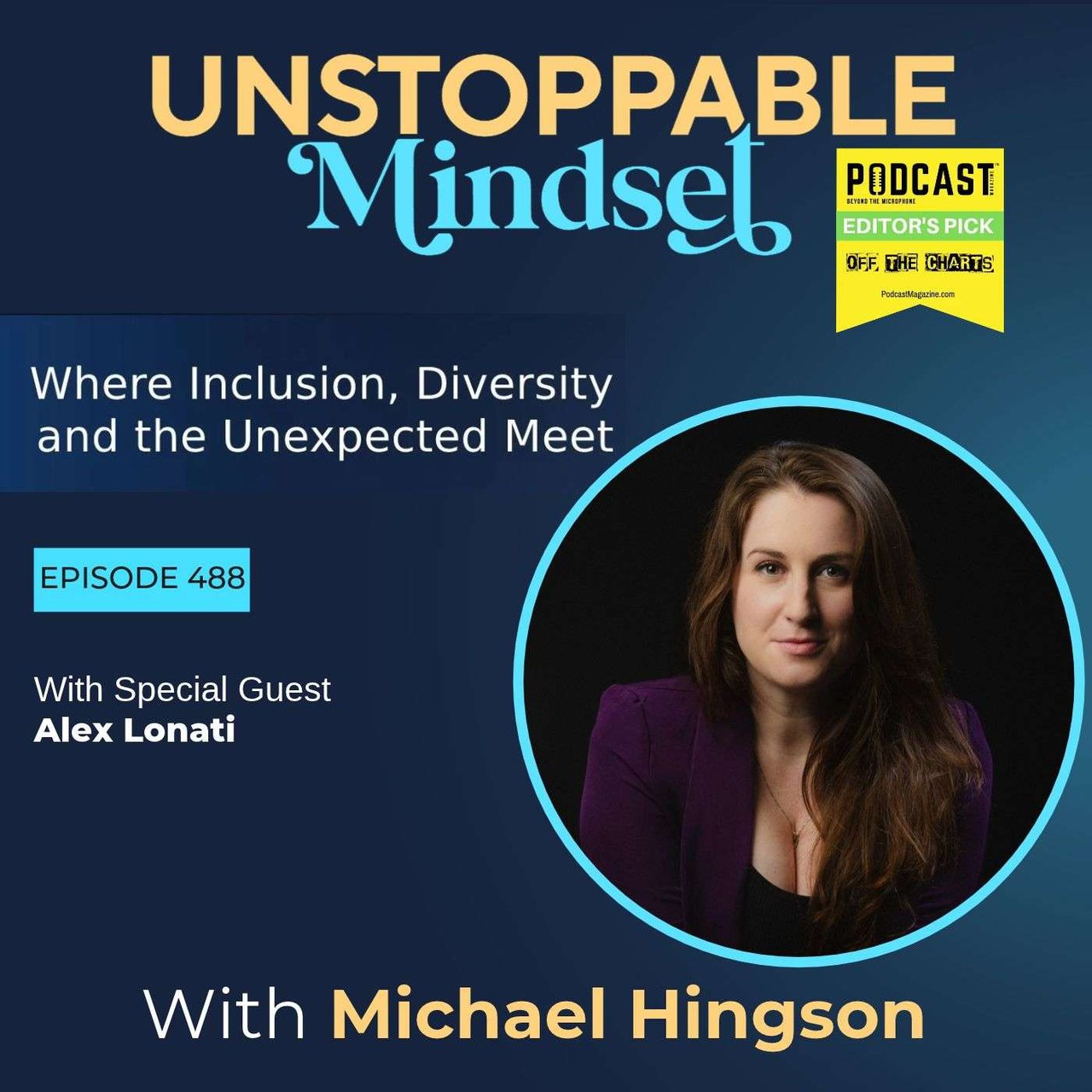
Episode 488 – Making Theater Accessible to Everyone: An Unstoppable Mission with Alex Lonati
What does it take to make theater truly accessible to everyone? Alex Lonati believes the arts should be a right, not a privilege. As a theater director, educator, and accessibility advocate in Boston, Alex is helping create more inclusive spaces where everyone can experience the power of live performance. She joins Michael Hingson to share her journey from aspiring actor to director and her work with Speakeasy Stage Company, where she has helped introduce audio description, open captioning, and relaxed performances. They discuss the importance of creative collaboration, listening to different perspectives, and supporting local artists. Alex also shares how the Theater Community Benevolent Fund helps artists facing unexpected hardships and why community support matters. From the challenges facing modern theater to the role of artificial intelligence in storytelling, this conversation shows how creativity, compassion, and inclusion can bring people together and make the arts more welcoming for all.
Highlights:
1:00 – How Alex discovered her passion for theater and shifted from acting to directing.
8:37 – How Speakeasy Stage Company brings bold, thought-provoking theater to Boston.
20:56 – Why working across different creative roles strengthens artistic growth.
27:30 – How collaboration and listening to different ideas lead to better creative work.
34:11 – How Alex helped make theater more accessible through inclusive performances.
54:03 – Why supporting local theater and artists is essential to keeping the arts alive.
About the Guest:
Alex Lonati is a Boston based director, producer, educator, accessibility advocate, and arts administrator. She has directed throughout the city, including at SpeakEasy Stage Company (upcoming – The Antiquities; Cost of Living; My Body, No Choice; The Boston Project: Project Resilience), Umbrella Arts Center (The Counter), Brown Box Theatre Project (The Hotel Nepenthe; Don’t Feed the Bear), and more. Professionally, she has been a member of SpeakEasy Stage’s administrative staff in a variety of positions since 2014, currently serving as the Director of Artistic & Community Programs, where she focuses primarily on artist relations, season selection, casting, accessibility, community outreach and partnerships, access to the arts, and equity and inclusion.
Alex believes first and foremost that the arts are about people, and strives to make theatre accessible and possible for all. She led the SpeakEasy team in the development of an accessibility program, which includes open captioning, audio description, touch tables, and Sensory Friendly/Relaxed performances and resources. She continues to work and learn more about this field, with the hope of steadily increasing the frequency and availability of these resources.
Additionally, Alex serves as the President of the Theatre Community Benevolent Fund (TCBF), an organization that provides emergency relief to artists in times of crisis. In her time as president, TCBF has awarded over $450,000 in no-string relief to artists in need.
She is also an adjunct faculty member at Emerson College, teaching Arts Management and Directing, and directs at local universities throughout Boston.
Alex holds a MS in Arts Administration from Boston University and a BA in Theatre Studies: Directing from Emerson College, where she hosted Standing Room Only on 88.9 WERS. She is passionate about travel, reading, adventurous eating, and her Australian Shepherd, Billie.
Ways to connect with Alex**:**
Instagram- alexlanotti
About the Host:
Michael Hingson is a New York Times best-selling author, international lecturer, and Chief Vision Officer for accessiBe. Michael, blind since birth, survived the 9/11 attacks with the help of his guide dog Roselle. This story is the subject of his best-selling book, Thunder Dog.
Michael gives over 100 presentations around the world each year speaking to influential groups such as Exxon Mobile, AT&T, Federal Express, Scripps College, Rutgers University, Children’s Hospital, and the American Red Cross just to name a few. He is Ambassador for the National Braille Literacy Campaign for the National Federation of the Blind and also serves as Ambassador for the American Humane Association’s 2012 Hero Dog Awards.
https://www.facebook.com/michael.hingson.author.speaker/
https://www.youtube.com/user/mhingson
https://www.linkedin.com/in/michaelhingson/
Thanks for listening!
Thanks so much for listening to our podcast! If you enjoyed this episode and think that others could benefit from listening, please share it using the social media buttons on this page. Do you have some feedback or questions about this episode? Leave a comment in the section below!
Subscribe to the podcast
If you would like to get automatic updates of new podcast episodes, you can subscribe to the podcast on Apple Podcasts or Stitcher. You can subscribe in your favorite podcast app. You can also support our podcast through our tip jar https://tips.pinecast.com/jar/unstoppable-mindset .
Leave us an Apple Podcasts review
Ratings and reviews from our listeners are extremely valuable to us and greatly appreciated. They help our podcast rank higher on Apple Podcasts, which exposes our show to more awesome listeners like you. If you have a minute, please leave an honest review on Apple Podcasts.
Transcription Notes:
Michael Hingson 00:04
What if the biggest thing holding you back isn’t what’s in front of you, but rather what you believe? Welcome to Unstoppable Mindset, where inclusion, diversity, and the unexpected meet. I’m your host, Michael Hingson, speaker, author, and advocate for inclusion and possibilities. This podcast explores how the beliefs we carry shape the way we live, lead, and connect with others. Each week, I talk with people who challenge assumptions, face adversity head-on, and show what’s possible when we choose curiosity over fear. Together, we focus on mindset, resilience, and the small shifts that lead to meaningful change. Let’s get started. Hi, everyone, and welcome to another episode of Unstoppable Mindset. Today we get to talk to a person who is a director and a bunch of other things in the theater and in other arenas around Boston. And I’m sure she’s got lots to talk about. She’s also an accessibility advocate, and I’m really interested to learn more about that. Our guest is Alex Lonati, and we will be chatting with her for the next hour or so. And I’m looking forward to it. So, Alex, welcome to Unstoppable Mindset. We’re glad you’re here.
Alex Lonati 01:31
Thanks so much for having me, Michael. I’m thrilled to be here.
Michael Hingson 01:34
Well, that’s always a good thing. It’s good when we get to to make everything work, you know.
Alex Lonati 01:40
Absolutely.
Michael Hingson 01:42
So tell us about the early Alex growing up and and all that. Let’s start at the beginning. Sure.
Alex Lonati 01:49
Starting right from the top. Well, I grew up in Franklin, Massachusetts, home of the first public library. Yeah, that’s what we’re known for. And you know, was a precocious kid right from the very start. So, of course, that’s how I got into the theater. And as as most of us theater kids are, I started as a performer. But by the time I made it to college, realized that I wanted to be behind the scenes, so I went to Emerson College for my undergrad, and did a bit of of performing there as well. But really, fairly quickly realized that I saw things from the outside, and I wanted to be in charge. I could. I had more of a vision on a larger scale, and and wanted to be the person organizing and and getting all the voices in the room, and so I I switched my focus to directing, and sort of haven’t looked back since. So I mean that I I I really just catapulted past those early days and got me right to to where I am now.
Michael Hingson 03:09
Well, there you go. I also I
Alex Lonati 03:10
also have a lovely, wonderful family that I grew up with. That’s that’s also part of my story.
Michael Hingson 03:16
Do you act at all?
Alex Lonati 03:18
Not anymore. I I did one professional acting gig many moons ago in a former life. I I like to say that I I love attention and I love to get up on stage and make a speech. But acting is very very difficult and takes a level of of vulnerability and and stamina that I think is remarkable, and I’ve let the actors keep do that. I’ll tell them to achieve it from my side of the table.
Michael Hingson 03:54
You know, it’s interesting, and I’ve talked to several people about this, but I’ll bring it up again. And that is that I know that one of the top fears that people have, according to various polling organizations, is speaking publicly.
Alex Lonati 04:08
Yes,
Michael Hingson 04:09
and I personally I don’t really understand that. I I guess I intellectually sort of do, but I do appreciate that in reality, speaking public. is is really not that horrible because the fact is that mostly audiences want you to succeed if you’re a public speaker or whatever, and I think acting kind of goes a little bit along with that. But audiences want you to succeed unless you’re just a real turkey, which is not generally the case.
Alex Lonati 04:41
Yes, I I am I am very fortunate in that that is not one of my fears either. I I like to say that I turn into a walking dad joke when I get up on a stage in front of a crowd of people. I love it. I love to make a speech. Love to greet a crowd, but I do think acting is something different because it’s not your own words. I I love to to be myself in front of people. I love to be Alex in front of people, but I think acting it’s it’s it’s harder because you’re being someone else and you have to figure out how to access some real deep, difficult emotions, and and do so with consistency for the sake of your scene partner, again and again. So my job as director is to not only to to guide the actors into that, but to do it safely and maintainably, and and to sort of lead everybody to the same vision into something cohesive.
Michael Hingson 05:52
Yeah. Well, and that and that makes sense. It it is a it is a challenge, and you’ve got actors who think they know it all, which is always another. That’s another story.
Alex Lonati 06:02
Well, you got a lot of people who think that know it all.
Michael Hingson 06:05
That’s true. That’s not just actors. But you know, but but the fact is, I think that being in front of people is something that we shouldn’t worry about so much, just because people really do want us to succeed.
Alex Lonati 06:20
Yeah, I think so. No one, no one wants to see anybody lose their words or or or mess up. But I understand that it’s it can be really overwhelming to to put yourself in a vulnerable position.
Michael Hingson 06:40
Yeah,
Alex Lonati 06:40
but in in many ways, I think that’s why theater is is a skill that everybody should have. I mean, there’s a case to be made. You know, when you talk about STEM versus STEAM, have you heard of this? Yeah, that adding the A for art. Yeah, because I honestly incorporating an acting class into like elementary school, middle school helps some of those like basic skill sets that that can last with you and really influence no matter what industry you go into, can make a huge impact on your public speaking, on your ability to connect with empathy. There’s so much of theater that can apply to all industries.
Michael Hingson 07:37
Yeah, well, I am the secretary of an organization called the Radio Enthusiasts of Puget Sound. So it’s a Washington State organization that is committed to working to prolong old radio and radio programs. And they every year do a couple of different programs where a number of radio shows are recreated in the Washington area, and it’s and it’s interesting to listen to some of the people who are are part of that, who just talk and and react and act without ever listening to what the original shows were, and and I think there’s value in that because I think there’s value in listening to what the original actors did because they knew how to communicate with people, they knew how to to project, and I find that all too often people don’t really necessarily know how to do that, and so they’re they’re trying to act, but they don’t get it. And if they would just listen to their predecessors, if you will, I think it would be a useful thing, and they would they would learn a lot from that.
Alex Lonati 08:56
Michael, if we all just listened a bit more, I think a lot of our world’s problems might be solved.
Michael Hingson 09:01
Yeah, well, there is that, you know. Yeah, there is that. Listening is is something that we just don’t tend to to nearly do as much as uh as really we could, which is unfortunately. But you know, so tell me about Speakeasy Stage Company. That’s a tongue twister.
Alex Lonati 09:24
Yes, yeah, I have it down to a science at this point. Well, Speakeasy Stage, we are a mid-sized professional nonprofit theater company. We are based in Boston. We were founded in 1992 by my mentor Paul Daniel, who ran the company for 34 seasons, and we are now in our 35th season. So we are in the middle of a season with our brand new artistic director, the brilliant Don M. Simmons. So we’re actually. In a big time of transition for Speakeasy Stage with our second ever artistic director, it’s going great. At Speakeasy, we produce five plays and musicals each season that are new to Boston and compel thoughtful conversation. So we are Boston’s home for the bold. That’s our tagline. So we focus on shows that are contemporary, relevant, edgy. We try to listen to our community, listen to what’s going on in the world, and then program work that is in conversation with that. We want people to leave the theater feeling like they have to talk about what they saw, like how it applies to their lives, what they learned, what they feel. We want to make an impact that lasts past them sitting in the seats. Yeah. So I’ve been at Speakeasy a long time in a number of roles, but I’m currently our director of artistic and community programs, meaning that I work sort of as the artistic director’s right hand, and working with her on all things artistic, with an extra focus on community engagement and really focusing on serving the people. So that’s that’s that’s Speakeasy.
Michael Hingson 11:20
What are some of the the plays and and musicals and so on that you’ve performed or that that you’ve produced there at Speakeasy? Yeah.
Alex Lonati 11:28
Well, let me tell you a little about this season first. This season we we are halfway through. So the two shows that we’ve done so far are the Pulitzer Prize winning by Primary Trust. That’s what we opened the season with, and then we did an absolutely wild three-person musical called Lizard Boy, where there was no band, just three actors that played about 20 instruments between them. That was a bananas show with very talented people, and we are about to open show number three, it is a thriller called Job that opens in just about oh I guess it opens at the end of this week, so just about a week. Show number four is The Antiquities by Jordan Harrison. I’m directing that one, so we can talk about that more perhaps. And then we are closing the season with a musical called Swept Away, based on the music of the Avett Brothers. But historically, we’ve done a lot of new work that is like right out of New York. So we do shows like some of our most popular shows have been Fun Home or The Prom or The Scottsboro Boys once on this island, but then we also do plays that are pretty heavy hitters too, like The Inheritance or Ain’t No Mo, or Jaja’s African Hair Braiding. So yeah, we kind of do a little bit of everything, but the the main through line is we do stuff that is brand new to Boston, so you wouldn’t have seen it in the city before, and that is contemporary. It’s now, and it has something to say.
Michael Hingson 13:11
So you didn’t do Phantom of the Opera, I gather.
Alex Lonati 13:15
No, we haven’t had the pleasure.
Michael Hingson 13:19
That’s a pretty Major undertaking,
Alex Lonati 13:21
yeah. No, no falling chandeliers in on our shows yet, but I wouldn’t say it’s out of the question.
Michael Hingson 13:29
Yeah, there’s always a possibility. Well, since you brought it up and you want to talk about it, tell us about antiquities, which is one that you love
Alex Lonati 13:38
to talk about it. Okay, well, the Antiquities is one of the wildest plays that I have ever read, and I am very excited to bring it to Boston. So the play is about a museum of humanity set in a post-humanity era. So the curators of this museum are not us; they are the technological beings who came after us. Maybe AI, and so the way this museum is set up is through a series of exhibits, like vignettes or scenes that look at how humans have interacted with technology over time, starting in the 1800s and then going through to the 2200s. So we get all these little scenes that span 500 years.
Michael Hingson 14:26
Wow!
Alex Lonati 14:27
And all these little scenes are humans trying to figure out what their relationship with the digital is. But more than anything, we’re seeing humanity in its most complex, weird, unique, complicated, beautiful forms. It’s a wild play, and there’s certainly an element of cautionary tale to it. But I think that the piece is about how human beings cannot be replicated. We are so uniquely. Special and it’s so lovely in that way. And the play on a on a on a director’s side is such a dream for an artist. It’s a real playground of a piece. I have a brilliant cast of nine actors, each of whom will play five or six different roles throughout the play from many different eras in time. I also have a talented design team who are building out this world, answering questions like, like what does the museum look like? What are the sounds of the future? How do we dress our characters so that the audience knows when each scene takes place? What props help us recognize the tech from the ’80s, from the ’90s, from the early 2000s? It’s all very fascinating.
Michael Hingson 15:49
Wow.
Alex Lonati 15:50
Yeah, and and I think the play couldn’t be more relevant. There’s so much conversation around AI happening. Can we use it ethically? What does it mean for humanity? And so yeah, I think there’s going to be a lot of discussion that’s going to happen after the lights come up for this show.
Michael Hingson 16:06
And I’m assuming there actually is a story in the play.
Alex Lonati 16:10
There is. There’s a lot of little stories in the play more than anything. It’s, I mean, the big story is why does this museum exist? But then there’s all of these like small stories that sort of connect us all, and it and it does have an overarching arc to it.
Michael Hingson 16:26
Wow!
Alex Lonati 16:27
Yeah.
Michael Hingson 16:27
So it’ll be interesting. Well, I’m I’m really curious now. Do you record the the plays? Is there a way to get a copy?
Alex Lonati 16:35
No, unfortunately, the the magic of live theater is that it
Alex Lonati 16:41
is only it is it is ephemeral. Yeah, it’s only there in the now, but it does for anyone who is who is in the greater Boston area. It’ll run for a a month, so it’ll run march 6 through the 28th. I
Michael Hingson 16:57
know when I lived in New Jersey, we would often go into New York, and we would see Broadway plays. My wife and I, and one of the things that we learned along the way was when there was a play or a musical, and it was performing its last time, they always recorded it, and they did that so that they had a record of it. And I don’t know, you know, where they go and they’re what archive they go into, but they record the last production of every play, and we saw one with Carol Burnett, for example, side by side with Sondheim, and oh
Alex Lonati 17:34
my gosh,
Michael Hingson 17:35
and it was there were four people in the play, and when the second act started, it was really kind of funny because everybody came out and they were dancing and they were singing, and all of a sudden Carol Burnett said, “Stop! Stop the music!” And they just kept going. And she said, “No, really, stop!” And they all stopped. And she said, “You know, things happen sometimes on Broadway, and there’s nothing you can really do except go with the flow. She said, “Let me show you.” And she was holding her skirt, and she let it go, and it dropped because the button fell off. And so she ran backstage to get it all addressed. And of course, the other three were out there going, yeah. Look at Carol Barnett. She’s always just looking for attention, isn’t she? It was cute. Oh my
Alex Lonati 18:25
goodness!
Michael Hingson 18:26
They were great. It was it was great.
Alex Lonati 18:28
And you will never forget that performance.
Michael Hingson 18:31
No, no, and it was recorded. So there you go.
Alex Lonati 18:35
Incredible. Oh yeah, that there are there are a couple stories that I think we have as well of of you will never forget that performance. Yeah, the magic of live theater.
Michael Hingson 18:47
Well, it is, and the same thing with with radio, which you know we’ve talked about. But old radio is the same way, and there are so many magical things that happen, and so many different things that you don’t expect. It makes it really fun, and I’m amazed at the number of times in radio that the actors just pull it off. And they even integrated commercials into some of the radio programs themselves, so that when they were when they were doing the show, when the appropriate time came up, they did the commercial right as part of the show, but they pulled it off so well, and and that’s one of the skills that those people had, Jack Benny and all you know all those other people. They could just do it.
Alex Lonati 19:35
Michael, I don’t think we talked about this previously, but I I have radio as part of my background, actually, I I went to Emerson College as my undergrad, and hosted a fairly popular radio show called Standing Room Only. Emerson has a pretty well known radio station, W E R S 88 nine. And has a Broadway show tunes themed radio show. I grew up listening to it actually from when I was like seven or eight years old, and my mom and I would play a game where we would try to race to see who could name the show tune the fastest.
Michael Hingson 20:16
Yeah.
Alex Lonati 20:16
And so when I got into Emerson, we dreamed that maybe you know my senior year maybe I could host the show, and my second semester freshman year they ended up needing somebody so I hosted it for three and a half years, and and yeah so I I did quite a lot of time on the radio in the end.
Michael Hingson 20:36
Well, I started in my freshman year and last quarter, doing radio at KUCI in Irvine, and then just played music and occasionally an old radio show. But the collection started developing, and by the time my sophomore year started, I had a show on Sunday night that I had then for five years. Every Sunday night, playing nothing but old radio shows, which was a lot of fun.
Alex Lonati 21:02
That’s amazing.
Michael Hingson 21:03
Yeah, and it’s
Alex Lonati 21:05
that’s a nice overlap.
Michael Hingson 21:06
It’s a lot of fun to do that, and you you learn about how to communicate with people, and you know you learn all about all the the different kinds of things that help make podcasts better than they than they might be otherwise. So that’s a good sure,
Alex Lonati 21:21
absolutely.
Michael Hingson 21:24
But you know, it’s really fun.
Speaker 1 21:30
If you enjoy Unstoppable Mindset and would like to help us continue bringing these conversations to you each week, we’ve created a way for you to support the show. Your contribution helps us cover production costs and continue sharing stories, insights, and ideas that inspire people to live with purpose and possibility. If supporting the podcast feels right for you, you’ll find the link in the show notes. Thank you for being part of the Unstoppable Mindset Community.
Michael Hingson 22:02
So you are a theater. You’re a director. In addition to working at Speakeasy, you’ve got a number of hats that you wear. Is that kind of unusual?
Alex Lonati 22:12
You know, I actually don’t think it is. I think in the theater industry, especially in 2026, it’s it’s it’s no longer possible to just be one thing anymore. We’re sort of all multi hyphenates. So, so personally, I consider myself to be a director dash producer dash educator dash arts administrator dash accessibility advocate. At least professionally, I would add a couple more personal half minutes, like like voracious novel reader dash, red wine enthusiast, wanderlust traveler dash, etc. etc. But more or less, everyone in the arts that I know wears many hats, and I think that’s not only a reality of making a living in this industry, which is unfortunately true. But I, I do think if I’m going to positively spin it, I kind of think it’s how an artistic brain works. I can’t speak for everyone, but I will say my brain moves a mile a minute, and I am constantly thinking about 10 projects at once. And and I I think I like to juggle. Like having a variety of projects that have different time commitments and different expectations works well for me. For like for example, working at Speakeasy is my constant, and while the work there changes day to day, I feel the most grounded in that work. Speakeasy is my is my grounding force, whereas when I’m directing, I can throw myself into a project for a month at a time and like fully immerse myself into the world of that play, and so it’s a much more intense period, but it’s also much shorter, so it’s sustainable. So it’s like I guess it’s a little bit of the you know the old varieties the spice of life trope, but it it keeps it busy, it keeps it interesting, and so it’s it’s you know it’s obviously a choice of how you structure your life, but it’s it’s I like to wear that many hats.
Michael Hingson 24:28
Do actors tend to not wear so many hats because they’re more focused on the play, they’re more focused on getting the character just right, and so on. So, do they tend to be? I don’t want to say one-dimensional because that’s not true. But do they tend to focus on not doing so many different kinds of jobs?
Alex Lonati 24:48
It’s a good question, and I think it depends on where you are. Because if you’re in New York, you might, as an actor, book a much longer gig.
Michael Hingson 24:57
Right. If
Alex Lonati 24:58
you book something on Broadway, you. Might book something that runs indefinitely, or you might, if you book a national tour, you might book something that runs six months, nine months. So there’s a world then where you really can focus on your performance, and I guess the same might go for, you know, if you’re a stage manager on a national tour or something like that, but I think if you work regionally, the same tends to be the case of where the projects are shorter, and so people tend to like to wear multiple hats. Even the the actors I know, I I think would consider themselves multi-hyphenates. I know a lot of actors who are also educators, who are also who are also coaches. I also think that being able to speak to other specialties makes you a more well-rounded artist in every field. I am. I could. I don’t believe I could ever be a lighting designer, for example. But I am eager to learn more about lighting design because I think that that will help me be a better director. In fact, one of my favorite collaborators in the entire world is a lightning designer, and any time she speaks, I am just eager to lap it up because I do think it helps me as an artist. Similarly to like stage management, I don’t I don’t know as much about stage management. I’m not a stage manager, but I am so eager to learn more because I think knowing more about stage management will help me as a director work better with stage managers. So I I think I I always encourage my students to like take classes in everything. Even even if you come into school and you say I want to be an actor and only an actor. I want. I don’t want to do anything else. I say, well, first of all, you don’t know that. You don’t know that yet. You might not have tried the thing you love the best yet. Yeah. But even if that is the case, and you only want to be an actor, that’s okay. But you should still take classes in everything else because learning everything else is going to make you such a better actor.
Michael Hingson 27:25
Well, the reality is, of course, it will be since by learning so many other things, you can appreciate how the actual designers, how the actual technical people put things together, and you never know when you might contribute something that would be a good thing too.
Alex Lonati 27:42
Absolutely, collaboration is is the most important part of our, for sure.
Michael Hingson 27:48
So I I think collaboration is such an important thing. I know that for me, in the when I was in sales managing computer hardware sales teams and so on, one of the things that I told everyone that I hired was, you’ve convinced me that you should be able to do the job. Now you’re going to have to be able to do it, but the other part about it is that I have talents that I bring, and when we collaborate and work together, and we we figure out how I can use my talents to add value to you, then we really become a whole lot more unbeatable than we otherwise might, and that is something that I, you know, when when people get that, then it works out really well, and and and I do have things that I bring to sales that most people don’t, but by the same token, it’s it’s a matter of learning to collaborate, and I think collaboration is always a good thing.
Alex Lonati 28:46
I I couldn’t agree more, and I I think my role as a director tends to be assembling the first and foremost assembling the team, and then helping to guide everybody to the vision. But it is not making people achieve my vision, it is helping to guide everybody’s voice. I what I love so much is working with people who know what they’re doing and who bring all of these brilliant ideas to the table, and then figuring out how to combine all of the brilliance to make be the best idea. Yeah, I just think that the best art comes from a table full of voices.
Michael Hingson 29:37
Have you ever had a situation where you really thought that something had to be done a certain way, and someone else disagreed with that. And it turns out that by the time all was said and done, the other person’s view was a better way
Alex Lonati 29:55
to do it. Oh, I’m sure, probably when I was young. I think, I think most of us enter this industry feeling very possessive of opportunities, and and I think that is something that’s really hard to break. And I still find myself falling into those old habits here and there because, quite frankly, there aren’t enough opportunities for as many talented people as there are in this industry, and so there is always that element of when is my next job? When can I? When will I get to work on something again? When when do I get my next passion project, and so I think where that comes, where that often comes out, is early in the career before you really understand that that collaboration is where it’s at, where you’ve finally been given the chance, and you say, “Here’s my one chance. I have to prove that my vision is the vision, and my idea is the idea, and then you get caught in that trap where, where you’re so dead set on proving that you have earned this spot that you aren’t collaborative and and aren’t open to working with other people and listening to potentially better ideas. So I don’t, I don’t know that I have a specific example off the top of the dome, but I absolutely am sure that I fell into that trap many times earlier in my career, and it’s just something I actively try not to do now because there are so many people who have better ideas than me or different ideas than me that could work better in this case, or have different ideas than mine that if we fuse them together might find something neither of us expected and will create something magical. So I just I find now that what I would like, what I find to be success for me is is not like necessarily wow that idea that she had from the start was the most incredible successful idea in the end, for me, success is that people like to work with me, and that people want to collaborate with me. That feels like success for me.
Michael Hingson 32:31
Well, and that’s ultimately the the issue. If you find that people want to collaborate with you, then you’re obviously doing something right.
Alex Lonati 32:38
Yeah, yeah, I like that.
Michael Hingson 32:41
Yeah, so that that makes a lot of sense, and you know, and there are always going to be times that somebody’s going to just think they’ve got the only idea that works, and then you don’t see the collaboration, and their idea doesn’t necessarily really work. But by the same token, it’s it’s no different in working in the theater than it is in any kind of business or any other kinds of environment. It’s all about collaborating. It’s all about really stepping back and looking for the best solution. Yeah, and that’s something that we just don’t do nearly as much as we should sometimes.
Alex Lonati 33:20
I agree. I agree.
Michael Hingson 33:23
So, you being on the Speakeasy staff and so on, what does it really mean for you to be the director of artistic and community programs? What is
Alex Lonati 33:35
that? Sure. Oh, sure. Oh man. Well, okay. At Speakeasy, we’re a pretty small shop, especially for being a theater company of our size. So our staff tends to cover a lot of ground. As the director of artistic and community programs, I manage all of the day-to-day artistic and community engagement programming. So artistically, I work with Don Simmons, our artistic director, on artistic programming, things like season selection, like choosing which which plays we produce, casting and hiring, supplemental programming, artist support Throughout productions, I read a lot of plays, but on the community engagement side, it can be pretty broad. For example, I run our fellowship program and our internship program. I manage our student matinee series. I facilitate any supplemental post show events or discussions like artist talkbacks or panels or community conversations, and I built out and now manage our accessibility programming, including our open captioning, audio description, and lax performances, which we offer for every production. But like I said, we’re. A small shop, so being a part of Speakeasy staff also just means like being a part of the team. So we just sort of jump in where we’re needed. We do whatever we need to in in order to make the art happen. So we just sort of take care of each other.
Michael Hingson 35:15
That makes sense. So what got you so interested in dealing with accessibility?
Alex Lonati 35:20
Yeah. You know, I’ve, I’ve, I’ve, I’ve always held on to this very basic belief that the arts are for everybody. Like, I don’t know, the art is not that art is not a privilege but a right, and that just feels very obvious to me. It kind of always has. And and Speakeasy would always use that language as well, but we never had any consistent, accessible programming, and it always bothered me that it wasn’t intentional. Like we we didn’t intentionally not have this programming. We just for a very long time never had the resources in place to make it happen or the personnel to make it happen. This was before I was in this role, And then the pandemic happened, and that was horrible and terrifying. And like all arts organizations, speakeasy shut down for 18 months. But instead of fully closing, we took the rare opportunity of having time to sort of reflect on our values and our mission, and sort of check in as to whether we were actually upholding them, and how we could do so even better. And so, at that point, I brought a proposal to our leadership, and and more or less said hello. We say that art is for everyone, but it is not. So I would like to build out an accessibility program. And to their credit, without any hesitation, they said yes. Please do. So I spent the majority of that first year of the pandemic just learning, and I I mostly did that. I completed the innovation and learning network program at the Massachusetts Cultural Council’s Universal Participation Initiative. It’s a bit of a mouthful, but an excellent program. I attended the lead conference that was online that year, and then I did a number of other online workshops and trainings. And I spent a lot of time, and continue to spend a lot of time talking to like really brilliant leaders in this work, like Charles Baldwin, Rhoda Bernard, Sam Gould, and and Chris Robinson over at Outside the Vox, which is a really great organization here in Boston, that that is pretty new, and that I’m really hoping to get more involved with. But in so many more, and so ultimately, Speakeasy built our accessibility program, which offers select performances with open captioning, audio description, and relaxed performances for every production, and we we have a long way to go. We have so many more services that I would like for us to offer. I want to be able to offer more options throughout every run, and I want to expand the community with whom we work. Like there is so much more to learn and to do, but I am, I am proud of the progress we’ve made over the past few years. So it’s a small step, but it is a step towards making art more accessible, and I and I am pretty proud of that.
Michael Hingson 38:35
You talked about relaxed performances. What is that?
Alex Lonati 38:37
So over the past few years, we have done a few sensory-friendly performances, and some some folks use sensory-friendly and relaxed performances interchangeably. But I believe they are two very different things. Sensory-friendly performances are performances that are specifically adjusted to make the work accessible to those with sensory sensitivities, for example, individuals on the autism spectrum, or with whom those who might benefit from like reduced sound cues or or limited flashing light cues. So we did a few performances like that where we worked with Rhoda Bernard, who was our consultant who who works at Berkeley, and she’s an unbelievable human being, but also person in this work. And she helped us adjust our productions by leaving the house lights at half for the entire performance, taking out flashing light cues or like loud sound cues. We built out a quiet space if people felt they needed to step out, but that still had like an audio or video recording or live stream of the show. We had fidget materials accessible, coloring books, things like that. This work. Doesn’t fit every performer, every production that Speakeasy does. In fact, a lot of our work just inherently is isn’t conducive to that type of programming. So we have to be specific with when we can offer sensory friendly. But there is an element of that which is relaxed theater etiquette, and that means setting the expectation that you are allowed to be whoever you need to be in this space. This is a judgment-free zone. This is a no-hush zone. This is a place where, if you vocalize in a way that might be different from the person sitting next to you. That’s okay. If this is a performance that doesn’t have an intermission and you need to use the bathroom, no one’s going to judge you for having to get up in the middle of the show and come back. That’s okay. And that element of it is something we can bring to every production. So while we would like our audiences to lead with generosity and compassion at every show. At this one relaxed performance, we demand it. So we do one relaxed performance, a production where we put a lot of signage up. We talk about what this is, and it’s for anyone who might not feel welcome in a traditional, with big air quotes, a traditional theater space, but might feel more comfortable at somewhere with relaxed theater etiquette.
Michael Hingson 41:35
Okay, yeah. What about making, and I’m assuming there is one. The website’s accessible.
Alex Lonati 41:43
Yes, we we’ve worked with a couple of accessibility website auditors with varying levels of success. I think our website is okay, but and it’s something we’re we’re continuing to improve. But I’ve done a couple trainings on it, and as our marketing teams change, we we have folks go through those trainings as well. There are some things I think we’re really good at, and some things we need to continue to improve upon. Um, but it is something that’s definitely on our mind to make sure that our website and our marketing materials are as accessible as possible. We do have we work with Perkins School for the Blind, and we have Braille playbills available. But mostly, we find that folks use a lot of e-readers, so we’re trying to up the readability of our both printed and emailed materials,
Michael Hingson 42:43
right? Well, internet website access is is certainly a big issue today, and if if we can help with that, I’d love to explore that with you. And glad you glad to help with that in so many different ways.
Speaker 2 43:00
That would be great.
Alex Lonati 43:00
Thank you.
Michael Hingson 43:01
So we could do well. So you also serve as the you serve as the president of the theater community benevolent fund. Tell us about that.
Alex Lonati 43:15
I do. You’re good. Just
Michael Hingson 43:17
all over, aren’t you?
Alex Lonati 43:18
Told you I like to wear hats, yes. So the Theater Community Benevolent Fund (TCBF) it’s another nonprofit based in Boston, and we are a resource for artists in times of need. So ultimately, TCBF exists to help artists in time of extreme and catastrophic emergencies. So think like an unexpected medical procedure, or your car gets stolen, or there’s a fire in your home. Things that artists might not necessarily have the emergency funds to bounce back from. TCBF provides no strings, judgment free grants to help our community members get through those difficult times, obviously COVID was a big. I was just going to ask about that. Yes, yeah. In those four years where COVID was hit the hardest, so from March 2020 to March 2024, we gave out almost half a million dollars in individual grants to get people back on their feet. So, so yeah, a big shout out to any Boston-based artists listening. Visit tcbf.org if you ever find yourself in trouble. We are a fully volunteer board. We have zero overhead, and we are we rely entirely on donations. So, if you are not Boston-based but want to make a donation, 100% of donations made to TCBF goes to Boston artists in need.
Michael Hingson 44:50
That’s pretty cool, and and I can imagine certainly during COVID, and and even this year with the flu epidemic, it’s. It’s a it’s a problem, but it’s nice that there is that level of support that can be out there to help.
Alex Lonati 45:08
Yeah, I think it’s a it’s a lovely additional resource, but more than anything, it feels sort of like this artist take care of their own. A couple years ago, I I’ve had a really difficult instance in my own life, and I found that you know the people who rallied around me the hardest were Boston artists, like actors who had been in a show at Speakeasy a couple years prior were reaching out to me, offering me anything they had, and it was just, it was just so unbelievably humbling and and moving. I I think the the theater industry is full of people who want to make a difference and and would give you the shirt off their back. It’s for people who take care who take care of our own, and it’s it’s really beautiful to see.
Michael Hingson 46:09
So that that is really a neat thing to certainly experience, and I’m sure you have lots of stories of ways the the benevolent fund has helped through the
Alex Lonati 46:22
years. Yeah. yes, but not ones I can share because we are very good about not sharing the stories of people without permission.
Michael Hingson 46:32
Wouldn’t what? Nope, wouldn’t ask. Wouldn’t ask. It wouldn’t be fair, and that’s not what it’s about, and it’s not about publicity and all that. It’s about doing work that needs to be done and helping.
Alex Lonati 46:49
Yeah, yeah.
Michael Hingson 46:51
So when you know, I I know you talked about it a little bit earlier, but when did you really decide that you wanted to be a director and that was
Alex Lonati 46:59
it? Hmm. Oh, that is a good question. I, you know, I went to Emerson for my undergrad, and I went in pretty hard, thinking I was going to be an actor, a Broadway star, and spent probably a year, maybe year and a half, thinking that, and then I can remember pretty clearly being in the audience of a show, a student production in London. Though it wasn’t, I was studying abroad, and it was a play I’d never heard of before. And it was doing something kind of wacky. It was telling. It was the scenes were all out of order. It was a very unique piece, and it was beautiful. It was poetic. It was gorgeous, and the production was terrible. And I just kept thinking, the script is so beautiful, and they’re doing it wrong. And suddenly, something clicked in my head, and I thought, I want to tell this story. Am I a director? And suddenly I was like, “Oh my goodness! I think I want to try directing because I can see this story clear as day. I know I know how to do this. I I know what what I I know what I want to do here.” And so I got back to America and got my hands on that script actually, and said, “Let me give this trap,” and and did a production of that play actually. But you know, I was a kid and and just wanted to play. But it sort of unlocked something in me of like, “Oh, I’m going to try reading a script with a different mindset, and and instead of saying what’s this one part that I could play, instead I’m going to think about it like, what is this? What’s the purpose of this script? What is this story meant to be saying, and and why and why now? And how do you bring all these parts together to to make the impact? And it sort of just changed everything for me. And it all just clicked together. And then suddenly it felt like I did a complete 180. And so people who are like, well, you’re you’re an actor, right? And I said, oh no
Michael Hingson 49:23
no no no, I’m a
Alex Lonati 49:24
director. But it really did change the trajectory of of my life.
Michael Hingson 49:31
I bet if you had been offered the job, it would have. I bet it would have been a real challenge to direct Pulp Fiction.
Alex Lonati 49:38
Oh my! I mean, you know, I I’ve never tried to direct film before. I think that is a whole different beast. Yeah. But you know, Michael, if you offer it to me, I’ll give it a go.
Michael Hingson 49:52
Yeah. Well, I don’t have the influence for it, but I would be interesting. I just thought to anyone listening.
Alex Lonati 49:59
I just thought
Michael Hingson 50:01
of it because you said that the the play in in London was was just so cattywampus in so many ways, but
Alex Lonati 50:09
but that that’s what
Michael Hingson 50:12
makes that’s what makes life fun, right? Going off and doing these kinds of things,
Alex Lonati 50:18
yeah, and just just experiencing all the yeah, experiencing life and and and seeing art, you know, and it’s it’s great to see what inspires you. Good art, bad art, and there’s there is an argument to be made that there is no such thing as bad art, or that bad art is just good art in it for somebody else. Oh, I don’t know what I’m saying. All that to say, like this, this, this piece of theater that I didn’t like very much was one of the most impactful pieces of theater of my entire life. So who’s to say it was bad? Maybe it was good because it changed my life forever. You know, and I. There you
Michael Hingson 51:01
go.
Alex Lonati 51:02
So, what is good? What is bad? Art is unbelievably subjective.
Michael Hingson 51:08
Yeah,
Alex Lonati 51:08
that’s so good.
Michael Hingson 51:10
And that’s okay.
Alex Lonati 51:11
That’s. I know.
Michael Hingson 51:13
I know. I went to see James Earl Jones in Othello on Broadway.
Alex Lonati 51:19
Oh,
Michael Hingson 51:20
and it was amazing to see because the audience was totally drawn in. It didn’t matter whether you knew the plot when they fell on their swords at the end. Everyone just inhaled and just it was it was amazing the the powerful nature of the performance. It was James Earl Jones and Christopher Plummer played the Argo. Yeah, I know.
Alex Lonati 51:45
Goodness, I can only imagine that.
Michael Hingson 51:49
Yeah, it was it was pretty amazing. But I think that that there’s so much to be said for powerful acting, and
Speaker 3 51:58
yes,
Michael Hingson 51:58
they did everything just right. Of course, they’re consummate professionals anyway, but they they did everything just right, and they drew in the audience, and you can’t beat that.
Alex Lonati 52:09
Absolutely, yes. There are so many talented people in this world. We’re so lucky to to now be in a in a a time when we get access to them. How exciting that you even got to experience it. That that’s amazing.
Michael Hingson 52:30
What kind of theater overall are you excited by? What kind of theater really excites you?
Alex Lonati 52:38
Oof, I love what I love about theater in general is I think it’s an art form where creativity can really shine, like because it is. I think I don’t know. I I know that there are a lot of films that don’t live in realism, but for me, realism is where is for film, and TV, and theater. I want to see. I I want to see something weird and wacky. I want to. I want. I want to see what your creativity can do. Personally, I’m drawn to. I I just directed a play this fall, which was sort of my first venture into realism, and it was a very exciting experience because I had to flex a muscle I hadn’t worked in a while. In that, I was I I directed a realistic play, but most of the time I like to live in a world that is you can you can kind of do anything in the theater. You can, you can use lights and sound and costumes to create totally different worlds and and just transform. So I’m I’m really excited by theater that does something different. I’m also I am. I am really thrilled by stories about written by, directed by, performed by marginalized people. I I particularly love stories about women, and feminine rage. So yeah, you mix that all together. Give me a, give me a some magical realism and feminine rage. Oh, would love it. But but mostly, I just want theater that has something to say, and that is saying something different. That was vague, but those are the big feelings I’m happy. But I understand the moment. You understand? I understand.
Michael Hingson 54:47
Well, what are some of the big challenges that theater is facing today, and how do we deal with them?
Alex Lonati 54:56
Oh gosh.
Michael Hingson 54:57
Yeah. Well, there’s that.
Alex Lonati 55:00
Well, I mean, in general, the the the biggest challenges facing the theater today are that is the general lack of support and resources. I mean, on the largest scale, is governmentally. That’s not a new thing, although it feels new. Other countries receive most of their funding from the government, and thus have the flexibility to create art that doesn’t rely on ticket sales so much, and have the freedom to be creative and try new things, and and not go just for the commercial, and I, I, I wish that we had a bit more of that model, but we don’t, and that is a shame. But in the model, we do have, I will say, a big challenge is that audiences are not back to pre-pandemic levels, at least not regionally, but I do. I don’t believe anywhere, and that’s challenging. I will say I don’t believe that our competition are other theater companies. I think our competition is Netflix, and I understand that, But I would say, what can we, what can people do is support local art and local artists. And if you know, if you have the means to make a donation to a theater company, absolutely do that. But more importantly, I would say go to the theater and then tell your friends about the theater because word of mouth makes the most difference of all.
Michael Hingson 56:47
In 2001, we went to see The Lion King on Broadway, and it was Karen, my wife, and I, her brother, his wife, and there. At the time, she was maybe three or four years old, daughter, and you know, just so many things. First of all, just the sound when they started singing at the beginning was just so different than anything that you would hear on on the stereo or whatever. It was just so so much better. But one of my favorite scenes or favorite things was when the hyenas first came and started meeting with Scar. They came from the back of the theater and they walked down the stairs and they were growling and growling and growling. And one of them got right up next to my wife Karen, who was in a wheelchair her whole life, and he was growling, and he got right up next to her, and he went. You never saw a woman in a wheelchair jump. It was funny,
Alex Lonati 57:57
but see, yeah, the impact live theater can can make such a lasting impact. I don’t think there’s anything quite like it.
Michael Hingson 58:07
No, I I got to see Jerry Lewis in Damn Yankees. That was the only time he was ever on Broadway. He played mr. Applegate, but was just phenomenal, and just so many things like that. It’s it’s such a blessing, and those memories are always going to be there, which is so cool.
Alex Lonati 58:25
That is amazing, really amazing.
Michael Hingson 58:27
Well, so tell me if you would, what would you say to somebody who wants to start out in theater and or start out even in any kind of an entrepreneurial environment? What what kind of advice would you offer them?
Alex Lonati 58:41
Absolutely. Well, I mean, first things first. If you are just interested in learning more about theater, or you think you might be interested in getting into theater, the first thing to do is go see theater in your local area. Figure out the scene. That’s the best way to start knowing what’s going on is by seeing theater. I recommend that to my students, to to anyone who’s trying to break into the scene is get to know the scene. So figure out what the theaters are. Figure out what kind of theater you like. Start to read plays, and and so so yeah. There’s I I recognize that saying yeah go see a bunch of plays that that might not be a possibility for everyone, but there are a lot of theater companies that have discounted tickets or accessible ticket pricing, so you know rush tickets. Speakeasy has a pay what you pay what you wish model the first weekend of every show. So so check that out if that’s something you’re interested in. A lot of theater companies will do something similar, but if that’s not something you can do right now, read plays. Your local library and figure out what you like. Past that, then I think you can just start to get involved. A great place to start, if you’ve never done anything before, is at the community theater level. Community theaters are amazing. They’re a great way to learn to meet people, to just sort of get the get the first levels of experience of like how to learn how to be in a play, how to meet other theater people, how to like get it in your bones, and then from there, if you have the resources, take an acting class, take a voice lesson, reach out to somebody at a theater company and get a cup of coffee with them and ask for advice. Eventually, there are you know citywide auditions or yeah things like that, or even company wide auditions like an EPA or something like that. But I think starting with seeing theater, reading theater, and figuring out what you love’s a great place to start.
Michael Hingson 1:01:11
That’s cool. Well, I want to thank you for spending an hour with us today. This has been absolutely fun and joyful. I really appreciate it, and I want to thank all of you who have been monitoring us and listening to us wherever you are. Would appreciate it if you give us a five star review. Certainly rate us highly, but also give us a review. We love reviews, and we appreciate those reviews. I don’t know whether directors like reviews, but I like reviews. But I like reviews, and and we appreciate it. So wherever you’re listening or watching the podcast, please give us a review. We and make it a good review. But we do really appreciate you being here. And if you know of anyone else that ought to come on the podcast for you, Alex and anyone, we’d sure appreciate hearing from you about them. But you know, for for you, if people want to reach out to you, Alex, how do they do that?
Alex Lonati 1:02:08
Great. So my website is alexlonati.com, a l e x l o n a t i.com. You can reach out to me through there. Also, Instagram at alexlonati, but you can also find me@speakeasystage.com. And please, if you are in the Boston area, come see the Antiquities running march 6 through 28th.
Michael Hingson 1:02:32
Right now, I don’t have anything scheduled to be there, but it would be fun to come and see it.
Alex Lonati 1:02:36
I think you should find a reason to be in Boston in March. I gotta, I
Michael Hingson 1:02:40
gotta work on that. I used to live. I used to live in Winthrop, and I love being in the Boston area. So yeah. Well, thank you again. This has been great, and we really appreciate your time today.
Alex Lonati 1:02:51
Thank you, Michael. It’s been an absolute joy.
Speaker 1 1:02:57
Thank
Michael Hingson 1:02:58
you for being here with me on Unstoppable Mindset. I hope today’s conversation left you with a fresh perspective, a new insight, or at least something worth thinking about. If you’re ready to go deeper into the ideas that shape how we see ourselves and others, I have a free gift for you. Head over to michaelhingson.com and download my free ebook, Blinded by Fear. It explores the invisible beliefs that hold us back, and shows you how to reframe them so you can move forward with clarity and confidence. Be sure to subscribe to our podcast, leave a review, and share this show with someone who can use a reminder that growth starts with mindset. When people think differently, we all move forward together. Thanks again for listening. Keep learning, keep questioning, and keep choosing to live with an unstoppable mindset.