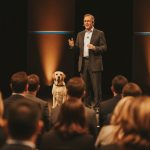
Corporate Event Speaker on Change Management: Leading Through Uncertainty in 2026
What if the secret to leading through a corporate merger or a sudden technological shift isn’t a better roadmap, but the ability to walk forward with confidence when you can’t see the floor beneath your feet? You’re likely feeling the weight of change saturation, a reality for 73% of organizations today. It’s exhausting to manage employee resistance while battling your own leadership fatigue, especially when searching for a corporate event speaker on change management who offers more than just hollow buzzwords.
I understand that trust isn’t built when things are easy; it’s forged in the moments when the path forward is completely obscured. By drawing on the lessons I learned while leading my colleagues down 78 flights of stairs in the World Trade Center, we can redefine how your organization handles the unknown. You don’t need another lecture on the mechanics of a “pivot.” You need a strategy for interdependence that empowers every individual to move with purpose.
This article will show you how to transform collective fear into adaptive trust. You’ll gain a practical framework for building resilience during high-stakes transitions and learn why the most successful teams in 2026 are those that treat uncertainty as a catalyst for connection rather than a signal for retreat.
Key Takeaways
- Discover why trust is the ultimate management tool for maintaining operational integrity during high-stakes strategic shifts.
- Learn to apply the “No Limits” mindset to transform perceived environmental obstacles into unique opportunities for growth.
- Find out how a corporate event speaker on change management can bridge the gap between academic theory and the lived reality of navigating a crisis.
- Identify your organization’s specific “Change Gap” to better support teams facing leadership transitions or digital transformations.
- Shift your leadership perspective from merely visualizing a destination to actively perceiving the potential within your team’s interdependence.
Navigating the Fog of Change: Why Trust is the Ultimate Management Tool
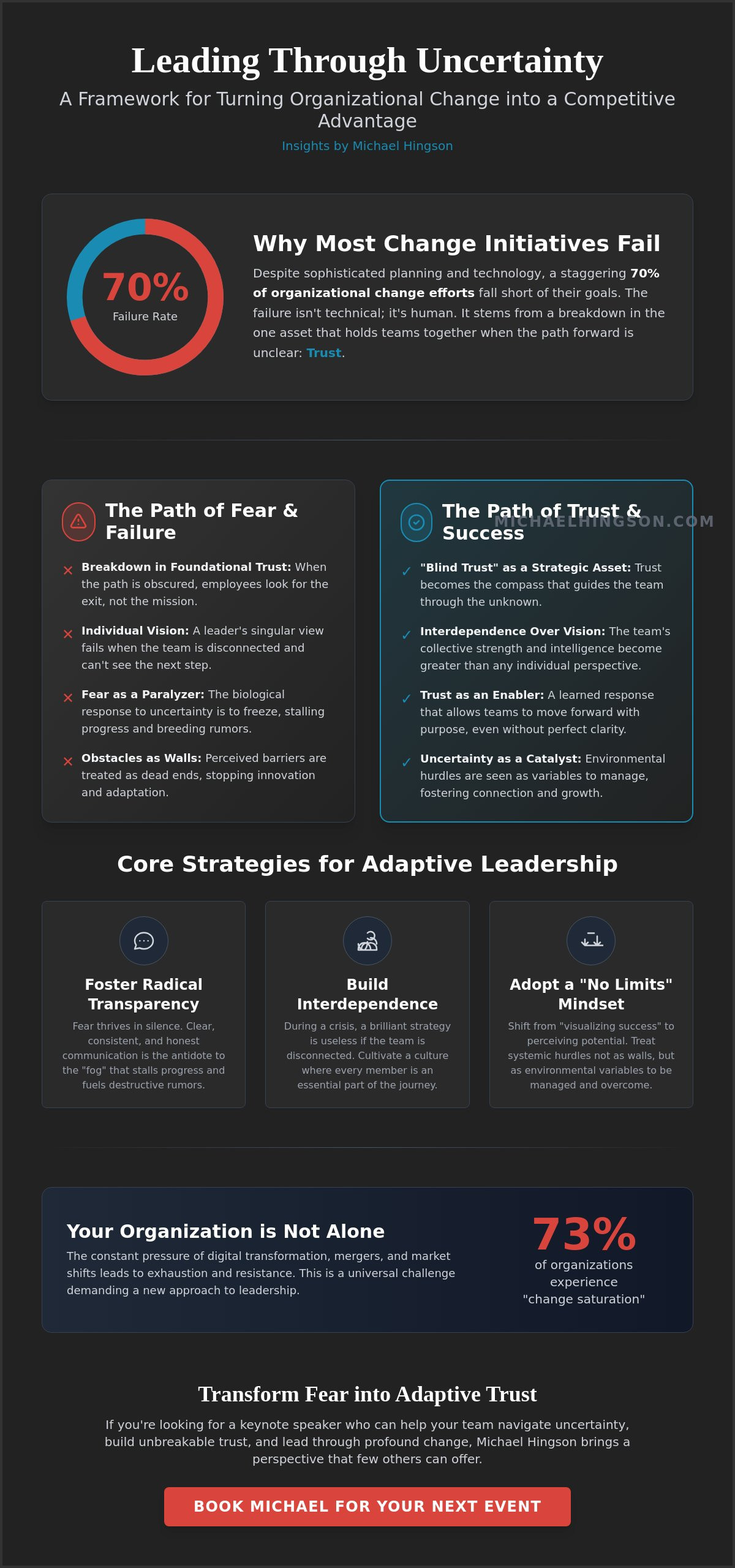
In 2026, the definition of change management has evolved into something far more profound than simple organizational adjustment. It’s the critical ability to maintain operational integrity while shifting your entire strategic direction in real-time. Despite the sophisticated AI tools and data models at our disposal, research suggests that nearly 70% of change initiatives fail to achieve their intended outcomes. These failures rarely stem from a lack of technical planning. Instead, they happen because of a breakdown in foundational trust. When the path ahead becomes obscured, employees often stop looking at the mission and start looking for the exit.
I often describe “Blind Trust” as a strategic asset rather than a liability. On September 11, 2001, I had to lead my colleagues down 78 floors of the World Trade Center. I couldn’t see the smoke or the debris, but I could feel the vibration of the building and hear the urgency in the stairwell. My guide dog, Roselle, and I shared a bond built on years of interdependence. That same trust allowed my team to follow me into the unknown. When you work with a corporate event speaker on change management who has lived through extreme uncertainty, your team discovers that change isn’t a threat to be feared. It’s an environment where trust becomes your most reliable compass.
Why Change Management Matters for Leaders
Leadership during a transition is about closing the “perception gap.” When change occurs, employees often lose sight of the long-term mission because they’re overwhelmed by immediate disruption. Trust acts as the bridge that maintains productivity while old systems are being dismantled. Leaders who prioritize psychological safety find that their teams adopt new technologies and workflows faster. They’re not just following orders; they’re moving forward because they believe in the collective strength of the organization.
Key Takeaways for Navigating Uncertainty
- Transparency is the antidote: Fear thrives in silence. Clear, honest communication removes the “fog” that stalls progress and breeds rumors.
- Interdependence over individual vision: During a crisis, even the most brilliant strategy fails if the team is disconnected. True leadership means fostering a culture where every person knows they’re an essential part of the journey.
- Resilience is a team sport: It isn’t a trait you’re born with; it’s a culture you build. A seasoned corporate event speaker on change management can help you move from individual survival to collective triumph.
Strategies for Adaptive Leadership: Seeing Beyond the Crisis
Adaptive leadership requires a fundamental shift in how we process information. Most executives are taught to “visualize success,” but when the environment is constantly shifting, sight alone is insufficient. You must learn to perceive potential by synthesizing all available data, much like I navigate the world using non-visual cues. This is the heart of the “No Limits” mindset. What many call a barrier is often just a characteristic of the environment that requires a different approach. Engaging a corporate event speaker on change management helps your team realize that systemic hurdles are simply variables to be managed, not walls that stop progress. Adaptive leadership is the practice of moving forward based on trust rather than sight.
Lessons from Tower One: Trust as a Survival Skill
Preparation doesn’t mean having a plan for every specific disaster. It means building a team that knows how to function together when the plan disappears. In Tower One, we didn’t survive because we had a map of the smoke-filled stairwells. We survived because we practiced leadership and trust as daily habits. When the environment becomes chaotic, your most important tool isn’t your dashboard; it’s your ability to listen to the people around you. A successful change leader understands that their team’s collective intelligence is always greater than their own individual perspective. This is the exact insight a corporate event speaker on change management provides to help your organization navigate its own high-stakes transitions.
Overcoming the Fear of the Unknown
Fear is a biological response to change. It’s a survival mechanism designed to keep us safe by keeping us still. Trust, however, is a learned response that allows us to move. When your organization is facing a massive transition, don’t ask your team to look at the entire staircase. Ask them to focus on the next step. By building a resilient mindset, you enable your employees to stay grounded in the present moment rather than being paralyzed by a hypothetical future. Bringing a fresh perspective to your next meeting starts with choosing a partner who understands the nuance of adaptation; you can learn more about how Michael’s story inspires teams on his official website.
- Focus on the immediate: Break large transitions into manageable, trust-based steps.
- Listen deeply: Use the “noise” of a crisis to identify where your team needs the most support.
- Reframe barriers: View challenges as environmental features that dictate your strategy, not your capacity.
Hiring a Corporate Event Speaker on Change Management
Choosing a corporate event speaker on change management requires more than browsing a list of trending names. You must first identify the “Change Gap” in your organization. Is it the friction of a recent merger? The hesitation following a leadership transition? Or perhaps the overwhelm of a massive digital transformation? Once you define the specific hurdle, you can find a speaker whose message provides the exact bridge your team needs to cross. A great keynote doesn’t just fill a time slot; it provides a “call to action” that employees can implement the moment they return to their desks.
Effective speakers move beyond academic theory. While change management tools and strategies are essential for structural planning, they often fail to address the human heart of the problem. A truly impactful keynote connects Diversity, Equity, and Inclusion (DEI) directly to core business performance. It shows that inclusion isn’t just a metric; it’s a prerequisite for the interdependence required to survive a crisis. When people feel seen and included, their willingness to trust the leadership during a transition increases exponentially.
The Impact of a Lived-Experience Keynote
Stories of survival and resilience create an emotional anchor that data alone cannot provide. When an audience hears about real-world triumph over adversity, concepts like agility and trust stop being abstract. They become tangible. Authenticity in speaking leads to higher engagement and ensures your team retains these lessons long after the conference ends. Choosing a seasoned keynote speaker transforms an ordinary meeting into a catalyst for cultural change.
Booking Michael Hingson for Your Next Conference
Michael offers a perspective on change that transforms how audiences view their own limitations. He doesn’t just talk about change; he demonstrates how to thrive within it by leveraging the power of trust and teamwork. Every presentation is customized to address the specific trust and leadership challenges your organization faces today. If you’re looking for a keynote speaker who can help your team navigate uncertainty, build trust, and lead through change, Michael Hingson brings a perspective that few others can offer.
Transforming Uncertainty Into Your Greatest Strategic Advantage
Leadership in 2026 isn’t about predicting the future with perfect accuracy. It’s about building an organization that’s resilient enough to handle whatever the future brings. By prioritizing foundational trust and adopting an adaptive mindset, you move your team beyond the paralysis of fear. We’ve seen that when employees feel included and empowered to perceive potential rather than barriers, they don’t just survive transitions; they lead them. This shift from individual survival to collective interdependence is what defines a truly successful organization.
Michael Hingson, a New York Times Bestselling Author and 9/11 survivor, offers the lived experience necessary to anchor these concepts in reality. As the host of the Unstoppable Mindset podcast and an expert in crisis management, he provides teams with the tactical tools to navigate high-stakes change. Choosing the right corporate event speaker on change management can be the catalyst that turns your organization’s uncertainty into a platform for growth. It’s time to redefine what’s possible for your leadership and your culture.
You can book Michael Hingson for your next corporate event or leadership conference to start your journey toward a “no limits” workplace. Together, we can build a future grounded in trust and unwavering optimism.
Frequently Asked Questions
What does a change management speaker actually do for a corporate audience?
A change management speaker serves as a catalyst for cultural alignment by translating abstract strategic goals into actionable human behaviors. Rather than focusing solely on technical processes, they address the psychological barriers to transition, such as fear and resistance. By providing a shared vocabulary for resilience, a corporate event speaker on change management helps teams maintain their operational rhythm while adapting to new market realities or internal shifts.
How does Michael Hingson incorporate his 9/11 experience into change management?
Michael uses his experience in Tower One to illustrate the difference between managing a crisis and leading through one. He moves beyond the survival narrative to highlight the specific trust-based protocols that allowed his team to function under extreme pressure. His message focuses on how preparation and interdependence create the mental clarity needed to make sound decisions when traditional data points are no longer visible or reliable.
Can a keynote speaker help with long-term organizational transformation?
A keynote speaker provides the emotional anchor and the conceptual framework necessary to sustain a multi-year transformation. While consultants handle the structural changes, a speaker aligns the workforce around a central mission. This alignment reduces the “change fatigue” that often stalls long-term initiatives. By shifting the internal narrative from threat to opportunity, a speaker ensures that the team remains committed to the transformation long after the initial rollout phase.
What is the “Art of Living with No Limits” framework?
This framework is a proprietary approach to leadership that redefines perceived barriers as mere environmental characteristics. It teaches individuals to perceive their surroundings through all available data points rather than relying on limiting societal labels. By adopting this mindset, teams learn to focus on their innate capacity for adaptation and innovation. It transforms the organizational culture from one of compliance to one of limitless potential through trust and teamwork.
Article by
Michael Hingson
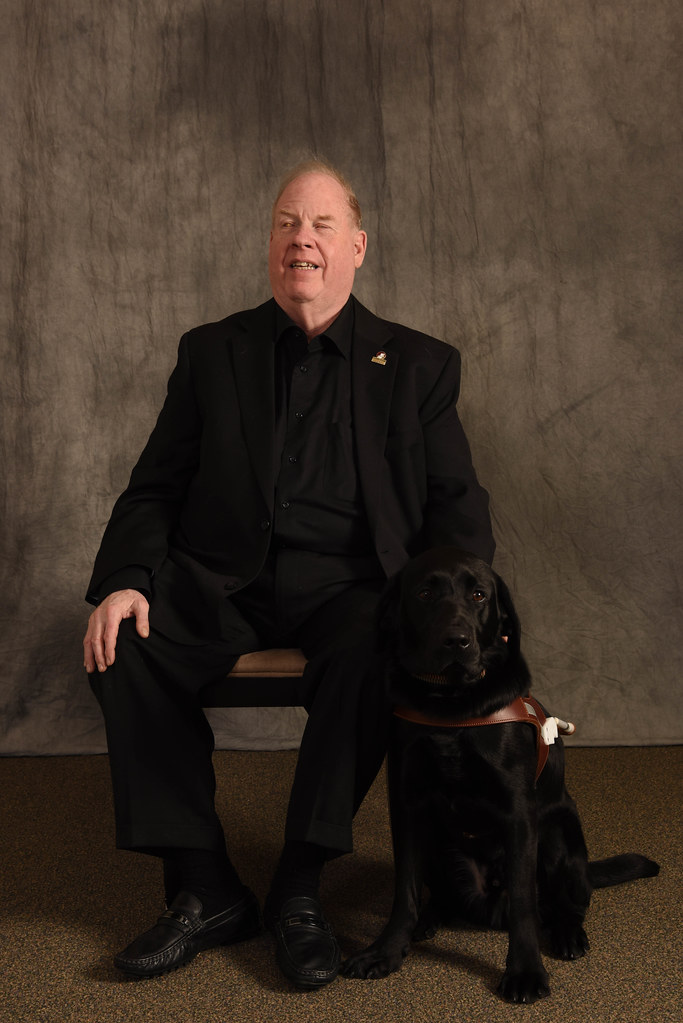
Michael Hingson is a keynote speaker, bestselling author of Thunder Dog, and a survivor of the September 11 World Trade Center attacks. Blind since birth, he brings a powerful and unique perspective on leadership, trust, and resilience in times of uncertainty.
He has spoken to organizations around the world, helping leaders and teams navigate change, build trust, and perform under pressure. His message combines real-world experience with practical insight that audiences remember long after the event ends.
👉 Book Michael Hingson for your next event.