
The Business Case for Disability Inclusion: Driving ROI and Resilience in 2026
What if the very thing your board views as a compliance cost is actually your most untapped engine for growth? Recent data from Disability:IN and Accenture reveals that companies leading in this space realize 1.6 times more revenue and 2.6 times more net income than their competitors. These aren’t just social metrics. They’re the foundation of a robust business case for disability inclusion. You’ve likely felt the frustration of fighting for a DEI budget when leadership only sees legal risk or social obligation. It’s time to shift that perspective from a burden to a competitive advantage.
I’ve learned through decades of leadership, including the morning I spent navigating the 78th floor of the World Trade Center, that true resilience is built on trust and interdependence. Inclusion isn’t about charity; it’s about expanding our collective perception. In this article, you’ll discover how disability inclusion transcends simple check-the-box exercises to become a primary driver of corporate revenue and organizational trust in 2026. We’ll examine the latest ROI data, provide practical frameworks for inclusive leadership, and outline the actionable steps you need to move from a culture of compliance to a culture of high-performance innovation.
Key Takeaways
- Understand how leading organizations achieve 1.6 times more revenue and double their economic profit by mastering the business case for disability inclusion.
- Learn to shift your organizational mindset from viewing disability as a compliance cost to recognizing it as a unique characteristic that drives innovation.
- Discover why adaptive thinking and interdependence, lessons forged in the World Trade Center, are essential for corporate resilience in 2026.
- Gain a 5-step framework to transition your DEI initiatives from “box-checking” to a culture-first approach that attracts top talent.
- Explore how digital accessibility and specialized training serve as tools for illumination, allowing your entire team to perceive and solve problems more effectively.
The Economic Imperative: Why Disability Inclusion is a Strategic Multiplier in 2026
True leadership isn’t just about managing what we can see. It’s about perceiving the potential that others overlook. The “Disability Inclusion Imperative” is no longer a peripheral HR initiative. By 2026, it has become a central pillar of high-performance corporate strategy. When companies lead in this area, they don’t just “do good.” They perform better. Research shows that organizations championing these values realize 1.6 times more revenue and double their economic profit compared to their peers. This isn’t a coincidence. It’s the result of building a culture that values interdependence and adaptive thinking.
This financial growth stems from what I call the “Innovation Dividend.” When you hire someone who has spent their life navigating a world not built for them, you’re hiring a master of adaptive problem-solving. This unique perspective sparks new product ideas and streamlines processes in ways traditional thinking cannot reach. The business case for disability inclusion is the strategic intersection of elite talent acquisition and massive market expansion.
Key Takeaways: The Hard Numbers of Inclusion
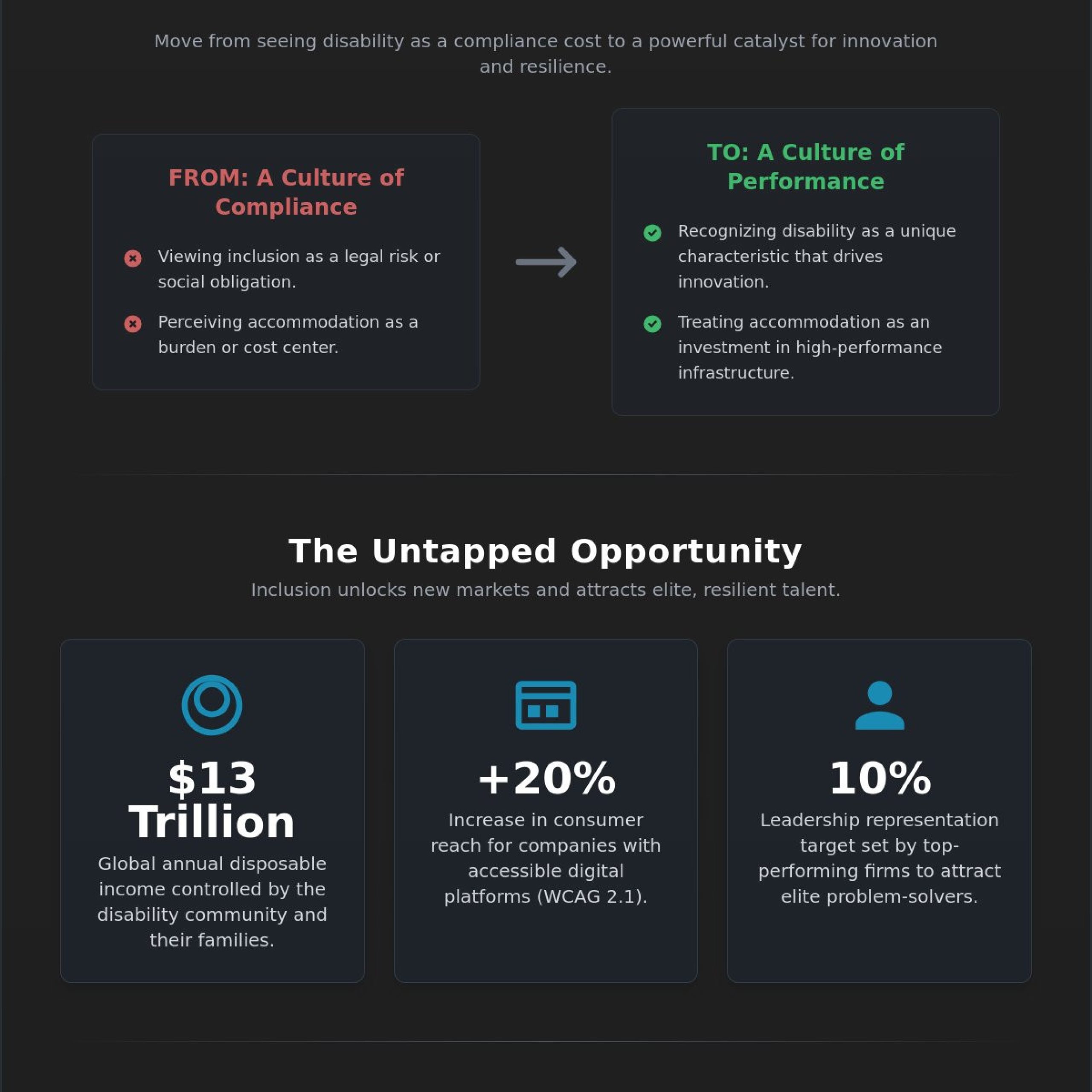
To understand the scale of this opportunity, we must look at the data driving boardrooms in 2026. The shift toward a more inclusive legal framework for disability inclusion has highlighted a massive, underserved market. Consider these benchmarks:
- Purchasing Power: The disability community, including their families and friends, controls over $13 trillion in global annual disposable income.
- Leadership Representation: Top-performing firms in 2026 have set targets for 10% disability representation in management to mirror the global population.
- Market Reach: Accessible digital platforms now reach 20% more consumers than those that ignore WCAG 2.1 standards.
Why This Matters for Leaders: Beyond the Spreadsheet
While the ROI is undeniable, the true value lies in organizational resilience. Inclusion reduces turnover and increases employee engagement across your entire workforce. When a team sees their leader value every individual’s unique characteristics, trust flourishes. This trust was the invisible thread that allowed my guide dog, Roselle, and me to lead others down 78 floors on 9/11. As a keynote speaker, I often share that when you remove the fear of “different,” you unlock a level of loyalty and stability that no spreadsheet can fully capture. Inclusive leadership isn’t just a policy; it’s a commitment to a future where every person’s light can shine.
Beyond Compliance: Building Resilience Through Cognitive and Physical Diversity
When we embrace the Art of Living with No Limits, we stop seeing disability as a deficit to be managed. We begin to see it as a characteristic that informs a person’s unique way of interacting with the world. This shift is vital for any leader building a business case for disability inclusion. It moves the conversation from “what does this cost?” to “how does this strengthen us?” Challenging the stigma requires us to reframe the cost of accommodation. It isn’t a burden. It’s an investment in infrastructure, much like a software upgrade that allows your most brilliant minds to function at their highest capacity.
My time in Tower One on 9/11 was a masterclass in this philosophy. As Roselle and I led my colleagues down 1,463 stairs, we weren’t just surviving. We were executing a plan built on years of preparation and a profound level of interdependence. In high-stakes environments, the myth of the “self-made” individual falls away. What remains is the Trust Framework. This framework recognizes that we are at our most resilient when we rely on one another’s diverse strengths. Inclusive cultures don’t just feel better. They are objectively better prepared for crisis management because they have already practiced the art of adaptation.
Lessons from Tower One: Trust as a Business Asset
The bond between Roselle and me illustrates the pinnacle of team trust. We functioned as a single unit, each of us aware of the other’s capabilities and needs. This level of interdependence is the secret to high-performing teams. When your culture is inclusive, you’ve already built the muscles of trust and adaptation. You’re ready for the unexpected. If you’re looking for a keynote speaker who can bring these tactical lessons to your next event, the focus should always be on how trust serves as your greatest business asset.
Fostering an Unstoppable Mindset
Fostering an Unstoppable Mindset means learning to see beyond the physical. It allows leaders to identify hidden talent in places their competitors are too afraid to look. It requires a discipline that looks past labels to find the human potential beneath. True vision is not a function of the eyes, but a discipline of the mind. By cultivating this perspective, you ensure your organization doesn’t just survive the next shift in the market. It leads it. To hear more about these strategies, you can explore the Unstoppable Mindset podcast where we dive deeper into the intersection of leadership and perception.
Implementing the Business Case: Strategies for Inclusive Leadership
Transitioning from a compliance-first mentality to a culture-first approach requires more than a policy update. It’s a fundamental shift in how an organization breathes. To truly realize the business case for disability inclusion, leaders must move beyond minimum legal requirements and integrate accessibility into the very fabric of their operations. This transformation begins with a structured framework designed to normalize adaptive living and interdependence. It’s about moving from a checklist to a heartbeat.
Execution requires a deliberate roadmap. First, audit current cultural barriers through specialized accessibility consulting. Second, prioritize executive storytelling. When leaders in the C-Suite share their own experiences with disability or caregiving, they dismantle the stigma of “weakness” and replace it with a narrative of resilience. Third, standardize adaptive tools as universal equipment. Fourth, invest in inclusive leadership training that teaches managers how to focus on outcomes rather than methods. Finally, track progress through human-centric metrics that reflect real growth and trust.
The Roadmap to Corporate Accessibility
Technology should be a bridge, not a barrier. Investing in adaptive technology training ensures your team can perceive opportunities others miss. Tools like JAWS screen readers shouldn’t be treated as “special” accommodations. They’re high-performance tools that allow brilliant minds to contribute. When these tools are standard corporate equipment, you send a clear message that every voice is expected to be part of the conversation. For a deeper dive into these strategies, explore our Corporate Accessibility: A Strategic Guide.
Measuring Success: Metrics That Matter
Numbers tell a story, but they must be the right numbers. Tracking self-identification rates reveals the level of trust within your culture. When employees feel safe to share their characteristics, your data becomes a true reflection of your organizational strength. Monitor the career mobility of disabled professionals to ensure the path to leadership is clear and illuminated for everyone. This data provides the evidence needed to prove that inclusion is a driver of long-term stability.
This organizational shift often needs a spark to begin. A powerful narrative can break through the noise of daily operations and inspire a new way of perceiving potential. If you’re looking for a keynote speaker who can help your team navigate uncertainty, build trust, and lead through change, Michael Hingson brings a perspective that few others can offer.
Illuminating the Path to Inclusive Resilience
The path to a resilient future isn’t paved with checkboxes. It’s built on a foundation of trust and the courage to perceive beyond our limitations. We’ve explored how the business case for disability inclusion is anchored in undeniable economic growth and superior net income. Yet, the true value lies in the Innovation Dividend. This occurs when we value every team member’s unique characteristics rather than focusing on their perceived barriers. By moving from compliance to a culture of interdependence, you prepare your organization to navigate any crisis with the same clarity I found on the 78th floor of the World Trade Center.
True vision requires a discipline of the mind. As the New York Times Bestselling Author of Thunder Dog and a 9/11 survivor, I’ve spent my career helping global leaders redefine what’s possible. Whether through my keynote presentations or the Unstoppable Mindset Podcast, my mission is to guide you toward a more inclusive and prosperous future. If you’re ready to transform your leadership culture, I invite you to book Michael Hingson for your next leadership event or DEI conference. Let’s work together to build a team that sees no limits.
Frequently Asked Questions About Disability Inclusion and Corporate Performance
What is the primary business case for disability inclusion in 2026?
The business case for disability inclusion centers on the strategic advantage gained by tapping into a global talent pool and a consumer market that controls over $13 trillion in annual disposable income. It’s no longer just a legal or moral obligation. It’s a fundamental requirement for companies that want to lead in a competitive, globalized economy where diverse perspectives drive market expansion and brand loyalty.
How does disability inclusion improve company ROI?
Inclusive companies achieve 1.6 times more revenue and 2.6 times more net income than their less inclusive peers. This financial performance is driven by higher employee engagement, lower turnover rates, and the “Innovation Dividend.” When you hire people who’ve mastered adaptive living, you bring in experts in creative problem solving who can develop products and services that resonate with a wider range of consumers. This is the core of the business case for disability inclusion.
Can disability inclusion help with crisis management and organizational resilience?
Yes, because inclusive cultures are built on a foundation of trust and interdependence. My own experience navigating the 78th floor of the World Trade Center showed that teams practiced in adaptation and mutual reliance are better equipped to handle high stakes crises. Resilience isn’t just about bouncing back. It’s about having the diverse cognitive and physical perspectives needed to see solutions that others might miss during a storm.
What are the common barriers to disability inclusion in the workplace?
The most significant barrier is the perception of disability as a compliance cost rather than a strategic asset. Many leaders still view accommodations as a burden instead of an investment in infrastructure. This fear often stems from a lack of practical frameworks for inclusive leadership and a failure to normalize adaptive tools like JAWS screen readers as standard corporate equipment. Breaking these barriers requires a shift in perception from limitation to characteristic.
How do I start building a more inclusive culture for my team?
Start by auditing your current cultural barriers through specialized accessibility consulting and standardizing adaptive technology for all employees. Leadership should engage in executive storytelling to normalize disability in the C-Suite and dismantle the stigma surrounding characteristics that are often mislabeled as limitations. Bringing in a keynote speaker who has lived these lessons can serve as the catalyst for this deep organizational shift toward trust and transparency.
Article by
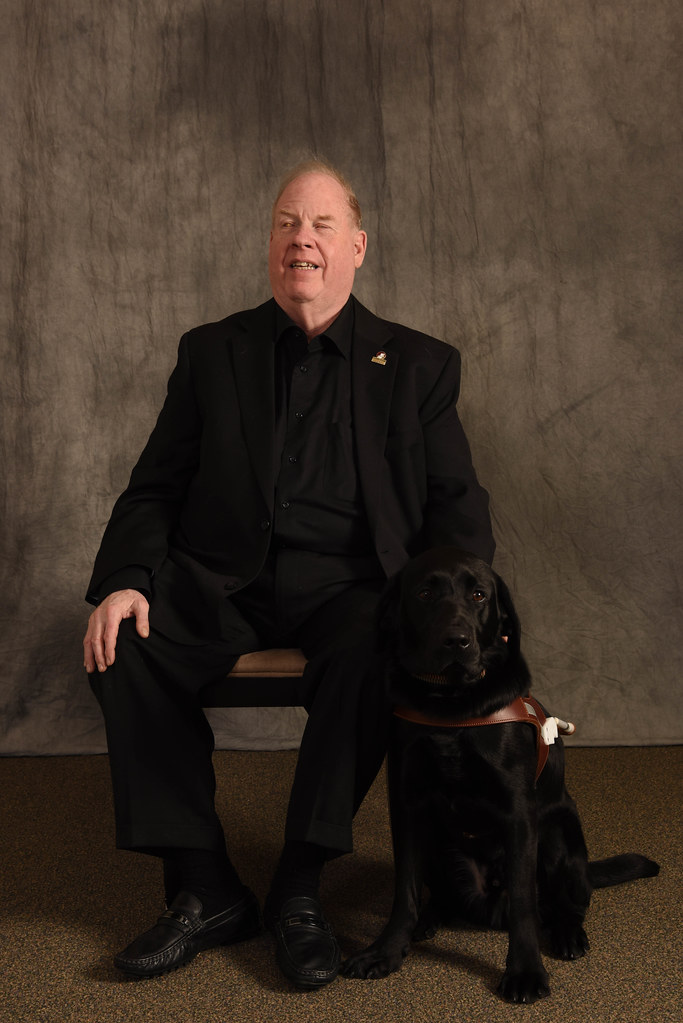
Michael Hingson
Michael Hingson is a keynote speaker, bestselling author of Thunder Dog, and a survivor of the September 11 World Trade Center attacks. Blind since birth, he brings a powerful and unique perspective on leadership, trust, and resilience in times of uncertainty.
He has spoken to organizations around the world, helping leaders and teams navigate change, build trust, and perform under pressure. His message combines real-world experience with practical insight that audiences remember long after the event ends.
👉 Book Michael Hingson for your next event.