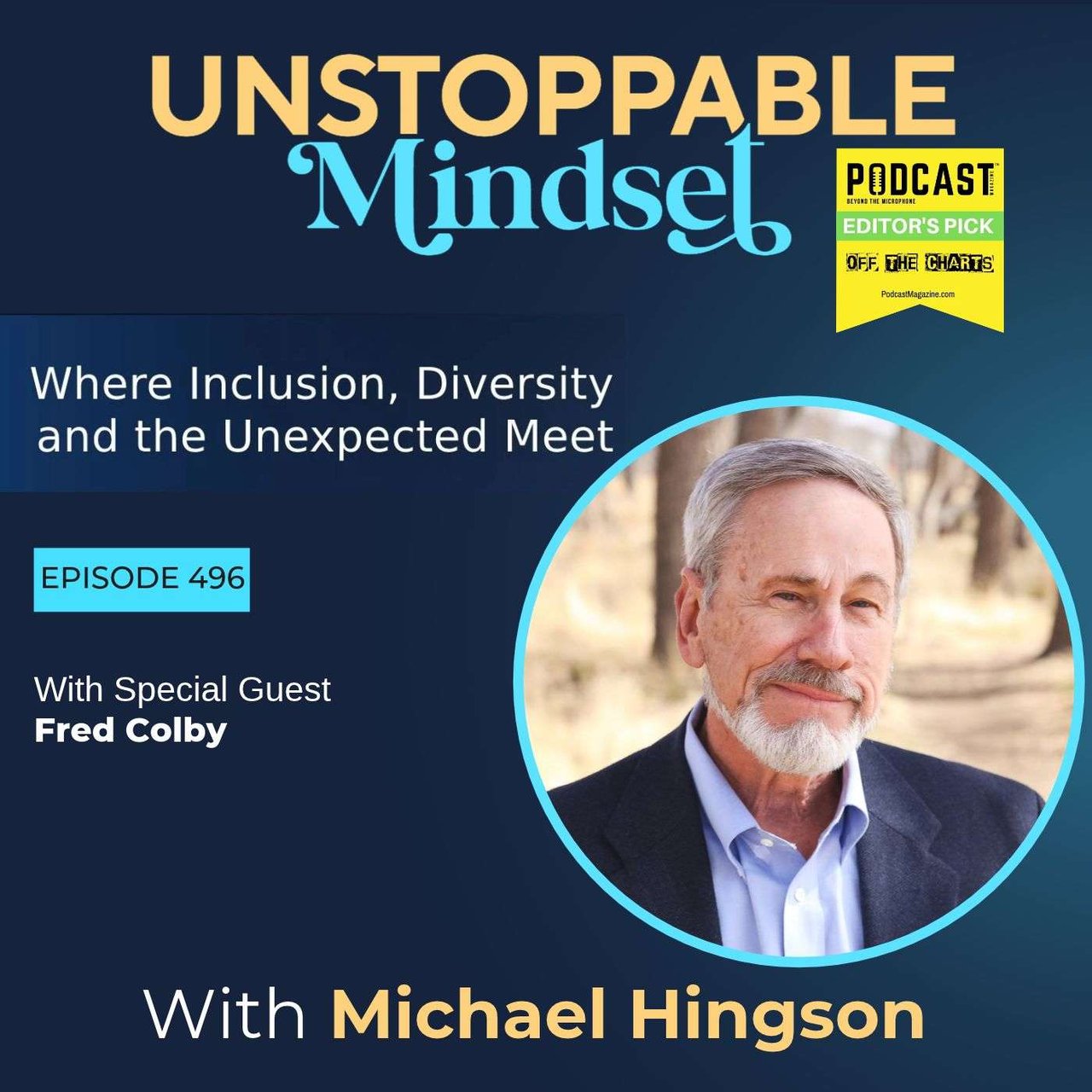
Episode 496 – Life After Loss: An Unstoppable Journey Through Grief with Fred Colby
How do you move forward after losing the person you’ve shared most of your life with? My guest, Fred Colby, knows firsthand the challenges of losing a spouse after 45 years of marriage. Following a successful career in nonprofit consulting, Fred found a new purpose in helping widowers navigate grief and rebuild their lives. His own search for answers led him to write Widower to Widower: Surviving the End of Your Most Important Relationship. Fred and I share our personal experiences with loss and discuss grief counseling, men’s emotional health, loneliness, dating after loss and the importance of human connection. We also talk about the difference between moving on and moving forward. I believe you will find our conversation encouraging, especially if you or someone you know is learning to live with loss while finding joy and purpose again.
Highlights:
00:47 – The inspiration behind writing Widower to Widower.
22:51 – How personal loss can deepen empathy for others.
37:36 – The unique challenges men face when navigating grief.
45:33 – Moving forward without moving on from a loved one.
48:36 – Rediscovering life, relationships and joy after loss.
59:39 – Practical advice for widowers navigating the grieving process.
About the Guest:
“If there is a book you want to read, but it hasn’t been written yet, then you must write it.” Toni Morrison
Fred Colby was born in Seattle, Washington where his father, Ralph Colby, worked as an engineer for Boeing after WWII. Following his father’s death in 1955 Fred’s family moved to San Diego to live with his maternal grandfather.
Fred grew up in San Diego, attending La Jolla High School and Mesa Community College. After marrying Theresa in 1970 he completed his college education at Claremont Men’s College in Claremont, California, graduating in 1972.
Five years later, Fred and Theresa welcomed their first of two daughters (Jennifer and Charlene) into their family. Fred embarked upon non-profit and political careers in the areas of fundraising and marketing. He worked in arts, education, and social service agencies as a Development Director, Director of Administration, and Executive Director. In the 90’s he launched Colby Consulting, which enjoyed a 15-year run serving dozens of San Diego area nonprofits.
His political career led him to work on state-wide and local initiatives, and candidate campaigns. He was elected to the San Diego Community College Board of Trustees in 1988, where he served for eight years in what was his most enjoyable and rewarding role.
Fred and Theresa relocated to Colorado in 2008 after their daughters and their growing families moved to Fort Collins. Theresa passed in 2015 after a year-long bout of medical treatment for uterine cancer. Having written thousands of pages of newsletters, grant applications, letters, and opinion pieces, Fred felt comfortable applying his writing skills to his first book, Widower to Widower.
This book is his way of passing on his lessons-learned and research to help other widowers suffering through this hell-on-earth experience.
Ways to connect with Fred**:**
Website: https://www.fredcolby.com/
Facebook: https://www.facebook.com/FredColbyAuthor
LinkedIn: https://www.linkedin.com/in/fredcolby/
Widowers Support Network: https://widowerssupportnetwork.com/
National Widowers Organization: https://nationalwidowers.org/
About the Host:
Michael Hingson is a New York Times best-selling author, international lecturer, and Chief Vision Officer for accessiBe. Michael, blind since birth, survived the 9/11 attacks with the help of his guide dog Roselle. This story is the subject of his best-selling book, Thunder Dog.
Michael gives over 100 presentations around the world each year speaking to influential groups such as Exxon Mobile, AT&T, Federal Express, Scripps College, Rutgers University, Children’s Hospital, and the American Red Cross just to name a few. He is Ambassador for the National Braille Literacy Campaign for the National Federation of the Blind and also serves as Ambassador for the American Humane Association’s 2012 Hero Dog Awards.
https://www.facebook.com/michael.hingson.author.speaker/
https://www.youtube.com/user/mhingson
https://www.linkedin.com/in/michaelhingson/
Thanks for listening!
Thanks so much for listening to our podcast! If you enjoyed this episode and think that others could benefit from listening, please share it using the social media buttons on this page. Do you have some feedback or questions about this episode? Leave a comment in the section below!
Subscribe to the podcast
If you would like to get automatic updates of new podcast episodes, you can subscribe to the podcast on Apple Podcasts or Stitcher. You can subscribe in your favorite podcast app. You can also support our podcast through our tip jar https://tips.pinecast.com/jar/unstoppable-mindset .
Leave us an Apple Podcasts review
Ratings and reviews from our listeners are extremely valuable to us and greatly appreciated. They help our podcast rank higher on Apple Podcasts, which exposes our show to more awesome listeners like you. If you have a minute, please leave an honest review on Apple Podcasts.
Transcription Notes:
Michael Hingson 00:04
What if the biggest thing holding you back isn’t what’s in front of you, but rather what you believe? Welcome to Unstoppable Mindset, where inclusion, diversity, and the unexpected meet. I’m your host, Michael Hingson, speaker, author, and advocate for inclusion and possibilities. This podcast explores how the beliefs we carry shape the way we live, lead, and connect with others. Each week, I talk with people who challenge assumptions, face adversity head-on, and show what’s possible when we choose curiosity over fear. Together, we focus on mindset, resilience, and the small shifts that lead to meaningful change. Let’s get started. Hi, everyone, and welcome to another episode of Unstoppable Mindset. I am your host, Mike Hingson. Our guest today is Fred Colby, who has written a book that I find an interesting title. It’s a very interesting title, Widower to Widower, and we’ll get to that. But I have to start with something else, Fred. That that you said, you quoted something from Toni Morrison. If there’s a book you want to read and hasn’t been written yet, you must write it by Toni Morrison. Tell me about what prompted that for you.
Fred Colby 01:35
Well, I has shortly after my wife passed, I was going through a very painful grieving process, and as I went through it, I I kept asking questions of my therapist and other people, and nobody seemed to have the answer. And the therapist would go looking for the answers too in all the right places, and still couldn’t come back to me with any answers. So after about three months of doing this, finally she looked at me. She said, “Fred, you might as well just write the book because nobody else has.” So that prompted me to start writing my book, Widower to Widower. And I was after two years of writing and editing and reviewing and putting out one edition and then another edition and then finally the final edition. It was worth the effort because I’ve had a lot of widowers get back to me and tell me how it helped them through this experience.
Michael Hingson 02:30
Well, I can can appreciate that. I had a little bit of time to prepare before my wife passed in 2022, and it it worked out okay, but still, it’s it’s no fun. But as I tell people, I’ve got 40 years of of good memories, and I live in the house that we built. People have asked me ever since. Well, two questions that people ask me all the time. They they stop fortunately, but one was, are you going to move? Are you going to stay there or move? And and my my answer is, I’ve got a 3.95% mortgage rate. Why would I move?
Fred Colby 03:10
Yeah, good point.
Michael Hingson 03:13
And and the other is, are you going to start dating? And my response to that Is basically, I know that wherever Karen is, she’s monitoring me, and if I misbehave, I’m going to hear about it. So I always have to be a good kid. I don’t even chase the girls, but I also point out that they’re not chasing me, so it’s
Fred Colby 03:35
okay. You got to be out there on the track if you’re going to get chased. Yeah, well, you know,
Michael Hingson 03:43
that’s okay. I, you know, if if the right person comes along, it’s going to be because Karen approved her, and so I’m not going to worry about
Fred Colby 03:54
it. Yeah, it’s funny. I eventually met a young lady through my various activities, and and it, we both felt it was about a year after my wife died, about two years after her husband had died, and we were both in a good place. And after we started dating, and we just felt so right, we both remarked, “You know, I feel like my spouse helped with this. Helped make this happen. We both felt that way. It was interesting. Yeah.
Michael Hingson 04:28
So you did you guys get together in a more permanent way? Are you still dating?
Fred Colby 04:32
We we are doing the L A T routine, which if you’ve not heard of it, is a common acronym for living apart together. Okay, and it it’s become very common amongst us older folks who have lost a spouse or divorced or whatever, and you just find it’s more complicated when you’re older to try and get married, make things formal. If you both have kids, you both have these financial situations and homes and things of that nature, and it’s it gets to be complicated trying to figure out how to make it work. And if you’re happy, which we both are and have been for over eight years now, why change it? You know, it’s it’s a great relationship, and I know several people doing the same thing, and younger folks do it as well nowadays. It’s just you know we’re not ready to make that kind of commitment, or you know why do we need to?
Michael Hingson 05:32
Well, if God wants you to, He’ll let you know. Oh
Fred Colby 05:34
yeah, that’s for sure.
Michael Hingson 05:37
But I will you know I will say we didn’t have kids. Karen was in a wheelchair her whole life, and she felt it would be difficult for her to have children because she’d be in bed a good amount of the time she’s pregnant. So we decided that we would. We both decided, and I felt it was more her decision to make. But we both decided we’ll spoil nieces and nephews because they can come and visit, and at the end of the day, we can kick them out, which is you know,
Fred Colby 06:04
yeah, yeah. It it’s really good when you’re both like our age, you know, and got kids who are grown up and adults, and they got kids, and you may or may not love the other ones’ kids and grandkids as much as you love your own for whatever reason, and so it’s it kind of like it’s nice to be able to say come over play with their kids and da da da da, and then say, okay, I’m going home. See you guys later. Have a good day.
Michael Hingson 06:31
Yeah. Well, and we’re basically the same age. You graduated college in 1972,
Fred Colby 06:39
correct?
Michael Hingson 06:40
And so did I.
Fred Colby 06:42
Aha! Where were you at? What college? UC
Michael Hingson 06:45
Irvine.
Fred Colby 06:46
UC Irvine. You weren’t too far from me. I was at Claremont Mechanic College. Yeah, kind of Pomona. Yeah, yeah. That was a great color. I love the collegial environment there. It’s kind of like a Harvard little mini Harvards, you know, all in that kind of beautiful setting and environment that feels like a small college, which they are. But there’s five of them, so you can take courses at all five of them, which is fabulous.
Michael Hingson 07:13
Well, I started at UC Irvine in 1968 when they actually that year was when they had their first graduating class. It was a brand new university. There were only a few buildings now. It’s crazy.
Fred Colby 07:30
Yeah,
Michael Hingson 07:30
there were only like 27, 2800 undergraduate students. Now there are almost 32,000. Scary. Yeah. I went last time I went back was in 2024. I was actually inducted into Phi Beta Kappa into the Mu chapter, which is the chapter at UC Irvine. Okay, and I was inducted in as an alumni member because they formed the organization about the time I was leaving the university. So years and years later, I happened to be interviewed by someone who wrote an article about me, and I happened to mention that Phi Beta Kappa was starting when I was leaving, and so I never got to be a member. And suddenly, I get a call from someone who was one of my professors, basically, gosh, 50 years earlier, she was still teaching at UC Irvine, and she was the historian for Phi Beta Kappa, and she said, “We would like you to come and be an alumni member.” So it’s it’s it’s a full member, but joining after the fact. Anyway, I did, and I went back in 19 or in in 2024, and got to see the university. What a difference!
Fred Colby 08:43
I bet, I bet.
Michael Hingson 08:45
Well, you know, UCI, UC Irvine, the the the acronym UCI really stands for under construction indefinitely. I agree.
Fred Colby 08:53
That’s true of all the UCs. I think. Yeah, they placed the one that’s in Northern San Diego. Now they’ve got one up there. Well, there
Michael Hingson 09:03
is University of California San Diego.
Fred Colby 09:06
Well, that yeah, that’s in
Michael Hingson 09:07
La Jolla.
Fred Colby 09:08
That’s in La Jolla. That’s yeah, UC La Jolla, San Diego. But there’s a new maybe that’s a state college. I’m thinking there
Michael Hingson 09:15
is could be. Well, there is there has been San Diego State for a while, but oh yeah,
Fred Colby 09:21
that’s been there forever. Yeah, but they’ve grown so much they had to open another college up on the northern side of San Diego County. There
Michael Hingson 09:28
you go.
Fred Colby 09:29
Yeah, yeah.
Michael Hingson 09:30
Scary.
Fred Colby 09:30
Yeah, it is growing.
Michael Hingson 09:33
Well, why don’t you tell us a little about kind of the early Fred growing up and all that? Love to hear about that and how that maybe started you off on whatever adventure you started on.
Fred Colby 09:45
Yeah, it always has to. One of the things I I’m always amazed at. I’ll preface my discussion with is that all the things that I did when I was younger, all the jobs I had when I was older, all the people. I met everything. You come up to a point where you’re starting something new, and you look back and you go, “Oh my God, what I learned there 3040, 50 years ago is so valuable to me right now in doing this new job, this new volunteer position, whatever it is, and it’s such a different field, but all that stuff I learned back there is a Longs drugstore floor manager, you know, or a or a publicist or PR guy or a political campaign coordinator. All of those things it all ties together with the things you learn later, and I find that true? So, yeah. When when I was a child, I lived in Seattle. My father had worked in Los Alamos during the war and been a part of that whole process. He was an engineer.
Michael Hingson 10:54
He he didn’t glow in the dark though.
Fred Colby 10:56
No, but unfortunately, he did pass when I was only five or six from the radiation exposure that he had had to do, but he worked at Boeing for a few years before that happened to him. Then we moved to San Diego, and it was a weird year. My mom obviously lost her husband. Her sister lost her husband from after effects of World War II in the Philippines and so
Michael Hingson 11:21
on, and then
Fred Colby 11:22
my grandfather lost his wife. It was like all three of them in one year. So my mom picked up the four of us kids who went and lived. We lived with my grandpa for a while in San Diego in the La Jolla area, and I grew up there. I had a my mom remarried about two, three years later to a wonderful man, and had two more kids. So I grew up with a family of six kids, and it was a great experience. Learned a lot of things, and then I went on and married myself in what would that been in 1970 to Teresa. We were kind of like from the opposite sides of the track and fell in love, and nothing was going to stop us. We had a great 45 year marriage while I lived in San Diego, and then went to Claremont McKenna College, moved back to San Diego. We had our own babies, and lived there. I was active in the community and in the arts, education, social services. Worked on some political campaigns. Quite diverse group. Served on the community college board for eight years, which I I just loved serving on the community college board. I I had myself dropped out of college twice at 18 and 19, and my third try, I went back to Mesa Community College in San Diego.
Michael Hingson 12:50
In San Diego, right?
Fred Colby 12:51
And I had probably the best. I know. I know he was the best professor I had in my whole educational career in political science, and it was right during the Vietnam War, so all the stuff he was teaching us was so relevant and so amazing how much you picked up on because of what you were learning in the class. And then I went on to Claremont McKenna College in part because I’m sure he helped me get into there, and graduated cum laude after having dropped out twice, really going so I was had a great great experience there and ended up I had to that was during 1972. So think back, recession was going then, and I ended up working at Long’s Drugstore as a floor manager. There
Michael Hingson 13:39
you go,
Fred Colby 13:40
and I got bored to death after two or three years. Stuck around for five, and then I got a job as a sales rep for STP Corporation, handling the whole Southern California area below LA. And I did the same for a toy distributorship company, and then I got into politics, helping a campaign by Garamendi, Senator Garamendi ran for the governorship and lost that election by a close margin. He was beat by Bradley in the primary. You might remember Mayor Bradley, right?
Michael Hingson 14:16
Tom Bradley.
Fred Colby 14:17
Yeah, Tom Bradley, and so that kind of got me involved on that side. I started working with nonprofits in fundraising and marketing. I served at every role: director of development, director of administration, and eventually executive director. And I served in those roles for about 15 years. And then I I got fired from a job. I had a job with a nonprofit in the area. I walked in the door on the first day. I said, “Oh man, what was it? What did I do here?” About a year later, I got fired from the job. Now sitting around, going, “What am I going to do now?”. And I had gotten to a point where my faith had kind of got me grounded, and I said, “I’m not going to worry about it. I’m just going to
Speaker 1 15:08
sit here
Fred Colby 15:08
and relax and get my head together, and I’ll be ready to go.” Within 30 minutes, I had a phone call from a nonprofit offering me a job to consult with them. Within a week, I had five contracts with various nonprofits up in the Escondido area in San
Speaker 2 15:27
Diego,
Fred Colby 15:28
and I never looked back. From that point forward, I had 100, 120, even 140% capacity, meaning I worked 50 hours, 60 hour weeks type of thing, and was billing board working with usually two, sometimes three nonprofits at a time, and it was wonderful because I got to work with these wonderful people doing wonderful things, and I was helping them to take that next step. I was huge in doing strategic planning with them, developing their board, developing their fundraising capacity, developing their marketing strategies, things of that nature. And again, it was in arts, education, social services, politics, you name it. I and I just I love doing it, and I did that for another 1520 years before I moved back to Colorado. And that kind of brings you up to date.
Michael Hingson 16:23
Wow, you you mentioned your political science professor and learning all about and learning so much and keeping up with everything that was going on. Did you read? I think it was yesterday that it came out in the news that Country Joe died. You know, Country Joe.
Fred Colby 16:40
Yes, yes, yeah. 1234. What are we fighting for? Yeah. Yeah. Classic that, and of course the oh, going to be going to be going blank. Dylan songs. Oh yeah. Yeah. Yeah. You can’t get better than those.
Michael Hingson 17:00
No. No. That was that was something, but yeah, well, well, things happen. When I first saw the news, it just said Country Joe died, and I went, oh, I bet I know who that is, and it was, yeah, yeah,
Fred Colby 17:15
I didn’t make the connection immediately either until I saw the fish, and I was like, oh, that’s it, yeah.
Michael Hingson 17:21
Well, as soon as I saw Woodstock, then I knew it was the right,
Fred Colby 17:23
you know, the right guy. Right.
Michael Hingson 17:25
Well, you know, you’ve you’ve obviously done lots of of interesting things, and so what are what are you doing now?
Fred Colby 17:36
Well, after when my wife became ill, I when I moved back to Colorado, I thought I was going to retire, and I got bored. So I started working with a group called Basecamp. In fact, I still had their old shirt on me, and setting up a fundraising, marketing, board development strategies, and all of that with just one organization in house, and I love doing it again. I met some wonderful people here in Fort Collins, Colorado, and helped them turn things around. and And then when my wife became a ill a couple years after that, I decided that I was time for me to retire and just give my full attention to helping her through her cancer treatment, she was getting in and getting the, you know, the all the chemotherapy and that kind of stuff, and it was painful time, obviously. But she was a trooper, just kept fighting through it, and I did what I could to make it easier on her. And then we got to a point where actually I took her in for an infusion and a blood infusion. And when we walked out, she was weaker than when she walked in. I knew something was wrong. She had a mild stroke that night. Took her in the hospital, and they came out and said, “We’re sorry to tell you this, but the cancer just spread, and it must have been very quickly because it hadn’t been that long. And so, took her home in hospice care, yeah, which introduced me. This is what they’re about, and she only lasted about another 10 days at home, and I was able to be there with her when she passed, and the children could come. One of the good things we found a group called Caring Bridge. Have you ever heard of them? Yeah, wonderful group where you can. I mean, it seems it’s it’s still an important function because you’re able to like do one email out, and it goes out to all the people you want to go to, and they’re able to feed back to you on whoever’s passing. They’re able to provide love and support for her. So my daughters and I would read her the comments back, and one of the things it did was allowed us to coordinate the support. You know, people wanted to bring food, wanted to bring flowers, wanted to know what they could do, and we coordinated through that. One of my daughters kind of managed that for us. One of her Teresa’s friends did another part of it, and so on and so on. So that helped tremendously, and I could keep everybody informed. And we were able to have people actually come and visit with her a little bit, even though she couldn’t talk. She just her eyes would just light up every time she saw one of her friends walk in the door. And then on the night she passed, as this the weirdest thing, I I knew the time was getting close, and I went up. I said I’m going to go to bed, lie down for a little bit, and I set my alarm for like 30 minutes later because I just didn’t want to leave her alone too long. I woke up in 20 minutes, and I knew instantly. I heard. I could tell by her breathing, even though I was upstairs, I could tell by her breathing that something had changed. So I was able to go down, be with her, put some music on, stroke her arm, let her know I loved her. I take care of the kids. It’s okay for her to go, and she passed that night within maybe 15 minutes of me coming down. So I was grateful I could be there for her and support her through that.
Michael Hingson 21:17
Yeah, I know a lot of the the feelings and things that you’re dealing with, because when when Karen passed, it it was it was strange. She contracted a a very serious bed sore and went into the hospital in late July of 2022, and was there basically a month. They finally kind of cured it, but they didn’t exercise her much or anything like that, and so she came home and just never really was the same. And eventually, just started eating less and less and less. And by by november 7, and she had someone who who came in and helped care for her. And Josie came in on the seventh and said, “Ken, you’re not looking good. We’re going to get you to the hospital.” Well, we got her to the hospital. Ambulance came and got her. And over the next few days, she just kept getting weaker and weaker. And by like Wednesday the ninth or Thursday the 10th, she wasn’t even talking. She could nod her head, and I could ask her questions and did, but even for the last few months before then, it was it was clear that something was going on. And then on Friday the 11th of November, actually later in the evening, I got a call from the hospital, and they said, “Look, she’s on life support. She’s not here anymore. You should let us turn off life support. And I said, well, not until we get the family there. And I made phone calls, and we all got there at about 1115 Saturday. Well, we got there earlier than that, but at 1115, we all agreed that she she wasn’t there, and so they discontinued. And at 12 o’clock, she her her heart just totally stopped. Right, but but you know the the thing is that as I as I said before we started this, she’s monitoring from somewhere, and your wife is as you pointed out as well. And we’ll we’ll do the things that we can, and the most important thing we can do is to honor these people, to honor her, and you know, and I think that’s so important to do. And I’m going to continue to do that,
Fred Colby 23:30
and I think that’s the best way to show love. Yep, yep. And you, one of the things I found after she passed was that I was a lot more empathetic than I had been before. That’s for darn sure. You know, you just you realize all those things that you complain about about what people say to you, and so on. After she passes, you realize, oh, I probably said things just as inane and stupid. Yeah, and I, you know, you’re trying to be sympathetic, but we don’t do a very good job when we haven’t been through it ourselves, right? So you you learn to appreciate when you do run into people who care and are empathetic with you. I mean, I remember, I I remember how desperate I was to have human contact, you know, and to to be acknowledged and loved, you know. And I would go pick up my granddaughters once in a while from the preschool they were at, and the woman who ran was just the sweetest, nicest woman you’d ever want to know, and she wasn’t afraid of me. She would come up and give me a hug and let me know, you know, that they were thinking of me and stuff like that. And that it just made such a difference to have some people like that instead of just the oh, sorry to hear that. Okay. They leave you; they’re gone. So it’s you do learn to appreciate that maybe you weren’t the best at that either before, and you better start making up for it right now, and encourage others to do the same because it it helps so much when you’re going through this to have that kind of support and love.
Michael Hingson 25:20
Well, of course, after she passed, we did a service right at at a church, actually her sister’s church. But then in January of 2023, we did an online celebration of life and invited anybody who wanted to come to be a part of that, and like about 50 people showed up, people that I knew, people that she knew, and we had a great time. And I have that all recorded. Oh, nice!
Michael Hingson 25:52
And so you know, it’s just kind of one of those those neat things. But you know, I think it’s important that we all go through these things, but there comes a time when you’ve got to recognize it that it is not something that you necessarily need to be sad about because the person who has left you has gone to a better place wherever that happens to be, and they’re they’re fine, and you and they expect you to be fine, right? Right. So you know you do have
Fred Colby 26:25
all those memories. You do have all those wonderful memories. Yeah. Yeah,
Michael Hingson 26:29
I’ve got 40 years of memories, which is great. And um, and I have um. Well, we rescued a cat in 2015, and after Karen passed, this cat really decided she liked to yell at me until I came and fed her and stayed with her and petted her while she ate, and even during the night she would walk on me. And the first time she did that, I said, “Stitch, I will get up once during the night and pet you while you eat, but you can’t double dip. You don’t get more than once a night.” And you know what? She’s really stuck to that. I can’t believe it, but I do believe it. It’s amazing.
Fred Colby 27:04
That’s right.
Michael Hingson 27:05
Yeah, once is all you get a night, and and she deals with that, so it’s pretty cool. But you know, Karen was a later sleeper than I, partly because a lot of the work that I did was working like from the West Coast in part with the East Coast, and actually for a while when we lived, we were living in Mission Viejo, and I had a job down in Carlsbad. Right, and so for about so for about six months, Karen drove me down at five in the morning, and then she came back up to Mission Viejo, and I took a bus home, but then we eventually moved down and we moved to Vista.
Fred Colby 27:44
Okay,
Michael Hingson 27:45
so so I know Escondido and all that pretty well, right? And so we we lived there, but it was fun and a lot of good memories of being in Vista and all that. But you know, things things happen and you move forward.
Fred Colby 28:02
Yeah, we lived in Scripps Ranch area.
Michael Hingson 28:05
Okay,
Fred Colby 28:05
which is right next to the Naval Air Station.
Michael Hingson 28:08
Right
Fred Colby 28:09
back in the day, and the Blue Angels would fly right over our house, and they were so close I could see the face of the guy and wave at him. It was crazy, but it’s a yeah, it’s a beautiful area. I love San Diego, but I have to say, it when I moved there as a child, there’s 500,000 people in the entire county. Yeah, now over 3 million, and the roads are just crazy. And had
Michael Hingson 28:37
a
Fred Colby 28:38
fire that came within a block of our house, and that was the time my wife turned to me and said, “Okay, even though she was born and bred in San Diego, she said I’m ready to move.” So we moved to Portland for three years, which was great until we moved to Fort Collins. Then,
Michael Hingson 28:54
so what got you to Fort Collins?
Fred Colby 28:56
Well, I got two daughters, and one of them got married to a gentleman who worked for the Department of Agriculture here in Colorado. He got the job here, so they moved here. The other daughter visited her and said, “Oh, this is great. Her husband flies all over the world, so it didn’t matter where. In fact, it’s better flying out of Denver because it’s centrally located for all the U.S. places he goes. So they moved here, and then the first grandbaby came. We said, “Okay,
Michael Hingson 29:24
okay, there’s a message here somewhere.”
Fred Colby 29:26
Yeah, yeah, yeah. And it’s it’s been great. It’s been what?
Michael Hingson 29:29
What does he do that he flies all over?
Fred Colby 29:32
He works for a group that handles systems, ticket sales, management things, Functions, fundraising records, and things like that for major nonprofits all over the world, like the well Kennedy Center. Yeah, whether that’s still happening, I don’t know. But but like the New York City Opera and San Diego Zoo, and man, it’s all all over the world, and they have. People work for them all over the world, and he he kind of manages it all. He he really loves it. He does a great job.
Michael Hingson 30:07
San Diego Zoo is a great place. They’ve got this new area called Elephant Valley. Have you heard of that?
Fred Colby 30:12
No, I have. Elephant
Michael Hingson 30:14
Valley is a 13-acre area where they have elephants. Okay, they’ve they’ve created an environment that’s their environment, so I’m hoping one of these days I can go down there and and somehow inveigle somebody into letting me talk to an elephant. I think that would be fun.
Fred Colby 30:29
Yeah, that’d be fun, and you could you could pull the old trick about feeling the different parts of the elephant and figure out what. Yeah, except I know what it is, though. Yeah, that’d be cheating. Yes, it would be. Yeah.
Michael Hingson 30:43
Well, I keep telling people when they come on the podcast from Australia that I hope somebody will one of these days invite me to come to Australia to speak because I’ve been to New Zealand, but I’ve never been to Australia, and I want to meet a kangaroo.
Fred Colby 30:55
There you go. I would love to get to New Zealand. I’ve heard my son-in-law goes there.
Michael Hingson 31:00
Oh, it’s great pass to go in Australia
Fred Colby 31:01
at least once a year, if not more, and he loves it. Yeah,
Michael Hingson 31:05
yeah, New Zealand. I absolutely enjoyed New Zealand, and I know I would enjoy Australia as well. But they don’t have kangaroos in New Zealand, so I’m going to have to do that in Australia. So we got to get there.
Fred Colby 31:16
Yeah, just make sure when you get close to them that they know you’re coming. Oh yeah, they’ll they’ll punch you out. You know. Yeah,
Michael Hingson 31:23
they will. I understand. Yeah, I well, I’d want somebody to provide a proper introduction.
Fred Colby 31:29
Yeah, yeah.
Michael Hingson 31:31
Seems only fair, but but you know, there there’s so many. You know, life is an adventure anyway, and I think it’s it’s so important to treat life as an adventure. What was your favorite job? You had a lot of different consulting and other kinds of jobs. What was your favorite? Yeah.
Fred Colby 31:49
Well, I’d say there’s two. One was the community college board, which was actually a paid position, believe it or not. And the other was the consulting. I loved the consulting. I had two or three clients at a time, and every six months to a year, I they were usually six month to 12 month contracts, and I would usually finish up on time. And it was like, as within a week before that contract had ended. Somebody would call me and say, “Fred, can we hire you to come in and do X, Y, Z?” And so I never had any downtime. I loved it, except for vacations that I purposefully took. But it worked out really well. And I, like I said, I met so many wonderful people that had founded and started some of these nonprofits that did wonderful things from Rainbow Children, who created a childcare center in the middle of the mostly black community and minority communities, and did wonderful things. In fact, she got invited by Clinton to come back and speak in Chicago. She was on a stage with Clinton and seven, eight other major nonprofit leaders as examples of what you know what we can do to improve our communities and and some of the initiatives that Bill Clinton was doing at that time. And it was I got to go to be there with her and coach her through it a little bit and everything. It was a wonderful experience, and I had so many experience. I met Mikhail Baryshnikov, and Rudolph Nureyev, and Martha Graham, and all these great dancers and musicians, Merce Cunningham, and and so on. And I and I worked with groups that Provided therapy counseling for families and children that were going through tough times. I helped a nonprofit that called trying to remember his name, drawing blind. Anyway, but they they served homeless children and women at Serenity House. That was the name Trinity House. Okay, yes, and they, I helped them to buy a hotel with support from the county and the state. We built a village of eight homes, and we provided all kinds of programs. They had bought a childcare center, got it up and running. I mean, these were things. Yeah, what wonderful, fun things to do, you know, to have such an impact. And then when I was done, I’d move on to the next nonprofit and and do some things with them. It was so I kind of introduced all these different things. Learned. I had people from immigrants from Africa contact me to help them get a grant to start a community center in their community in Middle San Diego, down in the Hillcrest area, and yeah, how how often you get a chance to meet such a diverse group of people and get to do so many different things, and feel good about it when you finish it because you help them go to that next step. Yeah,
Michael Hingson 34:58
well, it’s it’s so fun. Do I after September 11th, I was invited to come out to California and be the public spokesperson for Guide Dogs for the Blind in San Rafael, and that was my wife Karen. Always wanted to come back to California. She was a native. She didn’t want to stay in New Jersey, and you know we we won’t we won’t say that the terrorists listened to us and they got us back to California, but nevertheless we we got back to California, and so I learned a lot about nonprofits working there for basically six years, almost six and a half years, which was which was fun, but I’ve also served on on boards. I’m on, for example, the board of the Colorado Center for the Blind in Littleton, which is an organization that teaches people about how to be blind, and it’s a nine-month, primarily nine-month residential program, and there’s a shorter version of it in the summer. But
Fred Colby 35:56
it is
Michael Hingson 35:56
so much fun to to do things that really help and to know that people recognize that you’re you’re helping to help, and and appreciate it that way. It’s just so much more fun than just doing something just cause.
Fred Colby 36:15
Yes, the friendships I built in that night. I still talk to some of those people still 1020, 30 years later. You know, it’s crazy. One of my best friends ended up running a large organization in San Francisco that serves minority communities, the homeless, and things of that nature. They got educational programs, housing programs. You got it all, you know. So it’s yeah, it’s fun when I cross paths with some of them again.
Michael Hingson 36:41
Kept in touch with Bill Clinton at all?
Fred Colby 36:43
No, I cannot say that I did.
Michael Hingson 36:46
I met Hillary after September 11th. We were on Larry King together, so that was the one time that I got to meet her. But that was but that was fun. It was a show with with me, Hillary Clinton, Chuck Schumer, so both senators from New York at the time.
Fred Colby 37:04
Okay,
Michael Hingson 37:05
Lisa Beamer, her husband Todd was the guy who said, “Let’s roll on Flight 93 that they took back in Elvershanksville.” And then the other person who was on the show was Queen Noor from Jordan, and just all wonderful people all the way around.
Fred Colby 37:23
I bet, I bet that was an experience for sure.
Michael Hingson 37:26
Well, you know, I I I wasn’t sure what to expect at all, but after we we had the show, Queen Nor comes over and she said, “I want to meet Roselle.” And the next thing I know, she’s down there on the floor talking to my guide dog Roselle, which was great.
Fred Colby 37:43
That is good. That is good.
Michael Hingson 37:46
Yeah, but but you know, again, what great memories! Well, you wrote. Tell us about the book. What what got you to write it? And and tell us all about Widower to Widower.
Fred Colby 38:00
Okay, I’m holding it up right now so people can see it. Well, let me see. I have to get it just right with the camera. Oh, that’s right. I’m going to have trouble with that. I think you got the image. Maybe you can put it up. But
Michael Hingson 38:13
well, it’ll be there because we’re videoing this, so that’s okay. Okay,
Fred Colby 38:16
it’s widower to widower, surviving the end of your most important relationship, and again, I’ll briefly recap that when I was going in for counseling, my therapist and I would be looking for answers to the many, many questions that I had, and neither of us could find them. They just weren’t out there, and that’s because most of the material that’s been written for widows is for women. It’s not for men, and they don’t address the men-specific issues that we have that crop up. Like what? Oh, certainly the craving for the human touch and the woman’s touch and the sexual issues that pop up are unique to us. Yeah. The other thing is how we grieve. We do grieve differently. I would go to grief groups, and in at Pathways Hospice in my area, and eight out of 10, if not more, of the participants were women, and and I and the other men who attended here and there felt like we just couldn’t raise some of the issues that we were having in a mixed group, in a coed group, and the women seemed to, I don’t know, extend the grieving process longer than the men did. The men were ready to dive in and try and address the grief, find out how to solve it. You know, that’s not to say that always works. It doesn’t, but but that they have a different attitude about it. So I started a men’s grief group at the hospice with the support of the hospice, and. I found a. We found a peer. I became the peer mentor, but we also found a gentleman who could be a professional therapist to guide us through the process. And we started with like three or four guys. But before I left, in a couple years, we had regularly had 14 to 15 guys. So that that helped me with the book as well because I heard a lot of different stories from these gentlemen who participated in it, but I also was doing a ton of research because after the therapist challenged me to write this book, I realized I needed to know a lot more about it. So I did a lot of research of my own and found did find a couple books that were helpful, and lots of articles and things. I just pulled in the information that was relevant and helpful, folded that into the book. But the hard part for me in starting the book, I didn’t know where I was going to start. I’d never written a book before. I’ve written 200 page grant applications. I’ve written newsletters and letters and all kinds of written materials for the various nonprofits I worked for, but I’d never written a book. Well, after my before actually before my wife passed, I had started writing blogs first as a part of the Caring Bridge that we talked about earlier, and then I continued doing that for the year after she passed because I knew some people just wanted to know what the heck was happening with me. How was I adapting? How was I adjusting? What could they do to help me? That kind of thing. And so I had these blogs, and I realized the blogs could be the foundation or the starting point for the book, and I so I they were you know linear in the sense they followed the process that I went through from the very beginning to expecting her death to the end a year after her passing, and so I didn’t have to change that. I worked from each one and then worked out from it. Here’s what I learned through that process. Here’s other examples that I found. Here’s some research that I found on this, like, you know, how I would become suddenly ill. I mean, one of the weird things that happens to you. I don’t know if you had this happen to you, Mike, but early on in the first month or so, I could just feel like somebody had punched me in the stomach, and it would almost knock me over. And sometimes I just that would just force me to my knees or sit down on the stairs, and I just sob, you know. And at first, you’re shocked by it because face it, most guys don’t sob too often. We usually are restrainful and stuff, and we’re not.
Fred Colby 42:45
We’re avoiding exposing our feelings, but you find out you you can’t control it when you’re going through this. So things like that, I had to I had to do a little research. And what was weird about the sobbing was very few tears. Didn’t have a lot of tears. I didn’t. I said this doesn’t make any sense. Why I’m crying? Why don’t I have tears? Well, I found out there’s a reason for it. There’s a certain chemical that men have less of than women do, and that is part of the tear-inducing chemical that causes you to tear up and cry. So I mean, it’s weird things like that that I discovered in the research that I folded into the book. So it just every time I learn something new, I just add it to the book. Like I said, it was between 2016 to 2021. I wrote the original edition, a revised edition, and then I said I got too much other stuff I got to put in here, so I wrote another 50 pages, and and the second editions have been out since 2021, but it was very therapeutic for me as well because I I was writing down my feelings as well as what I learned and everything else, so it’s very therapeutic, and the interesting thing is, I can read some segments of that book now, 10 years later, and I’ll still tear up because
Fred Colby 44:11
they take me back to the moment, you know, of her passing and of the certain things that I challenges I faced and so on. So it just kind of like it’s whether you want to publish a book or whether you just want to write it for yourself or just a journal. It’s it’s very helpful to do that because you you’re getting it down and you can revisit that later when you want to and you’re going. I need to be reminded, you know, what it felt like because that also reminds me about the empathy that I need to be practicing now and things of that nature.
Michael Hingson 44:46
Right. Well, you did a lot of research. You learned a lot. What’s the most surprising thing that you learned during all the research and writing of the book?
Fred Colby 44:58
Well, there were a couple things. I think the depth of the pain shocked me because I’ve never experienced that before. I mean, I’ve lost two fathers, but I never felt that kind of pain when I lost them once as a five-year-old and once as a 20-year-old. There was just nothing like it, and it just surprised me. And I, out of that came the sense that maybe I was going crazy, that I was out of touch with myself, and I. One of the reasons that drove me to go to therapy was the sense that I was going a little crazy and that I didn’t have control over myself. And the going to therapy did definitely help that, but it shocked me, and so that’s one of the first things I tell every widower I meet who’s just starting the process: you’re not going crazy. This is normal. You will get through this. You know, it’s it’s, but you’re in for a rough ride. Probably minimum six months, maybe up to two years. Some guys drag it out longer because they have other issues they’re dealing with. But yeah, all all that was kind of all new to me and and eye opening, if you will.
Michael Hingson 46:13
Yeah, I understand, and and it makes a lot of sense. Yeah, I still think about her all the time, and and you know people have asked me, well, are you gonna are you moving on? And my response is, I’ll never move on from Karen. I’ll move forward, but I won’t move on because Karen is Karen’s got a almost 41 year part of my life. Why would I move on? So many things happen. I will move forward, but she’s part of that, and that’s okay. So that’ll be the way it works.
Fred Colby 46:47
I always tell people, you know, we will forever remember, honor, and love her because she’s 45 years apart of me. When you lose them, I described as you’re being raved in two. You’re almost physically being ripped in two. Half of you’s gone, and you got half left, and you’re going. Who the hell is this guy? Yeah, I don’t know who this guy is who doesn’t have a wife.
Michael Hingson 47:18
Where did he come from?
Fred Colby 47:19
Finishing her sentences. Finishing my sentences, and you know, keeping me in line and helping me set priorities and telling me what to do. I mean, all those things are gone, and you have to, you have to recreate yourself. You have to reinvent yourself, and it is not easy. So you, you, I, I’m a little tough with the guys who come to me for help in the sense I tell them it’s up to you. Somebody don’t get mad because your brother doesn’t call you, or your friend doesn’t call you, or your sister doesn’t call you, or whoever doesn’t call you. Don’t get mad at them. Call them.
Michael Hingson 47:58
Yeah,
Fred Colby 47:58
it’s up to you. You have to reach out because I’ll tell you what. They’re very uncomfortable. They don’t know what to say to you. They don’t know what you want, and they’re afraid to say the wrong thing. That they will offend you, you know, hurt you or whatever. So it’s up to you to reach out to them, and I did that early on. I recognized I had to do that, and I’d reach out to some friends, and they’d meet me for a beer, whatever. You know, we’d just have a chance to chat and talk. And I said, I told them up front, I said, “Listen, I’m still hurting. I may tear up a couple times, but if you don’t mind that, I’d love to get together with you and have a beer and get a pizza or whatever we’re going to do, go to a game, and it was wonderful because they all took that to heart, and several of them regularly contacted me and and would get together with me, and it just made me, it helped me to gradually pull out of that abyss that I found myself.
Michael Hingson 49:01
Yeah, well, and you know, a lot of things happened once you once you lost her. Yes, and I think you’ve talked about it some. How did you adjust overall to your new life? Because it was a new life.
Fred Colby 49:17
Yeah, once I recognized that things changed, you know, and that I had to reinvent myself. I I met a a medical. Well, okay, I got to preface this story with a quick one. About six months after my wife passed, I went to the dentist’s office, and the dental hygienist was a young gal, probably about half my age, and she could tell that something was wrong with me, you know. And I told her I just lost my wife a few months ago. I’m still going through it, and so on. And she started almost tearing up, and she had just got her husband had just left her, and she had a child just by herself and everything. Anyway, we. Had 30 minutes of all this constant commiserating with each other and everything, and long story short, I walked out. I had her phone number, her email address, and I’m driving away from there, and I’m going, Fred, what the hell are you doing? This is a gal half your age, what are you stupid? You you know she’s not going to feel comfortable with you if you get together. This is crazy. So I immediately called my therapist and I went to see her. And fortunately, as as you may have noticed, I have a little sense of humor, and sometimes it’s a weird sense of humor. By halfway through that meeting, we were both just rolling on the floor, laughing at the idiocy and the craziness of this whole situation. And I said, “What do I do?” She says, “Friend, I think you got to start dating.” So I kind of took it to heart, and I went online. I got on the dating services. I met a a gal who was just a little bit younger than me, and she had just lost her husband a couple years ago as well. And great relationship. We had a great time, and but she got me into a group called the Breakfast Club, which is part a part of the Meetup.com, which has 1000s of groups around the country doing everything from hiking to dancing to going to the movies to going out for dinner, you name it. And but through this Breakfast Club, I met quite a few people in my age group who were single. It was all singles, 55 and up, and I started going out snowshoeing, hiking, cross-country skiing. I mean, you name it. It was is because the group all had this different people who had different interests, and they would put it up and say, “Hey, who wants to go hiking with me? And four or five, six of us would sign up, and I went on two, three-hour cross-country ski trips, which I’d never even attempted before. And it was great experience. I met a lot of friends, and eventually I met Karen, my my Karen, a year later. And we’ve been together for eight years now. Is like I said, a living apart together arrangement. So yeah, it was a it was an interesting experience.
Michael Hingson 52:27
Well, outside that’s what
Fred Colby 52:28
got me out there. That’s what got me out there.
Michael Hingson 52:30
Well, outside of the dental hygienist, what was the biggest surprise that you experienced during the first year after you you lost her, lost your wife?
Fred Colby 52:41
Oh, as I met other women, particularly the the the two that I was closest to during this time, and Karen being the second one, I was shocked at how I felt in dating women again. I it literally felt like you were going back to being an 18-year-old, 16 to 18-year-old. You were nervous. You were constantly criticizing yourself for why did I say that, or things of that nature. I mean, it was just so weird. And then if you got emotionally involved, I mean, it was like being a kid, all head over heels for somebody again. I was thinking, I’m friggin’ 65. How can I feel this way? Well, you do, and it’s kind of a surprise. It happens. It happens. It was. It was good for me. You know, it was good for me. I mean, it was also very stressful. You may or may not have experienced this, Mike, but when I was early on through my grieving process, and especially when I started dating again and stuff, because of all the anxiety and the fears, the second guessing, and everything, I mean, I was lucky if I was getting two or three hours sleep a night. It was it was not not good and not healthy, and I eventually had to, you know, started taking some melatonin to help me get to sleep a little better. But there were some weird side effects like that that you just do not anticipate.
Michael Hingson 54:14
What was the biggest change that you made?
Fred Colby 54:17
Oh, well, I think you know I’m 45 years, so like many men who’ve been married 20 years plus, my wife and I had fallen into a routine. So pretty much did the same things. You know, we’d go to a movie, we’d stay home and watch a show, we’d go out with the same friends for a meal with the kids, and you know, and so I think the biggest surprise was just I found out you can do whatever you want to do now. Yeah, you kind of like at first you feel guilty about it, but then you get into it and you start going, “Well, this is kind of nice. I don’t have to schedule with anybody when I’m going to go out and go on a hike with a couple friends. I don’t have to worry about.”. About somebody being home alone when I’m going snowshoeing or whatever is it was kind of a freeing type of thing in a weird way, and so I tried things I had never tried before. It was it was it was great.
Michael Hingson 55:13
Yeah, well I know for me, I I since I did a lot of traveling for for business and so on, I was somewhat able to to really learn fairly quickly about being alone, and also again for the last couple last couple three months that Karen was alive, she was mostly just on her bed, and so I had to learn to be independent anyway. But for me, what I started to do was to just get up earlier, but go to bed earlier. So I I like to get eight hours of sleep, and I do that. And and I but I but I do it and get up at like 430 in the morning, and and I have a couple of hours to slowly move around and have breakfast and all that. So I’m in my office by about 630, and that works out really well. But I also know that if if there’s ever an issue, and I have to change that routine. I can do it. I’ve just always been pretty flexible, so it it works out.
Fred Colby 56:26
Yeah, yeah.
Michael Hingson 56:28
So, what was it like during the pandemic for you?
Fred Colby 56:32
Oh, that was weird, wasn’t it, for all of us? I know it was interesting because I at that point had moved into a condominium. I was living there, and I recognized how lonely it was for everybody, and how I thought, oh my God, there’s got to be a lot of widowers out there who are going through this awful experience of becoming a widower, and the grief and everything, and not being able to go out to anything for help can’t go to the grief groups, can’t go to a therapist, can’t do this, can’t do that. So I started a national online widowers group because Zoom had just started operating. I discovered I said I can do this, so I set it up on Zoom, and I’d have a monthly meetings with a group of guys, and it ended up being about I think we had maybe 12 guys at the max, and normal attendance was around eight or so. And they really grew to be friends with each other, and to like each other, and to exchange support for each other. And it was it was fabulous. They they all appreciated it so much. I did that for two full years through the pandemic, and it helped me too because that was my modus operandi. I had to be out there helping people in some way, so it was great to be able to do that. And I learned a lot from them too.
Michael Hingson 57:50
Well, for me, so when the pandemic started, Karen and I just decided to lock down. I had been in New York and actually flew out from New York. After delivering a speech, I flew out on the sixth of March, which was good because they locked down the city soon. I I was going to go out that afternoon, but I had heard about the the guy at the synagogue who caught COVID and other things like that, and I had spoken the night of the fifth. So I ended up being on an early flight out on the morning of the sixth, and I’m I’m glad I did that. But I got home, and Karen and I just locked down, and we had each other. We we we always like to talk to each other anyway, so it was good. And occasionally I could do a Zoom speech, but there were other things that happened on Zoom, and it and it worked out really well. Kept lots of cans of ice all around, and when mail came and packages came, we sprayed them and all. But you know, but even through all of it, and I’ve told this story a few times. But my favorite story about the pandemic was we had to go to the bank to deposit some money one day, and Karen, because of her wheelchair issues was much more prone to if she ever got sick, it was going to be a lot more serious. So she stayed in the car, and I went in. I didn’t even take my guide dog; I took my white cane. So I walk into the bank, and I went. I got to have some fun. I’m wearing a face mask, of course. I walk up to the counter when it’s my turn, and the the teller said hello. And they mostly all know me anyway. But I said, “Don’t you think it’s strange how nowadays a person can walk into a bank wearing a mask, come up to the counter where the teller is, and then I held up my cane and say, ‘This is a stick up, and she cracked up, and and eventually the manager came over. He said, “We haven’t had so much of a laugh in such a long time, but but you know you gotta you you gotta recognize that you can either be big.”. Or not, and I I just have always chosen not to be, so I work at it. But
Fred Colby 1:00:05
yeah, me too.
Michael Hingson 1:00:06
So for for you, what advice would you give to a new widower or somebody who you talk with about all this?
Fred Colby 1:00:15
Well, I I think reiterating a couple points that maybe for to know that this what you’re going through is normal, and that you’re not going crazy. And number three, go see a therapist if you have grief therapists in your area. I highly encourage you to go visit with them at least two or three times because it just really does help you to be able to talk things out with somebody that knows how to support you through the process, you know. So that I found that extremely valuable, and I support the creation of grief groups all across the country because of their value.
Michael Hingson 1:00:53
Well, Fred, I want to thank you for being here. If people want to reach out to you and maybe pick your brain some more or chat with you, how do they do that?
Fred Colby 1:01:01
Well, my website is very simple: fredcolby.com, f r e d c o l b y.com. I’m also on Facebook. If you type in my name on search, you’ll find me very quickly. And of course, my book, which I finally figured out how to show properly on here, by Fred Colby, and it’s on Amazon. Every other distributor you can find.
Michael Hingson 1:01:26
Well, that is great. I hope people will reach out, and you’re you’re doing some good work. And
Fred Colby 1:01:32
thank you.
Michael Hingson 1:01:32
So I’m glad you’re doing it, and I’m glad that you consented to come on Unstoppable Mindset and talk to us. It’s been over an hour now. Can you believe it? We’ve been here. I know.
Fred Colby 1:01:40
All right. Thanks, Mike. I appreciate you’re inviting me, and I’ve enjoyed it.
Michael Hingson 1:01:45
Well, this has been fun, and if any of you’d like to reach out to me, I’d love to hear from you. I’m easy to reach. It’s speaker at Michael Hingson m i c h a e l h i n g s o n.com. speaker@michaelhingson.com. Love to hear from you, and we really value your thoughts and so on. If you know anyone else, Fred, including you, who ought to be a guest on Unstoppable Mindset, please introduce us. We’re always looking for more folks. We really love to chat with people and hear their stories and talk like we’ve done today. So, Fred, again, I want to thank you. It’s been great. We really appreciate you being here.
Fred Colby 1:02:24
You bet. Thank you so much.
Michael Hingson 1:02:29
Thank you for being here with me on Unstoppable Mindset. I hope today’s conversation left you with a fresh perspective, a new insight, or at least something worth thinking about. If you’re ready to go deeper into the ideas that shape how we see ourselves and others, I have a free gift for you. Head over to michaelhingson.com and download my free ebook, Blinded by Fear. It explores the invisible beliefs that hold us back and shows you how to reframe them so you can move forward with clarity and confidence. Be sure to subscribe to our podcast, leave a review, and share this show with someone who can use a reminder that growth starts with mindset. When people think differently, we all move forward together. Thanks again for listening. Keep learning, keep questioning, and keep choosing to live with an unstoppable mindset.
About the host: Michael Hingson is a blind 9/11 survivor, the #1 New York Times bestselling author of Thunder Dog and an international keynote speaker on trust, resilience and inclusion. Book Michael to speak at your event.