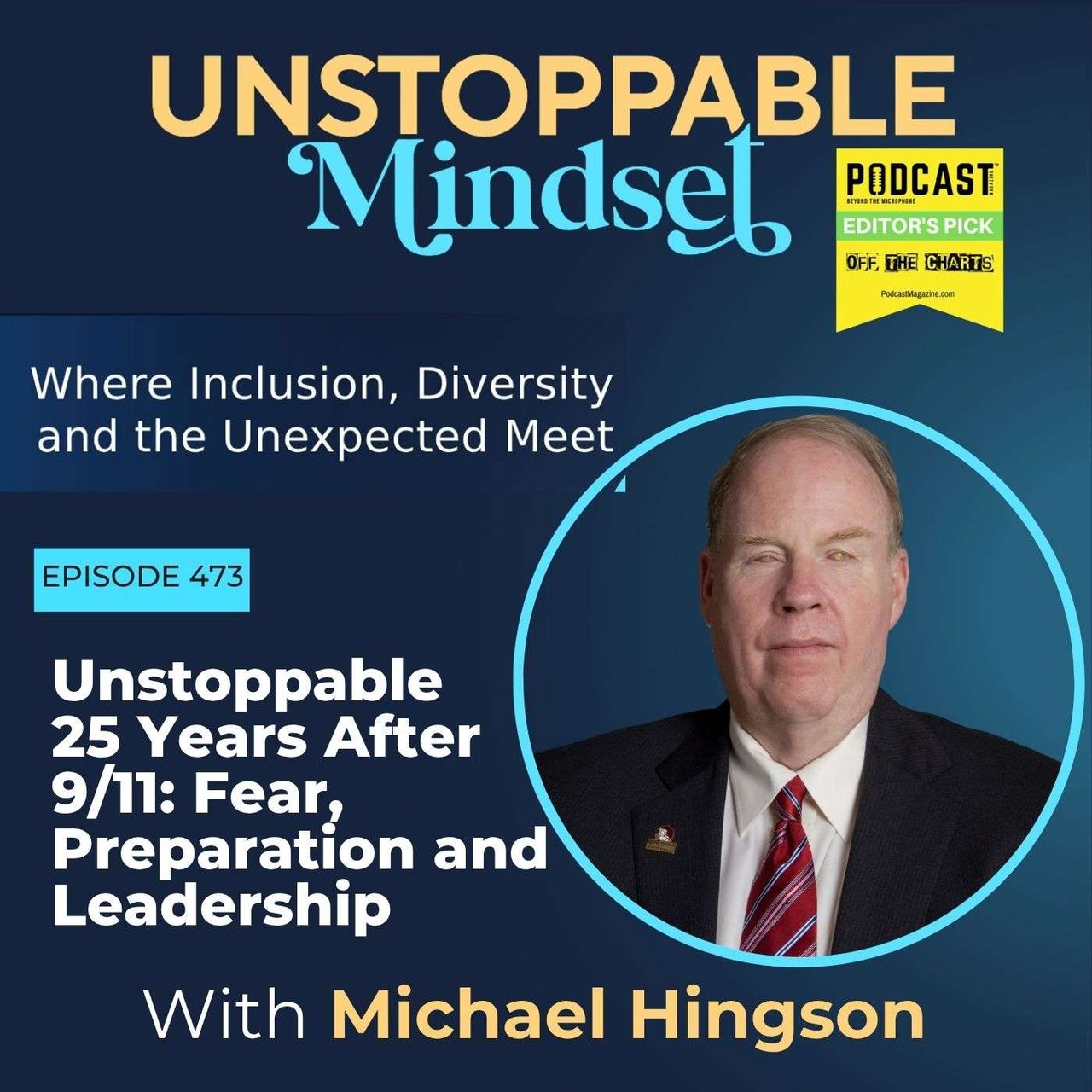
Episode 473 – Unstoppable 25 Years After 9/11: Fear, Preparation and Leadership with Michelle Abraham
Twenty-five years after September 11, I still believe that day has important lessons to teach us about fear, preparation, and leadership.
This time, Michelle Abraham from AmplifYou takes over the hosting seat and interviews me about my experience escaping the World Trade Center with my guide dog, Roselle. We talk about why knowing the building and its emergency procedures mattered, how I worked to keep fear from taking control, and why focusing on what I could control helped me keep moving. I also share how September 11 changed the direction of my life, led me into professional speaking, and helped shape the Unstoppable Mindset philosophy I continue to share today.
Highlights:
02:30 – The ordinary morning that became September 11.
08:04 – How preparation shaped Michael’s response when the tower was hit.
18:34 – How Michael and David helped keep panic from taking over.
27:15 – Why trusting Roselle mattered during the collapse.
31:38 – The lesson of focusing only on what you can control.
41:52 – How September 11 helped shape the Unstoppable Mindset philosophy.
About the Host:
Michael Hingson is a New York Times best-selling author, international lecturer, and Chief Vision Officer for accessiBe. Michael, blind since birth, survived the 9/11 attacks with the help of his guide dog Roselle. This story is the subject of his best-selling book, Thunder Dog.
Michael gives over 100 presentations around the world each year speaking to influential groups such as Exxon Mobile, AT&T, Federal Express, Scripps College, Rutgers University, Children’s Hospital, and the American Red Cross just to name a few. He is Ambassador for the National Braille Literacy Campaign for the National Federation of the Blind and also serves as Ambassador for the American Humane Association’s 2012 Hero Dog Awards.
https://www.facebook.com/michael.hingson.author.speaker/
https://www.youtube.com/user/mhingson
https://www.linkedin.com/in/michaelhingson/
Thanks for listening!
Thanks so much for listening to our podcast! If you enjoyed this episode and think that others could benefit from listening, please share it using the social media buttons on this page. Do you have some feedback or questions about this episode? Leave a comment in the section below!
Subscribe to the podcast
If you would like to get automatic updates of new podcast episodes, you can subscribe to the podcast on Apple Podcasts or Stitcher. You can subscribe in your favorite podcast app. You can also support our podcast through our tip jar https://tips.pinecast.com/jar/unstoppable-mindset .
Leave us an Apple Podcasts review
Ratings and reviews from our listeners are extremely valuable to us and greatly appreciated. They help our podcast rank higher on Apple Podcasts, which exposes our show to more awesome listeners like you. If you have a minute, please leave an honest review on Apple Podcasts.
Transcription Notes:
Michael Hingson 00:00
Everyone, I am Michael Hingson, the host of Unstoppable Mindset. You’ve heard my voice for the last 471 episodes, but I’m calling you all out today and asking you to listen to this because we’re going to make a special announcement now regarding the next four episodes, starting with 472. We’re going to help commemorate the historic events of September 11, 2001. Yes, they’re definitely historic, although not necessarily the most positive things that have ever happened. But as many of you may know, I was in the World Trade Center working on September 11, 2001, on the 78th floor of Tower One, and escaped with my guide dog. I’ve delivered a speech about that, which we put in the first episode of this podcast series back in August of 2021. But this Friday, episode 472 is going to have an updated speech that I delivered just a few years ago at the Marshfield, Missouri Cherry Blossom Festival. That festival is a yearly event celebrating different kinds of things that have happened in American history, and I was invited to come and speak, which I did. I’m going to put that speech up for you as episode 472. I think you’ll find it enlightening. It’ll teach you something about blindness and blind people. It’ll tell you my story, and it’ll give you some inspiration that I hope you will find helpful. Next Tuesday, september 8, Michelle Abraham is going to interview me. Michelle is with Amplify You, the company that does all of our back office stuff and helps me with the editing and other things regarding the podcast. Michelle owns her own podcast, and she is going to interview me about September 11th and other kinds of things relating to what I’ve learned and things that have happened over the past 25 years. She’s also going to be putting this up on her podcast Amplify You, so you can find us in a lot of different places. On September 11th, I’m going to chat with Bob Ellis. Bob was in the Pentagon on September 11, 2001, and had literally just walked out the door of the Pentagon when the plane crashed into the Pentagon and did the things and the damage that it did, and of course generated all the things that occurred at the Pentagon. On the 15th of September, I’m going to come back and have a conversation with all of you about lessons that I’ve learned over the past 25 years, and just reminisce a little bit about all of that. While the podcast is occurring on September 11th, I will be actually in Kilgore, Texas, doing a speech about September 11th. So lots of things going on, I hope you listen to these episodes. I hope that you’ll tell everyone that you can about them. I really enjoy all of the support that you’ve given us over the years, and we’re going to continue to do things with Unstoppable Mindset. And of course, as always, if you’d like to come on or know anyone who would, please let us know. We’re always looking for guests. Thanks very much. We’ll see you on Friday with the first of these four episodes. What if the biggest thing holding you back isn’t what’s in front of you, but rather what you believe? Welcome to Unstoppable Mindset, where inclusion, diversity, and the unexpected meet. I’m your host, Michael Hingson, speaker, author, and advocate for inclusion and possibilities. This podcast explores how the beliefs we carry shape the way we live, lead, and connect with others. Each week, I talk with people who challenge assumptions, face adversity head-on, and show what’s possible when we choose curiosity over fear. Together, we focus on mindset, resilience, and the small shifts that lead to meaningful change. Let’s get started. Hi, everyone, and welcome to another episode of Unstoppable Mindset. When and today is a little bit different than what we normally do because I’m going to be the guest on the podcast, Michelle Abraham from Amplify You, who is also putting this particular podcast episode on her podcast, but Michelle is going to mainly be interviewing me. As many of you should know, this is the 25th commemoration or remembrance of the terrorist attacks on the World Trade Center on September 11, 2001, and we thought it would be very relevant to to spend some time on a few podcast episodes talking about that a little bit.
Michael Hingson 04:46
For those of you that listened to the last episode before this one, you heard me deliver my speech talking about what happened to me on september 11. I used. A speech that we we delivered just a couple of years ago. So it’s a little bit different than the one that, if you listen to the initial episodes of Unstoppable Mindset, you heard way back 472, 473 episodes ago. But this one still tells the the same story, which is which is kind of cool, and so we’re going to talk about that, and we’ll talk about our next episode, which will be delivered on September 11th, and that one will be a conversation between me and Bob Ellis, who was in the Pentagon on September 11th, and so that’ll be a little bit fun, and then we’ll talk about some other stuff as well. But I’m going to turn this over to Michelle because she’s the the interviewer, the the boss, and I’m just a guest today. So hi, Michelle.
Amplifyou 05:50
Hey, Michael. Well, thanks for being a guest on your own show today for us. It’s great to be here with you, and we’ve been with you all along the Instoppable Mindset Show. It’s been really fun to work with you on this show, and so I know we’ve had we’ve recorded episodes around your story, and our listeners would have just listening to your keynote. But I would like to tap into Michael 25 years later. When you think back of the morning of September 11, 2001, what comes to your mind? It
Michael Hingson 06:23
was a typical day. We we did have a thunderstorm about 1230 that morning, and Roselle, my fifth guide dog, who was my guide dog at the time, was afraid of thunder. She had developed this phobia. The theory, basically, about dogs being afraid of thunder is it’s not just the thunder sounds, but it’s also the fact that the dogs have a static charge that builds up on their fur, and that gives them a tingly and kind of a strange feeling, and between that and the thunder, they learn to equate the two, and that just causes a lot of angst. And in Roselle’s case, at 1230 in the morning, we weren’t even hearing a thunderstorm, but she started getting really nervous, and so I took her down to my office. And as I was going downstairs, we started hearing thunder, and the storm actually came right over our house. So I love to say God clearly has a sense of humor of some sort because the thunder-I had never heard thunder like I heard That morning, that is, literally, it came right over our house, so we heard what were explosion sounds. It was it was different than I had ever heard before, but I didn’t have any message that said you shouldn’t go into the World Trade Center or go to work that day, and I had been planning on going to work that day because we were going to be conducting some sales training seminars, teaching about 50 people from a bunch of resellers under the auspices of Ingram Micro, our major distributor. We were going to be teaching them how to sell our products, so I was going to be there. David Frank, a colleague from our corporate office, was going to be there. He was flying. He flew in to deal with the pricing and distribution models that the Ingram Micro salespeople and resellers would be dealing with, but I was going to be doing the majority of the seminar. Well, anyway, at 1230, I took Roselle down and we stayed there in my office at home until 2o’clock, and then the thunderstorm had passed away and Roselle had calmed down. So we went back up and got to sleep, and woke up at five in the morning, which is what I originally planned on doing. I’d actually planned on going in a little bit earlier than usual, just to be able to spend more time preparing. And I got to the New Jersey train station in Westfield, the New Jersey Transit train station, at somewhere around 615, and I had been planning on taking a 6:18 train into the city. And at about 6:20 or 6:21, train having not arrived, an announcement came over the PA system that there was a problem with the train, and another train would be coming. The next train would be there in a little bit, and we could get on it, and and all that. The day was a calm day. It was a nice autumn day. was great. No indication of of anything to worry about. And I didn’t read anything into trains not working, much less the thunderstorm before. So when the train finally arrived, I got on the train and we went into Newark. Then I caught the train that takes me directly to the World Trade Center. It’s called Path Train. Path stands for Port Authority Trans Hudson, and that train went straight in from Newark Penn Station with the well to the World Trade Center, and so I got there. And by the time all of a sudden done, I got there at the normal time I would get there rather than getting there 20 or 25 minutes earlier. Go figure, but I went upstairs and I went to the office and there was a person standing outside the door with a big cart. We had ordered breakfast for all the early arrivals, and so I took him in and showed him where to set up, and then I went in. And got my laptop projector and other things that I needed to be able to set up to do the presentations, and went in and set all that up. And then David Frank, my colleague from our corporate office, got there about 8o’clock and helped do the final things, like making sure the projector was totally appropriately aimed. His aim is better than than mine was, anyway.
Michael Hingson 10:21
So again, everything was proceeding just as we expected it to do. David came with some early arrivals from Ingram Micro, and we put them in the in the conference room where we were going to be doing the presentations, and the the cart was all set up so they could have breakfast. As I love to tell people, best ham and cheese croissants in the city-they’re still good, as far as I remember-but all was was going well, and so we we were getting prepared. And the last thing we had to do before the seminars were to start was to create a list of all the people who would be attending that day and put it on letterhead. We had a spreadsheet with all the names, but we had to put it on letterhead and then fax the list on letterhead to the Port Authority security people so that they would have a list that they would recognize was legitimate. And then when people came into the World Trade Center, they’d go up to the security counter, they’d show their ID, and their names would be compared with a list, and if their name was on the list, then they would just be given a badge with a a barcode where they could go to the appropriate elevator and come up to our floor. So that was kind of the last thing we had to do before the seminars were to start.
Amplifyou 11:34
Kind of sounds like business as a norm and business as usual kind of morning for you. It
Michael Hingson 11:40
was. It was a total business as usual morning, by every stretch of the imagination. No clue about anything else.
Amplifyou 11:48
So, did you guys begun your seminar when the the troy towers were hit?
Michael Hingson 11:55
No, the seminar was supposed to start at 9o’clock, and literally, I was reaching for letterhead to print the list at about 845, 846. When suddenly we heard a muffled kind of explosion, the building sort of shuddered. And then, if you imagine my hand as the tower, literally as I’m tipping my hand towards the camera, that’s exactly what the tower did. It started tipping and tipping and tipping, and we moved maybe about 2025 feet before the building stopped. Now the thing is that I had spent time learning all I could know about the World Trade Center, learning what to do in an emergency, learning what the fire department did, learning what the police would do, learning where the emergency exits were, learning about all the emergency evacuation procedures, and the reason that I learned all of that was I had opened this office for Quantum Corporation, and I was the Mid-Atlantic region sales manager. I was the leader. I was going to be the person who would be running the office, and I knew that I needed to do what any other leader would do difference being I didn’t see stuff, so I needed to learn rather than rely on signs and other things that most sighted people would do. I actually had to learn everything to be able to function. But the difference is that by doing that, what I didn’t really realize was I was creating a mindset that says you know what’s going on, you know what to do. I knew why the building tipped because tall buildings like that are built with expansion joints. They’re made to be buffeted in windstorms, and I had felt that happen many times at the World Trade Center. If there were a wind, we could feel it sort of shake a little bit. But who would have ever thought that somebody would fly into the building with a plane load of jet fuel, 36,000 pounds of jet fuel? But nevertheless, I knew all that I could learn about everything. I learned where different offices and built and and organizations were in the World Trade Center. I had explored the kiosks on the first floor and the shopping mall, so I knew where all the phone kiosks were and where other things were. I knew where the restaurants were, so that if we ever had guests in and we were doing demonstrations and then we were going to be negotiating contracts, we decided to take a break for lunch. I could say, "What kind of lunch do you want? "Oh, you want a deli sandwich? There’s this great restaurant downstairs called Fine and Shapiro. Let me take you there, and I would take them. I would lead the way because I couldn’t very well say, "Oh, I don’t know how to get anywhere. I’m blind. Someone’s going to have to lead me. How’s that going to work a couple of hours later if we’re negotiating multi-million dollar contracts? I needed to literally work, and I don’t mean this in a negative way, but from a position of strength. I needed to know all of this in order to be able to do my job as the appropriate leader of the office, and so I learned all of that and put all of that together for whatever was going. On in the World Trade Center at any given time, and so when the building was struck and and the building was tipping, I was standing in my doorway, the doorway between my office and the other parts of of our facility, and the building tipped. David was holding on to my desk as it was tipping. Roselle was asleep under my desk, and finally, David and I were speculating about what was going on. He thought maybe it was an earthquake, and I said no because the building’s not shaking around; it’s going in one direction. I thought maybe it was just some sort of an explosion, which in a sense it was. But he said it didn’t sound like it, and it didn’t. But the issue was that we were 18 floors on average below where the tower was hit and on the other side of the building, but that was a calculation that came later. But the bottom line is that the building tipped and then it stopped, and it came back the other way and got vertical again.
Amplifyou 15:54
That’s incredible! Wow.
Michael Hingson 15:56
And as soon as it got vertical, I went back into my office. I met Roselle coming out from under my desk. I took her leash. I told her to heal, which meant to come around on my left side, which she did. She sat down, and about that time, the building dropped straight down about six feet.
Amplifyou 16:10
Wow!
Michael Hingson 16:10
Now, the reason it dropped is because tall buildings like that are constructed with expansion joints, which is why that it tipped in the first place, and the building didn’t break off, but then when it got to be vertical again, after a few seconds, literally the expansion joints contracted and the building went back to its normal configuration, which is exactly what happened.
Amplifyou 16:32
Gosh, interesting like technology that that’s built in there. I know you you never really I would never known that. Had you not explain that in the story? That’s very interesting. That expands like that, and then the six foot drop was then it contracting
Michael Hingson 16:47
again. The expansion joints were going back to normal configuration.
Amplifyou 16:50
Interesting. If
Speaker 1 16:55
you enjoy unstoppable mindset and would like to help us continue bringing these conversations to you each week. We’ve created a way for you to support the show. Your contribution helps us cover production costs and continue sharing stories, insights, and ideas that inspire people to live with purpose and possibility. If supporting the podcast feels right for you, you’ll find the link in the show notes. Thank you for being part of the Unstoppable Mindset Community.
Amplifyou 17:28
And so there’s so then what happened? So take us to the next steps.
Michael Hingson 17:32
So the building dropped about six feet, and then David turned from holding onto my desk and looked out the window, looking south toward Battery Park, and he started shouting, "Oh my God, Mike! There’s fire and smoke above us! There are millions of pieces of burning paper falling outside our window! And I could hear stuff going by our window, and I was wondering what it was because normally the sound was sort of like what window washers would do if they were on their tracks washing windows, but that wasn’t what was going on. It was debris falling, and David was describing it: millions of pieces of burning paper falling outside our window, and he said, "We got to get out of here right now. And I said, "Slow down, David. We’ll get out, but we’re not going to rush. No, we got to get out of here right now. Slow down, David. We’ll get out. Don’t worry about it. And finally, I I said several times, "Slow down. He kept saying we got to get out of here right now, and then he used what I call the big line: "You don’t understand. You can’t see it. Well, first of all, I knew everything that David was seeing and saying because he was telling me about it. So I knew we had millions of pieces of burning paper. Clearly, he said, "There’s fire and smoke above us, so the building’s on fire. I had all that information, but the problem was that it wasn’t what I wasn’t seeing that was the issue; it was what David wasn’t seeing. David wasn’t seeing that sitting next to me was my guide dog Roselle, yawning and wagging her tail, going, "Who woke me up anyway? I was sleeping real good here, sports fans, and and Roselle was not reacting. I wasn’t smelling anything that gave me an indication that we were in such peril that we had to run for our lives, and so I kept telling David to slow down. And finally, David did. He stopped. I said, "David, get our guests to the stairs. Do not let them take elevators, because I had learned, of course, that if the building’s on fire anywhere, if fire gets into elevator shafts, then anybody in elevator cars is probably going to perish, which did happen. And so David took our guests out of our office, got them to the stairs, and I made it really clear: do not let them take elevators, because there could be fire in the elevator shafts. Well, he got them to the stairs, and then he came back. Meanwhile, I called my wife Karen to let her know that something had happened, or an explosion, or something. But we didn’t know. People tell me all the time, even today. Well, of course you didn’t know because you couldn’t see it. You know, I think all these people who tell me I didn’t know because I couldn’t see it need to get a. The problem is they really don’t know a whole lot about blind people. The airplane hit, on average, 18 floors above us. It hit between floors 93 and 99, so I just say 96, which is 18 floors above where we were in on the 78th floor. But it also hit on the other side of the building. It hit on the north side, and we were on the south side. The last time I checked, Superman and X-ray vision are fiction, and people can’t really see through buildings, see through rebar and steel and concrete. The fact of the matter is that they no one knew what was going on. I didn’t know, but other people did, and I’ll prove that in a moment, but the fact of the matter is, you can’t see through all that stuff. Blindness had nothing to do with it, but people keep saying, "Well, you didn’t know because you couldn’t see it. Well, yeah, well, we’ll get to that. Anyway, David got our guest to the stairs. I called Karen. I told her that something had happened. We didn’t know what. She wanted to know more, but there was nothing else I could tell her, and so we we parted. I just said, "I’ll call you back as soon as I can, and by that, you know, the media hadn’t even gotten the story yet.
Michael Hingson 21:12
So I love to joke around and say that I beat Charlie Gibson in Good Morning America by eight minutes, but I still haven’t gotten a Pulitzer Prize for it. But it’s very disappointing. But anyway, so I disconnected with Karen. David came back. We swept the office. We went to the stairs, and we started down. Almost immediately, I began smelling an odor, and it was a familiar odor, but I couldn’t quite place it. And it took me a while to realize I was smelling the fumes from burning jet fuel. I did a lot of traveling for my company, and so I was very used to what was in airports and the smells and the odors. But it took me like four floors to figure out that I was smelling burning jet fuel. Other people were speculating, wondering what happened, why were we evacuating, what was the building doing, why did it shake, and all that. And then I observed that I was smelling burning jet fuel, and other people said, "You’re right. That’s burning jet fuel. We must have been hit by an airplane. But you see, we didn’t know. We had no clue. Eyesight had nothing to do with it. The fact is that we only figured out we were hit by an airplane because the blind guy realized he was smelling burning jet fuel, and so anyway, we went down the stairs. A couple of burn victims passed us along the way, and a woman, when we got down about 10 floors, stopped and she said, "I can’t go on, and we’re not going to make it out of here. And I literally just stopped and turned around and gave her a hug right there on the stairs. Roselle gave her some kisses, and other people stopped and joined us. And we all said, "Come on, you can keep going. You can do it. Let’s go. And she was able to keep going as we went down the stairs. But we knew instinctively we had to make sure that panic didn’t ensue on the stairs.
Amplifyou 22:56
Right.
Michael Hingson 22:57
We got to about the 50th floor, and then David suddenly said, and he had been getting quieter, but suddenly he said, "Mike, we’re going to die. We’re not going to make it out of here. And I said, in my best sharp voice, "Stop it, David. If Roselle and I can go down these stairs, so can you. And he told me that that brought him out of the funk that he was singing into. And he said, "I want to walk a floor below you, if it’s okay, and I’ll tell you whatever I see on the stairs. But I got to do something to get my mind off of worrying about all this stuff. Is that okay? And I said, sure. If that’s what you need to do, go ahead. Did it really matter? Well, you know, it did to David, and that’s all that really counted. But anyway, David walked a floor below us, and so when I got to the 48th floor, for example, I heard, "Hey, Mike, I’m on the 47th floor. All’s good here. Going on down the stairs. We went down, and finally I got to the 45th floor. And David said, ’44th floor is where I am. This is where the Port Authority cafeteria is. Not stopping. Going on down the stairs, and he did that all the way down the stairs. Why is that important? And why do I even mention it? Because we all did everything we could to keep panic from taking over on the stairs, and by definition, because David was just speaking up, "Hey, Mike, 42nd floor, all’s good here, and just shouting up to me what he saw on the stairs and sounding confident. By definition, anyone who was in the sound within the sound of his voice heard someone who was sounding okay and just able to go down the stairs and wasn’t seeing any problem, and so they focused on him, and that certainly had to help keep panic from ensuing on the stairs as we went down, and it’s so often not even mentioned, but David had to do that for maybe hundreds or 1000s of people who could hear him all the way up and down the stairwell, and I think that’s just one of the most important things that I remember about the day that David had to, by definition, help keep panic from going on on the stairs. Now, meanwhile, I was up. Encouraging Roselle, what a good dog, good girl, Roselle. Keep going, let’s go, good dog, doing that all the way down the stairs. And I’ve had people come up to me at speeches that I’ve given ever since. For example, one in Kansas City, and a woman came up afterward, and she said, "I came into the stairwell on the 54th floor just as you passed by, and I heard you praising your dog and encouraging your dog and sounding very confident, I and other people just followed you because you sounded really good and you didn’t sound like you had a problem at all and weren’t afraid. We just followed you, so you know that’s why I also know that what David was doing was so important because people focused on his voice.
Amplifyou 25:42
How fascinating! Someone that was right behind you that day in the stairwell, too.
Michael Hingson 25:46
Yeah, yeah. So we continued down. We got to the 30th floor, and that’s where we met firefighters coming up. They wanted to help me go down the stairs, and I didn’t want their help. I didn’t need their help, first of all, but I didn’t want their help because that would have meant we were always walking at least two abreast, and they were going to grab my arm and try to lift me as we were going downstairs and do other things that sighted people think you got to do if you’re helping a quote a blind person go down the stairs. But there was a more important reason that I didn’t want their help, and you know when the firefighter, the first guy, came up and he said, "We’re going to send somebody with you. I kept saying, "No, don’t do that. We don’t need that. What I knew because of all that I had learned was that they were a team. They had to carry all their equipment up the stairs with them. Why? Where would you store it? Let’s say you decided to store it on the 34th floor, and fire broke out on the 33rd floor. You’d never get to the equipment. They had to carry all their equipment up with them. They were a team, all 50 of those firefighters, and so I was not about to want to break up the team when, especially, I didn’t need it anyway. And I I worked at getting them finally to focus, and I said, look, I got my guide dog here, and they started petting Roselle, and it wasn’t the time to give them a lecture about don’t pet a guide dog in harness. And by the way, don’t pet a guide dog in harness. If you see a guide dog in harness, you can ask me if you can pet the dog, and if I have time, I will stop and I’ll take the harness off because Roselle likes to relax, Alamo, my current guide dog, likes to relax. The dogs all love to relax, but if I don’t have time, I’ll say, "Look, we’re kind of in a hurry, so sorry, but we just don’t have time. But the firefighters were petting her, and it wasn’t the time to give him a lecture about don’t pet the guide dog and harness, and it wasn’t the time to give him a lecture about don’t worry about the blind guy just because he can’t see and you can. The reality is that blindness isn’t the problem; it’s your attitudes about blindness that are more of the problem. But anyway, they finally agreed. When I finally said, "Look, I got my friend David over here who can see, and David and I are going down the stairs together, and they turn to David and they go, "You’re with him. And David said, "Yeah, Lee Malone, he’s fine. And mention all the hundreds
Amplifyou 28:06
of people that are following you.
Michael Hingson 28:08
Yeah, and and they all had to stop as we’re talking to the firefighters. But anyway, so they eventually started going up the stairs, and I continued down. David reassumed his scouting position, and we followed David by a floor down the stairs, and and did what we needed to do, and then we we finally got to the first floor. Well, David did, and he said the water sprinklers are on. You’re going to have to run through a curtain of water to get out of the stairwell, and the the reason there were sprinklers on is if there was fire in the stairwell, the water sprinklers would be keeping the fire from getting into the lobby. But if it were in the lobby, the sprinklers would be keeping the fire from getting into the stairwell. That’s part of what was supposed to happen. Well, it it all worked perfectly. So David went through the curtain of water, and I got down to the first floor, and I took Roselle’s harness and said forward and hop up and let’s go. And we went through this curtain of water and came out the other side into the lobby of Tower One. There was a guy with a bullhorn going, "Go this way, no, no, don’t go over that way, go this way, go to the central part of the building, don’t go outside, no, no, don’t go that way, go this way. And that was because that if they had gone outside, they would have been below where people were jumping, and you know who knows what else, so they didn’t, and and they went to the central part of the building. We got out, and I was hearing the guy with the bullhorn. This guy comes up to David and me, and he said he’s with the FBI, and he’ll take us where we need to go. And I asked him what’s going on. He said, "There’s no time to tell you. I wish he had, but he didn’t know me. He didn’t know that information was what I really valued more than anything else, and I wasn’t going to panic just because I heard information. But he took us through the complex and eventually up an escalator by the borders books, as far away from the towers as we could be, and then we got out. And as soon as we got out, David saw fire in Tower Two. We had no idea where that came from. We speculated that maybe our building, which had been tipping toward Tower Two, had its fire sort of jump across, maybe somehow. But we didn’t know what was going on, and so we were told to leave the area, which we did. We went over to Broadway, which is again what we were told to do and told to get away from the complex, so we went over to Broadway and started walking north on Broadway. So as we were walking north, on my left side was the building, on my right side was Broadway. We’re on the west side of Broadway as we’re going north, and we passed several streets, and then after we passed all the well, we passed a number of streets, and we finally got to Vessi Street. And David said, "You know, we’re very close to Tower Two. I want to take pictures of this fire I see in Tower Two. I said, "Okay. I took out my phone. I tried to call Karen. I couldn’t get through. The circuits were busy, as we now know. Of course, people were saying goodbye to loved ones, but for me, I couldn’t get through, so I put my phone away. And David was putting his camera away when a police officer yelled, "Get out of here! It’s coming down now! And we heard this sound, as I describe it, as kind of a combination of a freight train and a waterfall. What we heard was Tower Two collapsing like 100 yards away from us. You could hear glass breaking and shattering, you could hear metal clattering, and then the white noise of Tower Two just collapsing straight down, which is exactly what it was supposed to do. David and everyone turned and ran. I lifted Roselle by the harness, turned her 180 degrees, and started running back the way I came. David was long gone.
Michael Hingson 31:36
I got to the next street back that we had crossed a little while before, and that was Fulton Street. Turned right on Fulton to get more of a building between us and what was collapsing, and we ran about 25 yards and caught up to David. It turns out that we had gone the same way he went, but he had stopped realizing that he had left me and was going to come back and find me. But I found him first, and he apologized. I said, "Don’t worry about it, David. Let’s keep going. And we kept running. We got caught in all the dirt and the dust and the debris from Tower Two’s collapse. As David said, he couldn’t see his hand six inches in front of his nose. For my part, I couldn’t. With every breath I took, I could feel debris going down my throat into my lungs and settling. It was crazy, and we ran, and eventually, I decided we got to get out of this. So I started telling Roselle right, right, giving her hand signals. I don’t know whether she could hear me over the noise of the building collapsing, or whether she could see my hand signals. But I kept telling her to turn right because I wanted her to, because there was a building on my right. Now that we were going the other way, I wanted her to go into the nearest opening that she could find. As we ran, I suddenly heard an opening, and Roselle obviously knew what I wanted because she turned right. She took one step. She stopped. She wouldn’t move. Come on, Roselle, keep going. She wouldn’t move. Come on, Roselle, you can do it. Keep going. She wouldn’t move, and I realized, wait a minute, she’s a guide dog. She’s doing what she’s supposed to do. She stopped for a reason, which she had. I checked. I stuck out my foot, stuck a hand out along the wall, discovered we were at the top of a flight of stairs. Roselle had done her job perfectly. She stopped. So when I gave her the command to go forward, she went down the stairs, and we went down into what was the Fulton Street subway station, and we were there for about 15 minutes or so. Then a police officer found a bunch of us together and said, "The air is clear up above. You need to leave now. And didn’t wait for a response; just turned, and we all followed him back to the stairwell, up the stairs, through the little arcade that we had we had passed through part way down the stairs before, up the rest of the stairs and got outside. David looked around and he said, "Oh my God, Mike, there’s no Tower Two anymore. And I said, "What do you mean? He said, "All I see are pillars of smoke, hundreds of feet tall. There’s no Tower Two. It’s gone. Are you sure, David? "Yeah, it’s gone. It’s not here. We stood there for a moment, and then we continued to walk west on Fulton Street. And we walked for about 10 minutes, and then we were in this little plaza area when suddenly we heard that freight train waterfall sound again, and we figured it was probably our tower collapsing. David looked back and he saw another dust cloud coming our way, and in this plaza where we were, there was a small retaining wall, probably a planter or something, but anyway, there was a retaining wall. We got behind it, we ducked down, and we just waited till everything passed us by and stopped. And then we got up, and David looked around and he said, "Oh my God, Mike, there’s no World Trade Center anymore. And I said, "What do you see? And he said, "All I see are fingers of fire and flames, hundreds of feet tall, and pillars of smoke. It’s gone. The towers and everything are gone. And we stood there a moment, not able to fathom it. Then I tried to call Karen again, and this time I got through because all the circuits freed up from all the loved ones saying goodbye. Needless to say, and after, as I put it, tears on both sides of the phone line.
Michael Hingson 34:59
Karen was finally the first one who told us how two aircraft had been crashed deliberately into the towers of the Pentagon, hijacked aircraft towers at the World Trade Center. That is, one into the Pentagon, and a fourth was still missing over Pennsylvania at that moment. And so that’s kind of what happened. The rest of the day we spent getting up toward Midtown Manhattan, and eventually was able to get trains back to New Jersey and so on. And David walked up to where he was staying with his sister, who lived on the Upper East Side of Manhattan.
Amplifyou 35:30
What an experience, Sue! Thank you for going through that with us again. And you know, there’s there’s a lot of things that I want to well, there’s something I want to ask you. It’s like we often talk about preparation of that day, like all the things you did to prepare for what what you actually were able to do during that day. What mattered on that day from all that preparation?
Michael Hingson 35:55
That I knew what to do in an emergency. Also, although I really started learning to verbalize it more later, what I learned was how to control the things that I could and not worry about everything else. We what if everything to death as human beings? Yeah. And we what? Well, what if what if you were in the build in the World Trade Center and it collapsed? Well, okay. What could I have done about that? So it’s no sense worrying about it, because I, you know, I didn’t have access to something to hold the building up, you know, and so many different things. Well, what if Roselle had panicked? Well, that’s why I encouraged her and praised her so she wouldn’t. But the bottom line is, I didn’t have control over that, other than the fact that I encouraged her and and worked with her so well. Well, what if other people panicked on the stairs? I didn’t have control over that, other than doing all I could to try to keep panic from happening. And you know, I and other people did a number of things like what David did to keep people from panicking on the stairs. But the bottom line is, there was no sense worrying about those things because we had no control over them. And when we got home that night, I took Roselle’s harness off and I was going to take her outside. She ran off. She wouldn’t. She wouldn’t go outside right away. She grabbed her favorite tug botobone and started playing tug of war with my retired guide dog Linnie. And they were having a good old time just playing. When I talked to the veterinarians of Guide Dogs for the Blind the next day, I asked them, "What’s it going to be like for Roselle going forward? And they asked, "Did Roselle have anything that specifically threatened her? And I said, "No, not really, because nothing hit her, nothing threatened her in any way, shape, or form, and the veterinarian who I spoke with said, "Well, there you are. She wasn’t threatened. Dogs don’t do what if about everything. They live in the moment. It was over for her. She wanted to play, and that’s what she did, which was great anyway. But we what if everything to death, and we need to learn how to stop doing that and worry about just the 5% over which we really have control, and not worry about the rest. That’s one of the lessons that I learned. I learned about don’t worry about what you can’t control. Focus on what you can and leave the rest alone. I learned about what if you know and things like that.
Amplifyou 38:18
You and Roselle really understood each other in those moments. So what she realized what her job was, and you you were a leader in keeping everyone else under under control from you know reacting. Did you ever? You seem to have been very positive right from the beginning. Were there other moments that you were not sure that you or guys were going to get out of there.
Michael Hingson 38:44
No, and my response is there wasn’t time to worry about that for me. I was focused on Roselle. I was focused on listening because if people started to panic, I wanted to deal with it. There was a time on the 37th floor where people just started not talking. They were getting very quiet, and I went, "Oh, they’re going to be like David was, and so I said, "Hey, everybody, whether you can see me or not, my name is Mike, and I’ve got my guide dog Roselle here. I’m blind, but I don’t want anybody to worry, because if the power and lights go out in the World Trade Center, we’re offering a half-price special to get you out today only. You know, and and that’s exactly what I wanted them to do was to laugh, and I got people to laugh, which, which I’m sure helped. But those are the kinds of things that that I could focus on dealing with. But I I didn’t worry about what I couldn’t control, even though that was sort of an instinctive thing. But the mindset kicked in. All the things that I had learned that led up to September 11th kicked in that day, that allowed me to be able to function and and also help other people, and that’s the the important part about it is that they all did kick in the mindset kicked in and it all worked well.
Amplifyou 39:54
You’ve told this story so many times. Has the meaning of the story ever changed for you over 25 years?
Michael Hingson 40:00
No, I got to say that it hasn’t. Well, in some, yeah, I guess in some senses it has. Maybe some of the reasoning has changed. For example, speaking today, I’m speaking to oftentimes a generation of people who have absolutely no memory of the World Trade Center because they weren’t even born yet, or they were too young to remember it. Probably, if you’re under 30 years old, you really don’t have any memory of it. And if you’re under 25, you weren’t even born at the time. My job, I believe, and so I’ve expressed this more lately than I have in the past. But my job is to take people in as I speak to the building with me, and take them down the stairs. Take them through the experiences that I had and went through, and why I went through those experiences, and the lessons to be learned from those. And then bring them out when we get to the bottom and outside. Take them all the way through and out, so that they get the full sense of what I experienced. And I’ve had so many people tell me we were with you every step you took down the stairs. You tell the story so vividly and so well, and and you just you just had us with you all the way down the stairs, which is exactly what I wanted, because I want them to understand that in reality you can learn to deal with things that come along, there are going to be things that you can’t deal with because you don’t have the skill or whatever. But we all have a lot of skills that we don’t think we do, and one of them is that we can learn to control fear. We can learn that fear is around us, but we don’t have to let it overwhelm, blind, or paralyze us. We can learn to use fear in a very positive, constructive way to keep us focused and going down the stairs.
Amplifyou 41:45
What made you to decide to keep using your experiences each other’s?
Michael Hingson 41:49
Well, after September 11th, we and and the media got the story, and then people started calling because we got very visible in the media, and people started calling and saying we’d like to hire you to come and talk to us about what we should learn from September 11th. Learn about teamwork. Learn about what happened that day. Learn the lessons of World Trade Center, and so I decided that I would would do that and teach people what they could remember and and take away from it, and people started calling and saying, "Gee, would you come and let us hire you to tell the lessons of September 11th? And by the beginning of 2002, I had so many of those kinds of requests that Karen and I decided that selling life and philosophy was a whole lot more fun than selling computer hardware and being a computer hardware sales manager, and so that’s what I turned to doing full time, and learning to help people understand that the reality is that you are a lot better than you think you are, and you need to learn that. But you really can do in a more strong way what you think you can do than than a typical way.
Amplifyou 43:02
That’s what I was just going to ask you: is if September 11th changed the direction of your life, and it did, from the career you had into now being a professional speaker. Interesting.
Michael Hingson 43:13
Oh, yeah, it’s helped a lot. And you know, I I also there are other things that that helped me in terms of dealing with public speaking, I love to tell the story that when I was growing up, before I had access to braille, I had braille in kindergarten in Chicago, but then I didn’t have braille in California until the fourth grade, and my parents helped me learn things, and I learned all the spelling words that you know you had every every week you had to learn words, and then on Friday you the teacher would tell you the words, and you had to write them down, and you change papers, and the teacher would write the words on the board. Except in my class, in my class the teacher didn’t write the words on the board. The teacher would say, "Mike, you have to spell the words out loud for everybody. So I learned how not to fear crowds and learned that I could spell the words. I know one time I messed up a word, and I don’t even remember what the word was, but I heard somebody go, "Uh-uh, and I and I went, "Oh, I must have got it wrong, and I figured it out, and then I spelled it right. But that that only happened one time that I can recall. But clearly, that helped me learn not to be afraid of audiences. And today, I don’t even understand why people are afraid to speak publicly. The fact of the matter is, audiences don’t come to hear you so they can joke at you, make fun of you, yell at you, and so on. They come because they value what you’re you’re going to talk with them about, and they want to hear it. They want you to be successful, and they’ll help you be successful if you let them,
Amplifyou 44:41
I think you were always destined to be a public speaker, but it seems like the September 11th really just the universe conspired to make that happen. Maybe sooner than it would have. Did you ever see yourself before that becoming a public speaker?
Michael Hingson 44:57
I never thought of being a public speaker before that. Neither had I ever thought of being an author. I I was used to it because working at Quantum on any given day I could be speaking to anybody from the board of directors of a Wall Street firm to IT people to other management people and so on. So I got used to doing it, and I and I learned all about selling and being articulate in sales, so I kind of learned a lot about public speaking from that. But I never really thought I would just be speaking for a living. But given what happened on September 11th, and that I get the opportunity to talk with people and help them see that in reality, what happened on September 11th is a day of lessons that taught us, or can teach us about resilience, can teach us about dealing with things that we don’t expect to happen, and that we can learn how to control fear and so on, rather than letting it overwhelm us. So it it is it’s really been pretty good.
Amplifyou 45:57
Yeah, and when you hear the phrase "unstoppable mindset, how much of that philosophy do you think was shaped on that day, september 11?
Michael Hingson 46:05
Oh, I think a lot of it came from from that day and and beyond. You know, the mindset kicked in on september 11 because of what I knew. But I think also that when it came time to start this podcast, which someone asked me to do as part of being involved with the company. I heard a lot of people talking about resilience and so on, and I just thought of unstoppability, unstoppable mindset, because the reality is we all are more unstoppable than we think we are, and so the podcast is literally an opportunity to converse with anyone who wants to come on, and it is a conversation more, much more than an interview, but it’s a conversation about them, their lives, what they’ve done, and including what did you do that made you realize that you’re more unstoppable than you think you are, and maybe you didn’t realize that, but you are, and here’s let’s talk about this, and so those are those are things that I talk about. But I believe that everyone has a story to tell, so I’m always looking for people to come on the podcast and tell their stories and talk with with me about their experiences and so on, and that’s how you know we found Bob Ellis, who’s going to be with us on the Pentagon. I had actually contacted him about speaking to his organization, and I always mentioned the World Trade Center in initial introductory letters. And he wrote back and said that he would love to help, but he also wrote back and said, you know, I was in the Pentagon on September 11th, and that opened our dialog. And the result was that we finally set up for him to come on Unstoppable Mindset. And when when we did our conversation, I learned, for example, that he walked out the door, and it just he was supposed to be in a meeting that was right near where the plane actually came through the window, and in Bob’s case, he had literally just left because the meeting ended up not happening, and he had just walked outside the door when he heard the plane, and he didn’t really understand what was happening. But the plane sped up, and then it just crashed right into the tower, into the Pentagon, and he ran from the area, but he was very much involved with with talents that allowed him to help acquire things to help other people survive and so on, and did that for a couple of days or four days. But Bob will tell his story on September 11th. But he was literally just out the door when the plane hit.
Amplifyou 48:42
Wow! Well, your guests can look forward to that interview. Will be the next up after this one. And I want to thank you, Michael, for sitting down with me today. I oh, it’s always a pleasure, and thanks for allowing me to take over the hosting seat for today on your show, so we can hear more of your story, and thank you for sharing all the lessons you’ve learned from this experience.
Michael Hingson 49:07
Well, well, thank you, and and I hope people will take them to heart. And I would say, if anyone wants to be on the podcast, we would love to have you send me an email at speaker s p e a k e r at michael hingson m i c h a e l h i n g s o n.com. If you know of any speaking opportunities that need a keynote speaker to come in, not only to tell an inspiring story, but I want to make it very clear, but to teach also lessons about resilience, business continuity, and other things like that, email me at speaker@michaelhingson.com. Would love to talk with you about that. My website is www.michaelhinkson.com, or you can go to www.michaelhinkson.com/podcast. But we’d love to hear from you in in any way and and get to know you better and you know go from there.
Amplifyou 49:57
Awesome. Well, thank you so much, Michael, for today. We’ll take care and see you soon.
Michael Hingson 50:02
Sounds good. Thank you for being here with me on Unstoppable Mindset. I hope today’s conversation left you with a fresh perspective, a new insight, or at least something worth thinking about. If you’re ready to go deeper into the ideas that shape how we see ourselves and others, I have a free gift for you. Head over to michaelhingson.com and download my free ebook, Blinded by Fear. It explores the invisible beliefs that hold us back and shows you how to reframe them so you can move forward with clarity and confidence. Be sure to subscribe to our podcast, leave a review, and share this show with someone who can use a reminder that growth starts with mindset. When people think differently, we all move forward together. Thanks again for listening. Keep learning, keep questioning, and keep choosing to live with an unstoppable mindset.