Accessibility Consulting: A Leadership How-To for Building Inclusive Organizations in 2026
What if the greatest barrier to your organization’s success isn’t a lack of talent, but a lack of vision that leaves 1.3 billion people worldwide behind? True leadership isn’t about avoiding a lawsuit or memorizing the latest WCAG 2.2 technicalities. It’s about building a foundation of trust and interdependence. When I guided my team down 78 flights of stairs in the North Tower on September 11, 2001, it wasn’t a checklist that saved us; it was a culture of preparation and mutual reliance. Effective accessibility consulting shouldn’t be a frantic response to the 4,000 ADA title III lawsuits filed annually. It’s a strategic choice to empower every employee.
You likely feel the pressure of shifting digital standards and the frustration of siloed DEI efforts that overlook disability. It’s exhausting to play catch-up with regulations. This article will show you how to transform accessibility into a leadership advantage that fosters innovation and an unstoppable mindset. We’ll walk through a clear roadmap for 2026 that integrates digital and physical inclusion into the heart of your corporate identity.
Key Takeaways
- Discover why leading in 2026 requires moving beyond reactive compliance to a holistic culture of inclusion that addresses digital, physical, and cultural barriers.
- Identify the three essential pillars of a modern strategy that protect your organization from risk while fostering deep trust with every user.
- Learn to transcend the “checklist” mentality through expert accessibility consulting that prioritizes the actual user experience over technical-only audits.
- Master a proven 5-step framework to audit your current organizational culture and build a prioritized remediation roadmap for lasting impact.
- Leverage the “Unstoppable Mindset” to turn accessibility into a strategic engine for innovation and high-level leadership excellence.
What is Accessibility Consulting in a Leadership Context?
True Accessibility isn’t a checklist you complete to avoid a lawsuit. It’s a fundamental shift in how we perceive human potential. In the context of leadership, accessibility consulting serves as a holistic evaluation of how an organization functions across its digital, physical, and cultural landscapes. By 2026, the global market for assistive technology is projected to reach $31 billion, signaling a massive shift from reactive compliance to proactive, inclusive leadership. Leaders are realizing that waiting for a complaint is a failure of vision. Instead, they’re choosing to build environments where every person, regardless of their physical characteristics, can contribute their best work.
The difference between an ADA auditor and a strategic partner is the difference between sight and vision. An auditor tells you your doorway is too narrow. A strategic partner shows you how your culture is excluding brilliance. This is the core of the Unstoppable Mindset. When I navigated 1,463 steps down the North Tower on September 11, 2001, with my guide dog Roselle, it wasn’t just about a physical path. It was about trust, preparation, and a system that allowed us to move forward together. A consultant should be that guide, helping you see the invisible barriers that slow your team down.
The ROI of Inclusive Design
Inclusive design isn’t just a moral imperative; it’s a catalyst for innovation. When you challenge standard operating procedures to accommodate diverse needs, you often find a better way for everyone to work. This is the Curb Cut Effect in action. Just as sidewalk ramps help the parent with a stroller and the traveler with luggage, digital accessibility improves the user experience for every customer. Companies that prioritize disability inclusion see 28 percent higher revenue and 30 percent higher profit margins on average. It boosts employee retention because people want to work for an organization that values the human element. They feel seen, heard, and respected.
Beyond the ADA: Seeing the Human Element
Legal compliance is the floor, not the ceiling. If your only goal is to meet the minimum requirements of the Americans with Disabilities Act, you’re missing the opportunity to lead. Strategic leadership requires seeing beyond the surface of a balance sheet or a building code. It requires a commitment to interdependence and mutual success. We must view accessibility consulting as a way to build a more resilient workforce. It’s about creating a culture where trust is the primary currency. Ultimately, accessibility serves as a bridge to leadership and trust.
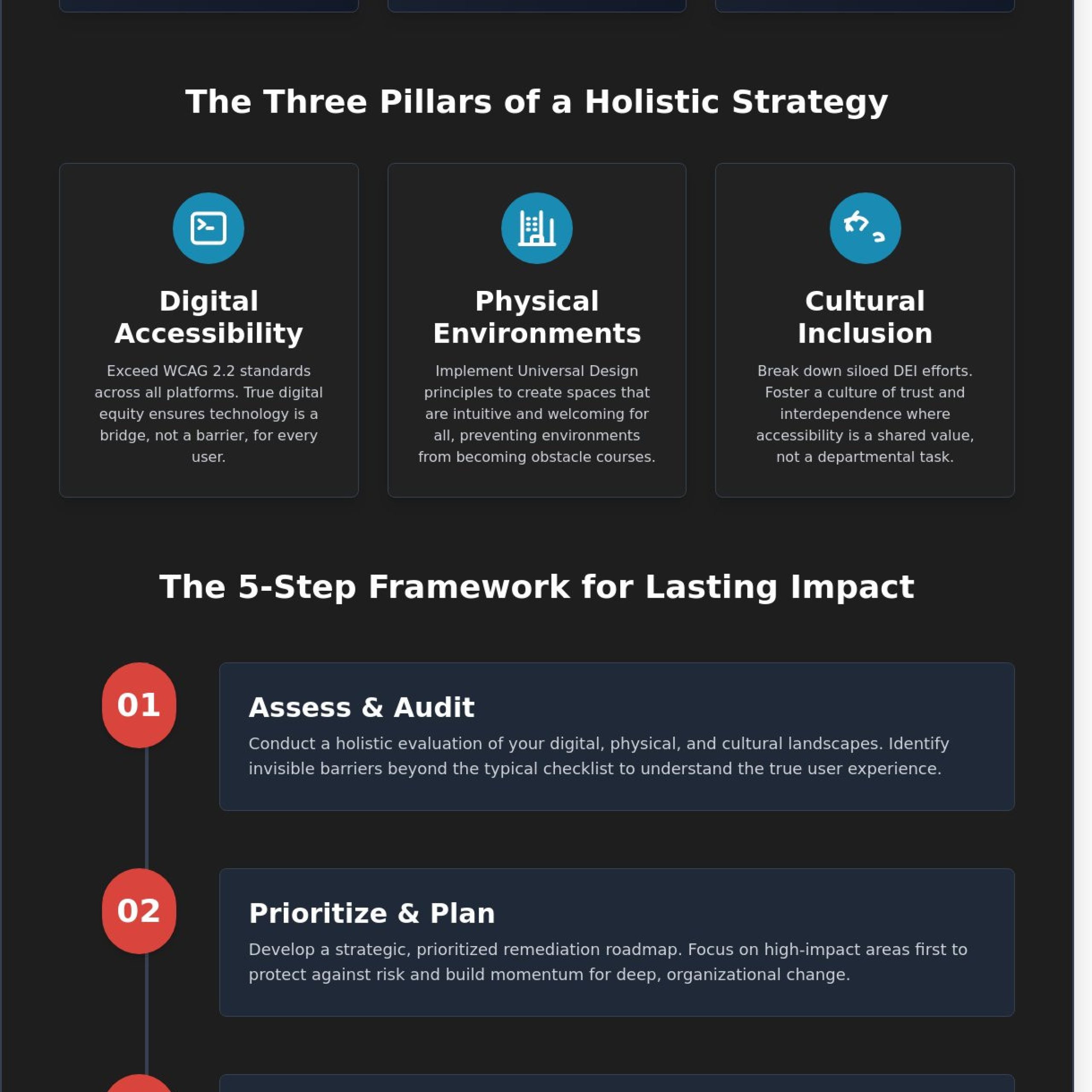
The Three Pillars of an Effective Accessibility Strategy
True inclusion requires a multi-layered approach that addresses every touchpoint of the human experience. Relying on a single solution is like trying to navigate a complex city with only a compass but no map. You might know the general direction, but you’ll hit every wall along the way. Effective accessibility consulting identifies these walls before they become barriers. Organizations that neglect one pillar while over-indexing on another leave themselves vulnerable to legal risks and, more importantly, the loss of human potential. We must weave an Unstoppable Mindset into the very fabric of our operations to ensure no one is left behind.
Digital Accessibility and Adaptive Technology
Digital equity starts with ensuring your tools work for everyone. By 2026, compliance isn’t just about meeting the bare minimum; it’s about exceeding federal accessibility standards to create a seamless user journey. You should evaluate every internal portal and public site against WCAG 2.2 criteria, which became the standard in October 2023. This includes rigorous JAWS training services for your IT teams so they understand how a screen reader actually interprets a page. When we identify common accessibility issues during the initial wireframe phase, we save 30% in remediation costs later. Technology should be a bridge, not a gatekeeper. Understanding the benefits of web accessibility extends far beyond compliance, creating stronger SEO performance and expanded market reach.
Physical Environments and Universal Design
Physical space should be intuitive and welcoming. My guide dog, Roselle, and I navigated the North Tower because the environment allowed for movement, yet many modern offices still feel like obstacle courses. Universal design goes beyond the basic 1990 ADA ramp requirements. It considers how 55 decibels of background noise might affect someone with a sensory processing disorder or how 3000K lighting improves focus for a multi-generational workforce. Spaces should speak to us through tactile markers and clear acoustics. This fosters a sense of belonging for the 61 million Americans currently living with a disability. When we design for the margins, we make the center stronger for everyone.
Cultural Inclusion and Leadership Training
Technology and architecture are only as effective as the people who manage them. Leaders must actively work to dismantle unconscious bias. True corporate accessibility happens when an employee feels safe enough to ask for an accommodation without fear of judgment. This culture of trust is a massive competitive advantage. According to 2023 research from Accenture, inclusive companies see 28% higher revenue than their peers. If you’re ready to transform your leadership team’s perspective, consider how an Unstoppable Mindset keynote can shift your organization’s focus from perceived limitations to infinite possibility. Trust is the foundation of every successful team.
Overcoming the Compliance Trap: Why Checklists Aren’t Enough
“We already passed our ADA audit.” This is the most frequent objection I encounter when speaking with executives about the future of their workforce. It’s a dangerous place to stop. Technical compliance is a legal baseline, but it doesn’t equate to a functional or welcoming workplace. Effective accessibility consulting goes beyond the binary of pass or fail. It examines the actual friction a human being feels when trying to contribute to your team’s mission. When we treat inclusion as a box to check, we miss the opportunity to unlock the full potential of our people.
Consider a digital interface that passes every automated scan. It has the right alt-text and the correct color contrast. However, the navigation order is chaotic, forcing a screen reader user to listen to twenty irrelevant links before reaching the main content. This is a technical success but a human failure. We must move from a “fix-it” mentality, which treats disability as a problem to be patched, to a “design-it-right” culture. This shift requires us to value interdependence from the very beginning of the creative process.
The User Experience Gap
Automated tools are useful for catching low-hanging fruit, but they lack the nuance of lived experience. When I mentor leaders through my Unstoppable Mindset approach, I emphasize that inclusion is a practice, not a product. Testing your systems with actual disabled professionals is the only way to identify hidden barriers that software misses. I use my experience as a blind professional to identify when a compliant software update actually disrupts the logical flow of a task. A 2023 report from Disability:IN revealed that while 70 percent of companies claim to have an accessible recruitment process, only 30 percent of candidates with disabilities found the process easy to navigate. This gap exists because checklists don’t account for the daily reality of navigating a workspace.
Trust as the Foundation of Accessibility
Leadership transparency is the fuel for any successful inclusion rollout. If an employee doesn’t trust that their needs will be met without judgment, they won’t use the adaptive tools you’ve invested in. When I led my colleagues down the stairs of the North Tower on September 11, it wasn’t just my training that saved us; it was the trust they placed in me and my guide dog, Roselle. Trust is the invisible infrastructure of any accessible office. Without it, your accessibility consulting efforts will remain a series of expensive, unused features. When leaders speak openly about their commitment to an Unstoppable Mindset, they give their teams the green light to bring their full, authentic selves to work. This transparency ensures that accessibility is seen as a shared value rather than a corporate chore.
How to Implement Accessibility Consulting: A 5-Step Framework
Building an inclusive culture isn’t a simple checklist; it’s a deep commitment to interdependence. When I stood on the 78th floor of the North Tower on September 11, 2001, my survival depended on trust, preparation, and the bond I shared with my guide dog, Roselle. Your organization needs that same level of foresight. Effective accessibility consulting provides the clarity you need to see barriers you didn’t know existed. It’s about moving beyond compliance to create a space where everyone can contribute their best work.
Real change starts with a structured approach. By 2026, the landscape of digital and physical inclusion will demand more than reactive fixes. You must build a foundation that supports every individual, regardless of their physical characteristics. This framework ensures your leadership doesn’t just talk about inclusion but lives it every day.
Audit and Roadmap Execution
Success begins with a dual-layered audit. We look at the technical WCAG 2.2 standards and the cultural environment. You must identify high-risk legal areas, such as non-compliant digital storefronts, while simultaneously hunting for high-impact cultural wins. For example, fixing a broken screen reader interface is vital, but ensuring your HR team understands how to interview a blind candidate is equally transformative. Your roadmap should balance these immediate fixes with a three-year strategy. Engage stakeholders from IT, HR, and Facilities early. This ensures that every department takes ownership of the mission. It’s about working together, not in silos.
Training for an Unstoppable Mindset
Training shouldn’t be a dry lecture on “sensitivity.” That approach often treats disability as a problem to be pitied. Instead, we focus on empowerment and interdependence. I teach teams to adopt an Unstoppable Mindset, where we view blindness or any other disability as a mere characteristic. This shift in perspective builds resilience across your entire workforce. When employees learn how to navigate challenges using the principles of trust and teamwork I used to survive the descent of the North Tower, they become more capable leaders. This isn’t a one-time event. It’s a continuous evolution of your corporate DNA. By choosing accessibility consulting that focuses on the whole person, you foster a culture where everyone feels seen and valued.
True accessibility must also reach your external partners. Integrate inclusive standards into your procurement contracts and hiring pipelines. If 26 percent of American adults live with a disability, your talent pool and vendor list should reflect that reality. Finally, establish feedback loops. Listen to your employees with disabilities. Their lived experience is the most valuable data you have. It’s the light that guides your organization forward.
Ready to transform your leadership approach and build a truly resilient team?
Partnering with Michael Hingson for Strategic Accessibility
Michael Hingson offers a perspective forged in the heat of the North Tower on September 11, 2001. He and his guide dog, Roselle, navigated 78 floors and 1,463 steps of chaos through trust and preparation. This experience transformed him into a global guide for modern leaders. He doesn’t just talk about disability; he teaches the power of interdependence. His approach to accessibility consulting focuses on removing the mental barriers that limit organizational potential. He views blindness as a characteristic, not a handicap. This mindset allows companies to stop reacting to compliance and start leading through inclusion. He blends the inspiration of a world-class keynote with the tactical precision of a strategic advisor.
Adaptive Technology Training
Mastery of assistive tools defines the career trajectory of visually impaired professionals. Michael provides specialized instruction on JAWS training services and other critical screen readers. Many organizations provide the software but forget the training. It’s a gap that leaves talent untapped and productivity stagnant.
Statistics from late 2024 indicate that employees with proper assistive tech training are 50% more likely to stay with their current employer for five years or more. Michael ensures your team doesn’t just have the tools; they have the proficiency to reach their full potential. He bridges the gap between software capability and user confidence. This training is a core pillar of his accessibility consulting framework. It turns technical accessibility into actual workplace empowerment.
Strategic Advisory for Executive Teams
Real change happens when leadership embraces an Unstoppable Mindset. Michael works directly with executive teams to align their accessibility goals with core business objectives. He helps teams move past the habit of “checking boxes” to create a culture of resilient leadership. By 2026, global markets will demand higher levels of social responsibility and authentic inclusion.
Forward-thinking companies that partner with Michael gain a distinct competitive edge. They build a culture that values every perspective and understands that true vision isn’t about physical sight. It’s about the ability to see opportunities where others see obstacles.
You can book Michael Hingson for consulting services to begin this journey today. His strategic advisory services provide the roadmap for a future with no limits. He teaches leaders to see beyond physical sight, ensuring the entire corporate structure is built on a foundation of trust and preparation.
Visionary Leadership: Steering Your Organization Toward True Inclusion
True leadership in 2026 requires more than a checklist. It demands a fundamental shift in how we perceive human potential. We’ve discussed the 5-step framework and the necessity of moving beyond the compliance trap to build a culture of interdependence. Effective accessibility consulting serves as the bridge between mere legal adherence and a thriving, unstoppable workforce. It’s about seeing beyond physical limitations to recognize the unique strengths every team member brings to the table. When you prioritize accessibility, you aren’t just following a rule; you’re unlocking innovation.
Michael Hingson, the New York Times Bestselling Author of Thunder Dog, understands this better than anyone. He famously navigated 78 flights of stairs in the North Tower on September 11, 2001, alongside his guide dog, Roselle. That journey was built on the same trust and preparation he now brings to corporate leaders worldwide. As a world-renowned keynote speaker and expert JAWS trainer, Michael helps organizations master adaptive technology and leadership strategies that work in the real world. Don’t let your organization stay blind to its own potential. Take the first step toward a future where inclusion is your greatest competitive advantage.
Partner with Michael Hingson to build an inclusive, unstoppable organization today.
Frequently Asked Questions
What is the primary goal of accessibility consulting?
The primary goal of accessibility consulting is to shift an organization’s focus from mere legal compliance to a culture of genuine belonging and interdependence. It involves identifying barriers that prevent 1.3 billion people globally from fully engaging with your brand or workplace. Consultants help leaders see that inclusion isn’t a checklist; it’s a strategic advantage. By 2026, companies that prioritize this mindset see a 28 percent higher revenue growth compared to peers.
How does digital accessibility consulting differ from an ADA audit?
Strategic accessibility guidance offers a long-term roadmap for growth, while an ADA audit serves as a one-time technical snapshot of failures. Audits focus on meeting WCAG 2.2 standards to avoid immediate lawsuits. Consulting builds the internal capacity of your team to create inclusive products from the start. Since 2023, 97 percent of homepages have failed basic accessibility tests, proving that audits alone don’t solve the underlying cultural issues that lead to exclusion.
Can accessibility consulting help with my company’s DEI goals?
These professional services strengthen your DEI goals by ensuring that “inclusion” includes the 25 percent of adults in the United States living with a disability. You can’t claim to have an inclusive culture if your internal software or hiring portals remain unusable for blind or neurodivergent talent. Integrating these strategies ensures your DEI efforts move beyond optics. Data shows that inclusive teams are 1.7 times more likely to be innovation leaders in their markets.
What industries benefit most from corporate accessibility consulting?
While every sector benefits, corporate accessibility consulting provides the retail, healthcare, and financial services industries with the most immediate returns on investment. In 2024, digital accessibility lawsuits in the retail sector accounted for 82 percent of all filings, making proactive strategy essential. Healthcare providers must ensure patient portals are accessible to maintain federal funding. Retailers who embrace accessibility tap into the 13 trillion dollars in global annual disposable income held by this community.
How much does professional accessibility consulting typically cost?
Professional guidance costs depend on your organization’s scale, with initial strategic assessments typically ranging from 5,000 to 50,000 dollars. Retainer-based partnerships for ongoing leadership training often fall between 2,000 and 10,000 dollars per month. While these numbers seem high, the cost of a single ADA lawsuit settlement averaged 25,000 dollars in 2023. Investing in a proactive strategy prevents these legal expenses while simultaneously expanding your market reach to a much wider, more loyal audience.
What is the first step in making my organization more accessible?
The first step is conducting a leadership mindset assessment to identify where your current culture creates invisible barriers. You must understand how your team views disability before you can fix technical issues. Start by auditing your most critical digital touchpoints, such as your careers page. By 2025, 75 percent of global procurement requests will require proof of accessibility. Engaging with an expert early ensures you don’t waste resources on “quick fix” overlays.
How does Michael Hingson’s approach differ from other consultants?
Michael Hingson’s approach centers on the Unstoppable Mindset, which views blindness as a characteristic rather than a limitation. He uses his experience navigating 1,463 steps with his guide dog, Roselle, on September 11, 2001, to teach leaders about trust. Instead of just checking boxes, he guides organizations to see inclusion through a lens of resilience. His methodology focuses on human connection, proving that when we trust our teammates, we can overcome any perceived barrier.
Is accessibility consulting only for large corporations?
Professional support is vital for organizations of all sizes, especially startups looking to scale without future technical debt. Small businesses that bake accessibility into their DNA from day one avoid the 30 percent higher costs associated with retrofitting legacy systems later. By 2026, small enterprises using inclusive design principles are projected to capture 15 percent more market share than less accessible competitors. Every organization has a responsibility to foster a world where everyone can participate.
Article by
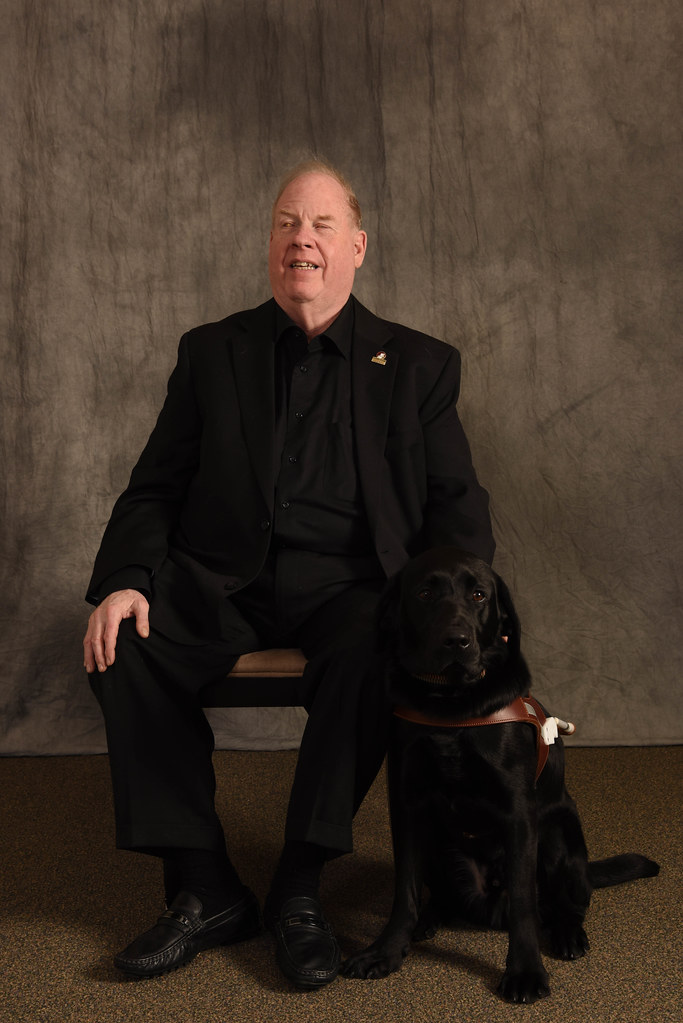
Michael Hingson
Michael Hingson is a keynote speaker, bestselling author of Thunder Dog, and a survivor of the September 11 World Trade Center attacks. Blind since birth, he brings a powerful and unique perspective on leadership, trust, and resilience in times of uncertainty.
He has spoken to organizations around the world, helping leaders and teams navigate change, build trust, and perform under pressure. His message combines real-world experience with practical insight that audiences remember long after the event ends.
👉 Book Michael Hingson for your next event.