
The Strategic Benefits of Web Accessibility: Building Trust and Resilience in 2026
Discover how web accessibility transcends compliance to become a powerful driver of business growth, SEO performance, and inclusive leadership.
Key Takeaways
- Expanded Market Reach: Web accessibility opens your brand to the one in four adults with a disability, a global market with trillions in disposable income.
- Enhanced SEO Performance: The principles of accessibility—clear structure, descriptive text, and usability—are directly aligned with the factors Google uses to rank websites.
- Reduced Legal Risk: Proactively embracing accessibility standards like WCAG mitigates the growing risk of costly lawsuits and reputational damage.
- Stronger Brand Trust: An accessible digital experience is a clear signal that your organization is committed to ethical leadership, inclusion, and serving every customer.
Why This Matters for Leaders
In today’s market, trust is the ultimate currency. A website that excludes a significant portion of the population is more than a technical oversight; it’s a breakdown in trust. For leaders, championing web accessibility is not a task to delegate to IT—it’s a strategic decision that demonstrates a commitment to equity, builds a resilient brand, and fosters a culture where no one is left behind. It’s a direct reflection of an organization’s values and its readiness to lead in an inclusive world.
What is Web Accessibility and Why Does it Define Digital Leadership?
Web accessibility is the practice of designing and developing websites, tools, and technologies so that people with disabilities can use them. It’s about removing the digital barriers that prevent interaction or access to information. But from my perspective, it’s much simpler: it’s about choosing to see beyond perceived limitations to provide equal opportunity for everyone.
When the web was created, its purpose was universal access. Any exclusion we see today is the result of a design choice, not a technical necessity. True digital leadership means making the conscious choice to include everyone. In short, web accessibility is the digital equivalent of the “curb-cut” effect—a feature designed for a few that ultimately benefits all.
According to Web Accessibility, this is a well-documented area of ongoing research and practical application.
The Human Impact: Beyond the Source Code
For millions in the blind community, a screen reader like JAWS is the key to the digital world. It transforms visual content into audible speech, making the internet navigable. But its effectiveness depends entirely on how a website is built. Without proper design, the experience is like trying to find your way through a maze without walls or signs.
On September 11, 2001, I navigated 78 floors down the North Tower of the World Trade Center. I didn’t do it alone; I did it with my guide dog, Roselle. The journey was possible because of absolute trust and teamwork. That same level of trust is what users with disabilities place in your digital interface. When it fails, they are left behind. True accessibility isn’t an “extra” feature; it’s a fundamental characteristic of high-quality, human-centered design.
Accessibility as a Foundation for Corporate Trust
Inclusive design is the first, most visible step in building a resilient mindset within an organization. When your digital front door is open to everyone, it sends a powerful message about your brand’s commitment to social responsibility and ethical leadership. It shows you are not just talking about inclusion, but actively building it into the core of your customer experience. This foundation of trust is what separates fleeting brands from enduring institutions.
The Strategic Business Case: Expanding Market Reach and SEO
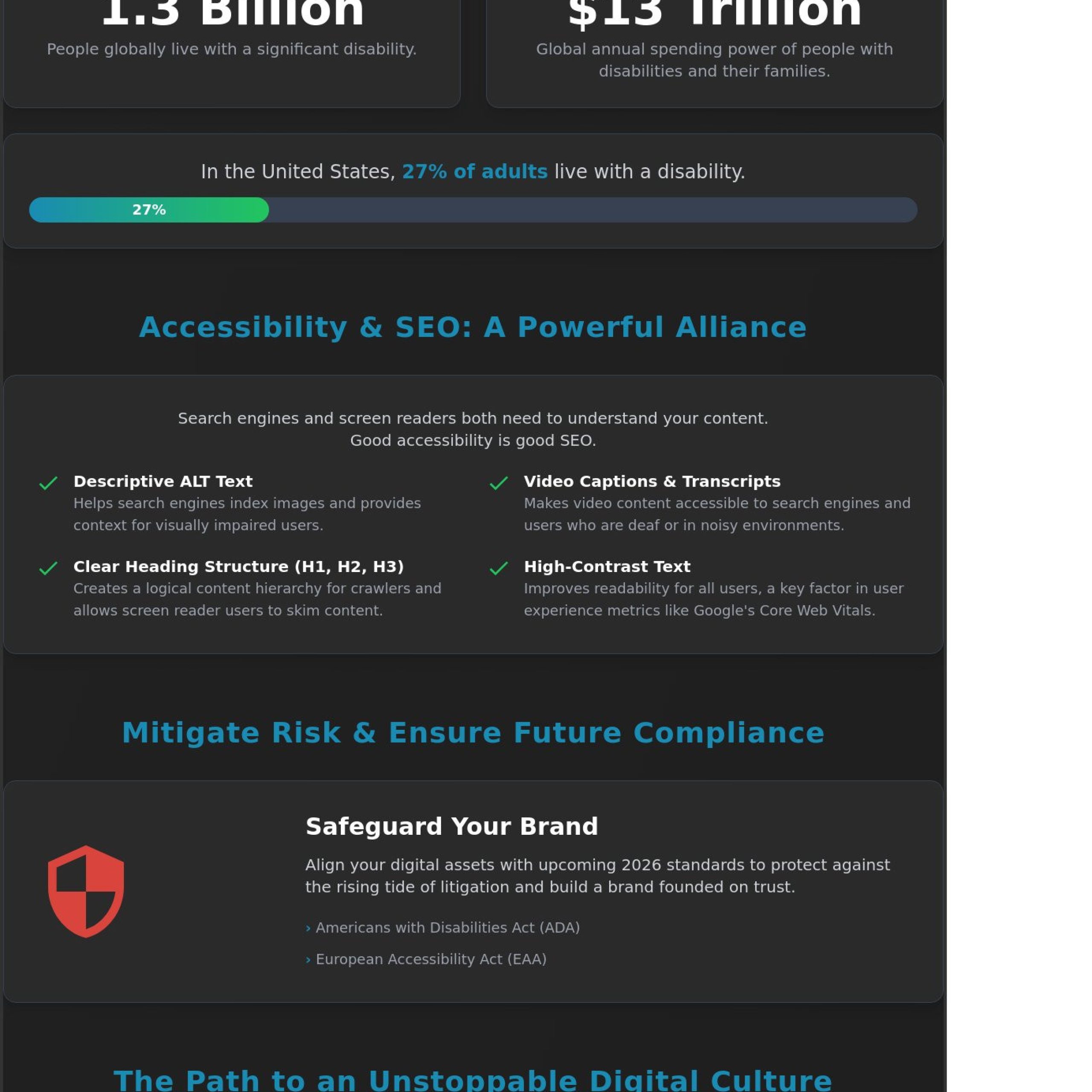
Prioritizing accessibility isn’t just the right thing to do; it’s a powerful business strategy. In the United States alone, one in four adults lives with a disability, representing a massive and frequently overlooked market. Globally, this “disability market” holds trillions of dollars in disposable income. By ignoring accessibility, businesses are voluntarily closing their doors to a significant customer base.
Furthermore, the “Curb-Cut Effect” proves that features designed for accessibility improve the experience for everyone. Captions help a user in a noisy environment, high-contrast text helps someone in bright sunlight, and a clear, logical layout helps a stressed user find information quickly. An accessible site is simply a more usable site for every single visitor.
Research published by strategic business case for accessibility shows that this is a well-documented area of ongoing research and practical application.
SEO and Accessibility: Two Sides of the Same Coin
Search engines like Google aim to provide users with the most relevant and usable results. It’s no surprise, then, that the best practices for web accessibility are deeply intertwined with those for search engine optimization (SEO).
- Descriptive Alt Text: Providing alternative text for images (a necessity for screen reader users) gives search engine crawlers rich, descriptive context about your visual content, helping it rank in image searches.
- Clear Heading Structures: A logical hierarchy of headings (H1, H2, H3) allows screen readers to scan a page efficiently. It also gives search engines a clear outline of your content, helping them understand its structure and importance.
- User Experience Metrics: Google’s ranking algorithms increasingly prioritize user experience. An accessible site is inherently easier to navigate, reduces friction, and keeps users engaged longer—all positive signals that can boost your rankings.
Improving User Retention and Conversion
The cost of an inaccessible website is measured in lost customers. A UK study found that 71% of users with disabilities will leave a site that is difficult to use. That’s not just a lost visitor; it’s a lost sale and a customer who will likely share their negative experience.
By designing for inclusion, you reduce friction for all users, which directly translates to higher engagement and better conversion rates. An inclusive approach also prevents the significant “rework” costs associated with fixing common accessibility issues after a site has already launched. Building it right from the start is always more efficient and cost-effective.
Mitigating Legal Risk and Ensuring Compliance in 2026
The legal landscape surrounding digital accessibility is becoming stricter every year. Laws like the Americans with Disabilities Act (ADA) Title III and Section 508 in the U.S., along with the European Accessibility Act, are increasingly being applied to websites and digital content. Web accessibility lawsuits have surged in recent years, resulting in significant financial and reputational costs for non-compliant organizations.
However, leaders should view compliance not as the finish line, but as the starting block for ethical business operations. In 2026, digital accessibility is no longer optional but a legal and moral mandate for any global enterprise.
Understanding WCAG 2.2 and Beyond
The Web Content Accessibility Guidelines (WCAG) serve as the global benchmark for accessibility. These guidelines provide a clear framework for making your content accessible to a wide range of people with disabilities. While automated testing tools can catch some issues, they cannot replace the necessity of manual testing by people with lived experience. True compliance and usability come from understanding the human side of navigation, which requires a more hands-on approach.
The Cost of Inaccessibility
The true cost of inaccessibility extends far beyond legal fees. It includes lost revenue from customers you turn away, negative PR that erodes brand trust, and the high price of “bolted-on” fixes made under pressure. This reactive approach is always more expensive and less effective than a “born accessible” strategy, which integrates inclusion from the very first stages of design and development. A proactive stance on accessibility is an investment in long-term brand resilience.
Building an Unstoppable Digital Culture: Leadership Lessons
Web accessibility is a technical outcome of a human-centric culture. It is a tangible expression of your organization’s commitment to diversity and inclusion in the workplace. For this commitment to be authentic, it must be championed by leadership. When leaders prioritize accessibility, it ceases to be a checklist item and becomes woven into the company’s DNA.
This inclusive digital presence does more than attract customers; it attracts top talent. The best and brightest employees want to work for companies that value equity and belonging. Framing the adoption of accessibility as a leadership journey transforms it from a requirement into a competitive advantage.
Empowering Teams Through Inclusive Design
Lasting change happens when teams are empowered with the right tools, training, and mindset. Leaders must foster a culture of empathy where designers and developers are encouraged to ask, “Who might we be excluding?” rather than just, “Is this compliant?” Appointing internal “accessibility champions” can help embed this mindset across departments, turning a top-down initiative into a grassroots movement.
Trust and Teamwork: The Michael Hingson Approach
The most important lesson I learned in Tower One was that preparation and trust are what allow you to navigate any crisis. My trust in Roselle was built over thousands of hours of teamwork. An accessible website is a form of preparation. It is an act of trust-building that ensures no user is left behind on their journey with your brand, no matter the circumstances.
Adopting an Unstoppable Mindset about digital equity means seeing it not as a problem to be solved, but as an opportunity to connect with humanity more deeply. It’s about leading with vision and ensuring your digital world reflects the inclusive world you want to build.
If you’re looking for a keynote speaker who can help your team navigate uncertainty, build radical trust, and lead through change, I bring a perspective that few others can offer.
Next Steps: How to Implement a Robust Accessibility Strategy
Creating a truly accessible organization requires a multi-layered approach that combines automated tools, expert audits, and, most importantly, testing by actual users with disabilities. It demands specialized training for your teams, particularly on how assistive technologies like the JAWS screen reader are used to navigate digital content.
A successful rollout is often phased. Start with a comprehensive audit to identify the most critical issues, then prioritize fixing high-traffic pages and conversion paths. This iterative process makes the task manageable and ensures you are making the most impactful changes first.
Strategic Consulting and Adaptive Technology Training
Moving from basic compliance to authentic inclusion often requires a guide. My consulting services help organizations bridge that gap, developing long-term strategies that foster a deeply embedded culture of accessibility. Through professional JAWS training and executive keynotes, I work with leaders to shift corporate mindsets, transforming accessibility from an obligation into a core business strength.
Your Accessibility Roadmap for 2026
A simple but powerful plan can guide your journey:
- Audit: Understand where you are today with a thorough audit combining automated and manual testing.
- Educate: Equip your teams with the training and resources they need to design and build inclusively.
- Iterate: Embed accessibility into your workflows so that it becomes a continuous practice, not a one-time project.
Ready to build a more inclusive, resilient, and trusted brand? Let’s connect and discuss how my experience can help your organization lead with vision.

Article by
Michael Hingson
Michael Hingson is a keynote speaker, bestselling author of Thunder Dog, and a survivor of the September 11 World Trade Center attacks. Blind since birth, he brings a powerful and unique perspective on leadership, trust, and resilience in times of uncertainty.
He has spoken to organizations around the world, helping leaders and teams navigate change, build trust, and perform under pressure. His message combines real-world experience with practical insight that audiences remember long after the event ends.
👉 Book Michael Hingson for your next event.