
Resilience Stories: How an Unstoppable Mindset Turns Adversity into Growth
On September 11, 2001, at 8:46 AM, the North Tower of the World Trade Center shuddered under the impact of a hijacked plane. I sat on the 78th floor, and while I couldn’t see the smoke, I felt the gravity of the moment. My guide dog, Roselle, remained calm, reminding me that even in chaos, we have choices. You likely understand the weight of feeling overwhelmed by things you can’t control. According to the American Psychological Association, 27% of adults report being so stressed they can’t function. It’s easy to feel isolated when your life feels like it’s crumbling. These resilience stories serve as more than just inspiration; they’re a practical roadmap for your own growth.
You’ll learn how to shift your mindset from fear to focused action by adopting an Unstoppable Mindset. We’ll explore the specific strategies of interdependence and leadership that allow you to move forward when the path ahead seems dark. This journey will validate your emotional state while providing the concrete tools to build a life with no limits.
Key Takeaways
- Learn to “bounce forward” after a crisis by using adversity as a catalyst for gaining new wisdom rather than simply trying to return to the status quo.
- Discover how proactive preparation and “adaptive technology” for the mind create a foundation of strength that sustains you long before a challenge arises.
- Explore how the 1,463-step descent from the 78th floor on 9/11 serves as one of the most profound resilience stories, illustrating the power of trust and calm in the face of chaos.
- Apply the “Unstoppable Mindset” framework to your own life to move beyond perceived limits and identify the partners or systems you can trust implicitly.
- Audit your current mindset to shift your focus from obstacles to opportunities, allowing you to navigate your own “Tower One” moments with confidence.
The Anatomy of Resilience Stories: Why We Need Them
When the first plane struck the North Tower on September 11, 2001, at 8:46 AM, my life did not just pause; it began a new chapter defined by a concept many misunderstand. Most people view resilience as a rubber band snapping back to its original shape. I disagree. True resilience is the act of bouncing forward. It is the process of taking the heat and pressure of a crisis and allowing it to forge you into something more capable than you were before. We share psychological resilience stories because they provide the mental maps we need to navigate our own 78th floor moments. These narratives aren’t just entertainment. They’re blueprints for survival and growth.
I have lived my life with a specific perspective on my blindness. To me, being blind is a characteristic, much like having blue eyes or being left handed. It’s not a handicap. A handicap is a self-imposed or externally forced limitation that stops progress. A characteristic is simply a trait you manage through adaptation and tools, like my guide dog, Roselle. When we view our challenges as characteristics, we strip away the shame and replace it with strategy. This shift is essential for leadership. It allows a leader to see a problem not as a wall, but as a logistical puzzle to be solved through teamwork and trust.
The Difference Between Survival and Resilience
Survival is a biological imperative. It’s about keeping your heart beating while you descend 1,463 steps in a smoke-filled stairwell. Resilience, however, is what happens when you reach the bottom and decide what that experience means. You move from being a victim of circumstances to being the architect of your future. As I often say, “I choose to live a life with No Limits.” This mindset requires you to find meaning in the aftermath. In 2002, just one year after the attacks, I began traveling to share how trust in my partner, Roselle, saved my life. That is the architect at work.
The Science of Storytelling and the Brain
Your brain doesn’t know the difference between a well-told story and reality. When you hear sensory-rich resilience stories, your mind treats them as a dress rehearsal for your own challenges. If I describe the pungent, metallic smell of jet fuel or the cool fur of Roselle’s neck, your brain activates the same regions it would if you were there. Research from 2014 suggests that character-driven stories can cause a 15% increase in oxytocin production. This chemical bond builds trust and empathy. Simultaneously, these narratives help regulate cortisol, the stress hormone, by providing a sense of order and resolution to chaotic events. We don’t just listen to resilience stories; we physiologically integrate their lessons to build our own Unstoppable Mindset.
Preparation: The Hidden Foundation of Resilience
Most people think resilience is something you find only when the world starts shaking. It isn’t. Resilience is a structure you build brick by brick while the sun is shining. If you wait for the storm to start construction, you’ve already lost. True resilience stories don’t begin at the moment of impact; they start years earlier in the quiet moments of daily discipline and mental conditioning.
The American Psychological Association on resilience defines it as the process of adapting well in the face of adversity. This adaptation isn’t a lucky accident. It requires specific tools that you integrate into your life long before you need them. I call this building your “internal infrastructure.” It’s the difference between a building that collapses under pressure and one that sways but remains standing.
As a blind person, I rely on JAWS, which stands for Job Access With Speech. This software is adaptive technology that translates what’s on a computer screen into spoken words. It allows me to navigate digital landscapes with the same speed as a sighted person. You need a similar “adaptive technology” for your mind. This mental software allows you to process fear, analyze your surroundings, and make decisions without being paralyzed by the chaos around you.
Trust is a currency that behaves like a savings account. You earn it during the 2,000 days of calm so you can spend it during the 2 hours of a crisis. On the 78th floor of Tower One, my team followed me and my guide dog, Roselle, because we’d built that bank account of trust over months of working together. We didn’t have to debate my competence or Roselle’s training while the building swayed. We’d already done the work.
Routine is the anchor that keeps your mindset steady. I’ve maintained a specific morning discipline for over 30 years. This consistency creates a baseline of normalcy that doesn’t fluctuate based on external events. When you master your routine, you master your response to the world. It’s about creating a sense of certainty in an uncertain environment.
Training Your Mind for the Unexpected
When the plane hit the North Tower on September 11, 2001, I didn’t have to guess where the nearest exit was. I’d already walked those paths and counted the steps. I’d practiced situational awareness every day since I started working there in 1999. I knew the sounds of the elevators and the specific feel of the air in the hallway. This wasn’t paranoia; it was professional preparation. You can cultivate this by identifying your safe exits in your career. List three people you can call if a project fails and two ways to pivot if your industry shifts by 20% this year. Knowing your exits before you need them reduces your panic when the lights go out.
Building a Culture of Trust Before the Crisis
Many corporate teams fail because they only focus on resilience during a downturn, such as a 15% drop in quarterly revenue. That’s a reactive approach. At Quantum, my team succeeded because we operated under a “Trust and Teamwork” framework every single day. We prioritized transparent communication and mutual support when things were going well. Interdependence is the highest form of human achievement, where individual strengths combine to create a result that no single person could reach alone. This level of connection is what allows a group to function as a single, resilient unit. You can learn more about developing this unstoppable mindset to lead your own team through any challenge.
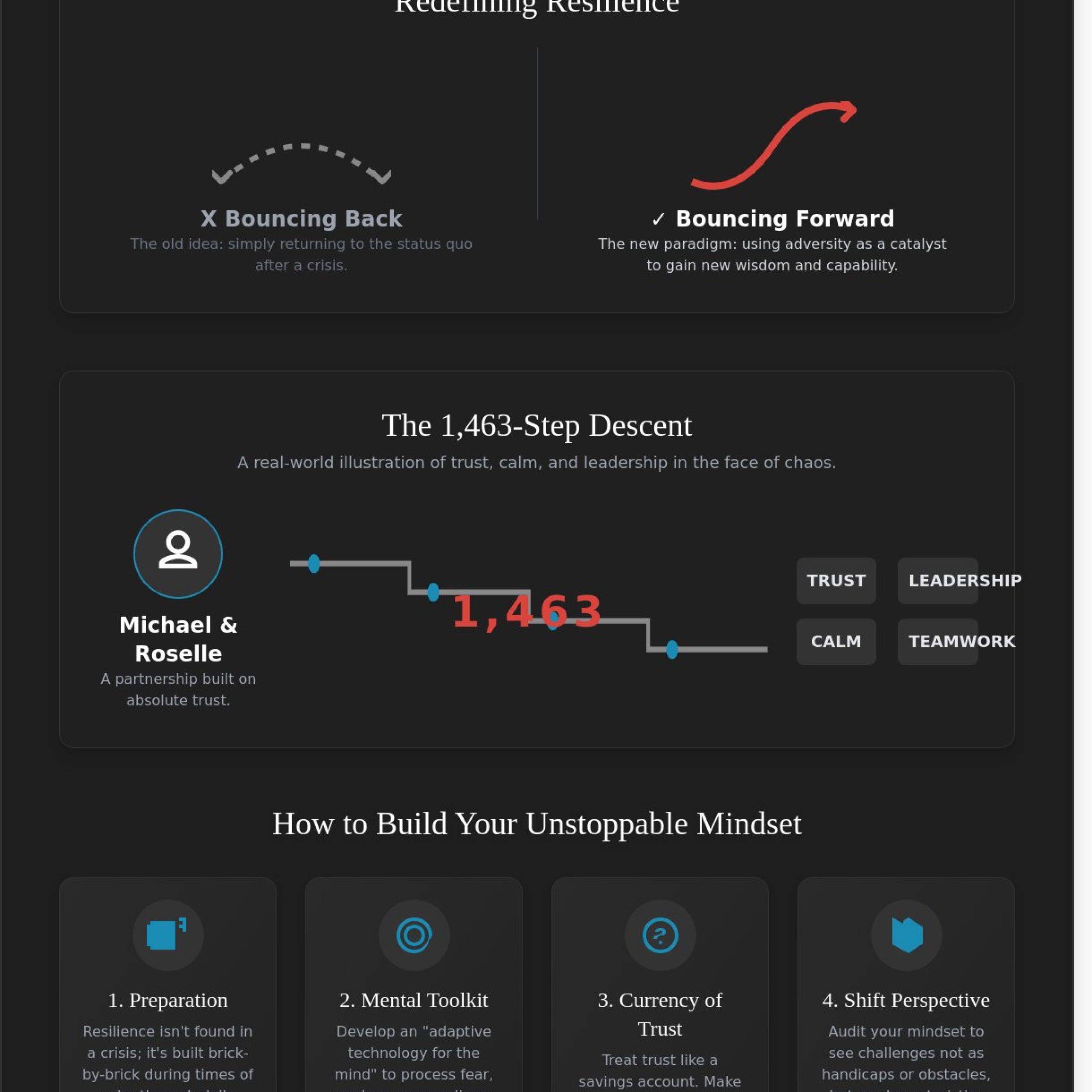
1,463 Steps: The Resilience Story of Michael and Roselle
At 8:46 AM on September 11, 2001, the world changed for everyone inside Tower One. I was sitting at my desk on the 78th floor when a Boeing 767 struck the building eighteen floors above me. The tower shuddered and tilted about twenty feet before slowly righting itself. In that moment, the air grew thick with the acrid, metallic scent of burning jet fuel. While others felt the grip of panic, I reached for Roselle, my yellow Labrador guide dog. She was calm. She wasn’t barking or pacing; she was waiting for me to lead. Her composure provided the foundation for one of the most enduring resilience stories of that day.
The descent down 1,463 steps was a marathon of the senses. I heard the rhythmic “click-click” of Roselle’s nails on the concrete stairs, a steady metronome amidst the sound of groaning steel and distant shouting. The heat intensified as we moved through the impact zone, yet Roselle stayed focused on her task. In the chaos of that stairwell, I learned that building resilience isn’t an isolated act of willpower. It’s a series of small, deliberate choices made in the dark. I didn’t need to see the lobby to know I had to take the next step. I only needed to trust the partner at my side and the training we had completed together.
One of the greatest lessons from those two hours in the stairwell is that clarity often comes from narrowing your focus. We didn’t obsess over the structural integrity of the entire 110-story building. We focused on the ten feet of space directly in front of us. This mindset allowed us to navigate past firefighters heading up and colleagues struggling to move down. By the time we reached the street level, the South Tower had already collapsed, filling the air with a blinding, choking dust. Still, we kept moving. We didn’t stop because we couldn’t see the finish line; we stopped only when we reached safety.
Interdependence: The Bond That Saved Lives
True resilience is rarely a solo endeavor. My relationship with Roselle was never one of master and servant; it was a partnership of absolute equals. While I provided the directional commands, she provided the tactical navigation. She focused on her “job,” which in turn allowed me to focus on my “mission” of keeping our group calm and moving forward. This level of interdependence is a hallmark of successful resilience stories. When you have a partner who shares your vision, even if they perceive the world through different senses, you can overcome obstacles that seem insurmountable to a single individual.
The Aftermath: Turning Tragedy into a Keynote Message
The transition from a regional sales manager at Quantum to a global messenger of hope began shortly after that day. In 2011, my book “Thunder Dog” became a New York Times bestseller by focusing on the mechanics of trust rather than the graphics of tragedy. Since then, I’ve delivered more than 1,000 keynote presentations to corporations worldwide. I teach leaders that blindness is merely a characteristic, not a limitation. This journey naturally led to the development of “The Art of Living with No Limits,” a philosophy that encourages people to move beyond their perceived boundaries by adopting an Unstoppable Mindset.
Diversifying Resilience: Stories from the Unstoppable Mindset Podcast
Resilience is often viewed through the lens of a single, catastrophic event. While my journey down 1,463 stairs on September 11, 2001, provides a vivid backdrop for survival, I’ve learned that the Unstoppable Mindset is a universal framework. It applies to every person, regardless of their specific struggle. Through my podcast, I explore these resilience stories to show that the mechanics of overcoming obstacles are remarkably consistent. Whether you’re leading a Fortune 500 company or navigating a personal health crisis, the internal shift from victim to architect remains the same. It is about moving from a state of paralysis to a state of purposeful action.
Entrepreneurial Resilience: Sara Blakely’s Journey
Sara Blakely didn’t start Spanx with a massive venture capital injection. She started in 1998 with $5,000 in personal savings and a relentless refusal to accept the word “no.” For two years, she faced constant rejection from hosiery mill owners who couldn’t see the value in her prototype. Sara’s resilience was rooted in a childhood lesson where her father encouraged her to share her failures at the dinner table. This reframing turned failure into a requirement for innovation. She practiced “seeing beyond the blindness” of market skeptics, focusing on the solution rather than the criticism. My strategic consulting helps organizations adopt this same vision, teaching teams to treat obstacles as essential feedback loops rather than roadblocks.
Physical and Social Resilience: The Story of Lizzie Velasquez
Lizzie Velasquez faced a different kind of fire. In 2006, she discovered an eight-second YouTube video labeling her the “World’s Ugliest Woman.” At just 17 years old, she encountered a level of social cruelty that would break most people. Lizzie chose to define her own narrative instead of letting the digital world do it for her. She transformed that trauma into a global advocacy movement against bullying. Her story illustrates that resilience isn’t just about bouncing back; it’s about moving forward with a new purpose. She used her visibility to foster empathy and inclusion, proving that our perceived limitations can become our greatest platforms for healing. She didn’t just survive the labels; she rewrote the dictionary of her life. You can explore more about Lizzie Velasquez’s journey from victimhood to vision and how she transformed online cruelty into a global movement for resilience.
Comparing these resilience stories reveals a fundamental truth. The “what” of adversity varies wildly, but the “how” of the unstoppable mindset is identical. It requires three specific actions:
- Acceptance: Acknowledging the reality of the situation without being paralyzed by it.
- Adaptation: Finding new ways to move toward a goal when the traditional path is blocked.
- Interdependence: Recognizing that we are stronger when we lean on the trust and support of others.
Each of these journeys demonstrates that resilience is a learned skill rather than an innate trait. Sara Blakely navigated the boardrooms of the fashion world. Lizzie Velasquez navigated the harsh landscape of social media. I navigated the smoke-filled descent of Tower One with Roselle. In each case, the path forward was lit by a refusal to let external circumstances dictate internal worth. Resilience isn’t a trait reserved for the few; it’s a strategy available to everyone who is willing to change their perspective and embrace the discomfort of growth.
Are you ready to build a culture of trust and adaptability within your team? Book Michael Hingson for your next event to learn how to master the Unstoppable Mindset.
How to Write Your Own Resilience Story: A Practical Guide
Resilience isn’t a fixed trait that some people possess while others lack. It’s a narrative you construct through daily choices and disciplined thought. On September 11, 2001, my descent down 1,463 steps wasn’t a solo act of bravery; it was a demonstration of a prepared mind. You can build this same strength by intentionally crafting your own resilience stories through a structured approach to your challenges.
Step 1: Audit your current mindset. Start by documenting your reactions to stress over a 48 hour period. Are you focused on your limits or your possibilities? If you find yourself saying “I can’t because,” you’re operating from a deficit. Shift your internal dialogue to “How might I?” to open the door to creative problem solving. A 2022 study on cognitive reframing showed that individuals who consciously shift their perspective during crises recover 30 percent faster from emotional setbacks.
Step 2: Identify your “Roselle.” No one succeeds in a vacuum. I trusted my guide dog, Roselle, with my life because we had spent years building a foundation of interdependence. Identify the partners, mentors, or technological systems you can trust implicitly. True resilience grows when you stop trying to be a lone hero and start becoming an effective partner.
Step 3: Practice “No Limits” thinking. Tackle one small perceived boundary every single day. If you believe you aren’t a public speaker, commit to sharing one idea in a three minute meeting update. These micro-victories recalibrate your brain to view boundaries as temporary hurdles rather than permanent walls. By the time a major crisis hits, you’ll have hundreds of data points proving your ability to adapt. Pairing this daily practice with powerful adversity quotes that reinforce an unstoppable mindset can sharpen your focus and sustain your momentum through even the most challenging moments.
Step 4: Reframe your past challenges as “training sessions.” Every hardship you’ve survived since your first day of school has been a rehearsal for your future self. Don’t look at a failed business venture or a personal loss as a scar; view it as high intensity interval training for your character. You’ve already survived 100 percent of your worst days. That’s a perfect track record.
Step 5: Share your story. When you articulate your journey, you reinforce your own growth and provide a roadmap for others. Sharing your resilience stories transforms your private pain into a public asset. It moves the narrative from “What happened to me?” to “What I did with what happened.”
Mastering the Unstoppable Mindset
The Unstoppable Mindset isn’t a destination you reach; it’s a daily commitment to excellence and adaptability. To master this, use sensory-rich language to visualize your goals. Don’t just think about success. Imagine the specific scent of the air in your new office or the tactile feel of the handshake after a closed deal. This level of detail creates a neural blueprint that guides your actions. For corporate teams, Michael’s “No Limits” keynote serves as a powerful starting point to instill these principles across an entire organization, turning collective fear into collaborative action.
Taking Action: From Reader to Leader
Passive consumption of stories won’t change your life. Active implementation will. Moving from a reader to a leader requires you to take the lessons from the North Tower and apply them to your specific boardroom or living room. If you’re ready to move beyond theory and bring a culture of trust and interdependence to your team, it’s time to take the next step. You can Book Michael Hingson for your next event to bring these life-changing strategies to your organization today.
Step Into Your Own Unstoppable Future
Resilience isn’t a rare gift given to a lucky few; it’s a discipline we build through preparation and trust. On September 11, 2001, Roselle and I didn’t just survive the descent from the 78th floor by accident. We relied on the 1,463 steps of preparation we took long before the first plane hit the North Tower. This journey shows that resilience stories aren’t just about survival. They’re about how we choose to move forward when the world shifts beneath our feet. By diversifying your perspective through the Unstoppable Mindset Podcast, you gain the tools to transform any obstacle into a catalyst for growth. You don’t have to navigate these challenges alone.
As the New York Times Bestselling Author of Thunder Dog and a survivor of the 9/11 attacks, I’ve dedicated my life to helping others see beyond their perceived limitations. True leadership thrives on interdependence and the quiet strength of a focused mind. Your team has the potential to overcome any hurdle if they have the right map.
Bring the Power of Resilience to Your Organization-Book Michael Hingson Today
The path ahead is clear when you trust your training and your team. You’ve got everything you need to begin your next chapter today.
Frequently Asked Questions
What is the most famous story of resilience?
Viktor Frankl’s survival in Nazi concentration camps remains the most influential account, detailed in his 1946 book “Man’s Search for Meaning.” He discovered that individuals who found a specific purpose for their future were more likely to survive extreme deprivation. This narrative is a cornerstone among resilience stories because it demonstrates how internal mindset dictates external outcomes regardless of the environment.
Can resilience be learned, or is it an innate trait?
Resilience is a skill you develop through intentional practice rather than a trait you’re born with. The American Psychological Association identifies resilience as a process of adaptation that involves specific behaviors and thoughts. You don’t just have it; you build it. By facing smaller daily obstacles, you strengthen your ability to handle 10 out of 10 life events when they occur.
How did Michael Hingson survive 9/11 while being blind?
Michael Hingson survived the North Tower collapse on September 11, 2001, by trusting his guide dog, Roselle, and his own preparation. They successfully navigated 78 flights of stairs over the course of 60 minutes. His survival wasn’t a matter of luck. It was the result of a disciplined mindset and a deep, interdependent partnership with his guide dog that allowed them to stay calm.
What are the 7 Cs of resilience and how do they apply to these stories?
The 7 Cs, developed by Dr. Kenneth Ginsburg, include competence, confidence, connection, character, contribution, coping, and control. These pillars are common themes in resilience stories across the globe. During the descent from Tower One, Michael utilized “control” by managing his breathing and “connection” by encouraging his colleagues. These elements transform abstract strength into a practical, repeatable strategy for survival.
How can I help my team build resilience during a corporate crisis?
You can support your team by prioritizing psychological safety and clear, 100% transparent communication. Data from Gallup shows that high-trust teams are 50% more productive during periods of intense change. Encourage your staff to focus on interdependence. When you move away from the “handicap” of working in silos, your team becomes an unstoppable force capable of navigating any market shift.
What role does trust play in overcoming extreme adversity?
Trust is the essential bridge between fear and action when the path forward isn’t visible. On 9/11, Michael’s trust in Roselle’s training allowed him to lead others to safety. In any crisis, trust reduces the cognitive load of second-guessing; it allows you to focus entirely on the next step. This ensures that your energy is spent on progress rather than panic.
Where can I find more resilience stories for the workplace?
The Unstoppable Mindset Podcast with Michael Hingson is an excellent resource for hearing from leaders who have overcome significant hurdles. Each episode provides 45 minutes of deep-dive interviews into how professionals navigate adversity. You’ll find specific examples of adaptive living and leadership strategies that apply directly to the modern office environment. These stories serve as blueprints for your own professional growth. For organizations looking to align their brand with these powerful messages of resilience and inclusion, consider exploring unstoppable mindset podcast sponsorship opportunities to reach an engaged audience of growth-oriented professionals.
How do I start a podcast about resilience and mindset?
You start by identifying 12 core topics that define your unique perspective on the Unstoppable Mindset. Invest in a quality microphone like the Shure SM7B and choose a reliable hosting platform. Your focus should be on authentic storytelling that provides listeners with 3 actionable takeaways per episode. Consistency matters more than perfection; aim to release one episode every Tuesday to build your community.
Article by
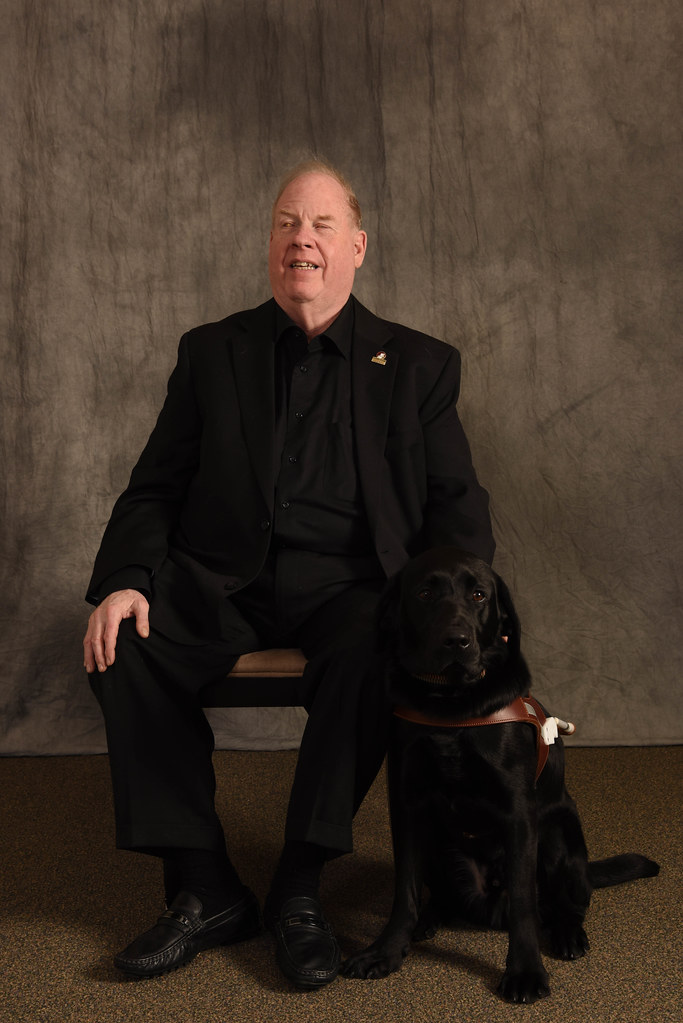
Michael Hingson
Michael Hingson is a keynote speaker, bestselling author of Thunder Dog, and a survivor of the September 11 World Trade Center attacks. Blind since birth, he brings a powerful and unique perspective on leadership, trust, and resilience in times of uncertainty.
He has spoken to organizations around the world, helping leaders and teams navigate change, build trust, and perform under pressure. His message combines real-world experience with practical insight that audiences remember long after the event ends.
👉 Book Michael Hingson for your next event.