Leadership and Trust: Tactical Lessons from Tower One
On September 11, 2001, at exactly 8:46 AM, a violent explosion rocked the North Tower of the World Trade Center, instantly turning a standard Tuesday into a fight for survival. From my office on the 78th floor, I felt the building sway nearly 20 feet before it began to right itself. I couldn’t see the smoke or the debris, but I could feel the calm confidence of my guide dog, Roselle, as she waited for my command. In those harrowing moments, the bond between leadership and trust became the literal difference between life and death for me and my colleagues. It wasn’t about a title or a corner office; it was about the interdependence we had cultivated long before the first alarm sounded.
You probably know the feeling of a team that freezes when a crisis hits or the frustration of communication breaking down during a high-stakes project. It’s difficult to move forward when your people are more afraid of making a mistake than they are focused on the mission. This article will show you how to build a resilient, unstoppable mindset by applying the tactical lessons I learned while descending 1,463 stairs to safety. We’ll explore a framework for creating an inclusive culture where every voice is heard and every person feels empowered to lead, regardless of the circumstances.
Key Takeaways
- Shift your perspective from a top-down hierarchy to a model of interdependence where leaders and teams rely on each other as equal partners.
- Learn how to “bank” trust during periods of stability to ensure your team remains resilient when the map no longer matches the terrain.
- Master the critical nuances of leadership and trust by learning to guide people through the unforeseeable rather than simply managing a process.
- Discover why disability inclusion is the ultimate stress test for organizational trust and how it redefines diversity as a tactical advantage.
- Implement an actionable strategy using the “Trust Audit” and “Intelligent Disobedience” training to foster open communication and empowered feedback.
Redefining Leadership and Trust Through Interdependence
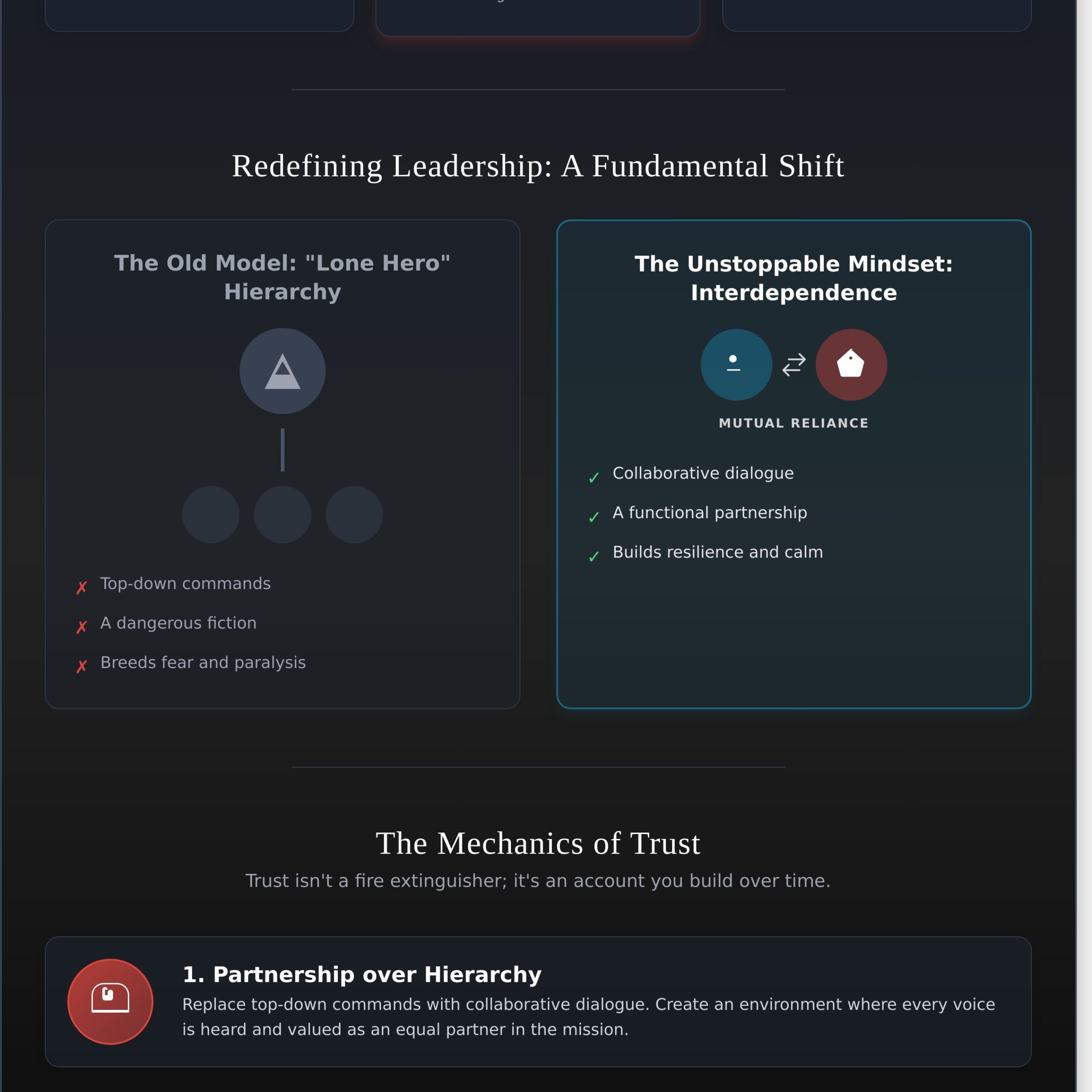
The traditional corporate ladder suggests that leadership flows downward, like a heavy weight pressing from the top. We’re taught that the person at the peak holds all the answers and carries the burden of every decision. This “Lone Hero” model is a dangerous fiction that ignores the reality of human connection. True leadership and trust aren’t about one person standing above the rest; they’re about a functional partnership where every member of the team is essential to the collective survival and success of the group.
Interdependence is the heartbeat of a high-performing organization. It’s the recognition that while a team relies on its leader for vision and direction, the leader is equally dependent on the team’s expertise, feedback, and execution. When I was on the 78th floor of the North Tower on September 11, 2001, I didn’t need a hero. I needed a partner. My relationship with my guide dog, Roselle, wasn’t a hierarchy where I gave commands and she blindly followed. It was a sophisticated dance of mutual reliance that allowed us to navigate 1,463 steps to safety. This synergy is the ultimate blueprint for professional trust.
The 9/11 Stress Test: When Trust Becomes Survival
At 8:46 AM, the world as I knew it shifted. The impact of Flight 11 into the North Tower sent a shudder through the building that felt like a slow-motion earthquake. In that moment, the immediate need wasn’t for panic or frantic shouting, but for a controlled, deliberate response. My colleagues looked to me, and I looked to Roselle. We had practiced our fire drills, and we had built a foundation of reliability long before the crisis began. Because we trusted our preparation, we were able to begin a descent that lasted over an hour without succumbing to the chaos surrounding us.
Leadership is the ability to foster calm in the center of a storm.
Trust as a Characteristic, Not a Limitation
Many people mistake trust for a passive state, often calling it “blind trust” when they describe my bond with Roselle. In reality, our partnership was informed and adaptive. Blind trust implies a lack of awareness, whereas true trust requires an acute sensitivity to your partner’s signals. Trust thrives when we embrace Ethical Leadership, where honesty and fairness create a stable foundation for every interaction. In a corporate setting, you must identify the blind spots in your own style that erode team confidence. These often manifest as a lack of transparency or a failure to listen to those on the front lines.
Building a shared vision requires sensory-rich communication. You don’t need physical sight to “see” where your organization is going. You need to articulate the textures, sounds, and feelings of your goals so that every team member can visualize the path forward. At The Unstoppable Mindset, we teach that blindness is merely a characteristic, not a limitation. When leaders stop viewing their team’s needs as “accommodations” and start seeing them as essential components of an adaptive system, they unlock a level of resilience that can withstand any market shift or internal crisis. Trust isn’t something you demand; it’s something you build through consistent, rhythmic action and a commitment to seeing beyond the immediate obstacles.
- Partnership over Hierarchy: Replace top-down commands with collaborative dialogue.
- Shared Vulnerability: Admit what you don’t know to encourage team input.
- Predictable Reliability: Ensure your actions match your words every single day.
By moving away from the “Lone Hero” myth, you allow your team to step into their own power. You create a culture where interdependence is celebrated as a strength. This shift doesn’t just improve morale; it builds a structural integrity that ensures your organization can weather the most intense stress tests. When you lead with an Unstoppable Mindset, you recognize that the strongest bond is the one where everyone is invested in the safety and success of the person standing next to them.
The Mechanics of Building Trust Before the Crisis Hits
Trust isn’t a fire extinguisher. You don’t grab it off the wall only when the smoke begins to curl under the door. You bank it. You store it away during the long, mundane hours of routine so that when the world tilts, you have a reserve to draw upon. On September 11, 2001, at 8:46 AM, I didn’t have to wonder if my guide dog, Roselle, was up for the task. We had 19 months of daily deposits in our trust account. Effective leadership and trust require this same foresight. It’s the quiet preparation that serves as the ultimate form of respect for your team and your organization.
By identifying potential points of failure through a “No Limits” approach, you demonstrate that your team’s safety and success are your primary metrics. This isn’t about pessimism; it’s about the 1,463 steps we eventually took to safety. We build reliability through a rhythmic communication style, ensuring every team member knows the heartbeat of the organization before the music stops. According to the 2023 Edelman Trust Barometer, 62% of employees globally find that a lack of transparent communication is the primary reason for workplace friction. We must move beyond that friction by establishing a cadence of honesty long before a disaster strikes.
Lessons from Roselle: The Language of Non-Verbal Trust
Roselle taught me that trust is often silent. She didn’t need to bark to lead me; her consistency in the harness told me everything I needed to know. This alignment of character and competence forms the building blocks of leadership trust that sustain a team when the lights go out. A vital part of this is intelligent disobedience. In guide dog training, if I tell Roselle to move forward but there’s a silent electric car approaching, she must refuse. She must speak up against a hazard I can’t see. High-performing teams require this same permission to dissent. When a team member identifies a risk, their voice must be heard without fear of retribution.
Practical Exercise: Audit your team’s “safety to speak” score.
- Ask every member to anonymously rate their comfort in challenging a senior decision on a scale of 1 to 10.
- If the average is below 8.2, your trust bank is nearing a dangerous deficit.
- Identify one specific “hazard” that was mentioned and address it publicly within 48 hours to show that speaking up produces results.
Creating a Culture of Radical Transparency
Radical transparency is the primary accelerator of execution. When the North Tower was hit, the air filled with the smell of jet fuel and the sound of groaning steel. I had to be vulnerable. I had to tell my colleagues exactly what I was feeling and what I was doing. Sharing bad news quickly doesn’t create panic; it creates a shared reality that allows for collective action. Michael’s choice to trust Roselle’s calm demeanor amidst the smoke was a result of her radical transparency. She didn’t hide her focus or her work ethic. When leaders show their human side, the speed of team execution increases because the friction of hidden agendas is removed. This vulnerability allows the team to move as one unit. If you want to explore how to apply these lessons to your own challenges, consider how an unstoppable mindset can reshape your corporate culture.
Crisis Management: Leading Through the Unforeseeable
Management is about the “how,” the systems, and the logistics. Leadership is about the “who.” At 8:46 AM on September 11, 2001, the systems failed. The “map” we used to navigate our professional lives was incinerated in an instant. In that moment, leadership and trust became our only currency. You can’t manage a catastrophe, but you can lead people through one by focusing on their humanity rather than the broken process.
Leading through the unforeseeable requires a shift from controlling the outcome to guiding the person. When the North Tower was struck, I didn’t need to manage the elevators or the phone lines; I needed to lead my team to safety. This involves maintaining a resilient mindset that accepts the reality of the situation without being paralyzed by its gravity. If you’re too busy wishing the world hadn’t changed, you’ll miss the window of opportunity to act.
Tactical decision-making becomes a matter of filtering noise. In a corporate crisis, the “noise” might be market volatility or conflicting reports. In the North Tower, it was the smell of jet fuel and the confusion of thousands. You must find the signal amidst the chaos. For us, the signal was the calm, steady work of my guide dog, Roselle. You focus on the next right step, like reaching the next floor, rather than the impossible task of the entire descent.
Empathy is the glue that keeps a team focused during high-stress transitions. It’s about recognizing that every team member processes fear differently and requires a unique level of support. Research into inclusive leadership and psychological safety shows that when leaders prioritize the emotional well-being of their team, they create an environment where people can think clearly. This psychological safety allows a group to move as one unit rather than a collection of panicked individuals.
Transparency vs. Certainty: What Teams Need Most
Admitting you don’t have all the answers isn’t a failure; it’s an act of honesty that builds immense trust. On the 78th floor, I was honest about the uncertainty of the situation. We used the “78 Floors” strategy by focusing only on reaching the next landing rather than the street level. This prevented the team from being overwhelmed by the 1,463 steps ahead. Certainty is a myth, but clarity is a choice.
Navigating the Descent: Teamwork Under Pressure
During our descent, we worked to prevent “panic contagion.” If one person loses control, it can spread like wildfire through a group. Roselle and I, along with my colleagues, spoke in calm tones and checked on each other constantly. This interdependence is what allowed us to exit the building safely before it collapsed. Understanding the true importance of teamwork beyond productivity to radical trust reveals how these moments of crisis can actually strengthen organizational bonds when teams prioritize mutual support over individual survival. You can learn more about how to lead your team through a major crisis by applying these principles of mutual support and preparation.
Inclusive Leadership: Diversity as a Trust Multiplier
Inclusion isn’t a peripheral HR goal. It’s the ultimate stress test for an organization’s foundation. When a team welcomes a professional with a disability, they’re testing whether their culture actually supports the leadership and trust required for high-stakes environments. If a leader hesitates to hire someone who navigates the world differently, it reveals a crack in their confidence. True trust thrives when we stop seeing different as difficult and start seeing it as a specialized skill set. It’s about recognizing that every person brings a unique way of processing the world.
We often view blindness as a deficit. That’s a mistake. In my experience descending 78 floors of the North Tower on September 11, 2001, my lack of physical sight wasn’t a barrier. It was a catalyst for heightened communication and precision. Diversity brings different processing styles that solve problems faster. A 2023 report from Accenture found that companies leading in disability inclusion saw 28% higher revenue and 30% higher profit margins. These numbers don’t lie. They reflect the power of diverse problem-solving and the resilience that comes from a varied workforce.
Adaptive Leadership: Tools for an Unstoppable Team
Working with different perspectives sharpens a team’s focus. When my colleagues worked alongside me and Roselle, they learned to communicate with absolute clarity. They adopted an Unstoppable Mindset that prioritized results over traditional methods. This approach to workplace accommodations isn’t about special treatment; it’s about removing artificial barriers to success. You can explore how this shift transforms teams in our guide on Diversity & Inclusion: Seeing Beyond Blindness.
Building Trust Through Accessibility
Accessibility signals value. According to the CDC, 27% of adults in the United States live with some form of disability. When a workplace is accessible, it tells every employee they’re valued for their contribution, not their physical traits. ADA compliance shouldn’t be a legal hurdle. It’s a floor, not a ceiling. It’s the foundation of leadership and trust that allows everyone to perform at their peak. To start this journey, conduct an accessibility audit of your digital and physical spaces to show your team you value their diverse needs.
True psychological safety begins with inclusive hiring. When employees see a company hiring for talent regardless of physical characteristics, they feel more secure in their own roles. They realize their value isn’t tied to a narrow definition of normal. This creates a No Limits culture where everyone feels empowered to contribute. According to a 2022 study by BetterUp, workers with a strong sense of belonging saw a 56% increase in job performance. Inclusion isn’t just about the person being hired. It’s about the signal it sends to the entire room. It says that here, we trust your talent above all else.
Ready to transform your organizational culture through the power of inclusion?
Action Plan: Implementing an Unstoppable Leadership Strategy
Building a culture where leadership and trust coexist requires more than a mission statement. It demands a tactical shift in how you engage with your team every day. When Roselle and I stood on the 78th floor of the North Tower on September 11, 2001, our survival depended on a foundation of trust built long before the first plane hit. You can build that same foundation in your office by following these four steps.
- Step 1: Conduct a Trust Audit. You cannot fix what you haven’t measured. Use anonymous assessments to identify where communication is breaking down. A 2023 report from the Edelman Trust Barometer revealed that 71% of employees believe trust is the most important element of a healthy workplace, yet only 46% actually trust their management. Look for the “blind spots” where your team feels unheard or unsupported.
- Step 2: Implement Intelligent Disobedience Training. This concept, borrowed from guide dog training, empowers your team to say “no” to a directive if it puts the organization or the mission at risk. Roselle practiced this perfectly. If I told her to move forward but she saw a hazard I couldn’t perceive, she refused the command to keep us safe. Your employees need the same psychological safety to provide honest feedback without fear of retribution.
- Step 3: Shift from Compliance to Connection. Move your DEI initiatives beyond the realm of checkboxes and HR quotas. True inclusion is about interdependence. It’s the realization that we all have different ways of “seeing” the world. When you prioritize connection over mere compliance, you create a space where every person’s unique perspective is a valued asset rather than a statistic.
- Step 4: Align the Organization. Consistency is the key to resilience. Use a unifying event to bring these principles to the forefront of your corporate identity.
From Theory to Keynote: Bringing the Message Home
Transforming a corporate culture doesn’t happen overnight, but a single hour can shift a team’s entire trajectory. My presentations are designed to move beyond the typical motivational speech by providing a roadmap for the Unstoppable Mindset. In 60 minutes, I share the reality of descending 1,463 steps in a darkening stairwell, showing teams how to focus on the person next to them rather than the chaos around them. This perspective resets team morale and provides a clear vision of what true partnership looks like. You can inquire about Michael’s Leadership and Trust Keynote to start this transformation in your own organization.
The Long-Term ROI of an Unstoppable Mindset
When trust becomes your primary KPI, the financial and operational results follow. A 2022 study by Accenture found that high-trust companies outperform their peers by 400% in total return to shareholders. This isn’t just about feeling good; it’s about performance. By prioritizing interdependence over ego, you build a lasting legacy that survives any market fluctuation or external crisis. A leader who empowers others to lead creates a ripple effect of resilience that lasts for decades. Trust is the light that guides us when we cannot see the way ahead.
Mastering the Descent Toward Excellence
True resilience isn’t found in a manual; it’s forged through the daily practice of interdependence. The 1,463 steps I took down the North Tower on September 11, 2001, weren’t navigated alone. My trust in Roselle, my guide dog, was a deliberate choice built long before the first alarm sounded. This same level of leadership and trust is what separates high-performing teams from those that falter under pressure. By embracing diversity and fostering an environment where every voice is valued, you create a foundation that’s truly unshakable. You don’t need physical sight to have a clear vision for your team’s success. You simply need the courage to prepare and the humility to lead with empathy. After 20 years of sharing these lessons with corporate audiences, I know that an Unstoppable Mindset is within your reach.
If you’re ready to transform your organization’s culture and empower your people to see beyond their perceived boundaries, let’s start that journey together. The principles of overcoming adversity and building an unstoppable mindset can transform how your team responds to challenges, turning obstacles into opportunities for growth and deeper trust. Book Michael Hingson for your next leadership summit and discover how the New York Times Bestselling Author of Thunder Dog and National Federation of the Blind Advocate can help your team reach new heights. You’ve got the tools to succeed; now it’s time to put them into action.
Frequently Asked Questions
How do leadership and trust relate to each other in a corporate setting?
Leadership and trust function as the bedrock of any resilient organization, where trust serves as the essential currency for collaboration. When I led my team down 1,463 stairs in the North Tower on September 11, 2001, it wasn’t authority that moved them, but the mutual trust we had built over months of preparation. In corporate settings, this bond ensures that employees feel safe to innovate and take risks. It’s the difference between simple compliance and true commitment.
Can trust be rebuilt after it has been broken in a team?
Trust can be restored through consistent, transparent actions and radical accountability over a period of 12 to 18 months. It starts with a sincere apology followed by a track record of keeping 100 percent of new promises. Leaders must demonstrate vulnerability and invite feedback to bridge the gap. This process requires patience because rebuilding a damaged reputation takes three times longer than establishing a new one. Don’t expect results overnight.
What are the most common barriers to trust in leadership?
Lack of transparency and inconsistent behavior represent the most common barriers to trust in leadership. A 2023 study by Gallup indicates that only 23 percent of employees strongly agree they trust their leadership. When leaders prioritize optics over honesty, they create a culture of fear. This disconnect prevents the interdependence necessary for high performing teams to navigate complex challenges or sudden crises. It’s a gap that requires immediate, honest attention.
How does Michael Hingson define the ‘Unstoppable Mindset’?
The Unstoppable Mindset is a conscious choice to focus on possibilities and solutions rather than being paralyzed by limitations. It involves mastering the art of adaptation through rigorous preparation and a commitment to lifelong learning. By choosing this perspective, individuals can transform 100 percent of their obstacles into opportunities for growth. It’s about seeing beyond the immediate crisis to the light of future potential. We don’t let circumstances dictate our direction.
What can a guide dog teach us about professional teamwork?
A guide dog like Roselle teaches us that professional teamwork relies on a partnership where each member respects the other’s expertise. During our descent on September 11, Roselle and I moved as one unit because we practiced 1,000 hours of training together. This relationship shows that true collaboration requires letting go of the need for total control. Leaders who trust their team’s specialized skills achieve 10 times more than those who micromanage.
Why is diversity and inclusion important for building team trust?
Diversity and inclusion are vital because they bring a wider range of perspectives that enhance problem solving and foster a sense of belonging. Teams with high levels of inclusion report a 50 percent lower turnover rate according to recent industry data. When every voice is heard, leadership and trust grow naturally. We must treat blindness or any other characteristic as a mere trait, ensuring everyone has an equal seat at the table.
How can I book Michael Hingson for a leadership keynote in 2026?
You can book Michael Hingson for a 2026 keynote by visiting his official website or contacting his speaking bureau directly. His calendar for 2026 is currently accepting inquiries for corporate events and global conferences. To ensure availability, it’s best to reach out at least 6 months before your event date. Michael provides tailored presentations that focus on resilience, teamwork, and the Unstoppable Mindset for audiences of all sizes. It’s a simple process.
What is ‘intelligent disobedience’ and why should leaders encourage it?
Intelligent disobedience occurs when a team member or guide dog refuses a direct order to prevent a catastrophe or error. I saw this when Roselle would stop at a curb even if I told her to move, because she saw a car I couldn’t hear. Leaders should encourage this behavior to create a fail safe against groupthink. It empowers employees to prioritize the mission over blind obedience, protecting the company’s long term health. It’s vital.
Article by
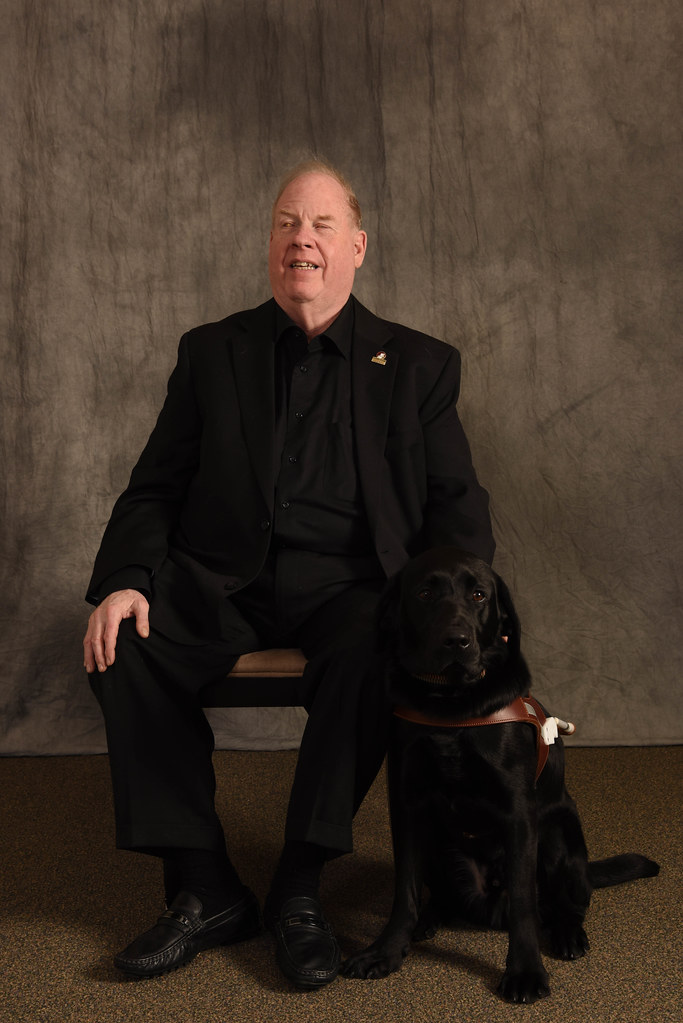
Michael Hingson
Michael Hingson is a keynote speaker, bestselling author of Thunder Dog, and a survivor of the September 11 World Trade Center attacks. Blind since birth, he brings a powerful and unique perspective on leadership, trust, and resilience in times of uncertainty.
He has spoken to organizations around the world, helping leaders and teams navigate change, build trust, and perform under pressure. His message combines real-world experience with practical insight that audiences remember long after the event ends.
👉 Book Michael Hingson for your next event.