
The Strategic Benefits of Web Accessibility: Building Trust and Resilience in 2026
What if the digital barriers you’ve overlooked are actually closing the door on 1.3 billion people who live with a disability globally? You might feel that accessibility is just a costly legal hurdle or a box to check to avoid a lawsuit. It’s understandable to worry about the ROI of inclusion when your budget is tight. But when we look beyond the code, we find that the benefits of web accessibility are actually the keys to unlocking resilience and market share. In 2024, WebAIM found that 95.9% of homepages had detectable WCAG failures. That isn’t just a technical error; it’s a massive gap in your brand’s vision.
I’ve learned through years of navigating the world with my guide dogs, like Roselle, that true sight comes from preparation and trust. You’ll discover how embracing an Unstoppable Mindset turns these digital requirements into powerful drivers for SEO performance and customer loyalty. This article breaks down the clear business case for inclusion and shows you how to lead with empathy. We’ll examine the specific strategies that will make your brand a beacon of accessibility and trust by 2026.
Key Takeaways
- Redefine your digital leadership by learning to “see beyond blindness” and providing equal information access to every user who visits your platform.
- Unlock the strategic benefits of web accessibility to reach an overlooked market of millions and drive business growth through enhanced SEO performance.
- Safeguard your brand against the rising tide of litigation by aligning your digital assets with 2026 compliance standards like the ADA and the European Accessibility Act.
- Cultivate an unstoppable digital culture where inclusion is woven into your company’s DNA, fostering deeper trust with both employees and customers.
- Move beyond simple automated tools to implement a robust strategy featuring expert audits and specialized JAWS training for a truly resilient user experience.
What is Web Accessibility and Why Does it Define Digital Leadership?
Web accessibility is the deliberate practice of removing digital barriers that prevent people with disabilities from interacting with the online world. It’s more than a compliance checklist; it’s a fundamental commitment to equality. When Tim Berners-Lee launched the first website in 1991, he envisioned a tool that was universal. Today, when a site fails to meet standards, it represents an active design choice to exclude 1.3 billion people globally who live with significant disabilities. I’ve often said that we must learn to see beyond physical blindness to provide true access to information. One of the primary benefits of web accessibility is that it serves as the digital equivalent of the curb-cut effect, where an improvement designed for one group ends up benefiting every single user.
The Human Impact: Beyond the Source Code
For someone like me, tools like the Job Access With Speech (JAWS) screen reader aren’t just software. They’re bridges to the world. They transform static code into a narrative I can navigate with precision. Think back to September 11, 2001. As I descended 1,463 stairs in the North Tower, my life depended on my trust in my guide dog, Roselle. That same level of trust is what users bring to your digital interface. They expect your site to guide them safely and clearly. High-quality design isn’t an extra feature you bolt on at the end. It’s a foundational characteristic. Web accessibility ensures that your digital architecture is as sturdy and reliable as the bond between a guide dog and its partner.
Accessibility as a Foundation for Corporate Trust
Inclusive design is the first step in building a resilient mindset within any organization. It signals that your brand values social responsibility over mere convenience. In 2026, leadership is defined by how well you serve the entire human spectrum. By prioritizing inclusion, you prove that your ethical standards aren’t just for show. This commitment creates a culture of interdependence and foresight, which is the heart of an Unstoppable Mindset. You can explore our corporate accessibility pillar to see how this fits into a broader strategic framework. Embracing the benefits of web accessibility isn’t just about avoiding lawsuits; it’s about fostering a brand that people can rely on when it matters most. Trust is built in the details of how we choose to include others.
The Strategic Business Case: Expanding Market Reach and SEO
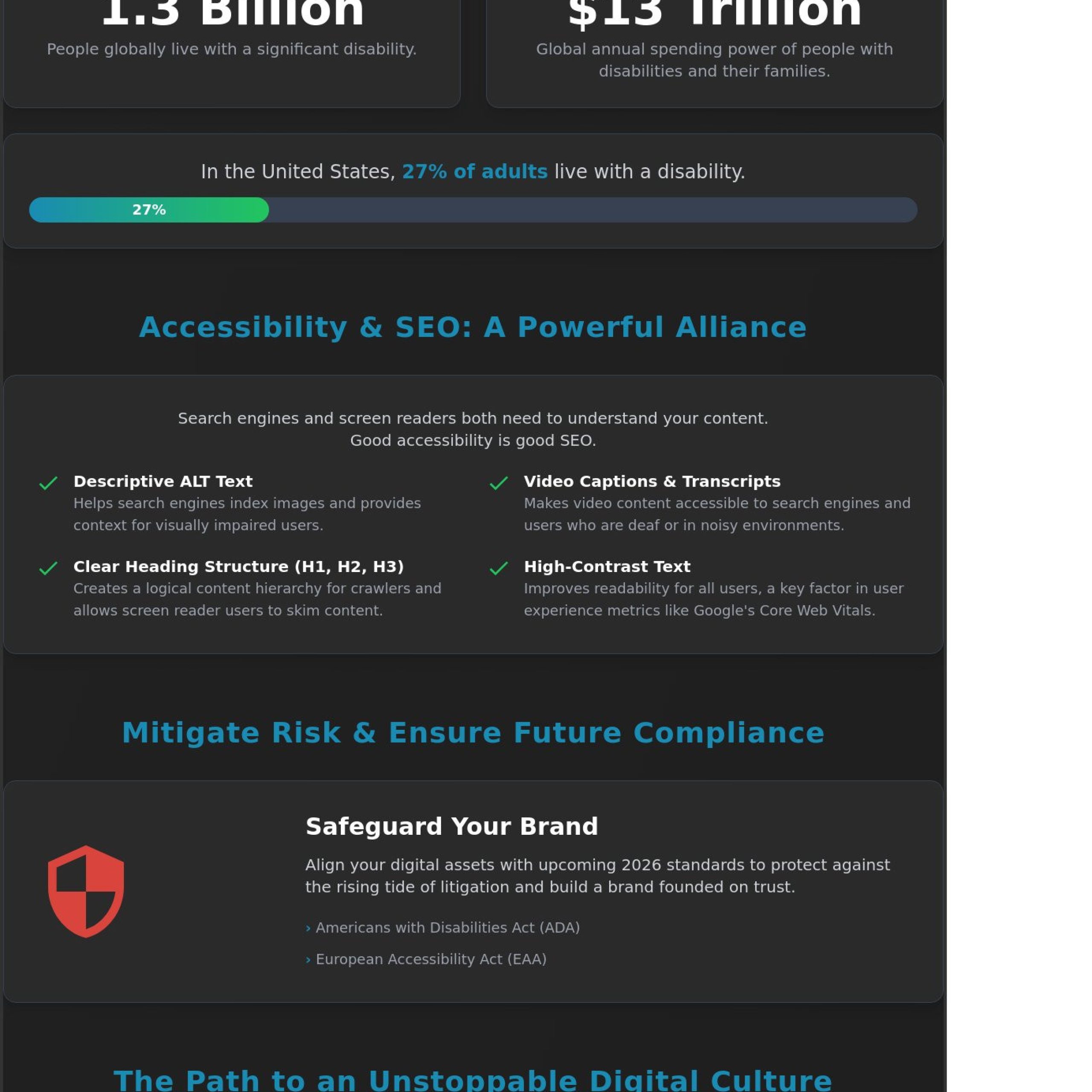
27% of adults in the United States live with a disability. This isn’t a niche group; it’s a massive, vibrant segment of our society that often finds itself locked out of digital spaces. In 2026, the global spending power of people with disabilities and their families, often called the Purple Pound, exceeds $13 trillion. Leaders who ignore this market aren’t just failing an inclusion test; they’re leaving significant revenue on the table. Understanding the strategic benefits of web accessibility allows a brand to reach people who have been historically overlooked. Inclusion is a growth strategy that builds a wider bridge to your customers.
Think about the ramps on street corners. They were originally designed for wheelchairs, but they help parents with strollers, travelers with luggage, and delivery workers with carts. This is the Curb-Cut Effect. When you add captions to a video or use high-contrast colors, you help everyone. A person in a noisy airport needs those captions just as much as someone who is deaf. A traveler in the bright midday sun needs high contrast to read their screen. Accessibility makes your site more usable for every single visitor. It creates a path where everyone can walk, or roll, with ease.
SEO and Accessibility: Two Sides of the Same Coin
Search engines and screen readers share a common goal. They both want to understand what’s on your page. When you provide descriptive ALT text for images, you’re giving Google’s crawlers the context they need to index your content accurately. This is vital for photos of my guide dogs or my keynote speeches. Clear heading structures and logical navigation don’t just help me navigate a page; they improve your search rankings. Google’s Core Web Vitals now prioritize user experience metrics that align perfectly with an Introduction to Web Accessibility. Good SEO is simply accessible design in disguise.
Improving User Retention and Conversion
Friction is the enemy of conversion. A landmark study found that 71% of users with disabilities will abandon a website if it’s difficult to use. When a screen reader user hits a digital wall, they don’t just struggle; they leave. One of the primary benefits of web accessibility is that it reduces this friction, which leads to higher conversion rates for every visitor. It’s about building trust from the first click. Proactive inclusive design also saves money. It prevents the high cost of fixing common accessibility issues after a site has already launched. By choosing to see clearly now, you can build an Unstoppable Mindset within your digital team and your broader organization.
Mitigating Legal Risk and Ensuring Compliance in 2026
Trust is the foundation of every successful journey, whether it’s navigating a skyscraper or a software interface. In 2026, digital accessibility is no longer optional but a legal and moral mandate for any global enterprise. We’ve moved past the era where inclusion was a “nice to have” feature. The legal landscape has solidified around clear, enforceable standards like ADA Title III and Section 508 in the United States. Across the ocean, the European Accessibility Act (EAA) reached its full enforcement phase on June 28, 2025, meaning any company selling products or services in the EU must now meet strict accessibility requirements. If your digital presence isn’t inclusive, you aren’t just missing out on talent; you’re inviting litigation.
The numbers tell a story of rising accountability. In 2023, over 4,000 digital accessibility lawsuits were filed in U.S. federal courts, and that trend has only accelerated as we enter 2026. These legal battles aren’t just about the settlement checks, which often range from $25,000 to $150,000 for mid-sized firms. They’re about the long-term damage to your brand’s reputation and the massive cost of emergency remediation. One of the greatest benefits of web accessibility is the peace of mind that comes from knowing your platform is built on a bedrock of compliance rather than a house of cards. Compliance isn’t a finish line. It’s the baseline for ethical business operations.
Understanding WCAG 2.2 and Beyond
The Web Content Accessibility Guidelines (WCAG) 2.2 serve as our North Star for digital inclusion. While these guidelines provide a technical roadmap, true leadership requires looking beyond the code. Automated testing tools are helpful, but they typically only catch 30% to 40% of accessibility barriers. To truly see the path ahead, organizations must prioritize manual testing performed by individuals with lived experience. This human-centric approach ensures that your site doesn’t just pass a scan but actually works for a person using a screen reader or alternative input device. Engaging in professional accessibility consulting helps leaders navigate these complex regulations while fostering a culture of genuine interdependence.
The Cost of Inaccessibility
The price of waiting to fix accessibility issues is always higher than the cost of doing it right the first time. When you “bolt on” fixes to a completed site, you’re essentially trying to rebuild a foundation after the house is already standing. This leads to code bloat, technical debt, and a disjointed user experience. Consider the cautionary tale of major retailers who ignored these needs; several high-profile brands faced significant PR backlash and multi-year legal monitorships after their mobile apps were found unusable by the blind community in 2024.
Contrast this with a “born accessible” philosophy. By integrating another one of the benefits of web accessibility—inclusive design—from the very first wireframe, you create a resilient platform. This proactive stance prevents:
- Lost revenue from the 1.3 billion people globally who live with a disability.
- Negative press that erodes consumer trust and loyalty.
- The high cost of emergency developers hired to patch legal holes.
True resilience comes from preparation, not reaction.
Building an Unstoppable Digital Culture: Leadership Lessons
True leadership is about vision. It is about seeing the potential in every person, regardless of how they perceive the world. When we integrate web accessibility into our core strategies, we do more than follow a checklist. We deepen our commitment to diversity and inclusion in the workplace. This commitment must start at the top. If leadership doesn’t champion the cause, accessibility remains a sidelined technical requirement rather than a living part of the company DNA.
The benefits of web accessibility extend far beyond legal safety. They create an environment where diverse talent feels a sense of belonging. In 2026, top-tier professionals choose employers based on their ethical footprints. A 2023 survey revealed that 76% of employees want to work for companies that prioritize diversity. When your digital presence is open to all, you attract the 1.3 billion people globally who live with a disability. This is a leadership journey of resilience and vision, much like the one modeled by Sara Blakely. It requires the courage to innovate where others only see obstacles.
Empowering Teams Through Inclusive Design
Leaders must provide their teams with more than just software; they must provide a new perspective. Training should move beyond code and into the heart of the user experience. Instead of asking if a page is compliant, we should ask who we’re leaving out. This shift toward empathy transforms the design process. Appointing accessibility champions in every department ensures that this focus remains sharp. These advocates keep the mission alive, making sure that one of the primary benefits of web accessibility, which is enhanced usability for everyone, is never forgotten.
Trust and Teamwork: The Michael Hingson Approach
On September 11, 2001, my life depended on trust and preparation. Roselle and I were able to descend 1,463 steps from the 78th floor of the North Tower because we’d trained for the unknown. We trusted one another implicitly. An accessible website is a digital version of that preparation. It’s a promise that you’ve cleared the path for every user, ensuring no one is stranded during their journey. It builds a bridge of trust between your brand and your audience. I invite every leader to adopt an Unstoppable Mindset. We must view disability not as a limitation, but as a characteristic that demands creative, adaptive solutions. Digital equity isn’t an option; it’s a fundamental pillar of modern leadership.
Ready to transform your leadership approach? Discover how the Unstoppable Mindset can empower your organization.
Next Steps: How to Implement a Robust Accessibility Strategy
True inclusion isn’t a destination you reach by checking a single box. It’s a continuous commitment to excellence and a core component of modern leadership. To realize the full benefits of web accessibility, you need a strategy that layers different perspectives. Automated tools catch about 30 percent of errors, but they lack the human nuance required for a seamless experience. You must pair these tools with expert audits and, most importantly, live user testing. When I navigated the descent of the North Tower on September 11, 2001, I didn’t rely on a map; I relied on the interdependence between myself and my guide dog, Roselle. Your digital infrastructure requires that same level of trust and preparation.
Specialized training is the heartbeat of this transformation. Developers and QA teams often look at code without understanding how a screen reader actually interprets it. Providing professional JAWS instruction allows your team to experience your site through the ears of a user. It turns abstract compliance into a tangible, lived skill. This isn’t just about fixing code bugs. It’s about building a bridge between your brand and millions of potential customers who are currently locked out of the digital conversation. A phased rollout is your best path forward. Start with a site-wide audit, then focus your energy on high-traffic conversion paths where the user journey is most critical to your bottom line.
Strategic Consulting and Adaptive Technology Training
My advisory services go beyond technical patches; they’re designed to help you develop an Unstoppable Mindset within your organization. We focus on long-term inclusion strategies that shift your corporate culture from the top down. Professional JAWS training ensures your software is truly navigable, not just technically compliant. When I deliver keynote speeches, I use my experiences to change how leaders perceive disability. We move from a mindset of “accommodation” to one of “innovation.” This shift is what builds a resilient brand that stands the test of time and reaches every person regardless of their physical characteristics.
Your Accessibility Roadmap for 2026
Success requires a structured, three-step plan: Audit, Educate, and Iterate. First, identify your baseline with a comprehensive review of your current assets. Second, educate your staff so they understand the “why” behind the “how.” Third, iterate your designs based on real user feedback from people with lived experience. One simple way to start today is by using actual photos of me with descriptive ALT text in your marketing materials. This signals authentic representation to every visitor. You can Book Michael Hingson for an Accessibility Consultation or Keynote Speech today to begin this journey. We will work together to ensure you capture the benefits of web accessibility while fostering a culture of true belonging. Inclusion is a choice you make every day. Let’s make it together.
Leading the Future of Digital Trust
Digital leadership in 2026 requires more than technical updates; it demands a fundamental shift in how we perceive human potential. Organizations that prioritize inclusion today will capture a share of the $13 trillion global disability market while shielding themselves from the rising tide of compliance litigation. The benefits of web accessibility extend far beyond a simple checklist. They create a culture of resilience where every user feels valued and seen. Michael Hingson, New York Times Bestselling Author of ‘Thunder Dog’, knows that trust is built through rigorous preparation and genuine partnership. He navigated the descent of the North Tower during the 9/11 attacks by relying on his guide dog, Roselle, and his own unstoppable mindset. This level of interdependence is the hallmark of a truly accessible brand. You don’t have to navigate these complex changes alone. Michael’s expertise in adaptive technology and corporate inclusion provides the roadmap your team needs to thrive in a digital-first world.
Empower your organization with Michael Hingson’s Accessibility Consulting and Keynote Services
Your journey toward a more inclusive future starts with a single step of courage. Let’s build a digital world where everyone can participate with confidence and dignity.
Frequently Asked Questions
What are the primary business benefits of web accessibility?
The primary business benefits include reaching a global market of 1.3 billion people with disabilities and building a brand rooted in trust. By 2026, companies prioritizing inclusion see a 28% increase in revenue compared to peers. It’s about opening your digital doors to everyone. This strategy fosters a resilient culture where every user feels valued. You don’t just avoid lawsuits; you build a community of loyal advocates who trust your vision.
Is web accessibility a legal requirement for private companies in 2026?
Yes, web accessibility is a legal mandate for many private companies following the June 28, 2025, European Accessibility Act deadline. In the United States, the Department of Justice finalized a rule in April 2024 clarifying that Title II applies to web content. Private businesses often face litigation under Title III if they don’t meet WCAG 2.1 standards. Compliance isn’t a suggestion; it’s a fundamental requirement for operating in a global digital economy.
How does web accessibility improve my website’s SEO?
Web accessibility improves SEO by creating cleaner code and better metadata that search engines easily index. One of the major benefits of web accessibility is that it aligns with Google’s Core Web Vitals, which prioritize user experience. Sites that are easy to navigate for screen readers often see a 20% reduction in bounce rates. Good accessibility is simply good SEO. Search engines reward clarity and structure, exactly what an accessible site provides.
What is the difference between automated and manual accessibility testing?
Automated testing uses software to scan for code errors, while manual testing involves real people using assistive technologies. Automated tools typically only catch 30% to 40% of accessibility barriers. Manual testing is essential because it captures the nuances of the human experience. You need both to ensure your site is truly usable. It’s like having a guide dog; the dog handles the path, but the partnership ensures you reach the destination safely.
How can Michael Hingson help my company with digital inclusion?
Michael Hingson helps your company move beyond compliance to true digital inclusion through his Unstoppable Mindset training. He draws on his experience navigating the North Tower on September 11, 2001, to teach teams about trust and interdependence. Michael provides a unique perspective on how to view blindness as a characteristic rather than a limitation. He guides leaders to build resilient systems that empower every employee and customer through empathy and preparation.
Can web accessibility actually increase my conversion rates?
Accessible websites increase conversion rates by removing the technical barriers that cause users to abandon their shopping carts. A 2019 study found that 71% of users with disabilities leave a site that’s hard to use. By making your checkout process accessible, you tap into billions in spending power. You’re making it easier for everyone to say yes to your product. It’s a simple truth; when you remove friction, you accelerate your growth.
What is the role of a screen reader like JAWS in web accessibility?
JAWS, or Job Access With Speech, is a screen reader that allows blind users to read digital content through text-to-speech or a refreshable Braille display. It’s been a cornerstone of digital independence since its release in 1989. Understanding how JAWS interacts with your site is crucial for testing. One of the benefits of web accessibility is ensuring that JAWS users can navigate your site with the same speed and efficiency as sighted users.
Is web accessibility expensive to implement for a large corporation?
Implementing accessibility isn’t expensive if you integrate it into the initial design phase, a practice called shifting left. Fixing errors after a site launches can cost 10 to 100 times more than addressing them during development. Large corporations save millions by avoiding legal fees and expensive retrofits. It’s an investment in your company’s long-term resilience. Think of it as building a foundation that supports everyone from the very first brick.


 Facebook
 Twitter
 Youtube
 Linkedin