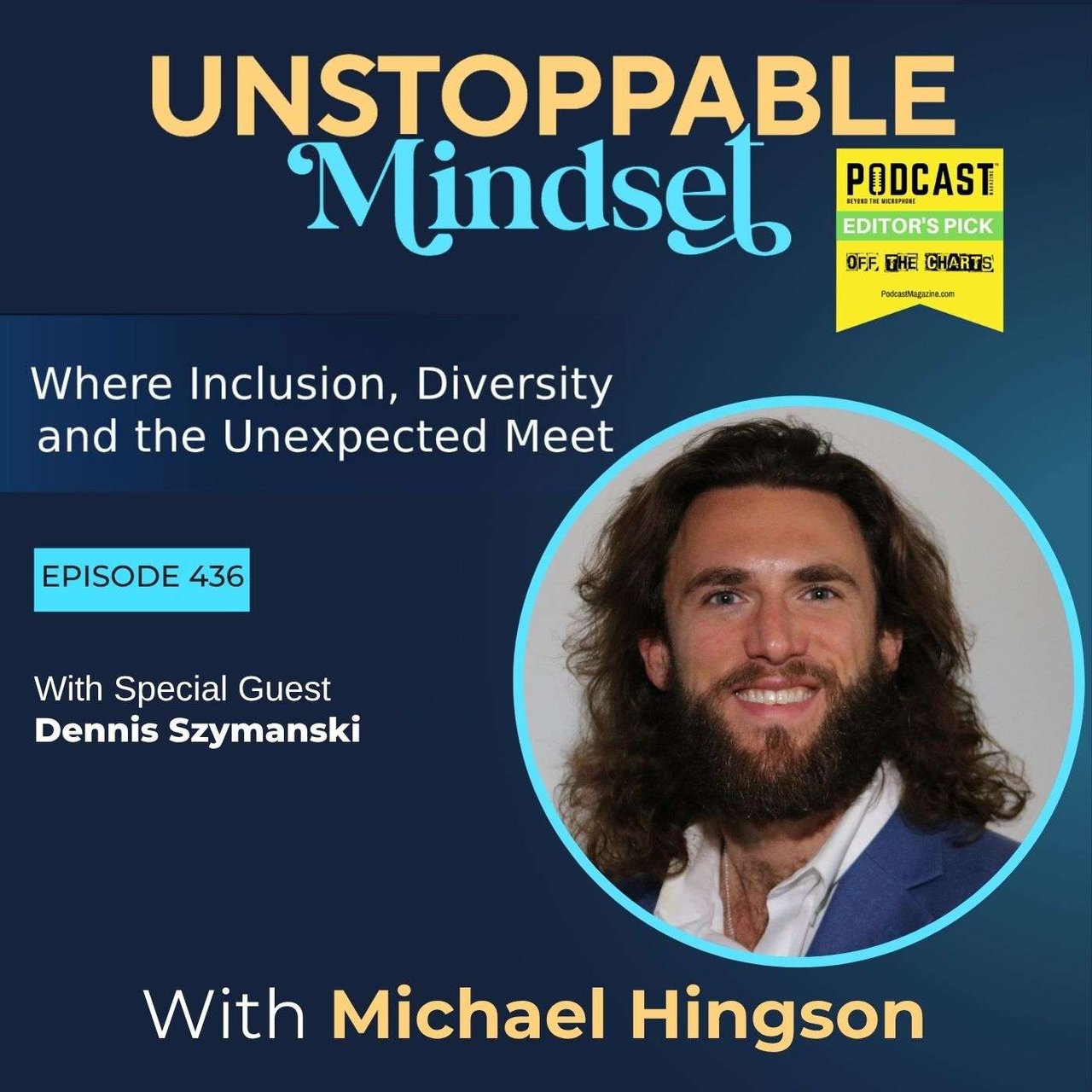
Episode 436 – Turning Setbacks into an Unstoppable Advantage with Dennis Szymanski
What if the thing you struggle with most could become your greatest strength?
In this episode, I sit down with Dennis Szymanski, a semiconductor engineer who has lived with a stutter his entire life and learned to manage it through a powerful mix of science, self-awareness, and holistic living. Dennis shares how his journey through speech therapy, stress management, and personal growth shaped both his mindset and his career in nanoscale engineering and compound semiconductors. You will hear how early support, resilience, and curiosity helped him move from struggling to speak to confidently presenting, creating, and even writing a children’s book. I believe you will find this conversation inspiring as it shows how challenges can guide you toward purpose, clarity, and an unstoppable mindset.
Highlights:
00:10 Learn how early support and environment shape confidence and long term growth
09:43 Understand what it means to live with a stutter and manage it daily
11:10 Discover why the root cause of stuttering is still not fully understood
35:07 Learn how speech therapy has shifted toward treating the whole person
47:32 Understand how stress directly affects speech and performance
56:01 Discover how creativity and purpose come together through writing and innovation
About the Guest:
Hello everyone! My name is Dennis Szymanski, and I was born and raised on Long Island, New York. Over the course of my life, I have moved 11 times up and down the East Coast of the U.S., meeting many people and having amazing experiences, all the while working on my relationship with my stutter. I currently embrace my inner beach bum and reside in a sleepy North Carolina beach town with my girlfriend Samantha and Lennie the turtle. I have spent the better part of my academic and professional career in the semiconductor industry. I hold a Ph.D. in Materials Science and Engineering from North Carolina State University and currently work as a Product Engineer for a U.K. semiconductor manufacturing firm. In my personal life I enjoy playing disc golf, reading, playing the trumpet, yoga, entrepreneurship, public speaking, and any water sport you can imagine. The beach has always been, and forever will be, my home, my place of peace and solitude, a place to "Be As You Are".
As a stutterer, I have practiced the physical art of communication ever since I have been able to talk. As a trumpet player, I understand the power of controlled breath. As an Engineer, I always strive to dig deeper. As a communicator, I believe it is all about connecting with people. As a human being, I endeavor to live a holistic life, where each facet compliments the others. My stutter made me a better engineer, just like my understanding of controlled breath as a trumpet player has made me a better communicator. I find myself to be a lifelong learner, believing that there is room for constant improvement even if, somewhat ironically, the area for necessary improvement is my (in)ability to rest and recharge. I love to travel and take much of my inspiration from the world around me. A change of scenery, pace, environment, and/or people is almost always welcomed in my life. No matter if I am out on the surfboard, generating an engineer data sheet, or giving a talk on stage, I live my life by once simple sentence: “It is all about the people.”
Ways to connect with Dennis:
website link is www.drdennyeddie.com
LinkedIn: https://www.linkedin.com/in/dennisszymanski/
TikTok: https://www.tiktok.com/@drdennyeddie
Instagram: https://www.instagram.com/drdennyeddie/
Facebook: https://www.facebook.com/dennis.szymanski.35
About the Host:
Michael Hingson is a New York Times best-selling author, international lecturer, and Chief Vision Officer for accessiBe. Michael, blind since birth, survived the 9/11 attacks with the help of his guide dog Roselle. This story is the subject of his best-selling book, Thunder Dog.
Michael gives over 100 presentations around the world each year speaking to influential groups such as Exxon Mobile, AT&T, Federal Express, Scripps College, Rutgers University, Children’s Hospital, and the American Red Cross just to name a few. He is Ambassador for the National Braille Literacy Campaign for the National Federation of the Blind and also serves as Ambassador for the American Humane Association’s 2012 Hero Dog Awards.
https://www.facebook.com/michael.hingson.author.speaker/
https://www.youtube.com/user/mhingson
https://www.linkedin.com/in/michaelhingson/
accessiBe Links
https://www.youtube.com/c/accessiBe
https://www.linkedin.com/company/accessibe/mycompany/
https://www.facebook.com/accessibe/
Thanks for listening!
Thanks so much for listening to our podcast! If you enjoyed this episode and think that others could benefit from listening, please share it using the social media buttons on this page. Do you have some feedback or questions about this episode? Leave a comment in the section below!
Subscribe to the podcast
If you would like to get automatic updates of new podcast episodes, you can subscribe to the podcast on Apple Podcasts or Stitcher. You can subscribe in your favorite podcast app. You can also support our podcast through our tip jar https://tips.pinecast.com/jar/unstoppable-mindset .
Leave us an Apple Podcasts review
Ratings and reviews from our listeners are extremely valuable to us and greatly appreciated. They help our podcast rank higher on Apple Podcasts, which exposes our show to more awesome listeners like you. If you have a minute, please leave an honest review on Apple Podcasts.
Transcription Notes:
Michael Hingson 00:04
What if the biggest thing holding you back isn’t what’s in front of you, but rather what you believe Welcome to unstoppable mindset where inclusion, diversity and the unexpected meet. I’m your host. Michael hingson, speaker, author and advocate for inclusion and possibilities, this podcast explores how the beliefs we carry shape the way we live, lead and connect with others. Each week, I talk with people who challenge assumptions, face adversity head on and show what’s possible when we choose curiosity over fear. Together, we focus on mindset resilience and the small shifts that lead to meaningful change. Let’s get started. Well, howdy, once again, everyone and welcome to another episode of unstoppable mindset. It is a wonderful time here. We’re recording this just a couple of days before Thanksgiving, and I especially give thanks for the fact that I get to join all of you and do these podcasts. So I want to thank you all for being here, and I want to thank our guest, Dennis Edward Szymanski, we’re going to stick with Dennis, but we really appreciate you being here. And Dennis is involved with semiconductors. He lives life to the fullest. We were just talking before we started about his turtle. Lenny the turtle, he can he can talk about that if he wishes. And he also has some other interesting things that I’m looking forward to chatting about since he brought it up, and that is that he is, among other things, or he was, a stutterer, and so he lives with his stutter. He now lives in North Carolina on a beach, so it’s his inner beach bum that he is supporting anyway. Dennis, without all without going in any much more detail about any of this, welcome to unstoppable mindset. We’re glad you’re here,
Dennis Szymanski 02:15
Michael, not just because it’s Thanksgiving. I am very grateful and thankful to be here with you, to have met you, as well as to be here with all the guests on unstoppable mindset and all the listeners to us, whether you’re watching listening, it’s great to be here and happy to have this great discussion here with you today.
Michael Hingson 02:36
Well, we’re glad you’re here, and this will I’m looking forward to it. This will be a lot of fun. Why don’t we start with kind of the early Dennis. I don’t always start that way. Start with kind of the early growing up person, and let’s go from there.
Dennis Szymanski 02:50
Of course, I think a good place to start a lot of the time is the beginning. So I I’m a New Yorker, born and raised on Long Island to two very loving parents who have been supportive throughout all of my endeavors, from supporting me and my stuttering journey to encouraging me to pursue other outlets like music, encouraging me to stick to my academics and and even supporting my love of pets, which, as you alluded to, I have a turtle right now. Her name is Lenny, but she she is one of many dogs, lizards, hamsters, ferrets, chinchillas, birds. We’ve had a lot of pets growing up, and you know that that has informed, actually a lot of my current worldview, but we can, we can get to that later.
Michael Hingson 03:45
What does your girlfriend think about all that?
Dennis Szymanski 03:48
Well, my girlfriend is a four legged pet woman herself staying outside of tanks. That’s, that’s one of her remits. So Lenny, we got to realize our shared dream, me, my girlfriend, and Lenny of getting Lenny out of the house, out of the tank and into a pond in the backyard of my home here on the coast of North Carolina. So we’re all happy. It’s, it’s been a, it’s been an amazing summer. They are getting us all out of the house. So that’s a good thing. You know, she’s she’s very supportive of of Lenny. We, we had two dogs together. Unfortunately, they were old and have since passed on. But we’re planning to get some some, some new four legged friends down the line. And we are even in the process of courting, adopting a stray cat that is hanging around our our neighborhood. So it’s a nice it’s a nice middle ground there not as much responsibility as a dog, you know, a stray cat, but still the potential for the companionship and for the routine and for taking care of something that I know we. Both miss being absent dogs. Not that Lenny doesn’t take taking care of it’s just a different companion, yeah, different kind of pet
Michael Hingson 05:10
we we have my guide dog, Alamo, and as listeners know, we also have stitch, the cat, who will be 16. We think in January, we rescued her. We think at about the age of five, family didn’t want her, and they said, Take her to the pound. And we said, No, we’ll find her a home. And along the way, I happened to ask what the cat’s name was, and they told me that the cat’s name was stitch. And I knew this cat wasn’t going to go anywhere, since Karen had been a professional quilter since 1994 so quilters aren’t going to give up an animal named stitch.
Dennis Szymanski 05:44
No, too, too many coincidences there to just not, not go ahead with stitch. Yeah, so,
Michael Hingson 05:53
so stitch is with us.
Dennis Szymanski 05:55
We, we, we think a very similar way all the pets that I had, I actually never had a cat that was my own, just parents were allergic. Sister was allergic, things like this. Brother was allergic. But when our most recent dog passed, we noticed that this cat started coming around at a very at only a few weeks before he passed. So we think that they had a little bit of a conversation to say that, you know, a little changing of the guard, a proper handoff, if, if you will. So we’re looking forward to having our tuxedo cat, which we named very appropriately and affectionately tuxy. We’re unsure if it’s a boy or a girl, yet. So we went with tuxi butcher, straying back from, from, from the original topic, coming back on, yes, the stray cat pun was somewhat intended. I get it born and raised, Long Island, New York. I left there when I was 17 out of high school to pursue my undergraduate degree in engineering, I stepping back a little bit. My father’s a insurance agent, but a serial entrepreneur. He cut his teeth in the insurance industry, but now is heavily involved in a cybersecurity startup. So a man who wears many hats, and my mother is in it. So my first desk job, if you will, was in computers, and that kind of led me down the path of some sort of engineering related to computers. So I went up to the colleges of nanoscale science and engineering up in Albany, New York, for those familiar with the SUNY system, it’s a State University in New York up in Albany, where I did four years there, and I studied nano scale engineering, which is a fancy way to say material science, with a focus in semiconductors, which led me to take my first job in industry while I was actually still getting my undergraduate degree, which bolstered my decision to continue on down here to North Carolina. I actually took my first step down in Raleigh as a PhD candidate at NC State, where I studied material science and engineering as well. And two things I’ve always you know, kept close is the love of business as it relates to technology. So I have a minor in business from my time in undergrad, as well as I took several MBA courses and got a technology Entrepreneurship Certificate from from NC State. So I take the business and the technology. I’ve married those into a career here as a product engineer for a compound semiconductor manufacturer, all of which we can get into a little bit more. But the other love that I keep close and have recently had a renaissance in my life, is my love of music. I was actually faced with a choice of music or engineering back when a lot of us started to apply to college or university at that time in their life, in high school, and I chose the engineering route, but but always kept the love of music. It was my first paying job, playing in a gig, playing gigs in bars when I was younger and right now I actually, like I said, I’m having a renaissance. I took a little bit of a hiatus while life got busy in grad school and getting my feet under me in the corporate world, taking my first job, but learned to to understand the need, the need that my brain, you know, to have that left brain, right brain, creative mind, logical mind flexed, and just to to have the time to myself. It’s something that I enjoy, something that I’ve enjoyed since I’m eight years old. And, you know, I’m happy to keep continuing it. And I want to finish the opening monolog here, if you will. With. With something you said that I’m a lifelong stutterer, and ever since I opened my mouth, I can remember having disfluent speech, and I have to say that the biggest support that my parents ever gave me was encouraging me, as well as helping me at a very young age start in speech therapy, I I have met so many people in my life that
Dennis Szymanski 10:32
did not have supporting parents or a supporting situation, and to To see that impact and that thread be traced throughout my life, and, you know, and juxtaposing it to other people’s lives, it really makes a difference to have that supporting environment, that belief, because, you know, you said it, I live with the stutter Every day. It’s very well managed. Now in my life, there was a time where I could not finish a sentence when I was in elementary school, early middle school, without having a stutter. But now I’ve learned through speech techniques, living my life in a relatively holistic way, how stress relates to my stutter and so many other things that I can manage it a lot better. But as my fellow stuttering people out there that might be listening, you always live with it. You know you’re you’re never, quote, unquote, cured. You’re always having that stutter, managing it, whether it’s overtly or covertly, it’s always there. But very happy to get into all of that and more here with with you Michael, as as we kick off the episode.
Michael Hingson 11:54
So what? What causes stuttering? Do we really know
Dennis Szymanski 11:59
that’s what, in part, is so fascinating is that we can’t really pinpoint it, whereas to say this part of the brain for sure is, you know, impacting this part of your vocal cord in this way. And if we get in there and treat it however way it’s going to go away there, of course, is ideas that you know certain parts of your brain have more of an impact or influence, and that it does directly relate to your vocal cords, because, at least from my stutter, how It works, and how I could, you know, most effectively explain it is my vocal cords simply lock up. So normal vocal cord operation, it’s like a string on a violin, right, or string on a guitar. If you pluck it, it resonates, vibrates, makes sound. Your vocal cords work just the same, but their mechanism of quote, unquote, plucking is the air that you breathe. So if they lock up, you don’t have vibration, you don’t have sound, you don’t have speech. And what’s interesting is that if you were to put your your your ear or your hand to my mouth during a stuttering episode, there’s still air flow like there’s still air leaving my mouth, just as it does during fluent speech, but there’s just no action and something else that is very interesting about the You know, my my stutter, and I’ve talked to other stutterers that have a similar experience, is that we know what we want to say. It’s all upstairs. It’s all formulated. It’s just the physical blocking of the vocal cord, at least in my case and I, I make the, you know, the I make it important to say my case, because there is very different manifestations of stuttering, stammering, how one might block, how one might repeat a word. What are different triggers, etc. So in a nutshell, we don’t really know which is why there’s so many different theories, methodologies of treatment, how to cope, deal with, treat the the stud itself.
Michael Hingson 14:32
Yeah, it’s, it’s fascinating, and I appreciate you giving us that explanation of it. It is something that I think is very important to point out that one of the things you mentioned is extremely crucial. Your parents were supportive. They helped you. My parents did the same thing when it was discovered that I was blind. Yeah, and a number of parents have really bought into helping their children recognize they can do whatever they choose and that they can deal with so many different issues. And oftentimes we also hear about parents who don’t support some people succeed in spite of it, and some do not. But it’s so important to really know that we, some of us, have parents who really help and and will do anything that they can to assist us in making life better for us
Dennis Szymanski 15:41
and when we first got connected, and then afterwards, doing more listening to your talks, and other episodes of unstoppable mindset, I had learned that your parents were were supportive as well, and that made a mental note, as a matter of fact, to bring this up here in this talk, because I could not agree more the importance of support of your parents, especially as a young child, that’s where everything starts. But then even as we grow our friends, you know, larger family and the networks that that that we keep is are so important to our development success as individuals.
Michael Hingson 16:24
Yeah, so your parents are still with us.
Dennis Szymanski 16:28
They both. Are they both? Are they divorced when I was very young, but that, again, you know, had no bearing on the support and the love I have a stepfather and a stepmother who are equally incredible and supportive. I always said I just got double the family that loves and cares. There you go. And my mother still lives on Long Island in the house where I grew up, so I love to go visit. Was just back there a couple of weeks ago, and are heading back up, you know, a couple of weeks time. And my dad actually lives in South Carolina. He relocated with my stepmother and my brother. They are around the Columbia area, so we’re actually both Dennis’ in the Carolinas. So that’s actually quite nice. And I’m just just just saw him a couple of days ago, and I’m gonna see him, you know, on the Thanksgiving holiday as well. So looking forward to, looking forward to that.
Michael Hingson 17:31
Well, last time I was back in the New York area for any length of time, I spent a week last year in Lindenhurst speaking to the Lindenhurst union free school district, and that was a lot of fun. Fortunately, it was before the snow hit. Oh, yeah, Lindenhurst.
Dennis Szymanski 17:51
Lindenhurst was about a half an hour from where I grew up, one of the many, many towns that is the infinite urban sprawl of Long Island.
Michael Hingson 18:00
Yeah. Well, yep. Well, it was fun. I was there for almost a week, and spoke to lots of sixth, seventh and eighth graders, did some faculty training, but enjoyed the area, and I’ve enjoyed Long Island every time I’ve been out there. So it was kind of fun. Well, I want to go back to this idea of nano scale. Tell me a little bit more about nano scale engineering.
Dennis Szymanski 18:26
Absolutely, like I said, it’s basically material science and engineering, but with a focus in semiconductors. So having had the hindsight now traditional material science background from NC State. When I went to do my graduate work, things like traditional material science, so metal stress strain curves. Didn’t learn that in undergrad, focusing in semiconductors, I learned about transistors and the ethics of scaling semiconductor technology and computer programming at a very basic level that could help run certain parts of a semiconductor process. So very specific, very targeted focus that was nanoscale engineering. I was very fortunate to be the sixth graduating class out of the small colleges of nanoscale science and engineering. Like I said, that was part of the SUNY Albany system, and very hands on. I was in a building on the University’s campus that was essentially an office building with 250 private companies pooling their resources in the office space as well as laboratory space, clean room space, but with a couple of classrooms. So not only was I rubbing shoulders with classmates, I was rubbing shoulders with people who worked at IBM or global founder. Or ASML Tokyo electron. These are big international companies that play in the semiconductor manufacturing space, and little did I know that was going to kickstart this incredible journey that has led me here to being a product engineer for a compound semiconductor manufacturer focused on gallium nitride power technology. So where people might be hearing this is in the AI data center talk. This material is going to enable faster, cheaper, cooler, more efficient chips, as well as you might have noticed, electric vehicles, your laptop, even your cell phone, charging a little faster and in recent years, and those bricks that used to sit on your lap and burn your lap get there, they’re cooler. They’re not as hot. All of these are direct advancements in compound semiconductor technology, semiconductor technology and essentially nanoscale engineering. And to go to its most fundamental route, you know engineer, nanoscale engineering is engineering on the nanoscale. And where we’re at with semiconductor technology is we are looking at in silicon, a transistor is about a nanometer, two nanometers, which to put it in perspective for everybody listening, your hair, the width of your hair is 60 to 80 micrometers and nanometers are three orders of magnitude smaller, smaller than micrometers. So you can imagine that the reason we need clean rooms in semiconductor manufacturing is because one of your hair could wipe out hundreds, if not 1000s, of transistors on one of the chips, which nobody wants, right? You want a good manufacturing process that has high yield. So nano scale engineering has been was, was the start for for me with you know, the continuation of that has been to go into, as I said, material science in a more quote, unquote, proper sense, learning those stress strain curves, learning a little bit of polymer science, All applications and material science, but staying focused from age 17 till now on nanoscale engineering, which is material science focused, and semiconductors,
Michael Hingson 22:51
if I recall, right, transistors were developed somewhere around 1948, so I mean, my gosh, that’s only 77 years ago, ago, and look how far we’ve come.
Dennis Szymanski 23:05
It truly is mind boggling.
Michael Hingson 23:08
Michael, at the same time, we need to do something to figure out how to stop so many lithium ion batteries from causing fires somewhere.
Dennis Szymanski 23:19
It’s they’re both material science problems for sure that that need to be tackled. I agree,
Michael Hingson 23:26
yeah, one of those things that we’re we’re on the cusp of so many different developments. People talk about autonomous vehicles and so on. But, you know, the reality is, we’re on the cusp. We’re living through the the change that is coming. And personally, from my perspective, in my opinion, I can’t wait for the time that we get to take driving out of the hands of drivers, because too many drivers don’t do very well.
Dennis Szymanski 23:55
You know, I have a very similar opinion, even though I will say one of my childhood dreams was to become a race car driver. So I do love to drive. I had an eighth of a mile go kart track in my backyard growing up, and one of the things that kept my sanity during my PhD program was going to the local go kart track and getting to put in some time trials. So I love to drive, but from a safety perspective, I could not agree with you more that it’s high time that that we can implement some better safety and probably less traffic.
Michael Hingson 24:33
Well, given the way most people seem to drive up here in Victorville or out here in Victorville, I am of the absolute opinion that I can drive as well as they can anyway, so
Dennis Szymanski 24:44
we’ll see. You know coming, coming from the New York driving environment to the North Carolina driving environment. Some things are similar, some things are very different, but, but it’s definitely been, been fun spending almost half of my life. You know now down down down here in North Carolina, we had
Michael Hingson 25:04
some people visiting us when my wife and I lived in New Jersey, and we drove into the city, and they said that the people who are with us, these cab drivers, are crazy. Just look at the way they drive. I would never want to be in a cab with with any of those drivers. And Karen pointed out, my wife pointed out something very relevant and so true for most cab drivers, at least back then, she said, look at those cabs. Do you see any dents? Do you see any dings? And they said, No. And she said, So what do you mean? You wouldn’t want to be in those cars. You’re probably safer in those cars than most anywhere else.
Dennis Szymanski 25:48
She was right. She makes a good point.
Michael Hingson 25:50
Practice. Makes perfect. It does. I love checker cabs, but we don’t see those anymore. That’s too bad. But oh well. But you know, one of the one way or another, I think that the time will come when autonomous vehicles will will make driving a lot safer, and that’ll be good. But we’re not there yet, and we’re not there with with so many things I mentioned, the lithium ion batteries, they would they too will get better, and we will get over all of that. Now, of course, what we need to do is to make sure that we still have rare earth elements around. But that’s going to be another challenge that we face over time.
Dennis Szymanski 26:27
Yes, that’s that’s part of the fun, Michael, of being actually in material science as a discipline that it encompasses so many different touch points that we have in our life. One of my closest friends and was a colleague in my PhD program, is working on solid state battery technology that could potentially replace lithium ion technology and solve some of those problems just and it spans the whole gamut. I have a friend doing nuclear waste remediation. So very, very cool material science as a whole. You know, I’m obviously very enveloped in and my love is semiconductors, but my insatiable curiosity, I think I’m in the right field at
Michael Hingson 27:20
large, yeah. What’s the difference between incumbent semiconductors and compound semiconductors?
Dennis Szymanski 27:30
Incumbent semiconductor technology has been predominantly silicon. So the raw material is you go to the beach and you get sand. That’s obviously very oversimplifying. I’m not saying that you know TSMC or Global Foundries, or any of these guys are going to the nearest beach, but that is the raw material. It’s very high purity. Silicon and compound semiconductors, on the other hand, are still very pure. That’s one of the biggest material challenges of semiconductors at large, is to make them pure. But, and I’m glossing over a ton of physics and a ton of material science when I say pure. So just for any any fellow material science colleagues out there listening, I am aware that I glossed over a lot, but compound semiconductors are compound so you have two or more elements that come together that have semiconducting properties. So indium phosphide, indium and phosphorus, gallium nitride, gallium and nitrogen, aluminum gallium nitride, aluminum gallium and nitrogen. So they all come together. And what’s very, very handy about these compound semiconductors is they can address a lot of niche applications in a much more efficient way than the incumbent silicon technology. So silicon technology can do a lot, I’m going to venture to say, almost everything we need. But the perfect example, and is on the top of everybody’s mind is AI. You’re not going to have AI in the form that we know it, if at all, without these compound semiconductors, silicon is just too inefficient. It’s, you know, we’ve, we’ve reached certain limits at the material level that we need these compound semiconductors to get more efficient, AI, faster data interconnects, even, you know, charging your phone, laptop, electric vehicle, quicker, all of these are enabled. Enabled, and then to continue to iterate and improve, necessitate improvements and compounds. I mean, yeah,
Michael Hingson 30:07
and that’s, of course, the real key, speed and efficiency have a lot to do with it. I don’t know. I remember having being a ham radio operator. I remember some of the early radios that I worked with. It was before, as ham operators would tell you, they went dark and went from tubes to transistors. So I remember vacuum tubes. My father was a TV repairman in Chicago before we moved out to California when I was five. And of course, then the biggest thing you ever replaced in a TV was a tube, although you did resistors and other things as well. But now, of course, it’s a totally different animal. Oh, yeah, absolutely.
Dennis Szymanski 30:50
I mean, the the vacuum tubes are exactly replaced with transistors. You replace with LEDs and all the different different things that modern semiconductors have enabled.
Michael Hingson 31:00
They take a whole lot less power and are a lot a lot cooler in in the sense of, Well, I guess in cool in all ways. I had one I had one ham radio. It was a Polycom, and I forget the model number, but it ran extremely hot. We finally put a fan on one end of it to pull air through it. But without the fan, I could actually thaw and heat tater tots on it. It was so hot.
Dennis Szymanski 31:29
Wow, you, you, you had a two in one. There you had, I did, and the ham radio
Michael Hingson 31:35
all at the same time. It was great. But, yeah, I understand, and tubes are were replaced, and rightly so, by transistors. But a tube is a great way to teach the whole theory of how it all works and give you a way to see it in a very visual way that you’re not going to see with transistors very well.
Dennis Szymanski 31:57
That’s true, and something that I was actually just kind of reappreciating Today was the history of it all, and how it’s so important to realize that science and history are obviously inextricably linked from the progression standpoint, And then from what you said, it’s it’s so easy to to forget fundamentals and kind of get lost in the sauce, if you will. But I fully agree with what you say, that sometimes the quote, unquote old technology is actually just as good, if not better, a way to teach the fundamentals of the new technology, yeah, because so often they just build off of one another, right?
Michael Hingson 32:49
The reality is that the process hasn’t changed in terms of what they do. It’s just that the product itself has changed, and it’s become a lot more efficient and so on. But still, you’re, you’re moving electrons and and controlling them with positive and negative charges through the whole transistor process, just like you used to do with tubes, exactly, exactly. That’s what makes it so, so interesting. And as you said, we take it way too much for granted. But I think that overall, it’s it’s great to have the old technology and the perspective to learn from, which is extremely important to do well. So what did you get your PhD in?
Dennis Szymanski 33:40
So my PhD is in material science. Okay, that’s what it is. My dissertation was on Super junction devices, a novel way to utilize gallium nitride in that particular device structure, super junction. So I again PhD, high level material science, compound semiconductors. And I focused on one particular material system, gallium nitride. And the goal was to learn about the material itself, make the material better and more suitable to be utilized in this type of transistor architecture that’s called a super junction.
Michael Hingson 34:32
So have we yet discovered a way to have any kind of superconductor operate at room temperature?
Dennis Szymanski 34:39
Well, I didn’t discover that there’s been I mean, I keep up to date as best I can on other areas of the science world, and I know that we’re doing really cool research that was previously thought to be impossible, right? Like most cutting edge scientific research.