
Building an Inclusive Workplace Culture: Seeing Beyond the Surface
What if the greatest barrier to your team’s success isn’t a lack of technical skill, but a lack of true vision? On September 11, 2001, as I navigated 1,463 steps down the North Tower with my guide dog Roselle, I didn’t rely on sight; I relied on a profound sense of interdependence. You likely see the value of diversity, yet you’re probably concerned about fragmented teams or the fact that 40% of employees in a 2023 Coqual study reported feeling excluded at work. Creating a genuine inclusive workplace culture is about more than just avoiding the wrong words; it’s about building a foundation where every person feels safe to contribute their best.
You’ll discover how to transform your organization into a truly inclusive environment by fostering trust, interdependence, and a mindset that looks beyond physical limitations. Embracing an Unstoppable Mindset means moving past surface-level initiatives to find the strength in our differences. We’re going to examine how shifting your perspective from “handicaps” to “characteristics” can build a high-trust culture and a brand reputation that attracts the very best talent. We will walk through the specific strategies to bridge the gaps in your team and create a space where everyone is seen for their potential rather than their boundaries.
Key Takeaways
- Learn how to move beyond mere diversity to create a state of psychological safety where differences are actively leveraged for organizational success.
- Discover why trust and interdependence are the essential foundations for any leader who aims to build a truly resilient and connected team.
- Reframe accessibility as a driver of universal innovation rather than a compliance burden to foster a more robust inclusive workplace culture.
- Gain practical steps for conducting comprehensive inclusion audits that go beyond physical office spaces to encompass digital and cultural environments.
- Explore the “Art of Living with No Limits” to redefine your perspective on disability and unlock the hidden potential within every member of your organization.
What is an Inclusive Workplace Culture in 2026?
In 2026, we’ve moved past the era where checking boxes satisfies the soul of an organization. True inclusion isn’t a policy manual or a yearly seminar. It’s a state of profound psychological safety where every person feels their unique perspective is a tool for growth rather than a hurdle to overcome. When I walked down those 1,463 stairs on September 11, I didn’t just rely on my guide dog Roselle; I relied on a culture of trust built long before the first alarm rang. An inclusive workplace culture functions exactly like that descent, where differences in how we perceive the world become our greatest collective strength.
We often talk about “seeing beyond the blindness” as a metaphor for all leadership challenges. To me, blindness is just a characteristic, much like the color of one’s hair or the sound of their voice. The real limitation in leadership isn’t a lack of sight, but a lack of vision. Leaders in 2026 must recognize that while diversity brings people into the room, inclusion is what allows them to contribute. An inclusive culture is a foundation of mutual trust and shared vision.
Leveraging differences in 2026 means moving beyond simple tolerance. Tolerance is a passive state; it’s simply putting up with someone’s presence. Leveraging is an active choice to use a different perspective to solve a problem. Think of it like a pilot and a co-pilot. They don’t just tolerate each other’s presence in the cockpit. They rely on their different vantage points to ensure a safe flight. This level of interdependence is what defines an inclusive workplace culture. It’s the understanding that my success is tied to yours, and our success is tied to how well we listen to the voices that see what we might miss.
To better understand this concept, watch this helpful video:
The Difference Between Diversity and True Inclusion
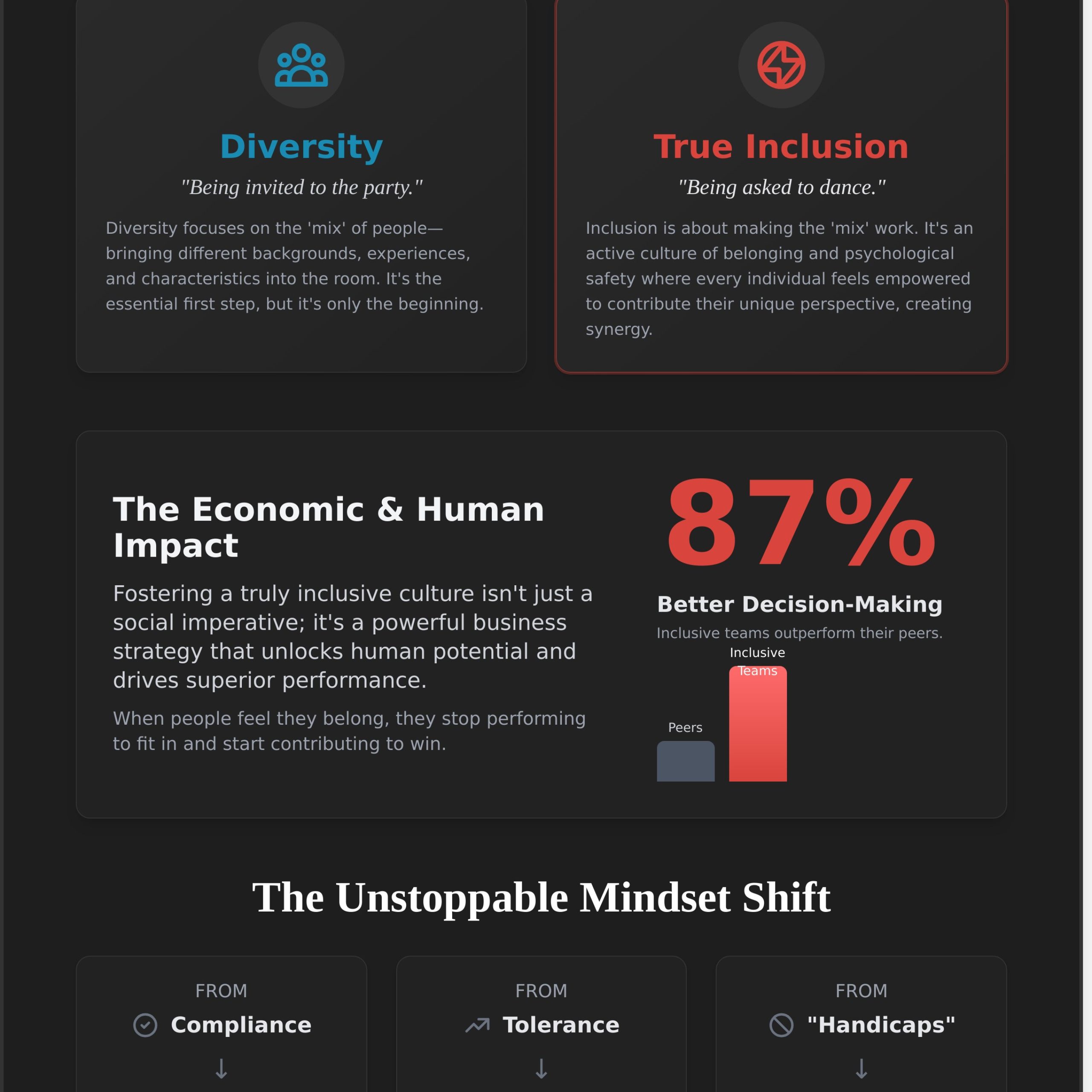
Diversity is being invited to the party, but inclusion is being asked to dance. If you hire for a quota without building a culture that supports diverse voices, you’re just creating a revolving door. By 2025, research showed that traditional frameworks for diversity, equity, and inclusion often fail because they focus on the mix rather than making the mix work. Belonging is the heartbeat of the modern employee experience. When people feel they belong, they stop performing and start contributing.
The Economic and Human Impact of Inclusion
Inclusive teams outperform their peers in decision making by 87 percent, according to data from Cloverpop. In a 2026 market where talent is the primary currency, retention hinges on how safe people feel to stop masking. When employees hide their true identities to fit in, it creates a hidden cost of mental fatigue. Fostering an environment where interdependence is valued allows companies to reduce this friction and unlock 100 percent of their human potential. This is the Unstoppable Mindset in action.
The 3 Pillars of Interdependence and Trust
On September 11, 2001, at 8:46 AM, life changed for everyone in the North Tower. For me, standing on the 78th floor with my guide dog Roselle, the world didn’t just shake; it demanded a level of trust most people never have to exercise. We had 1,463 stairs to navigate. In those moments, trust wasn’t a corporate buzzword. It was the absolute prerequisite for survival. True inclusive workplace culture begins when we stop viewing trust as a goal and start treating it as the oxygen of the organization. If I hadn’t trusted Roselle’s training and she hadn’t trusted my leadership, we wouldn’t have made it out of that building.
Interdependence is the second pillar. In corporate America, we’re often sold the myth of the rugged individualist. We’re told that the best leaders are those who carry the entire weight on their own shoulders. This is a dangerous fallacy. No leader survives alone. My descent from Tower One was a masterclass in recognizing that I needed Roselle’s eyes and she needed my direction. We were a team. When you value the unique navigation tools every employee brings to the table, you create a synergy that’s impossible to achieve in a vacuum. It’s about moving from “me” to “we” in every strategy session.
Finally, we must build a shared communication language. This language needs to transcend physical limitations or different ways of processing information. It’s about clarity and calm. During our hour long descent, I had to communicate with Roselle through the harness, but I also had to communicate with the people around us. We created a bubble of focused energy. This is how you build an inclusive workplace culture that lasts. You don’t just talk at people. You build a bridge of understanding that accounts for every person’s perspective, regardless of how they perceive the world.
Building Trust Through Vulnerability
Leaders have to go first. If you want your team to be open, you must share your own challenges and limitations. I call this the Roselle Factor. She didn’t pretend the building wasn’t shaking. She stayed focused and calm, which allowed me to stay calm. When leaders admit they don’t have all the answers, it creates space for others to step up. Try creating Trust Circles in your departments. These are small groups where employees can speak freely without fear of judgment. It’s a proven way to foster genuine dialogue and psychological safety.
Practicing Radical Interdependence
Stop rewarding the “lone wolf” mentality. Instead, look for how diverse skill sets mesh in high pressure environments. On 9/11, the synergy between a blind man and a yellow lab was what worked. In your office, it might be the synergy between a data analyst and a creative director. Identify the specific “navigation tools” your team members use. A 2023 study by Gartner showed that teams practicing high levels of interdependence saw a 21 percent increase in profitability. You can learn more about these strategies by exploring the Unstoppable Mindset approach to leadership.
Accessibility is Innovation, Not Just Compliance
True inclusion isn’t about checking boxes or satisfying a legal department. The Americans with Disabilities Act (ADA) provides a vital baseline, yet it represents the floor of our efforts rather than the ceiling of our potential. When we treat accessibility as a mere bureaucratic hurdle, we miss the opportunity to ignite innovation within our teams. Building an inclusive workplace culture requires us to look past the checkboxes of legal requirements and focus on how we can empower every individual to contribute their best work. We must choose to see accessibility as a catalyst for creative problem solving.
Consider the impact of adaptive technology like JAWS (Job Access With Speech). While this screen reader is essential for blind professionals like myself, its implementation drives a higher standard of digital literacy across the entire organization. When developers and content creators ensure that digital assets are compatible with screen readers, they produce cleaner code, better metadata, and more logical navigation. This rigor benefits everyone. It improves search engine rankings and makes information easier to find for every employee, regardless of how they access the screen. An accessible workplace is a more efficient workplace for all.
This phenomenon is often called the “Curb-Cut Effect.” Originally designed to help people in wheelchairs navigate sidewalks, curb cuts now benefit parents with strollers, travelers with luggage, and delivery workers with heavy carts. We see this in the digital world too. According to data from 3Play Media, 80% of people who use closed captions are not hard of hearing. They use them for focus, for learning in noisy environments, or for better comprehension. When we design for the margins, we create a more resilient and flexible environment for the center. We move from a mindset of “fixing” a problem to one of “enhancing” the collective experience.
Busting the Myth of the “Accessibility Burden”
Many leaders hesitate to lean into accessibility because they fear the cost of accommodations. However, data from the Job Accommodation Network (JAN) shows that 56% of workplace accommodations cost exactly $0 to implement. The remaining 44% typically involve a one-time cost of $500 or less. Proactive design is far more cost effective than reactive, expensive legal fixes. By building accessibility into your digital infrastructure from day one, you reach a wider customer base and avoid the 2,300 plus accessibility lawsuits filed annually in federal court. It’s a strategic investment with a clear return on investment.
Seeing Beyond Physical Limitations
We must challenge the “handicap” label that still lingers in professional settings. A person’s method of execution matters far less than their final output and contribution. Whether a report is written using a standard keyboard, voice-to-text software, or a Braille display, the value of the insights remains the same. I learned this lesson clearly while descending 78 flights of stairs in the North Tower on September 11th. My guide dog, Roselle, and I relied on trust and interdependence, not just physical sight. We encourage a “No Limits” mindset where we focus on the unique brilliance each person brings to the table. When we stop defining people by what they cannot do, we finally see what they can achieve.
5 Steps to Foster an Inclusive Culture Today
Building an inclusive workplace culture requires more than a policy manual or a set of HR guidelines. It demands a shift in how we perceive the capabilities of our colleagues and the environment we provide for them. When I walked down 1,463 steps on September 11, 2001, I did not do it through a miracle. I did it through a partnership with my guide dog, Roselle, grounded in absolute trust and preparation. Your organization needs that same level of interdependence to thrive in 2026.
Step 1: The Inclusion Audit
True vision begins by acknowledging what we cannot see. Start by looking at your digital infrastructure and social norms. A 2023 WebAIM analysis found that 96.8% of the top one million home pages failed basic accessibility standards. You cannot lead a team if your digital tools effectively lock the door on them. Use a website accessibility checklist to identify barriers in your internal software and public platforms. Gather anonymous feedback from your staff to uncover the “blind spots” in your current culture. This data provides the roadmap for a more accessible future.
Step 2: Training for the Unstoppable Mindset
Traditional sensitivity training often misses the mark because it focuses on what people can’t do. We must pivot from “pity” to “empowerment.” Use storytelling to bridge the gaps between diverse team members. When we share our lived experiences, we build the trust necessary for high-level leadership. By 2026, organizations adopting this “Unstoppable Mindset” approach will see a 25% higher engagement rate among staff. Set clear, measurable goals for these sessions. Don’t just track how many people attended; track how many team members feel they have the tools to succeed.
Communication is the bridge that connects us. Review your internal channels to ensure they work for everyone. Are your town hall meetings captioned? Do your internal PDFs work seamlessly with screen readers? In 2026, with 75% of the global workforce operating in hybrid environments, digital clarity is a requirement, not a luxury. Inclusion is a choice you make every time you hit “send” or schedule a video call. It’s about ensuring every voice is heard, regardless of how it’s delivered.
Establish Employee Resource Groups (ERGs) that have actual executive sponsorship. These groups shouldn’t just be social circles for lunch breaks. They should function as strategic advisors that help the C-suite understand the lived experiences of their workforce. Companies with active, sponsored ERGs report a 30% higher retention rate for diverse talent. When leaders listen to these groups, they gain a perspective that helps them navigate the complexities of a modern, inclusive workplace culture.
Finally, celebrate “different-ability” as a core corporate value. Blindness or any other characteristic is just that, a characteristic. It isn’t a limitation or a handicap. When we value the unique ways people navigate the world, we unlock a level of innovation that a homogenous culture can never reach. We don’t need to “fix” people; we need to fix the environments that prevent them from shining. This is the essence of resilience and the foundation of a truly unstoppable team.
Ready to transform your team’s perspective and build lasting trust?
Leading With No Limits: How Michael Hingson Can Help
Creating a truly inclusive workplace culture requires more than just policy changes; it demands a fundamental transformation of the heart and mind. Michael Hingson brings the “Art of Living with No Limits” to the corporate world, challenging leaders to look past physical characteristics to see the inherent value in every individual. His approach is grounded in the reality that disability is not a tragedy to be overcome, but a different way of being that offers unique perspectives and strengths. By focusing on the intersection of leadership and resilience, Michael helps organizations move beyond compliance to create environments where every employee feels seen and valued.
Keynote Speaking That Inspires Change
Michael’s flagship presentation, “Diversity and Inclusion: Seeing Beyond the Blindness,” serves as a catalyst for cultural evolution. He moves beyond traditional diversity training by focusing on the fundamental human elements of trust and vision. This keynote isn’t just about awareness; it’s about shifting the internal compass of every attendee to recognize that limitations are often self-imposed or socially constructed rather than inherent.
The power of this message is rooted in Michael’s experience on September 11, 2001. When the North Tower was struck, Michael and his guide dog, Roselle, didn’t panic. They relied on their bond and preparation to navigate 1,463 stairs to safety. This 60 minute session teaches teams that an inclusive workplace culture is built on the same interdependence he shared with Roselle. By sharing this narrative, Michael helps organizations realize that true leadership involves guiding others through uncertainty with calm confidence and a clear vision. He provides a roadmap for teams to build that same level of trust within their own ranks.
Strategic Consulting and Adaptive Training
Moving from inspiration to implementation requires a strategic roadmap. Michael provides C-suite leaders with the tools to audit and improve their current accessibility frameworks. His consulting services bridge the gap between high-level inclusion goals and the daily reality of employees with disabilities. This process ensures that every department, from leadership to entry-level staff, understands how to foster a truly equitable environment.
A critical component of this training involves technical proficiency. Michael offers specialized JAWS (Job Access With Speech) and adaptive technology training for IT and HR teams. According to the CDC, 61 million adults in the United States live with a disability, yet many corporate digital infrastructures remain inaccessible. These sessions provide practical knowledge on how to integrate software that allows blind and low-vision employees to perform at their peak. You can Book Michael Hingson for your next conference to secure these customized advisory services and ensure your technology doesn’t leave talent behind.
Building a culture of inclusion is an ongoing process that requires constant nourishment. To support this journey, the “Unstoppable Mindset” podcast serves as a vital resource for continuous learning. Each episode features leaders and thinkers who embody the spirit of resilience and innovation. By engaging with these stories, your team can maintain the momentum generated during Michael’s keynote. This consistent exposure to diverse perspectives helps solidify the principles of an inclusive workplace culture into the daily habits of your workforce. Michael doesn’t just give a speech; he provides a partnership for long term growth and a vision for a world where everyone truly belongs.
Mastering the Vision of Interdependent Leadership
True leadership isn’t about physical sight; it’s about the clarity to recognize that accessibility drives innovation rather than just meeting a legal checklist. On September 11, 2001, I navigated 1,463 steps down the North Tower with my guide dog, Roselle. That journey proved that trust and interdependence are the bedrock of any resilient team. By 2026, the most successful organizations will be those that treat inclusion as a core strategy for growth. You can start today by implementing the five steps discussed to build a truly inclusive workplace culture.
We’ve moved past the era where diversity is a buzzword. It’s now a requirement for survival in a global market. As the New York Times Bestselling Author of Thunder Dog, a 9/11 survivor, and host of the Unstoppable Mindset Podcast, I’ve spent decades teaching leaders how to see beyond the surface. We can transform your organization into a place where every individual feels valued and empowered. If you’re ready to redefine what’s possible for your team, Book Michael Hingson to transform your workplace culture. Together, we’ll build a future where no limit is left unchallenged.
Frequently Asked Questions
What is the first step to building an inclusive workplace culture?
The first step is a fundamental shift in mindset where leadership commits to seeing beyond physical characteristics to recognize the value of every individual. This requires a 100% commitment from the executive team to move past the handicap label and embrace interdependence. When I navigated 78 floors on September 11, 2001, it wasn’t sight that saved us; it was trust. Leaders must build that same foundation to foster a true inclusive workplace culture.
How does disability inclusion benefit employees who do not have disabilities?
Disability inclusion creates a more resilient and adaptable environment for the entire workforce. According to a 2023 Accenture study, companies that prioritize disability inclusion see 28% higher revenue and 30% higher profit margins. These practices foster an atmosphere of psychological safety. When team members see that a colleague’s unique needs are met, they feel more secure knowing their own future challenges will be handled with the same empathy and respect.
What are common mistakes leaders make when trying to be inclusive?
One common mistake is treating inclusion as a checklist rather than a core philosophy of leadership. Research indicates that 75% of diversity initiatives fail when they lack a long-term strategy or focus on helping rather than empowering. Leaders often fall into the trap of pity, which creates a hierarchy instead of a partnership. Real inclusion requires looking at someone like my guide dog Roselle and seeing a partner, not a burden to be managed.
Is an inclusive culture the same as diversity and inclusion (D&I)?
An inclusive culture is the lived experience of belonging; D&I refers to the metrics and strategies used to achieve it. Diversity is about the numbers, but culture is about the connection. By 2026, projections suggest that culture-first organizations will retain 40% more talent than those focusing solely on hiring quotas. You can hire a diverse team, but without an inclusive workplace culture, those talented individuals won’t feel empowered to contribute their best work.
How can I measure the success of our inclusion efforts?
Success is measured through tangible shifts in employee engagement scores and long-term retention rates. You should track specific data points, such as a 10% increase in the internal promotion of underrepresented groups over a 12-month period. Use anonymous surveys to gauge how many employees feel they can be their authentic selves at work. Data doesn’t lie, but it must be paired with the stories of the people behind the numbers to see the full picture.
What role does digital accessibility play in workplace culture?
Digital accessibility serves as the bridge that allows every employee to participate in the collective mission. If your software doesn’t meet WCAG 2.2 standards, you’re effectively closing the door on 1.3 billion people worldwide who live with disabilities. Accessibility isn’t just a technical requirement; it’s an act of respect. When tools work for everyone, it signals that the organization values every voice and ensures no one is left wandering in the dark without the right tools.
How do I handle objections about the cost of workplace accommodations?
Address cost objections by pointing to data from the Job Accommodation Network, which shows that 56% of accommodations cost exactly $0 to implement. Most other adjustments involve a one-time cost of $500 or less. Frame these as investments in human potential rather than expenses. An Unstoppable Mindset recognizes that the cost of losing a skilled employee far outweighs the price of a screen reader or an ergonomic chair. Inclusion pays dividends in loyalty.
Can an inclusive culture be built in a remote or hybrid work environment?
You can build a thriving culture in any environment if you prioritize trust and intentional communication. The 2024 Buffer State of Remote Work report found that 98% of workers want to work remotely at least some of the time, making digital inclusion vital. Remote work levels the playing field for many, but it requires leaders to be more deliberate. Focus on the results and the relationship rather than physical presence to ensure every team member feels visible.


 Facebook
 Twitter
 Youtube
 Linkedin