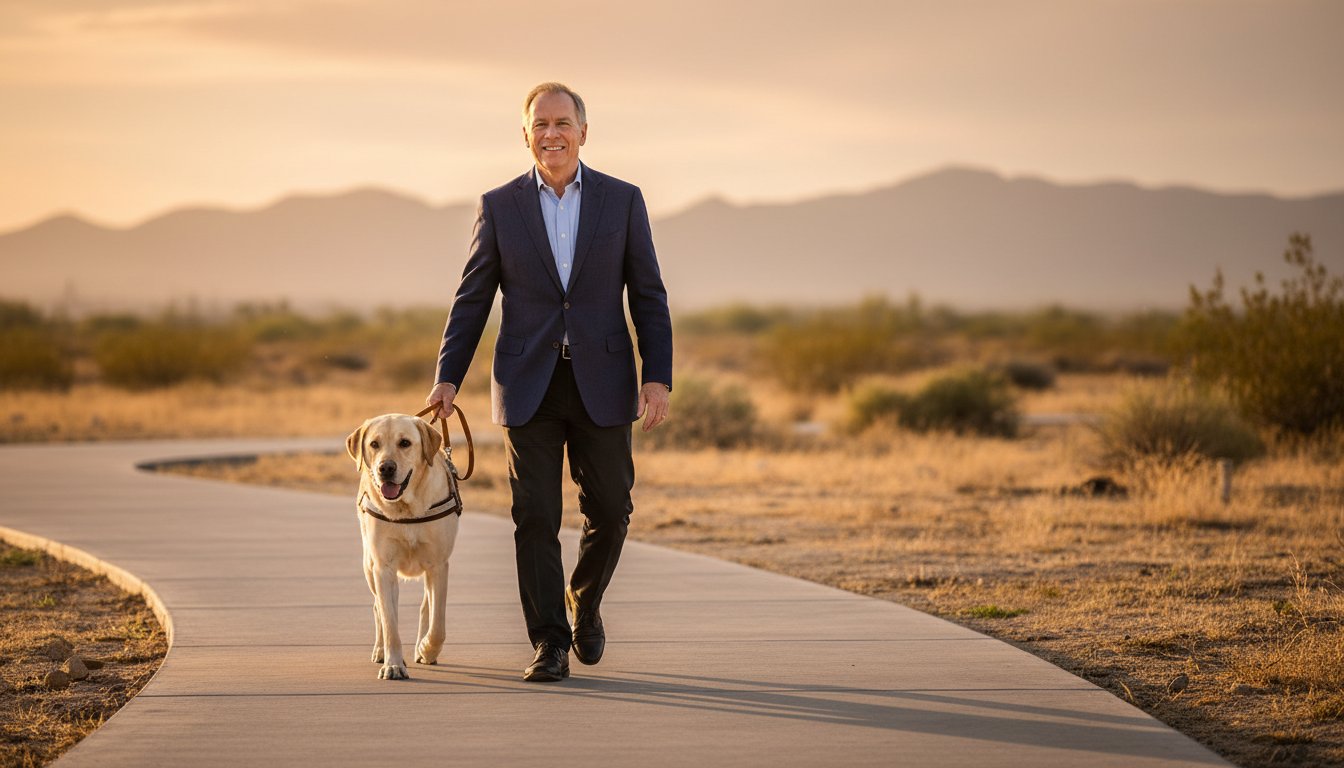
The Guide Dog Bond: A Masterclass in Trust and Interdependence
On September 11, 2001, at 8:46 AM, I stood on the 78th floor of the North Tower when the world suddenly tilted. In that moment of chaos, I didn’t reach for a handrail; I reached for the leather handle of my Labrador Retriever, Roselle. You might think a guide dog is simply a highly trained tool, but the guide dog bond is actually a sophisticated masterclass in interdependence. It’s a relationship where two distinct species learn to think and move as a single unit. This level of connection doesn’t happen by accident; it’s built through thousands of tiny moments of shared vulnerability.
You probably realize that bringing a new partner into your life can feel overwhelming. It’s natural to worry if you’ll ever truly “click” or if you’ll struggle to read the subtle cues your dog provides. This article promises to reveal the mechanics of that partnership and how you can foster deep trust. We’ll explore how to transition from seeing a dog as a pet to seeing them as a professional partner. You’ll gain the tools to create an Unstoppable Mindset that navigates any challenge with grace and confidence.
Key Takeaways
- Redefine your understanding of partnership by exploring how true interdependence creates a single, cohesive unit capable of navigating any environment.
- Discover how the guide dog bond is forged through a tactile language of cues and leash tension that communicates more than words ever could.
- Learn how a foundation of trust empowered calm leadership during the descent of the North Tower, offering a blueprint for managing modern crises.
- Identify the common challenges of the initial adjustment period and how to bridge communication gaps by learning to read your partner’s unique body language.
- Transform your professional life by applying the lessons of the guide dog partnership to cultivate an unstoppable mindset within your corporate team.
What is the Guide Dog Bond? Defining a Life-Saving Partnership
The guide dog bond is not a matter of simple pet ownership. It is a dynamic, working partnership built on the bedrock of absolute trust. When Roselle and I stood on the 78th floor of the North Tower on September 11, 2001, our connection was the only thing that truly mattered. We did not just exist side by side; we functioned as a single, cohesive unit. This is the essence of interdependence. It is the realization that while I provide the destination, my dog provides the safe path to get there.
For decades, many viewed a guide dog as a sophisticated tool, much like a white cane. This perspective has shifted dramatically within the blind community. We now recognize these animals as partners who contribute their own intelligence to our daily lives. This shift is the foundation for what I call the Art of Living with No Limits. By moving away from the idea of “using” an animal and toward “working with” a teammate, we unlock a level of freedom that physical sight alone cannot provide. Since I received my first guide dog in 1964, I have seen how this synergy transforms a person’s entire world view.

The Difference Between a Pet and a Working Partner
A pet provides emotional support and companionship. A guide dog provides navigational safety and life-saving decision making. This relationship operates 24 hours a day, every day of the year. It requires a level of constant focus that standard pet interactions never demand. While a pet might play fetch for fun, a guide dog processes complex environmental data to keep their handler from harm. The guide dog bond is a commitment to mutual survival and success where two distinct lives become one shared journey.
The Role of Mutual Respect in the Partnership
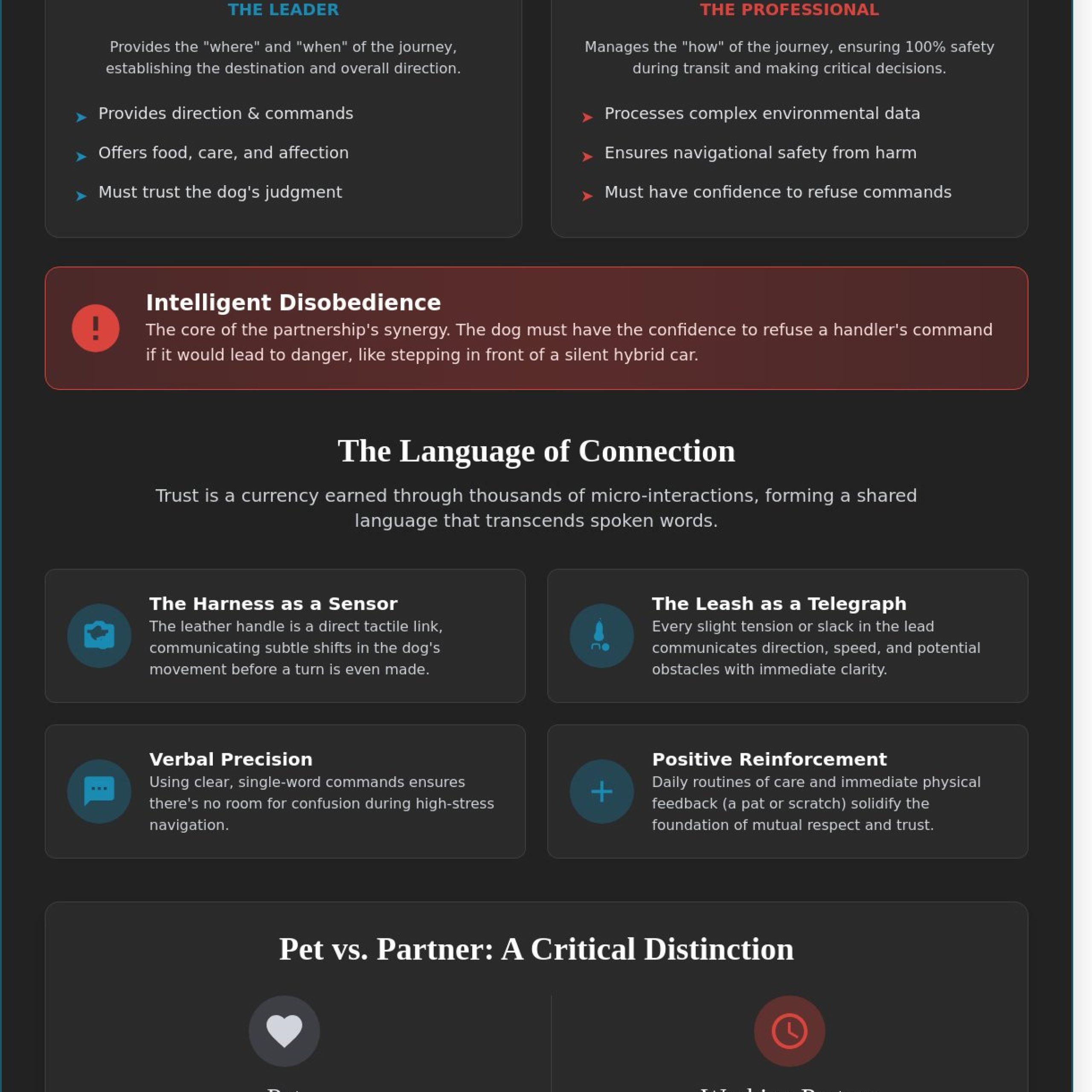
Trust is a two-way street that requires constant maintenance. The dog views the handler as a leader who provides direction, food, and affection. In return, the handler must respect the dog’s professional boundaries and unique skills. This Guide dog partnership relies on the concept of intelligent disobedience. If I tell my dog to move forward but there is a silent hybrid car approaching, she must have the confidence to refuse my command. This synergy is the core of the Unstoppable Mindset.
- Leadership: Handlers provide the “where” and “when” of the journey.
- Professionalism: The dog manages the “how,” ensuring 100 percent safety during transit.
- Boundaries: Respecting the harness means knowing when the dog is on duty and when they are off.
When we respect these roles, we move from a place of limitation to a place of infinite potential. It is about seeing beyond the physical and trusting the bond to lead the way.
The Anatomy of Trust: How the Connection is Forged
Trust isn’t a gift given at a graduation ceremony; it’s a currency earned through thousands of micro-interactions. A guide dog bond relies on a shared language that transcends spoken words. When I hold the harness handle, I’m not just holding a piece of leather; I’m plugged into a living, breathing sensor. This tactile connection allows me to feel the subtle shift in a dog’s shoulders before they even make a turn. We move as one unit because we’ve practiced the rhythm of our partnership until it’s as natural as breathing. This connection is built on a framework of predictable communication:
- The Leash as a Telegraph: Every slight tension or slack in the lead communicates direction, speed, and potential obstacles.
- Verbal Precision: Using clear, single-word commands ensures there’s no room for confusion during high-stress navigation.
- Physical Feedback: A pat on the head or a scratch behind the ears serves as an immediate, non-verbal “well done” that reinforces the partnership.
Consistency, Care, and Communication
Reliability is the cornerstone of safety. If I’m inconsistent with my cues, I create anxiety for the dog. Our daily routine includes feeding, grooming, and play, which are just as critical as harness work. These moments of care build a foundation of mutual respect. We use positive reinforcement training techniques to ensure every successful navigation is met with a clear, rewarding signal. My emotional state matters too; if I’m tense, the dog feels it through the harness. True leadership requires a calm heart and a steady hand. You can explore these concepts further through my unstoppable mindset keynote sessions.
Understanding Intelligent Disobedience
Perhaps the most profound aspect of our partnership is intelligent disobedience. This occurs when a dog intentionally refuses a command to prevent a disaster. It requires the dog to have enough confidence to tell the handler “no.” This is the highest level of trust. Imagine standing at a curb on a busy street. You hear no traffic and give the command “Forward.” However, a silent electric car, traveling at 20 miles per hour, is approaching the intersection. The dog stays planted despite your command. In that moment, the dog’s judgment overrides your authority to save your life. This level of interdependence is what makes the guide dog bond so unique; it’s a partnership where both members are empowered to lead when safety is on the line.
Lessons from Tower One: The Bond Tested by Fire
On September 11, 2001, at 8:46 AM, the world as I knew it shifted. I was working on the 78th floor of the North Tower when the first plane struck. In that moment, the guide dog bond I shared with Roselle became our literal lifeline. While the building swayed and the smell of jet fuel filled the air, I had to make a choice. I chose to trust the training we had practiced every day since our partnership began in 1999. I stayed calm because I knew that my reaction would dictate hers.

Calmness is Contagious: Leading Through Crisis
Dogs are incredibly sensitive to human emotion. If I had succumbed to terror, Roselle would have sensed my racing heart and shallow breath. She would have stopped working to comfort me or, perhaps, became too anxious to lead. By maintaining a steady voice and a focused mind, I gave her the permission she needed to do her job. This feedback loop created a pocket of peace in a chaotic stairwell. Research shows that this level of interdependence has profound psychosocial effects on the handler, allowing for heightened resilience during trauma. Your team is only as strong as the trust you’ve built in quiet times.
Seeing Beyond the Smoke
We descended 1,463 stairs together. As the smoke thickened and the emergency lights dimmed, the sighted people around us struggled to find their way. For Roselle and me, the environment hadn’t changed our strategy. I trusted her “eyes” to navigate the debris and the crowds while she trusted my leadership to keep us moving forward. This descent was a masterclass in seeing beyond blindness. Our bond was forged in the months of training, not just the minutes of the crisis. We didn’t just survive; we moved with purpose because we were a single unit.
- Preparation: Consistent practice eliminates the space where panic grows.
- Interdependence: Trust is a two-way street that requires daily maintenance.
- Resilience: The guide dog bond provides a psychological anchor when the external world is in flux.
When we finally reached the street, the South Tower collapsed. Even then, Roselle stayed focused. She didn’t run. She didn’t bark in fear. She waited for my command, proving that a well-prepared partnership can withstand any fire.
Common Challenges in Strengthening Your Partnership
Building a guide dog bond isn’t a magic trick that happens the moment you first grip the harness handle. It’s a disciplined practice of mutual discovery that requires more than just affection. The initial adjustment period often feels like a high-stakes dance where both partners are learning the steps in real-time. You might misinterpret a subtle pull or miss a signal your dog is giving through the leather. These miscommunications are inevitable. They aren’t failures; they’re essential data points. Learning to read your dog’s unique body language, like the specific tension in their shoulders or the rhythmic tilt of their head, requires a quiet mind and a high level of intellectual engagement.
Navigating the Learning Curve
Data from leading mobility schools indicates that the first 180 days are the most demanding for any new team. This six-month window is when the “honeymoon phase” fades and the reality of 24/7 interdependence sets in. You’ll make mistakes. Your dog will make mistakes. The key is to handle these errors without eroding the underlying trust. If you find yourself hitting a plateau, don’t wait for it to resolve itself. I’ve seen that consulting with professional trainers can resolve 90 percent of technical friction before it becomes a permanent habit. Professional guidance ensures that setbacks become stepping stones rather than roadblocks.
Maintaining the Bond Over Time
Even the most seasoned teams face the risk of burnout. A dog might lose focus if their daily routes become too repetitive, or a handler might become complacent in their commands. You’ve got to keep the work fresh. Introduce new environments or practice “find” commands for various objects to keep their mind sharp. Watch for signs of stress, such as a tucked tail or a sudden reluctance to work. These are clear signals that your partner needs a break. Eventually, every team faces the transition to retirement. Honoring the guide dog bond means recognizing when your dog’s working days should end, ensuring they transition into a life of rest while you carry their lessons forward.
The fear of “not clicking” with a new dog is a heavy emotional burden for many handlers. It’s a vulnerability that requires an unstoppable mindset to overcome. Remember that trust is built through shared challenges, not just easy successes. If you’re struggling to find your rhythm, focus on the small wins of the day. Resilience is found in the recovery, not the perfection of the walk.
Discover how to lead with confidence and build lasting trust by exploring the Unstoppable Mindset approach to partnership.
Cultivating an Unstoppable Mindset Through Your Guide Dog
The guide dog bond isn’t just a tool for navigation; it’s a masterclass in the power of trust. When Roselle and I stood on the 78th floor of the North Tower on September 11, 2001, our survival didn’t depend on my individual independence. It rested entirely on our ability to function as a single, cohesive unit. This synergy is the heartbeat of an Unstoppable Mindset. It requires moving past the outdated belief that asking for help is a sign of weakness. In reality, knowing when to lean on a partner is the ultimate expression of professional and personal confidence.
Interdependence as a Leadership Strength
True leadership mirrors the way a guide dog and handler navigate a crowded city street. I don’t give the dog a GPS coordinate; I provide a direction, and she manages the immediate obstacles. In business, data shows that 86 percent of employees and executives cite a lack of collaboration as a primary cause of workplace failure. Leaders who embrace interdependence create environments where diverse perspectives are valued as assets. I’ve always viewed blindness as a mere characteristic of diversity, similar to height or eye color, rather than a deficit. When teams trust each other’s unique strengths, they move with a speed and clarity that “independent” individuals simply can’t match. You can build this trust today by delegating a high-stakes task without micromanaging the process. Watch how your team rises to the occasion when they feel truly trusted.
Final Thoughts: Living with No Limits
Roselle’s legacy isn’t defined only by the 1,463 steps we descended together that morning. It’s defined by the realization that limits are often just stories we tell ourselves to stay comfortable. You don’t need a service animal to experience the depth of the guide dog bond in your own life. You only need the courage to be vulnerable and the discipline to prepare for the unexpected. When we stop trying to control every variable and start trusting our partners, we move from a “No Limits” philosophy to a “No Limits” reality. Trust is a choice you make every single day. If you’re ready to transform your organization into a resilient, high-performing team, I’d love to share these lessons with you. You can invite Michael Hingson to speak at your next event about trust and teamwork to learn how to cultivate your own unstoppable mindset.
Embrace Your Own Path to Interdependence
True trust isn’t a passive state; it’s an active choice you make every day. Our journey through the mechanics of the guide dog bond shows that interdependence isn’t a weakness. It’s the ultimate strength. On September 11, 2001, this bond allowed Roselle and me to navigate 78 floors and 1,463 steps to safety. That experience wasn’t just a survival story. It was a masterclass in how preparation and mutual reliance create a foundation for leadership. You can apply these same principles to your corporate teams or personal life to overcome any perceived limitation.
As the New York Times Bestselling Author of Thunder Dog and host of the Unstoppable Mindset Podcast, I’ve spent decades teaching audiences how to see beyond their physical sight. Whether you’re facing a literal fire or a metaphorical shift in your industry, the lessons of trust remain constant. You don’t have to navigate the dark alone when you have the right mindset and the right partners. It’s time to transform your perspective on what’s possible.
Book Michael Hingson for a Keynote on Trust and Teamwork to bring these life-changing lessons to your next event. You’re capable of more than you know.
Frequently Asked Questions
How long does it take for a guide dog and handler to truly bond?
It typically takes 6 to 12 months for a guide dog and handler to achieve a deep, intuitive connection. This period allows the team to move past basic commands into a state of true interdependence. During my time with Roselle, we spent nearly 300 days working together before our coordination felt truly seamless. This timeframe ensures both partners understand each other’s subtle physical cues, creating a resilient guide dog bond that can withstand any challenge.
Can a guide dog bond with more than one person in a household?
A guide dog primarily bonds with its handler to maintain the integrity of their working partnership, though they can be friendly with 100% of family members. For the first 90 days, the handler should be the only person providing food and affection. This focused attention prevents the dog from looking to others for direction. While the dog loves the whole family, its primary loyalty remains with the person holding the harness. This ensures the dog remains focused.
What is the most important factor in building trust with a guide dog?
Consistent communication is the most vital factor in building a strong connection with your canine partner. You must trust the dog’s training 100% of the time, especially when they perform “intelligent disobedience” to keep you safe. In the North Tower on September 11, 2001, my trust in Roselle’s calm demeanor allowed us to lead others to safety. Trust isn’t granted; it’s earned through thousands of successful curb approaches and street crossings. It’s a partnership built on mutual respect.
How do you know if a guide dog bond is failing?
A failing bond often manifests as a 20% or higher increase in avoidable errors or a visible lack of enthusiasm in the dog’s work. If a dog ignores commands or shows signs of stress, the partnership may be struggling. According to industry standards, about 5% of teams require remedial training to realign their guide dog bond. Recognizing these signs early allows for professional intervention before the team’s safety is compromised in daily navigation.
Does the bond change when the guide dog retires?
The bond shifts from a professional partnership to one of pure companionship once a guide dog retires after their typical 8 to 10 years of service. While the harness is put away, the emotional connection remains 100% intact. I’ve seen retired dogs continue to watch over their handlers even without a formal job. It’s a transition from a life of shared mission to a life of shared rest. This stage of life honors their years of dedicated service.
How does a blind person “read” their dog without sight?
A handler reads their dog through the handle of the harness, which transmits 95% of the dog’s physical movements directly to the hand. You feel the slight hesitation at a curb or the tension when an obstacle appears. This tactile feedback creates a vivid mental map of the environment without the need for physical sight. It’s a specialized form of vision that relies on touch and rhythm, allowing us to navigate the world with confidence.
Can you play with a guide dog, or is it always “all work”?
Guide dogs spend approximately 70% of their day out of the harness, during which time they’re encouraged to play and relax. When the harness comes off, they’re just like any other dog. They play fetch, enjoy belly rubs, and nap in the sun. This downtime is essential for their mental health and longevity. A balanced dog is a better worker because they’ve had the chance to simply be a dog, recharging for their next mission.
What happens if a guide dog makes a mistake during the bonding process?
Mistakes are treated as learning opportunities that occur in roughly 10% of training sessions during the initial bonding phase. Instead of punishment, the handler uses immediate redirection to correct the behavior. This process builds the Unstoppable Mindset needed for high-stakes environments like the one I faced on September 11, 2001. Every corrected error strengthens the team’s shared language. We view mistakes as building blocks of future safety and mutual respect.


 Facebook
 Twitter
 Youtube
 Linkedin