Overcoming Adversity: A Guide to Building an Unstoppable Mindset in 2026
Life’s greatest challenges rarely announce their arrival. They appear suddenly, like a tremor that shakes the foundation of everything you thought was stable. In that moment, the path forward can seem to vanish, leaving you in the dark, overwhelmed, and uncertain. The question that echoes in the silence is universal: How do I move forward when the challenge in front of me feels insurmountable?
The answer is not found in sheer force of will or rugged independence. True resilience—the kind that builds an unstoppable mindset—is forged in trust, partnership, and the profound understanding that we are far stronger together than we could ever be alone. It’s about learning to navigate the darkness by relying on a vision that transcends physical sight. This guide will provide a clear framework for that journey, using lessons learned from descending 78 flights of the World Trade Center’s North Tower on 9/11 to transform adversity into your greatest opportunity for growth.
Defining Adversity: Why Hardship is the Forge of Resilience
We often think of adversity as a singular, catastrophic event—a sudden loss, a corporate crisis, a personal failure. But this view is incomplete. To truly begin overcoming adversity, we must first redefine it not as a tragedy that defines us, but as a set of circumstances that demands new, adaptive strategies.
-
Adversity is a set of circumstances requiring adaptation. It can be event-based, like the sudden chaos of 9/11, or systemic, like navigating a world not built for you. My blindness, for example, is not a tragedy; it is a characteristic that has required me to develop different, often more effective, ways of navigating the world.
-
Resilience is a muscle, not a personality trait. No one is born with a finite amount of courage. Resilience is developed through preparation, practice, and the conscious decision to face challenges. It is a skill honed in the forge of hardship.
-
Challenges are boundaries, not stop signs. This is the core of the ‘No Limits’ philosophy. An obstacle is simply the edge of what you currently know. The unstoppable mindset sees that edge not as an end, but as the starting point for innovation and growth.
Adversity as a Characteristic, Not a Definition
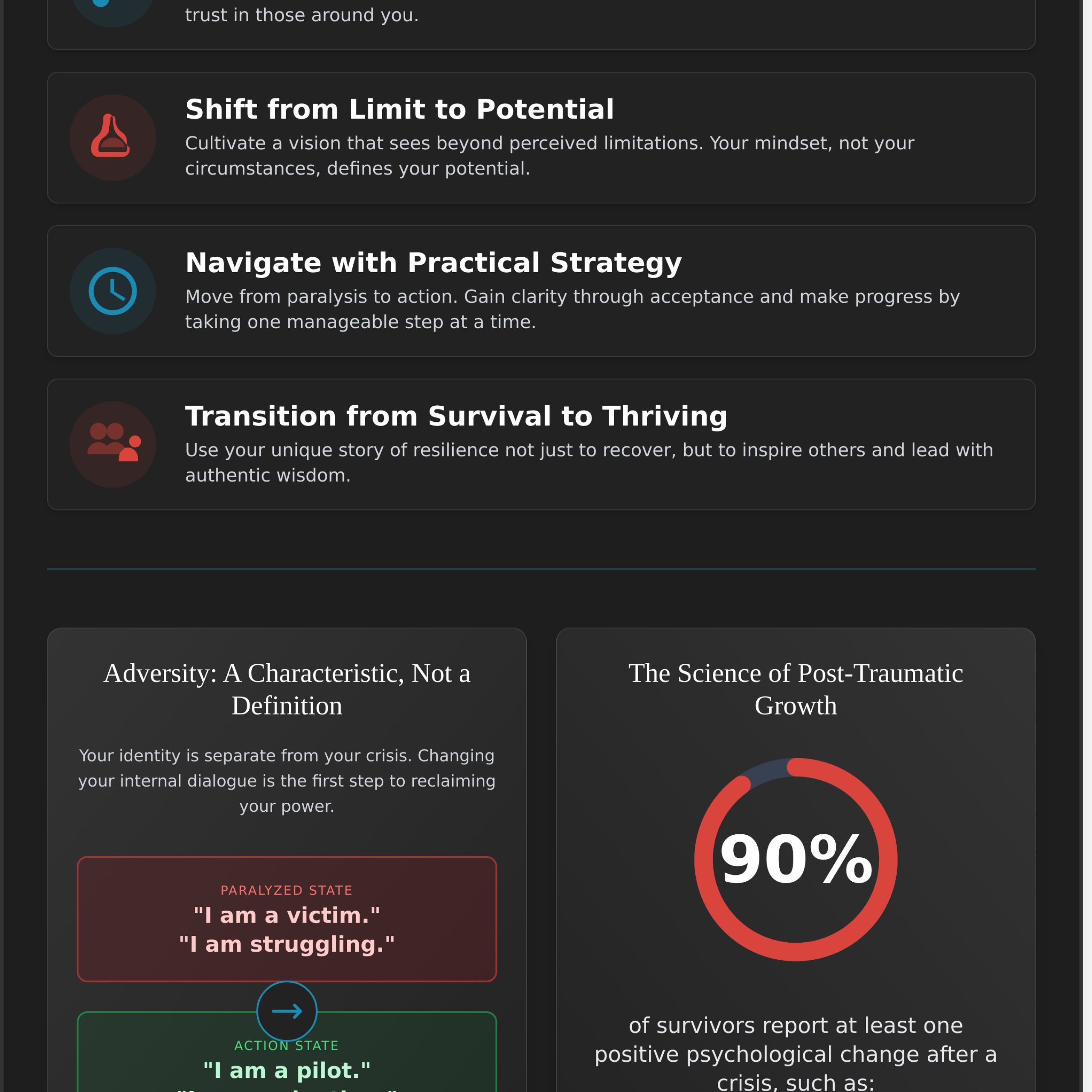
The most common trap in a crisis is allowing the event to become your identity. You are not your setback. To build an unstoppable mindset, you must separate who you are from what you are experiencing. The language you use is critical. Shifting from "I am struggling" to "I am navigating a struggle" is more than just semantics; it reclaims your power as the pilot of your life, not a passenger subject to the turbulence. Labeling yourself a "victim" cedes control and prevents the very growth you seek.
The Science of Post-Traumatic Growth
Psychologists have long studied the phenomenon of post-traumatic growth, where individuals experience positive psychological change following a significant life challenge. This isn’t about ignoring pain or "bouncing back" to who you were before. It’s about using the pressure of the experience to forge a stronger, more focused version of yourself. Adversity has a way of stripping away the non-essential, clarifying your values and sharpening your focus on what truly matters. True resilience, therefore, is the ability to adapt and thrive because of the challenge, not just in spite of it.

The Unstoppable Mindset: Shifting Your Perspective from Limit to Potential
An unstoppable mindset is a deep and unwavering commitment to finding a solution, regardless of the sensory or physical information available. It’s a way of operating that relies on an internal vision, one that can see a path forward even when the way is dark, filled with smoke, or obscured by fear.
Most people are "blind" not by a physical characteristic, but by their own limiting beliefs. Fear and uncertainty create a kind of blindness that prevents them from seeing their own potential and the opportunities hidden within a crisis. The key to overcoming adversity is to learn the difference between sight and vision.
-
Sight is the passive act of seeing what is directly in front of you—the obstacles, the chaos, the reasons to stop.
-
Vision is the active process of creating a mental map of where you need to go. It is the hallmark of leadership, allowing you to see a successful outcome where others only see a wall.
This vision must be fueled by grounded hope, not toxic positivity. Acknowledging the danger and difficulty is essential; pretending it doesn’t exist is foolish. Grounded hope is the belief in your ability to navigate the reality of the situation, one step at a time.
Seeing Beyond the Physical Boundaries
On September 11, 2001, physical sight was useless on the 78th floor of the North Tower. The air was thick with smoke, and panic was a tangible force. But I had been preparing for a moment like this my entire life. Using my mobility skills, I constructed a mental map of our surroundings. I could "see" the path to the stairwell, the location of my colleagues, and the calm, steady presence of my guide dog, Roselle. This is the power of vision. You can cultivate it by using sensory-rich goal setting—imagining not just the sight of success, but its sounds, smells, and feelings—to anchor your mindset in a future you are actively creating.
Overcoming the Fear of the Unknown
Fear is often described as "False Evidence Appearing Real." In a crisis, your brain is flooded with worst-case scenarios. The antidote to this panic is not bravery, but preparation. On 9/11, we had practiced fire drills. We knew the location of the stairs. That preparation provided a framework for action, allowing us to override the instinct to freeze. The calm, orderly descent of 1,463 stairs was not an act of heroism; it was the result of trust in our plan and in each other. By focusing on the immediate task—the next step, the next landing—we made the unknown manageable.
Trust as a Survival Tool: The Power of Interdependence
Our culture glorifies the myth of the "rugged individualist," the lone hero who overcomes all odds through sheer grit. This is a dangerous fantasy. In any real crisis, solo resilience leads to burnout and failure. The most powerful survival tool you have is not independence, but interdependence.
Interdependence is the synergistic relationship where individuals, each with unique strengths and characteristics, work together toward a common goal. It’s a state of mutual reliance built on a foundation of absolute trust. The partnership between a blind person and a guide dog is perhaps the ultimate model of this principle. On 9/11, my trust in Roselle and her trust in me was the force that guided us, and dozens of others, to safety. I am the strategist, the decision-maker; she is the tactical expert, navigating the physical terrain. Together, we are far more effective than either of us could be alone. This is the lesson for any team or leader facing a corporate crisis. Trust is the highest form of leadership.
The Guide Dog Model of Interdependence
How do you build a "guide dog" level of trust within your team? It rests on three pillars:
-
Reliability: Consistently doing what you say you will do.
-
Competence: Possessing the skills and knowledge to perform your role effectively.
-
Empathy: Understanding and valuing the perspectives and contributions of others.
In this model, asking for help is not a sign of weakness; it is a sign of strategic strength. It shows you understand that the collective is more powerful than the individual and that you trust your team to fill the gaps.
Leading Your Team Through the Smoke
When a crisis hits, a leader’s primary role is to be the calm center. Your team will look to you not for all the answers, but for reassurance that a path exists. Clear, calm, and consistent communication is vital. It cuts through the noise of fear and provides a focal point for collective action. Fostering a culture of inclusion is not just an ethical imperative; it is a tactical advantage. In the North Tower, every person, regardless of their role or title, became a crucial part of our survival network. By leveraging every person’s unique "characteristic" and perspective, you create a team that is resilient, adaptive, and truly unstoppable.
Practical Strategies for Navigating Your Own Crisis
Philosophy is essential, but it must be paired with action. When you find yourself at the base of an insurmountable challenge, use these strategies to begin your ascent.
-
Acknowledge and Accept the Reality: The first step is to stop fighting the reality of the situation. Acceptance is not surrender. It is the calm, clear-eyed assessment of your starting point. You cannot navigate from a location you refuse to acknowledge.
-
Break the Insurmountable into the Manageable: No one can climb 78 flights of stairs at once. You do it one step at a time, one landing at a time. This is the "one step at a time" approach. Break your overwhelming challenge down into the smallest possible components and focus only on the very next one.
-
Leverage Your Adaptive Tools: You don’t have to reinvent the wheel in a crisis. Identify the adaptive technologies in your life—the software, systems, mentors, or team members that can help. My screen reader, JAWS, is an adaptive tool that allows me to access information. Your "JAWS" might be a trusted advisor or a piece of project management software. Use what is available.
-
Establish a Resilience Routine: Your mental state is your most valuable asset. Protect it with daily habits. Whether it’s five minutes of mindfulness, a morning walk, or a daily check-in with your team, create a routine that anchors you and provides stability in the midst of chaos.
-
Seek Mentorship and External Perspective: Find your "Roselle." This is a person, a team, or a mentor who you can trust implicitly to guide you through the terrain you cannot see clearly. An outside perspective is invaluable for cutting through your own biases and fears.
The Step-by-Step Descent Technique
When a project or problem feels overwhelming, focus only on the "next ten feet." Don’t worry about the finish line; worry about the immediate step in front of you. A practical way to implement this is the 5-Minute Focus Window: set a timer for five minutes and work on one, and only one, small component of the task. This "staircase method" for managing a crisis turns an insurmountable mountain into a series of manageable steps, building momentum with each one.
Building Your Adaptive Toolkit
Take inventory of the assistive technologies in your professional life. These are the tools and people who possess specialized expertise. A diverse and inclusive team is the ultimate adaptive toolkit. Different life experiences and perspectives are not a liability; they are a tactical advantage in complex problem-solving, allowing your team to see solutions that a homogenous group would miss.
Living Without Limits: Sustaining Growth After the Storm
Overcoming a major adversity is not a finish line. It is a transformation. The goal is to transition from "survival mode" back into "thrive mode," carrying the lessons of the storm with you. Your story of resilience becomes a powerful tool for leadership, allowing you to inspire and guide others who are still navigating their own challenges. This is the art of living with no limits—a lifelong commitment to growth, adaptation, and using your experiences to build a more resilient world.
Becoming a Beacon for Others
The survivor has a unique responsibility: to share the lessons learned to help others. You can become a mentor to those who are currently "in the tower" of their own lives, offering the perspective and hope they need to find their way down. By sharing your journey, you build a legacy of inclusion, trust, and unstoppable resilience that extends far beyond yourself.
Next Steps: Mastering Your Mindset
This journey of building an unstoppable mindset is ongoing. To continue learning and applying these principles, you can explore resources that offer a deeper dive into these concepts.
-
Listen to the Unstoppable Mindset Podcast for continuous insights and conversations on resilience and leadership.
-
Read the New York Times Bestseller Thunder Dog for the full, detailed account of the 9/11 story and the profound lessons of trust and teamwork it holds.
-
And most importantly, bring these lessons directly to your team.
Empower your team with Michael Hingson’s ‘Art of Living with No Limits’ Keynote
Frequently Asked Questions
What is the best way to start overcoming adversity today?
The best way to start is with acceptance. Acknowledge the reality of your situation without judgment. Then, identify one single, small, manageable step you can take right now. Action, no matter how small, is the antidote to paralysis.
How can I be resilient when I feel like I have no support?
Resilience often begins with an internal shift before external support arrives. Start by focusing on what you can control: your mindset, your language, and your daily routines. Then, actively seek out one person or resource that can serve as a starting point for building your support network, or "interdependence team."
What is the difference between independence and interdependence in a crisis?
Independence is relying solely on your own abilities, which often leads to burnout. Interdependence is a strategic partnership where individuals leverage each other’s strengths for a common goal. It is a more effective and sustainable model for resilience, built on mutual trust and respect.
How did Michael Hingson use his guide dog to survive 9/11?
Michael and his guide dog, Roselle, operated as a seamless team. Michael provided the strategic direction and calm leadership, while Roselle provided tactical navigation through the smoke-filled, crowded stairwells. Their relationship, built on years of absolute trust, allowed them to guide each other and many others to safety.
Can an unstoppable mindset be learned, or is it something you’re born with?
An unstoppable mindset is absolutely a learned skill. It is not an innate trait but a muscle built through conscious practice, preparation, and the consistent application of principles like trust, interdependence, and focusing on vision over sight.
How do I help my team overcome a major professional setback?
As a leader, your role is to provide calm, clear communication. Acknowledge the setback without placing blame. Re-establish a shared vision and break the path forward into small, achievable goals. Foster a culture of interdependence where team members feel safe asking for help and relying on one another.
What are some powerful quotes about overcoming adversity for daily inspiration?
"The only thing that’s a handicap is a bad attitude." "Vision is about seeing a path forward where others only see a wall." "Trust is the highest form of leadership and the foundation of all teamwork."
How does disability inclusion improve a company’s resilience?
Disability inclusion brings diverse perspectives and problem-solving methods to a team. Individuals with disabilities are often master adaptors, having spent their lives developing creative strategies to navigate the world. This inherent innovation and resilient mindset is a massive tactical advantage for any organization facing a crisis.


 Facebook
 Twitter
 Youtube
 Linkedin