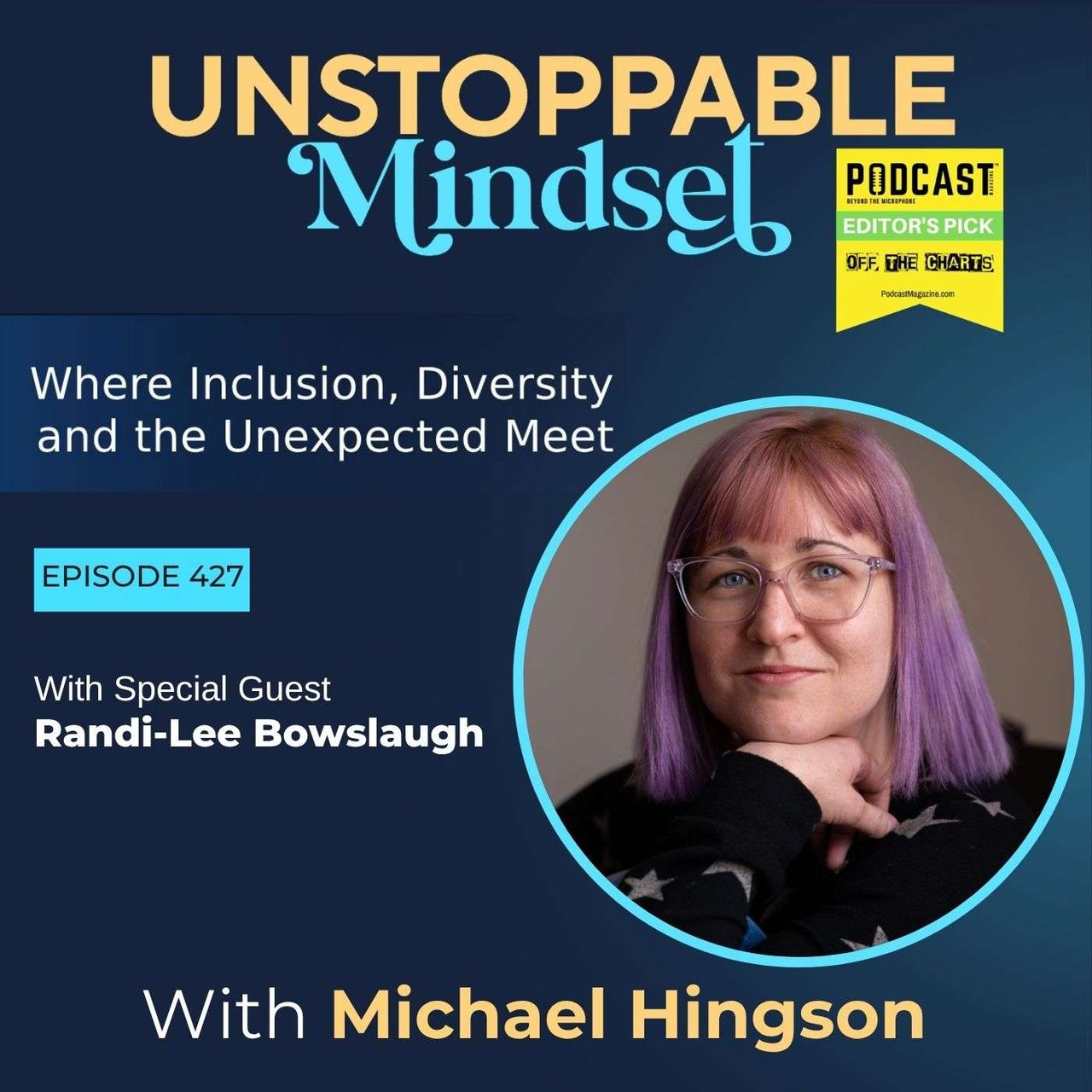
Episode 427 – How Writing Builds an Unstoppable Voice and Purpose with Randi-Lee Bowslaugh
What happens when you finally understand yourself after decades of feeling different?
I sit down with Randi-Lee Bowslaugh as she shares her journey through autism diagnosis, mental health struggles, and loss, and how she turned those experiences into writing, advocacy, and purpose. You will hear how she navigated depression, chronic pain, and family trauma while raising a daughter with autism, and why self-advocacy became her most powerful tool. I believe you will find this conversation both honest and encouraging as it shows how understanding your story can help you move forward with strength and clarity.
Highlights:
00:01:35 – Discover how early signs of autism can be missed in childhood
00:06:54 – Understand how chronic pain and fibromyalgia impact daily life
00:08:23 – Learn what a late autism diagnosis reveals about identity
00:12:54 – Discover why autism appears to be increasing but isn’t
00:35:18 – Learn the real challenges of raising a child with autism
00:58:26 – Discover why self-advocacy is the most important skill to build
Bottom of Form
About the Guest:
Randi-Lee was born and raised in Ontario, Canada and from a young age she had a passion for helping others. She attended Niagara College and graduated at the top of her class from Community and Justice Services, after completing her placement at a recovery house for alcohol and drug addictions. Post-graduation she worked at a Native Friendship Centre for two and a half years while pursuing a university education in psychology. Randi-Lee continued working in social services for another four years as an employment counselor until she left to pursue her other passions.
Randi-Lee is an author and outspoken advocate for mental health sharing her true story with honesty. From the age of 14 she struggled with depressive thoughts. There were times in her life that she wasn’t sure how she would continue. Depression continues to be a battle in her life but she is glad that she continues to live. She has spoken at events that promote wellness and compassionately shares her experiences with her own mental health. In 2021 she started a YouTube channel, Write or Die Show, to spread awareness about various mental health issues and to end the stigma associated with mental health.
Growing up she never felt that she fit in, being the last to understand jokes and confused about many emotions that she saw on others. In 2021 she finally had answers to the questions about herself that had been nagging at her. She was diagnosed with moderate Autism.
Another of Randi-Lee’s passions is kickboxing, which she did for about 10 years. She was a Canadian National Champion in kickboxing in 2015, competed at the World’s Kickboxing tournament later that year and 2016 competed at the Pan-Am Games, where she received silver in her division. In 2020 she was chosen as one of the coaches for the Ontario Winter Games where she inspired and coached young athletes.
Randi is a mom to two; her youngest child has autism and she is a grandma to one. Randi encourages and supports her youngest child’s entrepreneurial spirit as he follows his dream of being an artist. When she can, she incorporates his art into her stories.
Ways to connect with Randi-Lee:
Websites:
My Books
Write or Die:
https://www.youtube.com/channel/UCSTmVQUW8K8r1sBDchLyTwA?sub_confirmation=1
What I’m Reading
https://open.spotify.com/show/4kMt8h95cfD3idamZ5LJZK?si=189fc2f901124993
Merch Store
https://write-or-die-show.creator-spring.com
https://www.facebook.com/rbwriting
https://www.instagram.com/randileebowslaugh
TikTok
https://www.tiktok.com/@randileebowslaugh
SubStack
https://randileebowslaugh.substack.com/
About the Host:
Michael Hingson is a New York Times best-selling author, international lecturer, and Chief Vision Officer for accessiBe. Michael, blind since birth, survived the 9/11 attacks with the help of his guide dog Roselle. This story is the subject of his best-selling book, Thunder Dog.
Michael gives over 100 presentations around the world each year speaking to influential groups such as Exxon Mobile, AT&T, Federal Express, Scripps College, Rutgers University, Children’s Hospital, and the American Red Cross just to name a few. He is Ambassador for the National Braille Literacy Campaign for the National Federation of the Blind and also serves as Ambassador for the American Humane Association’s 2012 Hero Dog Awards.
https://www.facebook.com/michael.hingson.author.speaker/
https://www.youtube.com/user/mhingson
https://www.linkedin.com/in/michaelhingson/
accessiBe Links
https://www.youtube.com/c/accessiBe
https://www.linkedin.com/company/accessibe/mycompany/
https://www.facebook.com/accessibe/
Thanks for listening!
Thanks so much for listening to our podcast! If you enjoyed this episode and think that others could benefit from listening, please share it using the social media buttons on this page. Do you have some feedback or questions about this episode? Leave a comment in the section below!
Subscribe to the podcast
If you would like to get automatic updates of new podcast episodes, you can subscribe to the podcast on Apple Podcasts or Stitcher. You can subscribe in your favorite podcast app. You can also support our podcast through our tip jar https://tips.pinecast.com/jar/unstoppable-mindset .
Leave us an Apple Podcasts review
Ratings and reviews from our listeners are extremely valuable to us and greatly appreciated. They help our podcast rank higher on Apple Podcasts, which exposes our show to more awesome listeners like you. If you have a minute, please leave an honest review on Apple Podcasts.
Transcription Notes:
Michael Hingson 00:04
What if the biggest thing holding you back isn’t what’s in front of you, but rather what you believe Welcome to unstoppable mindset where inclusion, diversity and the unexpected meet. I’m your host. Michael hingson, speaker, author and advocate for inclusion and possibilities. This podcast explores how the beliefs we carry shape the way we live, lead and connect with others. Each week, I talk with people who challenge assumptions, face adversity head on and show what’s possible when we choose curiosity over fear, together, we focus on mindset resilience and the small shifts that lead to meaningful change. Let’s get started. Hi everyone. I am Michael Hingson, the host of unstoppable mindset where inclusion, diversity and the unexpected meet today. Which one do we get mostly unexpected? Which is anything that doesn’t directly have to do with inclusion or diversity, but you never know where we might go with it all. So we’ll see anyway. Our guest today is Randy Lee Bowslaugh, who actually was on our podcast well now years ago, as a result of one of the pot of Palooza episodes. And we kind of re encountered each other, because we both Sarah publicist Mickey Mickelson, who I sent an announcement to, saying, Tell everybody you record, that you that you serve, that we’re always looking for podcast guests. And guess who showed up? There’s Randy Lee. So here we are. Yeah, I know, isn’t it great? So here we are. And Randy Lee, welcome. Well, we’ll call you Randy right to unstoppable mindset. We’re glad you’re here.
Randi-Lee Bowslaugh 01:58
Thanks. I am so glad to come back. And I find it funny that I also, you know, send Mickey the hey, my podcast is looking for guests, and who comes on my show. Will you
Michael Hingson 02:11
turn about spare play? Randy is, among other things, an author, and we’re going to talk about some of those books and so on. But let’s start like I love to do tell us about kind of the early Randy growing up.
02:23
Well, the early Randy back in the day time
Michael Hingson 02:27
ago, in a galaxy far, far away.
Randi-Lee Bowslaugh 02:30
Yes, this feels like it now. So I mean growing up, I guess I would say, I would say I was your typical kid, but looking back and knowing what I know now, I was definitely not a typical child. But yeah, I loved the same things both most kids do, playing in the mud and writing. Yep, loved writing at the young age, making movies, all that jazz. And then as I got older into my teen years, that’s when, that’s when I dealt with some depression that just keeps following me around. Yep. And then graduated high school, went to college, graduated from that couple times. How come? A couple times? Well, I took the first program I took. It was called pre community services. So by the time I had to actually apply to college, it was like two months before college would start. There wasn’t a lot of options left open. So I kind of picked something that I’m like, Okay, it’s still open. Looks kind of interesting. So I went with that, but it was just like a one year certificate program. And so from that, I was like, hey, I need to figure out a real program to take. So I looked around and I found one that had a lot of similar classes, because they didn’t want to do a lot of repeat of stuff. So I took community and Justice Services, which was a lot of fun. Never thought that was going to be what I took, but I did from there. Learned psychology was amazing, so I took some university psychology and got into social service work for a few years before I was like, oh my goodness, the amount of governmental red tape. Here I am out,
Michael Hingson 04:16
and we should explain Randy is from Canada. Yes, originally Toronto, right.
Randi-Lee Bowslaugh 04:22
No, Toronto’s about, no, Toronto’s about two hours north of me. What town I am in?
Michael Hingson 04:31
Welland. Welland, okay, is that? But that where you’re from originally?
Randi-Lee Bowslaugh 04:35
Well, I grew up in St Catherine’s, which is still the same region as well, and so well and is part of how many we got 12 municipalities, something like that, called the Niagara region. And we encompassed Niagara
Michael Hingson 04:49
Falls, got it. So anyway, you You went off and did this other program in college. Then what did you do?
Randi-Lee Bowslaugh 05:01
So from there, I was like, I’m going to be a probation officer. That’s what I decided I was going to be. But at that time, you needed to have a bachelor’s degree. So I started doing University and of course, by the time I was burnt out from social services, they had changed, and you didn’t need a bachelor degree anymore, but I was over it, and I didn’t want to do it anymore. Yeah, awesome, awesome. So I worked, I worked as an employment counselor at two different spots for a total of, I want to say, around six ish years, give or take, before, yeah, before I burnt out and went, Oh, my goodness, I am done with social services. Through like government agencies, I can do a lot more help. And just talking to people about my story or writing about it, I can be a lot more useful. Yeah. So, yeah, I stopped. I quit there at that time, I also had cancer. So that’s fun, no fun, right? It was, it was not a good time at all. But you can ask me more about that after one train of thought at a time, or else I’ll get totally distracted. So from there, I was actually a personal trainer. Had my own little business for a while there doing personal training and kickboxing, because I was competing, competing in kickboxing.
06:28
Tell me about I’m I don’t know much about kickboxing. Tell me about that.
Randi-Lee Bowslaugh 06:33
Yeah, so I started doing that. Oh, many moons ago. Now it feels like and what is it exactly? It is kicking and punching people. Well, okay, yep, all right, now we know the kind of person you are. Okay, exactly. There’s different styles. So, like, there’s depending what style of it you do is going to depend on the rules, but basically, you’re kicking and punching people in the front of their body, from the knees up to the head. Got it basically, for the most part. There. There’s a few variations of rules depending if you’re doing like k1 or low kick or whatever. So yeah, that was that was awesome. I competed nationally a couple times. I went to worlds. I went to the pan Americans. It was so much fun. I keep telling my husband, one day I’m going to do it again, and he keeps telling me to remember that my body is broken now. It’s broken now. Yeah, it’s a few years ago, probably, I guess it would have been around 2022 when covid started to release its hold on Canada, because we took forever, I started getting all these aches and pains, and there were days that I literally couldn’t get myself up off the ground. It was, it was ridiculous. So lots of doctor’s appointments, lots of testing, and so there is arthritis in both my sacroiliac joints, which are pretty important when you’re kickboxing, because that’s your hips, and that’s how you move. So really hard. When the doctors tell you don’t, don’t, you know, jostle those more because, you know, that’s where it already is. And I’m like, oh, cool, cool. And then, and then Fibromyalgia was the other diagnosis they gave me. So there’s just days that I don’t really want to move much I’ve been getting for the past year and a half now, been getting nerve ablation. So that is basically when they stick really long needles into your spine, like between your vertebraes, into your nerves, and they burn them so that they don’t send pain signals to your brain. Yeah, that’s, that’s the easy version
Michael Hingson 08:49
of it. Well, maybe with all this pain, it’s time to go into chess, right?
Randi-Lee Bowslaugh 08:53
I mean, I, I was in chess club in grade eight. I know how to play it. I’m good at it anymore.
Michael Hingson 09:01
Well, well anyway, as I recall, you got diagnosed with autism also, right?
Randi-Lee Bowslaugh 09:09
Yes, I did. So remember I was like, Hey, I thought I was a typical kid, but really I was not. That explains it. I was. How was it manifested?
Michael Hingson 09:19
How do you manifest that it was different and you weren’t really typical, even though you thought you were
Randi-Lee Bowslaugh 09:24
well, I feel like first when, when you’re living it and people aren’t telling you different, you don’t realize that anything is different. Because I did well enough at school. I had some friends, but where I went to school, specifically, it was very small school, and there was like five girls in my class, so basically you were all forced to just be friends with each other. And it wasn’t until, as we got older and they started, I remember this one year, I think it was like grade five, and they’re all talking about having dates to the Fun Fair, which is just like a. Little carnival, and they all want to have dates. And I’m like, why? I don’t why. But it was things like that where I was like, as I got older, you could kind of see more, but when I was younger, manifested a lot in sensory overload. That ended up in meltdowns and yelling and screaming and people telling my mom, oh, you need to discipline her more. She’s just spoiled. My mom’s like, I didn’t tell her no, so I don’t know what you’re talking about.
Michael Hingson 10:29
So how old were you when you were finally properly diagnosed?
Randi-Lee Bowslaugh 10:35
I’m 38 now. I’m gonna say 3233
Michael Hingson 10:41
interesting, pretty recent. I’ve talked to a number of people on this podcast who were diagnosed as being on on the autism spectrum, if you will, or having autism in their adult lives. And they they kind of a lot of them say, well, we noticed that there was something different about me, but I didn’t know what it was, and they were very uncomfortable, but eventually realized that, well, not realized, but discovered through diagnosis, that they had autism. And you know, obviously the part of the issue is we’re better at it now than we used to be.
Randi-Lee Bowslaugh 11:20
Yes, that is a huge part. I will say I totally have those same feelings more as a teenager, the older I got, the further away from your typical teenager, and the more I could tell I didn’t really fit in, right, like I didn’t understand their little inside jokes. I didn’t understand again, the whole dating thing. So things like that where you’re like, well, you’re 15, you should be going out doing that. I’m like, Can I just stay home and go to bed? I’m in bed by 10. Why would I go out? I have a routine, and that’s not typical of a teenager. So I definitely felt it more the older I got, as opposed to when I was really little. And I think a big thing with the late diagnosis is it happens a lot more with females. A lot of what, yeah, a lot of what they like, researched and stuff. When autism first became a thing, it was all in boys. So all the research and all their kind of stuff is all based around how a boy would show it. So boys are more likely to rock back and forth, say as their STEM, whereas girls were more likely to maybe. So I have a little piece of Lego here that I’m playing with. We’re more likely to do things that are more easily hidden. So we’re still doing the same thing, but we’re doing it in a smaller way so that, you know, it’s not as noticeable. And people are like, Okay, well, that’s, that’s not big, so that’s not a big deal. And girls are also more likely to, you know, a feminine quality is being quiet and staying to yourself. So when girls are just quiet and reserved, well, that’s just feminine. So you’re fine not Oh, you don’t know how to interact in the social situation, so you don’t want to talk like you don’t know what to say. You are confused, right? It’s perceived very differently,
Michael Hingson 13:17
yeah, and I have heard that before from from from people. I didn’t know it, but I’ve heard it from several people on this podcast, and I appreciate it, and it’s important to know but, but I think that people keep talking about how autism is on the increase, and I wonder how much that really is true, as opposed to how much better we are at diagnosing it now,
Randi-Lee Bowslaugh 13:41
I think that’s exactly what it is, is we’re better at diagnosing it. I don’t think it’s necessarily on an increase. I think it’s always been there. Because, like, I really should have been diagnosed back in the 90s, yeah, right. Like everybody my age who’s getting diagnosed now would have been diagnosed in the 90s, but they weren’t as good at it. They didn’t know what to look for, and so now that we they know more what to look for, and we can a lot of times articulate for ourselves, like when they’re asking me then the psychologist was asking me the questions I can articulate for myself, what I was like, how I felt, how I learned to figure out how To cope. Because by the time you’re older, you’ve learned ways to just figure it out. You’ve had no choice. Doesn’t mean it’s been easy, but you’ve had no choice but to figure it out.
Michael Hingson 14:29
I realize it’s not the same, but conceptually, people who happen to have dyslexia are the same sort of thing. They’ve got to figure it out, and they do, and many of them do, even though they have this thing where the brain doesn’t necessarily accurately communicate what or cape or easily communicate what the eye is seeing and recognize it, so people learn to deal with it and to cope. But, but, yeah, it is one of those things. That we have to deal with exactly.
Randi-Lee Bowslaugh 15:03
And I was interviewing somebody on my show a little bit ago, and they were dyslexic, and that’s what they said. They said, You know, I learned to deal with it because I didn’t know she was older than me, so she would have been in school, I want to say, maybe in the 60s, 70s, something like that. And so you just didn’t complain, right? You didn’t You didn’t talk back, you didn’t complain. You just figured it out. And so that’s what she did, until later, when finally, I think I want to say maybe she was in college, and she finally told a professor, and they’re like, you might have dyslexia, and that would explain a lot. It’s like, Oh, wow.
Michael Hingson 15:44
Well, and again, it wasn’t something that people understood until later as well.
Randi-Lee Bowslaugh 15:50
Exactly. I know I remember when my kid was in kindergarten, she’s she’s going to be 19 next week, but it was all about phonics. That’s how they were teaching the kids to learn. They weren’t teaching them any other way. They were doing phonics. So they sent all the phonics books home, and she could not grasp it, not not because of dyslexia, I don’t think, but she could not grasp, like, phonetically, what things sounded like. So we had to come up with a different way. And she was later diagnosed with, like, a reading writing disability. But they didn’t name any one specific one, but she still, now at 19, struggles with words, especially those crazy words like knife. Why does it start with a K, things like that that she just, she just has to find different ways to go about it. And luckily that, you know, talk to text now is a lot better than
Michael Hingson 16:45
it used to be. Yeah, yeah. Voice recognition is really pretty good these days, which helps a lot. Now, is she diagnosed also with autism?
Randi-Lee Bowslaugh 16:55
Yes, she was diagnosed when she was eight.
Michael Hingson 16:58
So that must have been interesting, and certainly in a lot of ways a blessing, because she learned about it earlier, and also for you, because then you could start to and you have some some other aspects of it that make it easier for you to understand, but that made it more possible for you to help her.
Randi-Lee Bowslaugh 17:19
Yeah, so she was diagnosed before I was it was actually I came out of my room one day a tooth Mom, if I have dyslexia or sorry if I have autism, I got it from you. I go, huh? Yeah, you probably did, and that’s what prompted me to go and actually find out. But yeah, being able to get diagnosed earlier gives them the best opportunity to go and get support once we had that, you know, diagnosis on paper, the school was like, Oh, we can do this now. We could do that now. Whereas before they’re like, she’s just being bad, we’re sending her home.
Michael Hingson 17:57
What do you think about all these people who keep saying that it’s all caused by vaccinations.
Randi-Lee Bowslaugh 18:04
Well, number one, so load of hooey. There’s no actual scientific research. Number two, if I had to choose my kid living in an iron lung or being autistic, I would pick being autistic. Uh huh. So I mean, what? What’s worse being autistic or being in an iron lung or dead?
Michael Hingson 18:27
Yeah, I’d rather not be dead. And I’d rather not be in an iron lung or on a respirator all the time, exactly.
Randi-Lee Bowslaugh 18:37
I mean, vaccinations absolutely don’t cause it, but if they did for some strange reason, I still would choose to vaccinate, because I still would want my kid to live
Michael Hingson 18:49
back when I was born. It was not accepted by medical science that if you were born prematurely and put in an incubator, that you could go blind because your retinas wouldn’t properly form. It had been actually proposed, though, by one person at the Wilmer Eye Institute in Johns Hopkins University, but medical science wouldn’t accept it. They they kept saying, too much oxygen is never a bad thing. Well, it is actually, and today, you still can become blind what’s now called retinopathy or prematurity. Back when I was born, it was called retro lentral fibroplasia. I like that much better, but retinopathy or prematurity, but today, medical science accepts it. So if there’s a premature baby, and they have to put it in a pure or, well basically a pure oxygen environment. At least they know what they’re dealing with, and the parents are warned. But also, incidents of the blindness are a lot less in part, because you don’t have to give a child a pure oxygen environment. For 24 hours a day. You can even not do it for a short period of time every day, and the incidence of blindness goes down to zero.
Randi-Lee Bowslaugh 20:09
Wow. I did not know that, though, so interesting.
Michael Hingson 20:12
But when I was born, you were put in an incubator, and it was pure oxygen environment, and that is what caused my blindness and the blindness in so many other children who were born prematurely back in the baby boomer era, that the average age of blind people in the country actually, well, dropped from 67 to 65 years of age. That’s how many premature kids were born who became blind.
Randi-Lee Bowslaugh 20:40
Wow, isn’t it interesting how far along science has come? I find it so interesting when I look back, because I always like to say, in all reality, medicine is just a baby, right? Like the big breakthroughs really didn’t come till the 1900s when things were being more discovered. And that’s that’s very recent in the grand scheme of history of everything. So I find it, yeah, it’s intriguing. And we’re
Michael Hingson 21:13
still learning a lot, and still so much to learn. Medicine still is very much a baby in so many ways. There’s so many things that we are learning about but don’t really know totally
Randi-Lee Bowslaugh 21:24
yet, by any standard, exactly like they don’t know what actually causes autism, they have ideas, but they don’t know. And even, like fibromyalgia, there’s, you know, these two factions of people that say that’s just because they gave up. They don’t, they don’t know what’s wrong with you, so they just give you that label, sort of, but it is a real thing. So just because they don’t know what causes it doesn’t mean that it doesn’t exist. What it just means, pain, lots of pain, okay? I mean, there’s other things, but my biggest thing is just pain all over body, pain and you just It hurts to move so,
Michael Hingson 22:09
so getting a hammer and sticking your thumb out and then hitting your thumb with the hammer isn’t going to really make that much of a difference. No, feel pain all over anyway.
Randi-Lee Bowslaugh 22:18
Huh? Exactly. That was an idea. I appreciate that.
Michael Hingson 22:25
I’ve had friends with migraines, and I say you want to get rid of the migraine pain. Put your finger down. Get a hammer, hit it. You won’t have a migraine anymore. Yeah, yeah. Well, you’re too
Randi-Lee Bowslaugh 22:34
busy, because your finger hurts too much. I got it exactly.
Michael Hingson 22:37
Yeah. No, seriously. The bottom line is that I appreciate that, that all the pain is there, and hopefully those are the kinds of things that at some point we’ll learn to deal with and fix, just like cancer, which we still are learning so much about,
Randi-Lee Bowslaugh 22:56
exactly right? And that’s that’s the thing. That’s a medicine’s a baby, because we’re still learning. We still don’t know the human body is so intricate.
Michael Hingson 23:08
Yeah, well, you, you, you had a lot of depression and depressive thoughts when you were growing up. What was that from?
Randi-Lee Bowslaugh 23:21
That’s a great question. I mean, there definitely were some mitigating factors, but a lot of times, depression doesn’t necessarily have a root, like it doesn’t have a cause. It just your brain is not firing all of the all the proper channels and proper, happy hormones. My brain is not working right now, but when I was a teenager, there definitely was some issues. I mean, again, talked about not feeling like I belonged. I mean, that’s going to put anybody into a horrible mindset, right? You don’t feel like you belong. What is wrong with me? Why can’t I fit in? Why don’t I understand these things? Why don’t people like me, right? So that’s kind of a spiral on its own. And then at the time, my brother, who was four years older than me, he was in and out of jail, he was doing drugs, and that just caused chaos in the house. And then my my mom’s ex husband, he was also an alcoholic, so just lots of chaos. You never knew what to expect. And autism likes to know what to expect. We like routine. We like to know what’s going to come so again, all these different layers. But ultimately, I think, you know, I have depression because my brain is not quite wired correctly, and then you add in all those other layers and it just, it makes for a really bad soup. Yeah, not good. Do you
Michael Hingson 24:55
still have depression? Sort of, kind of things from time? Do you do?
Randi-Lee Bowslaugh 24:58
Definitely, time. Yeah. Yeah, so I take antidepressants every day, so they keep me from going really down. So what I like to say, because I actually had a bit of a depression over the summer, because there was just so much chaos in the house we were renovating, which it turned out amazing, but it was just a lot. So I like to say, you know, without the medication, the depression goes, whoo, really far down, like it just, you know, bottoms out with the antidepressants. It, it goes down, but at a manageable level where then you can still, because I’ve done a lot of therapy, so it goes down, but the antidepressants keep it at a level where you can still go I am going to use one of my coping strategies? Yes, I can do that. Whereas, without the antidepressants, you’re so far down, you’re like coping strategies don’t work. I don’t care. They’re not going to do anything, right?
Michael Hingson 25:51
Well, so you said your brother was in and out of jail and drugs and all that sort of stuff. So whatever happened to him, he died.
Randi-Lee Bowslaugh 25:59
What are we 2025? 2025, four years ago now? So he drug overdose, drug overdose, yeah, so it was something that I always assumed was going to happen. Because, I mean, when you’re living that lifestyle, obviously it wasn’t the phone call I wanted to receive. But, I mean, for years, every time there’d be like, a news report about it, I’d look to see if it was his name, because I figured that that’s how I was going to find out. Luckily, I got a phone call instead of reading in the newspaper. I guess that was kind of a nice, nicer way to find out. Yeah, so four years ago, back in May.
Michael Hingson 26:45
And so now, did your brother, or was he ever diagnosed with autism, or any of those sorts of things, or was it just totally different?
Randi-Lee Bowslaugh 26:56
He, I want to say he had anxiety. He might have had other stuff too, but he did have an anxiety prescription at one point, I know, because the one nice thing about being in jail is that they do have some supports to try and figure out how to get you healthy and back on the street and not be a re offender. It doesn’t always work, but so I know he did have that, and he suffered from panic attacks. I remember the one day I was, I was a teenager, he was maybe 19, and he’s having this full blown panic attack. He thought he was having a heart attack kind of thing. And so he called 911, and everything. And they came. They tried, like, no, it’s panic attack. So he definitely had stuff going on. He probably also had PTSD from from different things that I’m not necessarily privy to. But, I mean, I know that as a kid, we had a different dad, so I know his dad was kind of a big jerk. My dad was definitely a big jerk to them. So there was, you know, again, layers and layers to them. And a lot of times, people that do drugs or alcohol, they do it to numb the pain of something else. Addiction is usually to numb the pain of something else. And I don’t know exactly what those things were, but definitely, I’m going to say some kind of trauma and anxiety.
Michael Hingson 28:23
Yeah, understand. Well, it’s still a sad thing, and it happens all too often. Yes, I met, we had a family who lived next door to us when we lived after Karen and I got married in Mission Viejo, and they adopted a little girl whose mother was a drug addict, and so she as a child, also was addicted, and it affected her behavior a lot. I haven’t heard what happened to her later, but it was pretty uncontrollable. We observed some of it, and, you know, we knew it, and they could talk with us about it, because we understood, but it is, it is sad. Drugs Don’t help a lot at all.
Randi-Lee Bowslaugh 29:09
No Exactly. They numb the pain for that moment. But it’s definitely not the correct solution. It’s not going to solve the problem, and it’s not going to help you in the long run.
29:19
Now, in addition to your brother? Did you have other siblings?
Randi-Lee Bowslaugh 29:22
I did. I did slash do? So I had two, yes. So I had two sisters, younger sisters. The one died, actually, again by drugs, and she was really sick with, I’m not sure what else, but she went go to the doctor to find out. So she died a year ago, and then I have my baby sister. And my baby sister is still around and doing well, good.
Michael Hingson 29:55
Yeah, nice to have somebody else in the family, the sibling i.
Randi-Lee Bowslaugh 30:00
Yeah, yeah, we’re like, 12 years apart, so it’s a pretty big gap, but, but it’s nice now that she’s an adult, it’s not, it doesn’t feel as big of a gap, right? When you’re, she was first born, and I’m, you know, a teeny bopper, and she’s, I loved her, you know, you get the babies and you babysit, and you’re, oh, this is my little sister, my little doll, and dress her up. But then you get into, like, 1718, and into college, and I’m in college, and I’ve got my my kid, and I’m trying to do all this college stuff, so I don’t have time for doing other stuff. Yeah, so that that was harder to stay connected, because she’s just, you know, she was like, 10, and I’m trying to figure out college and a career and all this stuff. So, yeah, it was definitely, it was, yeah, it was definitely tough for a while when you have a huge age gap, but the older you get, the less the age gap matters.
30:54
Yeah. How long you been married?
Randi-Lee Bowslaugh 30:58
13 years. Yeah, I’ve been together for 18 years.
31:05
Well, that’s a long time, but that, you know,
Randi-Lee Bowslaugh 31:08
yeah, as my entire adult life, I always like to say, I’m so glad I never had to date anybody else as an adult, see,
Michael Hingson 31:15
and it all works out that way. What does he do?
Randi-Lee Bowslaugh 31:19
He’s a mechanic. Oh, yeah, I love it because it’s so expensive. Get your car fixed. Yeah? I go, honey, something spoken,
31:29
yeah, I turned the key and nothing happens, right?
Randi-Lee Bowslaugh 31:33
I’ll call them sometimes they’ll be like, Oh, I don’t want to forget, but there’s this light on. I don’t know what it means, but fix it well?
Michael Hingson 31:41
And the answer to that is, of course, just watch the Big Bang Theory, the check engine lights on for all 13 or 12 years. Yeah, exactly, yeah. Gosh, but you know it’s, it is it is a challenge, and we all have different, different issues now, is your your mom still about?
Randi-Lee Bowslaugh 32:03
Yes, actually. So my mom broke her hip very recently. Yes, that’s actually why we had an original date, and I had to change it because she had broke her hip, so I had to go to the hospital and visit her too much football, huh? Exactly? She, you know, she’s just too competitive there. No, she got, they diagnosed her with osteoporosis. I’m like, okay, that makes sense, because you’re kind of young for a broken hip, yeah? So she’s doing all right now she’s around and kicking. So she’s, we had to switch is, my mom actually lives with me, and she is on the second floor. My room is on the first floor, so I had to give her my room and my bed, because I love her, yeah, but I can’t wait till she can walk up the stairs and I get on my bed
32:51
back so right now she’s on the first floor. Yes, yeah.
Michael Hingson 32:56
Well, you know, we when we moved to New Jersey. Karen, I think I’d mentioned in the past, is in a wheelchair her whole life, we built an accessible house. So we used we had an elevator that was the only incremental cost to making the house accessible. Because the neat thing about building an accessible home is, if you’re building it from scratch, it really doesn’t cost anything to build accessibility in like ramps or lower counter wide doorways, but it was in an area where they only, well, everyone had a two story home, so we had to put an elevator. And so let’s build into the mortgage, which was okay, so it’s a $15,000 incremental cost. That’s not that bad. Plus the county engineers made, made it hard to get it done, but we got it in. But still, it actually, although assessors tend not to value those kinds of things, actually the elevator ended up being a great asset when we were selling the house, because a husband and wife, who are both very short, bought the house, and so they love the lower counters, and also the washer and dryer were in a room on the second floor, so that all worked.
Randi-Lee Bowslaugh 34:12
Well, awesome. Oh, I love that. We just renovated our kitchen and bathroom because the floor was rotting and it just by sheer how we wanted to kind of arrange the cupboards, because before the kitchen’s a really big room, but it was not, it was not designed well. It was not very functional. So we kind of we moved things around a little bit, and it’s definitely a lot more functional for her now that she has the walker, at least until she’s all the way better. She can actually move around the kitchen to get to the bathroom. In the bathroom door, they My house is over 100 years old, so some of the doors and stuff, they’re smaller than what they do now. So they widen the door to put in a real size door. Run stuff. I’m like, Oh, this is that’s much more convenient for you now. And everybody actually, oh, yeah, it’s really great. And we did. We got the all in one washer dryer, which I love, and now it is in the kitchen, and I don’t have to worry about taking laundry downstairs on those really bad days when I don’t want to move anymore, yeah, and I don’t forget to switch it over, because that’s one of the biggest problems when you’ve got autism, is you forget you’re doing something. Yeah. And your laundry sits for three days, so you have to wash it again, and it reminds you, so that helps, yep. So now I put it in, it washes, it dries, and then it’s done.
Michael Hingson 35:39
That’s cool. Well, love it. So, so your daughter with autism is, you said 19,
Randi-Lee Bowslaugh 35:48
she will be on Tuesday.
Michael Hingson 35:49
So what was, what is it like raising a child with autism? You know, you you’ve learned to deal with it, but, and that must help you in terms of some of the expectations, but what is it like?
Randi-Lee Bowslaugh 36:03
It’s so hard. It’s it’s definitely hard. Now, I don’t really have a typical child to base it off of, because even my older one, like my stepdaughter, I wouldn’t say she’s typical, but she’s definitely not atypical, either, like she’s not on the spectrum or anything. So raising the two very different, and I gotta say, with love, it is a battle every day, and you have to the older she gets, the more difficult it becomes, because you’re expecting a certain level of maturity by the time they’re 19, and that’s just not there. And you know, hopefully, hopefully, in 10 years, she will act like she’s 19, because right now at 19, she’s acting like she’s 12 ish, 13 ish. So it definitely helps to remind ourselves that at times, because you just, you want to be like, but you’re an adult, like, go and change your clothes. What are you doing? But then you have to stop and go, wait. Okay, we have to break down these steps. We have to, you know, give clearer directions and just reminder, yeah, biggest thing is remind ourselves that she’s going to be a little bit harder to deal with sometimes. But a lot of the things that yeah, that I’ve found that work for me, routine, making notes, those are things that definitely help her and through school. Luckily, she was able to, not so much through school, but through our journey with school and doctors and stuff. She went to it’s called CPRI here in Ontario, and she went there for three months way back when, and it helped her a lot. They finally did the psycho educational assessment and the OT assessment, a few other things, so that helped her to understand herself and also us to understand what she needed. Because I hate the whole low functioning, high functioning thing, but she is more severe when it comes to life skills than I am. So in that part, it’s tricky, like, I’ve always been like, you get up and you get dressed. She’s like, I get up, but I’m not going anywhere. Why would I get dressed like cuz, yes, stink. So it’s just little things like that that are different between her and I. So it’s a learning experience, but we make it work for the most part. So has she gone through high school? Yes. So she finished high school. She graduated two I guess it’s almost two years ago now, a year and a half, she tried college. It did not go well again. It was it came down to the functional, social aspect of things. It just didn’t work well for her. She loved she took baking. She loved doing the baking. She was capable of doing the baking, but she could not fit into the social standards that the college wanted from their students. So it was a disaster. That’s putting it lightly, but it did not go well, and so they actually gave her what’s called a medical withdrawal so that we could get our tuition back past the like your deadline of getting it back, because it just it wasn’t going to work. So she’s kind of figuring out what the heck she’s going to do. She tried volunteering at the at the cat place that didn’t. She said it was too boring. And I’m like, okay, just trying to figure it out. We don’t, we don’t know where life’s gonna lead at this point.
Michael Hingson 39:48
Yeah, well, and maybe it’s one of those things where you just kind of have to wait and see how it goes exactly.
Randi-Lee Bowslaugh 39:57
Now that’s where we’re at. We’re at wait and see, and we’re. Work on those life skills.
Michael Hingson 40:01
Does she have any idea what she wants to do with life? Or it’s just
Randi-Lee Bowslaugh 40:05
not there yet, not not there yet. She loves doing art, but to do art as like a career, I think would be hard. It’s deadlines. So she’s done some art for some of my kids books, and they’re great, and people love them, but it is. I’ve had this one kid’s book written for two years now, and I’m still waiting on her to finish the artwork, and it’s only like 10 pictures, but she just doesn’t have a sense of deadline. If she’s not, if she’s not in the art mood, she just doesn’t do it. I’m like, Hey, but I I pay you to do these like I do actually pay her to do them, because I want to incentivize her. I mean, it’s good work. I’m selling it so you should get something, but just doesn’t, doesn’t really matter
Michael Hingson 40:53
to her. It doesn’t, doesn’t really gel yet. Yeah, yeah. Whether it does, remains to be seen. Of course,
Randi-Lee Bowslaugh 41:00
exactly what we’ll see as we go well.
Michael Hingson 41:04
So tell me about the books that you write. What kind of books do you write and what got you started in the writing path?
Randi-Lee Bowslaugh 41:12
So I write a lot of non fiction. My big thing is always talking about mental illness and autism, and I love sharing that stuff, because that is what I’m passionate about. That’s what got me into social services. Realized I could do more with this and talking about it, right? So I write a lot about that, but it’s heavy stuff, so I do intersperse like kids books in there, just to lighten my mood, and it’s fun. So I do have a few kids books out there, but yeah, a lot is mental health. And I actually did write a book about my brother’s death. It’s called Goodbye Too Soon, and it got into it because of mental health. So my very first book was a book of poetry. The poems were what I had written as a coping strategy. Didn’t even know it was a coping strategy at the time, but as a coping strategy as a teenager dealing with all that. So those got turned into my first book, called thoughts of a wanderer. And then from there, I was like, I love writing, and I just kept going.
Michael Hingson 42:21
So how many books have you written so far?
Randi-Lee Bowslaugh 42:24
I got a count, but I want to say over 10.
42:27
Wow. Are they all non fiction? Or have you written any fiction?
Randi-Lee Bowslaugh 42:32
I wrote one fiction. It’s a collection of short scary stories, well, and the kids books, I guess those are fiction too, but I did a collection of short scary stories a few years ago, because I love horror.
Michael Hingson 42:47
Stephen King loves you, huh?
Randi-Lee Bowslaugh 42:49
He was one of the first authors that I actually read the full book all the way through without complaint. Which book I want to say it was it? Oh, it.
Michael Hingson 43:04
He’s an interesting writer. I I haven’t read much of his lately, but I’m amazed. How do people come up with these things?
Randi-Lee Bowslaugh 43:15
I, I mean, I have some pretty messed up monsters that I had in my book. I don’t know how we do it. We our brains are just just coming up. Yeah, our brains are just wrong.
Michael Hingson 43:29
I think the first one of his that I read was The shining and then I read Carrie, and then Salem’s Lot, and it went from there. But I’ve just have always been amazed. How do people come up with these concepts? It’s just amazing.
Randi-Lee Bowslaugh 43:45
Yeah, me, for most of the ones that I wrote came from, I’d be walking the dogs, and I was like, oh, that’s an interesting tree. It looks like it has a face. And then all of a sudden, this tree that looks cool became a monster. Like, oh, okay, cool. This is where we went with it. And then some of the other stories. My my kid had drawn pictures, and I’m like, ooh, that picture looks like you’re harvesting body parts and you’re trying to fix stuff. So this is gonna happens. Do you
Michael Hingson 44:18
find that your characters end up writing the books. I’ve talked to authors, and many have said that, that that the characters really create the stories and they write
Randi-Lee Bowslaugh 44:30
the books. Yeah, it’s hilarious, because when I first started interviewing other authors, and they would say that, because at the time, I’d only really, really written nonfiction, I’m like, Ha, weird. But as I got going and I started writing the scary stories, or a few other short stories that I haven’t published, they’re just, I just wrote them. I was like, Huh? The characters really do tell you what’s gonna happen. This is weird,
Michael Hingson 44:56
and if you don’t pay attention, they’re gonna get you.
Randi-Lee Bowslaugh 45:00
Yeah, it is the strangest thing, and I it’s a phenomenon I don’t know how to explain, but they really do. They come to life in your head and they tell you exactly what’s going to
Michael Hingson 45:10
happen, yeah, which, which, excuse me, is certainly understandable. It makes for a very interesting world. Needless to say, yeah. So you have other books that are coming out,
Randi-Lee Bowslaugh 45:27
not right now, other than that one kids book that I’m waiting for the pictures on. What I’m doing right now actually is I am working on turning my book, Goodbye Too Soon, into a screenplay and into an indie film. Okay, how does that work? That’s a great question. I’m in the very early stages. I’m in the very early stages. So I am me and my best friend, because she likes to research. She’s doing all the research stuff and figuring out that side of thing. I’m focusing on writing the script right now, so it’s going to be interesting. It’s going to be a learning curve, and as I figure it out more, I might have to come back and tell you, because I’m not 100% sure yet, but I’m going to figure it out because I think it would be so much fun to do, and because it’s such an important topic, it needs to be done. We’ll see. We’ll see what happens.
Michael Hingson 46:25
Do you write basically full time, or do you have an addition a full time job, or anything like, I have
Randi-Lee Bowslaugh 46:30
a job to pay the bills. I actually really like my job. So I work. I work in an office, and the girls I work with, they are absolutely amazing. They are the reason I like going to work. They get me out of the house, and I get to talk to other adults, other than like I talked to adults here now, but I get to just get out and refreshed, which sounds weird, that work is refreshing, but it’s because of who I work with. They’re amazing. Be nice to be able to make enough money to pay all my bills through writing. But again, I think I like the whole being able to leave the house. It’s kind of nice. And what kind of job do you have? So I do scheduling. Okay, yeah, I schedule different, different lessons and stuff. What’s the company that you work for or the office. Um, I don’t know if I’m allowed to say it’s not that it’s it’s not that it’s confidential, but I don’t know what, what their rules are around their marketing so
Michael Hingson 47:31
well, not the company. But I mean, what kind of, what kind of of you said, education? Is it involving schooling? Is it it’s driving? Oh, okay, all right, all right.
Randi-Lee Bowslaugh 47:42
But I work in the office. I do,
Michael Hingson 47:43
no, no, that’s okay. I don’t think I could. Yeah, well, that’s another story. I can tell you that my opinion is that it will be a wonderful day when autonomous vehicles get to the point where they truly are reliable and we can take driving out of the hands of drivers. A lot of people will hate me for saying that, but it’s still true. I am absolutely convinced that the way they drive here in Victorville, I could drive as well as any of the people out there on the road, right?
Randi-Lee Bowslaugh 48:13
Yeah, sometimes I wonder, and it gives me a heart attack, because I’m like, Oh my gosh, would you like our business card? I think you need to come do some lessons.
Michael Hingson 48:21
Yeah, you tell them. One of my favorite comedians is Bob Newhart. Have you ever heard The Bob Newhart driving instructor?
48:28
I have not.
Michael Hingson 48:29
Oh gosh, go find it on YouTube. It’s called Bob. It’s Bob Newhart, the comedian, and it’s the driving instructor. It’s really hilarious. He’s also got a bus driver training school and an air traffic controller, one that’s pretty funny, but anyway, yeah, go find the driving instructor. It’s, you’ll love it, but it’s, it is interesting to to see how how people deal with some of these things. And I do think that the time will come when autonomous vehicles truly do come into their own. We’re not there yet. We’re sort of still on the cusp, and there’s a lot to be done, but it will happen, and
Randi-Lee Bowslaugh 49:11
they’re definitely working on it.
Michael Hingson 49:12
They are, and it will it will become a lot better when truly autonomous vehicles work as we want them to, because then we will be able to take driving out of the hands of drivers, and that’ll probably be a good thing, so that we won’t have nearly the accident levels that we have today.
Randi-Lee Bowslaugh 49:29
Yes, some of them are quite, quite high and quite nasty.
Michael Hingson 49:34
Yeah, well, and we’re getting to the point where technology helps in so many ways. So you know that that’ll that’ll be pretty cool as as we get there. How do you have do you ever use like AI and any of the things that you do with writing? Does any of that help you with ideas? Or do you utilize any of those technologies?
Randi-Lee Bowslaugh 49:56
Um, so I haven’t really used AI for my writing, although. I’ve used it for my uncle passed away in the summer, and my aunt was like, Oh, can you write a eulogy based on all of these things? And I’m like, sure, hey, chat. GPT write a eulogy with all of this stuff, because I didn’t actually have the time to do it or the brain power. So I did that, and it came out, spit out something real nice, and I sent it to her. Oh my gosh, this is amazing. I’m like, Cool.
Michael Hingson 50:28
I have used chat GPT to help in writing. I don’t want to let it be the writer, but I I’ll ask it to write things, and I’ll do it three or four times, and I’ll take all the ideas that it comes up with and integrate them with my own because I I really need to be responsible for what ultimately comes out. But I think that chat, GPT and the other technologies that are out there do and will continue to help a great deal. I remember the first time I heard about AI, it was when somebody was complaining that students are using it to write their papers, and the teachers can’t necessarily detect it, and that’s not a good thing. And immediately I thought and said, Well, I don’t quite see the problem. What you do is you let the students write their papers using chat, D, P, T, they turn them in. Then you take one day, and you give each student a minute, and you tell them to come up and defend their paper. There you go, without looking at it, because the teacher has it. Either they’re going to know the subject or they’re not. And I think that’s, you know, that’s a sensible thing to do.
Randi-Lee Bowslaugh 51:36
And what I’ve what I’ve seen, and the little bits that I’ve kind of played around with it just to see what it’ll spit out. It really only gives you something worth a good mark in school. Say, like, a good grade, if you are giving it the information you want it to have to use, yeah. So you should, you should have already done the research and know stuff, like, I know that you can ask it and say, like, you know, give me some research on whatever topic, but if you’ve done the research, the paper will actually spit out much better. I find that if you say, I want you to do this, this, this, this, this, and, like, give it a lot of criteria, and then it spits out your paper. So I mean, if kids are gonna use it. They’ve done the research. They just maybe struggle with their grammar. They like with my kid, that would have helped her immensely. Sure she she knows the facts, but she doesn’t know how to write, you know, an essay. Even though we’ve tried and tried to try, it’s just not computing. There’s kids out there, right? We talked about dyslexia and stuff like, if kids can do all the research fine and source it somehow and then spit it into this machine so it can come out in a readable paper. I mean, what’s to say that’s bad?
Michael Hingson 52:50
Well, again, what I do is a little backwards from that, because I’ll give it a lot of information, and it’ll come back, and it’ll give me something, and I’ll say, give me another one, and I will get five or six of those, and then I will take what I like from each of them and put them together with my own words, because I want it to be my style, and I know that the large language models are getting better at emulating your individual writing style, but still, I want it to be my style, so I will write the final document, but it has contributed a lot of neat ideas and a lot of things to help that make that to actually be something that is sensible, and the articles or the books not well. I haven’t used it to write a book, but the articles and other papers and other things I’ve written with it do come out well, but, but I’m still the one that has to approve it and make it occur. And I realize that somebody who has like dyslexia, it’s a little bit different story, or somebody who maybe has autism, they’re going to have some problems with it, and I can appreciate that, and they may rely on it more, but you’re right. She knows the facts, and she gives it the information she can also figure out how to do it in such a way that she’s going to get something that would be written the way she wants it written, exactly right.
Randi-Lee Bowslaugh 54:08
So I don’t necessarily think it’s a bad thing. I just think we need to use it as a tool, not as a crutch, correct? And when you talk about AI, one thing that I do use, and I absolutely love, so on my podcast, I use Riverside Riverside, will AI generate you like, the little short clips that I can stick on Tiktok and stuff? Oh, it saves me so much time. Most of the time, the clips are awesome. Sometimes I’ll be like, and that clips not so good. I’m not going to use that one. But for the most part, it’s pretty spot on finding the good clips to use for, like, Tiktok shorts and stuff. So that saves an immense amount of time. I do really like that. AI tech
Michael Hingson 54:46
well, and we’re all going to, as we go forward, find more and more ways that this technology will help us, but it’s still us that has to be in control of it. I’m i. Think we’re a whole heck of a long way from sentient computers that are able to do all that.
Randi-Lee Bowslaugh 55:05
Yes, yeah, we’re a little far away from the Terminator era.
Michael Hingson 55:09
Yeah, so it isn’t going to happen in the in the near term, but, but we’ll, we’ll get there, and we’ll, we’ll see some things occurring. It’ll just take it a while. But I think that writing is so fascinating. I’ve now written three books. I love it. I don’t, and people have asked if I’m going to write another one. And my response right now is, nothing’s coming up, but something else may pop out in the future, and if it does, then we’ll do
Randi-Lee Bowslaugh 55:37
it exactly. I always, Mickey actually asked me a little bit ago, well, I want to show when your next book is out, and I was telling him about the script idea. We gotta actually talk a little bit more. But he’s like, so is you’re writing on pause? I’m like, well, not really, because I always have ideas. So like it is, but like it isn’t, you know, focusing on one thing, but there’s always going to be ideas that are going to generate that I might have to get out onto paper. Maybe not finish, but get out.
Michael Hingson 56:06
Yeah. Now we talked about we, we discovered each other through Mickey. Mickey has also been a guest on unstoppable mindset. I don’t remember when that episode is coming up, but, but we got him on. That’ll be fun.
Randi-Lee Bowslaugh 56:23
Yeah, Mickey did an episode on my show a while back. Now, he should probably come back and do another one, but he did one a while back.
Michael Hingson 56:31
But I enjoy writing. I think it’s fascinating. I think it’s fun. I believe it’s really important to be able to communicate with people. Of course, I’ve been a keynote speaker now for 24 years, ever since September 11. And I realized somewhere along the line, probably, oh, I’d say seven or eight years ago, it really hit home that we have a whole new generation of people who never experienced and don’t know anything about September 11. So what I love to tell people is my job now is to take people into the building with me and take them downstairs, step by step, going through all the things that I experienced, and coming out the other end, and really being able to follow all of that so that they have a true sense of what happened for me, at least in the World Trade Center, and why it happened. The idea being that that helps to teach them more about September 11, teach them more concepts about why it’s important to truly learn emergency preparedness and not rely on reading signs and things like that, but learn truly how to have all that information. Because if you have information in your head, and you’re not relying on signs, if you truly know it, and you know what’s supposed to happen in any kind of given set of circumstances, that helps you control fear and that keeps it from overwhelming you, which is what’s really important as far as I’m concerned. And that’s what we did with live like a
Randi-Lee Bowslaugh 58:01
guide dog, yeah? And that’s what we talked about on my show. So everybody go watch Michael’s episode on the Ride or Die show, and you’ll hear more about it.
Michael Hingson 58:07
There you are. See it’s important, yeah? Well, I want to thank you for being here. This has been a lot of fun. If people want to reach out to you and talk with you, how do they do that?
Randi-Lee Bowslaugh 58:19
Yeah, so my website is rb, writing.ca and then you can find me. RB, writing.ca RB, writing.ca writing as in, WR, I T, okay. And then I am on Facebook, Instagram, Tiktok, Randy, Lee Bowslaugh, YouTube, you can either do my name or you can do right or die show. And then all the all the podcasting platforms, you can find it on the Ride or Die show, spell for us, B, O, W, s, l, a, U, G,
Michael Hingson 58:52
H, bowslaugh. There you go see. So if you had some advice to give to a young person, not necessarily who’s dealing with autism or whatever. But if you wanted to impart some lesson for for people to take away from our show, what would it be today
Randi-Lee Bowslaugh 59:12
advocate for yourself? That would be the biggest one. It’s way harder than it sounds to actually, truly advocate for yourself and keep going until you find answers. If you’re feeling like any of the things that we’ve talked about on the show, right? And I think that’s yeah, advocate for yourself. And if you can’t, then find somebody that can advocate for you and learn to do it.
Michael Hingson 59:40
Yeah, and it’s important to do that. And the fact of the matter is, in so many ways, you have to learn to advocate for yourself, because no one else is really going to do it like you can. And a lot of times, no one’s going to do it period, because their priorities are all different. So you do need to learn to be a self advocate. Well, Randy, thank you. For being here, and I want to thank all of you for listening. Love to hear your thoughts about our episode today. Feel free to email me at Michael H, i@accessibe.com that’s m, I, C, H, A, E, L, H, I at accessibe, A, C, C, E, S, S, i, b, e.com, and if you would please give us a five star rating, and please review us wherever you’re observing our podcast. We value your reviews and your ratings very highly. And also, if you know of anyone who ought to be a guest on unstoppable mindset Randy, that goes for you as well, we would sure appreciate any introductions. We’re always looking for other people who want to come on and help us discover and learn and show others that we’re all more unstoppable than we think we are, and you can help make that happen. So I urge you to to do that. We’d love to hear from you, and we value your input and your thoughts very highly. And again, Randy, I want to thank you for being here. This has been fun again.
Randi-Lee Bowslaugh 1:01:01
Yes. Thank you so much for having me back.
Michael Hingson 1:01:07
Thank you for being here with me on unstoppable mindset. I hope today’s conversation left you with a fresh perspective, a new insight, or at least something worth thinking about if you’re ready to go deeper into the ideas that shape how we see ourselves and others. I have a free gift for you. Head over to Michael hingson.com and download my free ebook blinded by fear. It explores the invisible beliefs that hold us back and shows you how to reframe them so you can move forward with clarity and confidence. Be sure to subscribe to our podcast, leave a review and share this show with someone who can use a reminder that growth starts with mindset. When people think differently, we all move forward together. Thanks again for listening, keep learning, keep questioning, and keep choosing to live with an unstoppable mindset. You.


 Facebook
 Twitter
 Youtube
 Linkedin