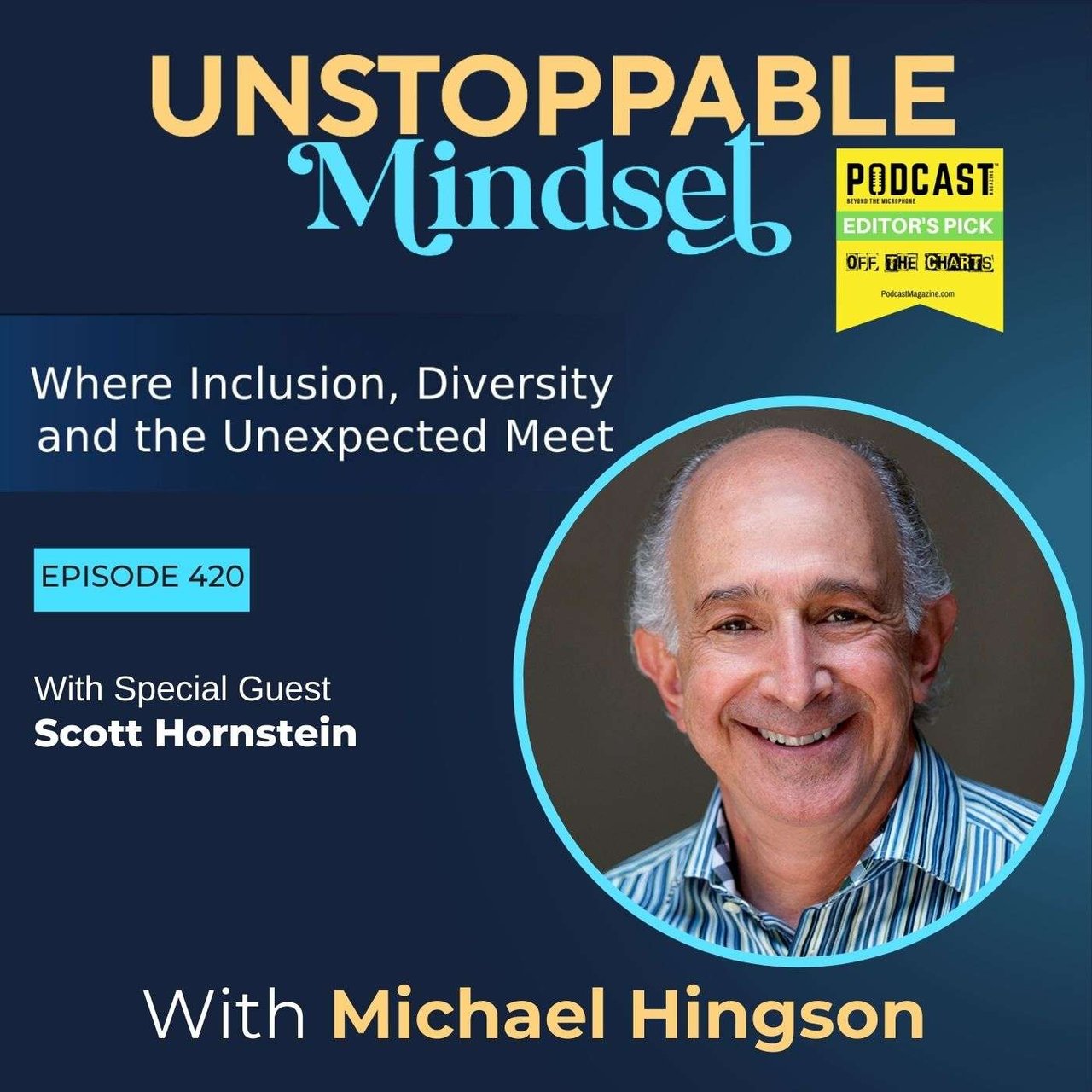
Episode 420 – How Customer Stories Create Unstoppable Business Growth with Scott Hornstein
Great marketing does not start with your product. It starts with your customer.
In this conversation, I speak with marketing strategist Scott Hornstein about why storytelling, customer research, and trust are the real drivers behind successful brands. Scott shares lessons from decades in marketing, including his work with IBM and major technology launches, and explains how companies often fail when they focus on themselves instead of the people they serve. You will hear how listening to the voice of the customer can reshape messaging, build trust, and unlock growth. Scott also reflects on entrepreneurship, resilience, family, and the mindset required to get back up after setbacks. I believe you will find this conversation both practical and encouraging as you think about how relationships and trust shape business success.
Highlights:
· Creativity in Queens – Scott reflects on how music and culture shaped his early creativity.04:10
· From Literature to Marketing – His love of books leads him toward storytelling and marketing.12:57
· Learning to Experiment – A mentor teaches the value of trying ideas and learning from failure.20:46
· The Customer as the Hero – Scott explains why marketing must center on the customer.31:48
· Customer Insight Drives Messaging – Research helps reshape a company’s message and market entry.41:23
· Resilience Through Setbacks – Scott reflects on perseverance in life and business.50:59
Top of Form
Bottom of Form
About the Guest:
I currently live in Reston VA, my wife and I having moved there to be close to our 2 daughters and our 2 granddaughters. I am an independent business consultant specializing in storytelling – which embraces marketing, research, and content. Family is the most important thing in my life and it has taught me that lasting relationships, business and personal, are steeped in empathy and commitment.
I was born in Manhattan on July 25, 1950. My parents soon moved the family to the up-and-coming borough of Queens. I attended the public schools in and around Forest Hills. Writing was always my goal.
I graduated NYU as an English major. Upon graduation I traveled, then pursued my (naïve) dream of living as an artist – as a writer, an actor, and a musician. I wrote plays for the brand-new cable industry, wrote for a movie-making magazine, was in several off-off Broadway plays, worked as a pick-up musician. I helped in the office for a former professor to earn subway money.
Got tired of starving to death. Took a job with CBS in the Broadcast Center, pulling together the Daily Log for the local station. Then, got hired to answer Bill Paley’s mail. Then, I was hired as a marketing manager for Columbia House where I got some of the best advice – keep going.
I met this guy from my neighborhood while commuting to my job in Manhattan. Turns our he worked for Y&R and said they were looking for someone. I interviewed and jumped over to agency-side work as an Account Executive, then Account Supervisor, then, going back to my roots, copywriter and eventually Creative Director.
The entrepreneurial life has been a roller coaster, but I have been blessed to work with some brilliant people in marketing and sales, and some great companies. It allowed me to understand how I can really help my customers become successful in the long-term.
Ways to connect with Scott**:**
About the Host:
Michael Hingson is a New York Times best-selling author, international lecturer, and Chief Vision Officer for accessiBe. Michael, blind since birth, survived the 9/11 attacks with the help of his guide dog Roselle. This story is the subject of his best-selling book, Thunder Dog.
Michael gives over 100 presentations around the world each year speaking to influential groups such as Exxon Mobile, AT&T, Federal Express, Scripps College, Rutgers University, Children’s Hospital, and the American Red Cross just to name a few. He is Ambassador for the National Braille Literacy Campaign for the National Federation of the Blind and also serves as Ambassador for the American Humane Association’s 2012 Hero Dog Awards.
https://www.facebook.com/michael.hingson.author.speaker/
https://www.youtube.com/user/mhingson
https://www.linkedin.com/in/michaelhingson/
accessiBe Links
https://www.youtube.com/c/accessiBe
https://www.linkedin.com/company/accessibe/mycompany/
https://www.facebook.com/accessibe/
Thanks for listening!
Thanks so much for listening to our podcast! If you enjoyed this episode and think that others could benefit from listening, please share it using the social media buttons on this page. Do you have some feedback or questions about this episode? Leave a comment in the section below!
Subscribe to the podcast
If you would like to get automatic updates of new podcast episodes, you can subscribe to the podcast on Apple Podcasts or Stitcher. You can subscribe in your favorite podcast app. You can also support our podcast through our tip jar https://tips.pinecast.com/jar/unstoppable-mindset .
Leave us an Apple Podcasts review
Ratings and reviews from our listeners are extremely valuable to us and greatly appreciated. They help our podcast rank higher on Apple Podcasts, which exposes our show to more awesome listeners like you. If you have a minute, please leave an honest review on Apple Podcasts.
Transcription Notes:
Michael Hingson 00:00
Access Cast and accessiBe Initiative presents Unstoppable Mindset. The podcast where inclusion, diversity and the unexpected meet. Hi, I’m Michael Hingson, Chief Vision Officer for accessiBe and the author of the number one New York Times bestselling book, Thunder dog, the story of a blind man, his guide dog and the triumph of trust. Thanks for joining me on my podcast as we explore our own blinding fears of inclusion unacceptance and our resistance to change. We will discover the idea that no matter the situation, or the people we encounter, our own fears, and prejudices often are our strongest barriers to moving forward. The unstoppable mindset podcast is sponsored by accessiBe, that’s a c c e s s i capital B e. Visit www.accessibe.com to learn how you can make your website accessible for persons with disabilities. And to help make the internet fully inclusive by the year 2025. Glad you dropped by we’re happy to meet you and to have you here with us.
Well, hi everyone, and welcome once again to another episode of unstoppable mindset today. Our guest is Scott Hornstein, although when he came into the Zoom Room, I said, is it Hornstein or Hornstein? And of course, he also understood, because we’re both of the same age, and are both fans of Young Frankenstein, who always said that his name was really pronounced Frankenstein. But you know, you have to have to know Gene Wilder for that. But anyway, if you haven’t seen that movie, you got to see it. Mel Brooks at his best, but Scott is a marketing person and specializes a lot in storytelling, which fascinates me a lot, because I am a firm believer in storytelling, and I know we’re going to have a lot of fun talking about that today. So Scott, I want to welcome you to unstoppable mindset. We’re really glad you’re here.
Scott Hornstein 02:20
Thank you so much, Michael. I have to start by saying I have great respect for your work, and this is really quite a privilege for me. Thank you very much.
Michael Hingson 02:32
Well, thank you. You’re a long way from where you were born, in New York, in Manhattan. Now you’re in Reston, Virginia, but that’s okay. Well, you’re not that far. It’s just a short train ride, a few hours.
Scott Hornstein 02:41
I That’s true. That’s true, although with that particular train, you can never be sure exactly how long it’s going to be good
Michael Hingson 02:52
point, yeah, yeah, good point. It is one of the things one has to deal with. But that’s okay. But, you know, I’ve taken that train many times, and I’ve taken the the Metro liner as well, and also just the regular train. And I like the trains. I enjoy the train. I wish we had more of them out here.
Scott Hornstein 03:15
I do too. I when it a long time ago in business, when I had a client here in DC, and I was living in Connecticut, I started taking the train, and it was so superior to flying. Oh yeah. And then recently I was, as I was mentioning to you, I was in Germany and taking the trains there is just wonderful. It’s so superior.
Michael Hingson 03:47
Yeah, I wish we would have more of them out here. If I, for example, want to take a train to San Francisco from where I live in Victorville, the only way I can do it is to take a train at roughly four in the morning to Los Angeles and then transfer on a train to go to San Francisco, which is no fun. I’ll fly because it’s it’s kind of crazy, but I like the trains, and wish we wish we had more of them all over, and wish more people would use them. It’s a lot better than driving, and it’s a lot more pleasant. When I lived in the east, there were any number of times that I knew people who would travel from like Bucks County in Pennsylvania to New York Wall Street people, and they would go two, two and a half hours on the train every day and back again. And they formed discussion groups or other sorts of things. They they made it a part of their regular day, and it was there was nothing to them to do that.
Scott Hornstein 04:54
And to them, I say, God bless. I am not in love with commuting, right? Yeah.
Michael Hingson 05:00
Well, I understand that. I appreciate that, but they, they did well with it, and so good for them, or, as I would say in Australia, good on them. But you know, well, why don’t we start tell us a little bit about you, maybe growing up in the early Scott and all that stuff. Let’s start with that, sure.
Scott Hornstein 05:21
First one brief aside about Young Frankenstein when I was living in Connecticut, I would go to the theater in Stanford, and for one performance, my tickets were at the will call, so I went up to the ticket booth, gave them my name, and the woman be on the other side of the iron bars keeps throwing her head to the side, wanting me to look over to my left, and I finally look over to my left, and there’s Gene Wilder. Oh my gosh. What an enormously tall individual, very gracious, very nice. In any case, yes,
Michael Hingson 06:06
with him, did you? Did you talk with
Scott Hornstein 06:09
him just for a moment, just for a moment, you know, just Mr. Wilder, how nice to meet you. And he said a couple of nice things. And that was about it. Still, we all went to see the to see the show. Still, it was quite a thrill for me. What show I do not. Oh, that was, oh, no, excuse me. That was the the madness of King Charles, madness of King George. King George. But he was quite mad, and the play is excellent, excellent. Well, anyway, in any case, I grew I was born in Manhattan. I spent the first couple of years of life on the west side. I don’t remember much of that. But my parents quickly moved us out to Queens, which at that point was rather undeveloped. You could get a lot more for your money, and we have lived in an apartment building. And around our apartment building was nothing but empty lots. It was just not developed yet. But it was a great place to grow up because the there was so much going on in those years and so much so much music that was going on. The first recollection I have, in light of all the talk about vaccines and healthcare and all of this is I really remember that polio was a real thing there, and I remember kids with the braces on their legs. And I remember that when one of my friends got chicken pox, that the mothers would get us all together and have a play date so that we got chicken pox too. Okay, but it was,
Michael Hingson 08:20
I’m sorry, remember, I remember getting the polio vaccinations, even starting in kindergarten,
Scott Hornstein 08:24
yes, yes. And it was such a remarkable thing at that time. We all thought it was like a miracle. And, and Jonas Salk, I mean, he was like, such a hero, yeah. The other thing, so I, we were out in Queens, in an area that’s the larger area is called Forest Hills, and it was, it was a great place, because the the whole museum, whole music scene was just exploding. So I’m moving on until my junior high school and high school years, and it was just all over the place. Yes, we were playing in bands, but also there were these wonderful venues to go to. And there was the subway. If my parents only knew where I really was, we would get on the subway, go down in the village, go to all the cafe bar Gertie spoke city, all these places to hear the this wonderful mind changing music. And by mind changing, I don’t mean drugs. I mean mind changing that it was, it was just everything in life.
Michael Hingson 09:57
And there’s nothing like hearing a lot. Music,
Scott Hornstein 10:01
even to this day, it’s my very, very favorite thing to do. Yeah, and so many musicians and artists came out of that area. I not being one of them. But it was so exciting.
Michael Hingson 10:27
I remember when we lived in New Jersey, and I would commute into New York. I heard, for example, even then, and it was in like 96 to beginning of 2002 Woody Allen on Monday night would play his clarinet somewhere. And less, less, Paul was still doing music and playing music at the meridian ballroom. And you can even take your guitar in and he would sign it for you
Scott Hornstein 10:55
the it was Joe’s Pub. Woody Allen would right. And I went there a couple of times to see him. Of course, it was so pricey that we had to kind of sneak in have one beer, yeah,
Michael Hingson 11:16
but still, it was worth doing.
Scott Hornstein 11:19
And then they Yeah, and they were great clubs. I think that was, there’s certainly the blue note for jazz that I went to a lot. And then there in Times Square, there was iridium, which was where I was able to see Les Paul, right? And many of those greats.
Michael Hingson 11:42
Yeah, I never did get to go and get my guitar signed, and now it’s too late. But oh, well, do you play? I play at it more than anything else. My father, I think, even before the war, before World War Two, or somewhere around there anyway, he traded something and got a Martin grand concert guitar. Oh, still, I still have it. That’s wonderful. What a wonderful sound it is.
Scott Hornstein 12:15
What a wonderful story. Yes, I play as well. I And growing up very early on, I decided I wanted to be Ricky Nelson. Oh, there you go. But I quickly learned that I was not going to be Ricky Nelson. However, the guy that was standing behind him playing guitar, now that might be something that I could do. So yes, so I picked it up, and I played in all the bands and then, which quickly taught me that I was not cut out for rock and roll, that I wasn’t very good at it, but it led me into many other avenues of music, certainly listening, certainly being part of that scene, I’d go see friends of mine who could play well rock and roll and And that was so exciting for me. And then I, I played in pickup bands through college. So on a weekend night there would be a wedding, Bar Mitzvah, and this guy, I forget his name, piano player, he he got all the gigs and Howie was the first choice for guitar, and if Howie wasn’t available, they’d call me.
Michael Hingson 13:47
There you go, hey. So second choice is better than no choice. Absolutely.
Scott Hornstein 13:54
I i enjoyed it thoroughly and that they paid me money to do this. There you go, right, inconceivable to me.
Michael Hingson 14:05
So what did you major in in college?
Scott Hornstein 14:10
Well, I started off majoring in biology, and there you go. And why I chose biology is is a mystery to this day, it didn’t last long. I cycled through a number of things, and I graduated with a degree in literature, in English, particularly American literature, which is not quite the same as learning a trade. But you know it, it was consistent with with who I was at that time. I was the guy who, if he went out the door, would have two books with him, just in case I finished one. I didn’t want to be left at sea, so a voracious reader couldn’t stay away from the theater. So it was very consistent with who I was and and it was good for me, because I think through things like like literature and fiction and biography, you learn so much about the world, about how different people are confronted with challenges, how they process their lives, how they overcome these challenges or not or not, it just exposes you to so much.
Michael Hingson 15:49
Yeah, and so I’ll bet you had some challenges finding some sort of real, permanent job after getting a degree in English?
Scott Hornstein 16:03
Yes, I did. But when I got out the idea of it didn’t cross my mind that people actually would not earn a great living by being just an artist. What did I want to do? I wanted to write. I wanted to be involved in music. I wanted to act. I did all these things until the point when I got thoroughly fed up with being poor, with not having a dime in my pocket. Ever starving to death is, is sort of what you would call it. Yeah, yeah. You know, I did. I have modest success. Yes, I was able to keep myself off the streets, but no, it was no way for a career. It was no way to even be able to afford your own apartment, for gosh sakes. So I from there i i had done a lot of promotion for the different things that I was involved in, trying to get audiences, trying to get awareness of what I was doing, and that led me to have some contacts inside of CBS. And when I started looking for a job, I started talking to these folks, and they offered me a job. So here I was, and actually gainfully employed.
Michael Hingson 17:44
What was the job? Well, I
Scott Hornstein 17:47
was sort of a gopher for my first job. Mostly what I did was type, but I do have one good story for you. So I was down in the depths of the CBS Broadcast Center, which is all the way on the west side of 5017 and it’s an old milk factory, so which they had converted to broadcast purposes. And so there were long holes, and the halls would always slope down. And there was one day where I was late for a meeting, and I came running down the halls, and there are always these swinging doors, I guess, for in case there’s a fire or something, and I’m bursting through the doors, and I go running, and I burst through the next set of doors, and I’m running, and I burst through the next set of doors, and I knock this guy right on his bum. I pick him up, I dust him off. I say, I am so sorry. He says, Don’t worry about a thing. It’s all fine. I continue running. A friend of mine grabs me and says, Did you see Paul Newman?
Michael Hingson 19:10
There you are.
Scott Hornstein 19:12
So I have the unique entry on my resume of knocking Paul Newman to the ground.
Michael Hingson 19:22
I Well, at least he was civil and nice about it.
Scott Hornstein 19:26
He was very nice about it, though. Yeah, so I worked there and then through my writing, because I was writing for a film magazine at night, which, of course, didn’t pay a cent, not a cent, but I got to go to all the premiers, and I got to meet all the people and interview all the people so whatever. So through that, I was able to go over to the main building and answer letters for Bill Paley, who was the.
Michael Hingson 20:00
Chairman, Chairman, I said, Yes, right,
Scott Hornstein 20:02
and it was my job to explain to everybody why Mr. Paley, I never called him, Bill, never, nobody, no, no, why he was right and they were wrong. That was my job, and that I did that for a little while, I can honestly say that I enjoyed having money in my pocket, but that was not the most fulfilling of jobs, and from there, I was able to go over and get my first marketing position, working for the Columbia record and tape Club, which was part of CBS Records at that time. And when I Ben or Dover was the president of Columbia House at that time, and when he made me the offer, he gave me one of the great life lessons that I’ve I’ve ever had. And he said, Scott, if you sit in your office and you do exactly what I ask you to do, and you do it on time, and you do it perfectly, we are not going to get along. But if you are out there and you’re trying this and you’re trying that, and this works, and that doesn’t work, but you get up and you keep trying, we’re going to be fast friends. Interesting. Yeah, yeah. That’s something that has stayed with me my whole life. One of the great pieces of advice that I’ve ever gotten,
Michael Hingson 21:57
well the for me, what’s fascinating about it is thinking about how many people would really do that and allow that to happen, but it’s really what more people should be doing. I’ve I’ve always maintained that the biggest problem with bosses is that they boss people around too much, rather than encouraging them and helping them and using their own talents to help people be more creative. When I hire sales people, the first thing I always told them was, well, the second thing because the first thing I always told them was, you need to understand right up front if you’re going to sell here, you have to learn to turn perceived liabilities into assets. And that’s got a story behind it. But the second thing that I always talked about was my job isn’t to boss you around. I hired you because you convinced me that you’re supposed to be able to do the job, and we’ll see how that goes. But you should be able to but my job is to work with you to figure out how I can use my talents to help you and to enhance what you do to make you more successful. And the people who got that did really well, because we usually did things differently, and we both learned how to figure out and actually figure out how to work with each other and be very successful. But the people who didn’t get it and wouldn’t try that, generally, weren’t all that successful.
Scott Hornstein 23:26
Not terribly surprised, sir. You know, I think that people miss the the humanity of all this. And that if we bring our respective strengths and work together, that it’s going to be a more complete and more successful whole than if I try and dominate you and tell you what to do, right, just that hasn’t been a successful formula for me. I have never done well with people who tried to tell me exactly what to do, which is probably why I went out on my own. Probably why, in the greater scheme of things that I I did well, working for people from Columbia House. I met this guy on the train, and we got friendly, and he said he worked for an advertising agency, and they were looking for somebody would I be interested in interviewing? And this was with the young and Rubicon. And I did get the job, and I did work my way up to an account supervisor. And then i i said, i. Hate this, and I went back to be a copywriter and worked my way up to be a creative director. But, you know, I went on my own on January 1 of 86 and it was like a liberation for me, because at that point there was a new a new president of the division that I worked for, and he was not a nurturing individual. He was more of the dominant kind of you’ll do what I tell you to do. Didn’t sit well with me at all, and I had the opportunity to go on my own. So I I packed up my dolls and dishes, and I walked in on January 2, and I said, Bill, I quit.
Michael Hingson 26:02
There you go. Was it hard for you to do that?
Scott Hornstein 26:11
You know, at that point? So I here I am. I’m a creative director. I got the office on Madison Avenue, and I’m doing freelance all over the place, not only because it was extra money, but because it was it was fueling my creativity. It was giving me something back. It was fun. And I really like to have fun. I have so much fun working with people and that interaction that that humanity, the spark of humanity. So I was doing a lot of freelance, and I wrote this proposal for this one design group who was near where I was living at that time, and it got sold. So they said, Do you want to you want to work on it? And at that point in my life, I didn’t have any responsibilities. I had a studio apartment there that was real cheap. And I said, If I don’t try this now, yeah, I don’t think I’ll ever try it. So that’s what I did. I quit, and I walked out the door into the great unknown,
Michael Hingson 27:39
and the entrepreneurial spirit took over.
Scott Hornstein 27:43
It did, and it worked well for about six, seven months, and then we got to the summertime, and I couldn’t get arrested for a while. But you know, you have to take it one day at a time. And I figured, all right, well, let’s just be open and network and see what’s going on. It’s not the time to quit. It’s not the time to go back and get a job. And I was fortunate in that I was sitting at the desk one day, and this one guy called me, and I had met him before his folks ran one of the biggest, or actually the biggest, telemarketing agency in New York at that time, and I had met, met this fellow, and he said, I got this project. I’ve been asking around for creative source, and three people gave me your name. So I figured, well, let’s go talk. And that turned into a very, very good situation for me, it gave me a lot of responsibility and a lot of leeway to take all the things that I had learned and put them in service of my client and I had a ball. I loved it. The only thing I didn’t love was the and I did love this for a while was the constant travel. Now, everybody doesn’t travel, and they’re all sitting in their rooms at home, looking at screens. But that was that was a great opportunity for me to to spread my wings and to take and I learned so much one of the. Initial assignments I had was for IBM and IBM at that time was, was Mount Olympus. Oh my gosh, working for IBM, and I worked in tandem with this research group. We were all working on the introduction of the IBM ThinkPad and what these folks, they had a methodology they called voice of customer research, which was a qualitative research we’re talking to decision makers from a carefully prepared Interview Guide to come up with the attitudes, the insights that we could put together to to come up with a solution. And I was fascinated by this of how to tap into what what the customer really wants by talking to the customer. How unusual.
Michael Hingson 31:16
What a concept. Oh yeah. I mean
Scott Hornstein 31:19
then and now, it’s still the operative phrase of this would be a wonderful business, business, if it wasn’t for all those annoying customers and and this just turned that on its head. That’s another thing that I learned that has stayed with me through my entire career, is that for the the storytelling, and what I mean by storytelling is, is two things. Is, first, you know all your stories are going to come from what you consider to be your brand, but if you’re not developing your brand according to the wants, the needs, the desires, the expressed future state that your Customers want, then then you’re wide of the mark. So I was able to bring this in, and I think do a much better job for my customers. Now, the way that relates into storytelling is that you’re you’re able to take what you do and put it into the story of how your customer succeeds with the hero in the hero’s journey, is
Michael Hingson 32:55
your customer, your customer? Why do you think that is such a successful tactic to use,
Scott Hornstein 33:02
because everybody else is completely enamored of themselves. When other companies craft their their brand, it’s mostly because why they think they are special and what their vision tells them is their future. And quite frankly, most customers really don’t care when, when a new customer first confronts you and your brand. They ask three questions, who are you? Why should I care? And what’s in it for me? And if you can’t answer those, if the story that you tell whether complete or in fragments or in in different parts according to where they are on their consideration journey. It doesn’t resonate. It doesn’t resonate. Hey, I have the best technology out there. I have brilliant people working on this technology. And guess what? Your technology? Somebody will eat your technology in 18 months, and I don’t care, I want to know. What does it do for me?
Michael Hingson 34:28
Yeah, as opposed to saying, After asking enough questions, I have technology that will solve this problem that you have identified. Let me tell you about it. Is that okay? Exactly?
Scott Hornstein 34:44
Yeah, exactly. And as odd as it sounds, that helps you to stand out in the field, in a crowded
Michael Hingson 34:55
field, it does, but it’s also all about the. Relating to the customer and getting the customer to establish a rapport and relating to you. And when you, as you pointed out, make it about the customer, and you talk in such a way that clearly, you’re demonstrating you’re interested in the customer and what they want they’re going to relate to you.
Scott Hornstein 35:24
There’s two, two things in there that, well, there’s a million things in there that are particularly true. And the first is not only recognizing and and internalizing the goals of your client, but also opening yourself up and saying, these are people. These are humans. And the other real distinguishing fact that a lot of people don’t either realize or embrace is that in business to business, and I’ve spent most of my life in business to business, it’s all personal. It’s all about personal connections. It’s all about trust. And call me crazy, but I am not going to trust a machine. I will have confidence in technology, but my trust is going to be placed in the human through this, one anecdote that that is has really impressed me is that I was doing one of these interviews once, and I was talking to the CEO of of this company. And I said, Well, you know, I of course, I’m working for company A and you’ve been a client for a long time. What’s, what’s the greatest benefit that you get from this company? And without hesitation, he said, our salesman. Our salesman is part of our team. He understands who we are, he knows what we need, and he goes and he gets it. So that kind of that, to me, has always been a touchstone on things.
Michael Hingson 37:43
Well, the fact that the salesman earned that reputation, and the President was willing to acknowledge it is really important and crucial.
Scott Hornstein 37:56
And within that, I would say the very important word that you used is earn. You need to earn that trust. Sure it doesn’t come just because you have brilliant technology. It’s all people. It’s all personal, all people.
Michael Hingson 38:20
And that’s success, the successful sales people are people who understand and work to earn trust.
Scott Hornstein 38:32
Well said, and I think that particularly in this age of accelerating remoteness, that this concept of earning the trust and the person to person becomes a compelling competitive differentiator. And I think that that telling the story of of how you make your customers successful, of the role you play, of where you’re going, this allows you to bridge some of those troubled waters to people who are sitting remote. It helps you to open your ears you know where you’re going, so you can listen, yeah,
Michael Hingson 39:40
well, and that’s an extremely important thing to to keep in mind and to continue to hone, because bottom line is, it’s all about, as I said, trust, and it certainly is about earning, and that isn’t something you. First, it’s something that you understand.
Scott Hornstein 40:04
It’s a gift that can only be bestowed on your customer. You can want it, but they’re the only ones who can give you. Your brand is the meal you prepare. You but your reputation is the review, right? So, yeah, you gotta earn that trust.
Michael Hingson 40:32
So how long so you you own your own company? How long has the company been in existence?
Scott Hornstein 40:40
I Well, let’s see. I went on my own on January 1 in 1986 and I am still without visible means of support.
Michael Hingson 40:58
Well, there you go, same company all along, huh?
Scott Hornstein 41:03
I Yeah, you know, do different work with different people, sure, but yes, it’s still me.
Michael Hingson 41:13
It’s still, do you actually have a company and a name or anything like that?
Scott Hornstein 41:17
I did. I did for a long time. I operated under Hornstein associates, okay, and recently I have dropped that and I just work as myself. I think that I had employees, then I had expandable, retractable resources then, and I’m not so interested in doing that right now. I am interested in working as and I love working as part of a team. Collaboration is my middle name. I might not have put that on my resume, but yeah, and I’m just, I’m really just interested in being me these days.
Michael Hingson 42:13
That’s fair. There’s nothing wrong with that. No, well, in your current role, what do you think is the greatest contribution you’ve made to your clients, and I’d love an example, a story about that.
Scott Hornstein 42:28
I would love to tell you a story. Oh, good. So one of my clients is a manufacturer. And they manufacture of all things, barcode scanners, as you would use in a warehouse and in a warehouse, absolutely everything, including the employees, has a barcode. Theirs is different than the the ones that you would normally see, the ones that like have a pistol grip. These are, these are new. It’s new technology. They’re ergonomically designed. They sit on the back of your hand. They’re lightweight. They have more capabilities. They’re faster and more accurate. Well, that sounds like sliced bread. However, they had a big problem in that all the scanners in all the warehouses come from the titans of the universe, the Motorola’s, the great big names and these great, you know the old saying of Nobody ever got fired for buying IBM. Well, you know, if they need more scanners. Why would they go elsewhere? They just go back and get the same thing. So the the big problem is, is how to penetrate this market? And we did it. I worked with them in a number of ways. The first way was to conduct interviews, qualitative interviews, with the executive team, to come up with their their brand. What did they think? What did they think that was most important? And they said, clearly, the productivity gains, not only is this faster, not only can we prove that this is faster, but the the technology is so advanced that now we can also give you. Information from the shop floor. Well, then we talked to their their partners, who were already selling things into these warehouses. And we talked to a number of companies that were within their ICP, their ideal customer profile, I think that’s very important to be prospecting with the folks who can make best use of your products and services. And what we found is that it wasn’t just the productivity, it was that we solved other problems as well, and without going heavily into it, we solved the a big safety problem. We made the shop floor more secure and safer for the workers. So we changed the message from Warehouse productivity to the warehouse floor of making each employee safer, able to contribute more and able to have a better satisfaction, and that we were able to roll out into a into great messaging. The initial campaign was solely focused on the workers, and our offer was We challenge you to a scan off our scanners, against yours, your employees, your products, your warehouse. Let’s have a head to head competition, because we then knew from these interviews, from working with the partners, that once these employees got the ergonomic the lightweight, ergonomic scanners on their hands, and realized how much faster They were, and how much safer that they were, that they would be our champions. And in fact, that’s what, what happened. I can go deeper into the story, but it it became a story. Instead of coming in and just saying, boost your productivity, it’s the scanners work for your your overall productivity. It helps you to keep your customers satisfied, your workers, one of the big problems that they’re having is maintaining a stable and experienced workforce, this changed the characteristic of the shop floor, and it changed the character, how the employees themselves described their work environment. So we were able to take that and weave a story that went from one end of the warehouse to the other with benefits for everybody in between. So you said, What is the the one you said, the greatest benefit, I would say the contribution that I’m most proud of, it’s that it’s to recast the brand, the messaging, in the form, in the shape of the customer, of what they need, of helping them to achieve the future state that they want. And I’m sorry for a long winded answer,
Michael Hingson 49:10
yes, that’s okay. Not a not a problem. So let me what would you say are the two or three major accomplishments or achievements in your career, and what did they teach you?
Scott Hornstein 49:26
Well, you know, I think the the achievements in my career, well, the first one I would mention was incorporating that, that voice of customer research, bringing the customer to the planning table, letting the executives, the sales people, the marketers, unite around, how does the customer express their hopes, their dreams, their challenges? I would say the second. Uh, is this idea of taking all of the content of all of the messaging and and unifying it? Some people call it a pillar view. I call it storytelling, of relaying these things so that you are giving your prospects and your customers the information that they need when they need it, at the specific point in their consideration journey, when this is most important, and it might be that a research report for a prospect that talks about some of the challenges in the marketplace and what’s being done, it might be as simple for a customer as a as a video on how do you do this? You know, how do you screw in a light bulb? Oh, here it is. Everybody’s used to that. The the third thing, and, and this is something, forgive me, for which I am, I am very proud, is that now I take this experience and this expertise, and through the organization called score, I’m able to give this back to people who are are trying to make their way as entrepreneurs
Michael Hingson 51:35
through the Small Business Administration. And score, yes,
Scott Hornstein 51:40
very proud of that. I get so much for from that.
Michael Hingson 51:46
Well, what would you say are maybe the two or three major achievements for you in life, and what did you learn? Or what did they teach you? Or are they the same
Scott Hornstein 51:57
I did? Well, I would say they’re they’re the same, and yet they’re a little bit different. The first one is, is that it’s only very few people who lead the charmed life where they are never knocked down. I’m not one of those people, and I’ve been knocked down several times, both professionally and personally, and to get back up, I to have that, and you will forgive me if I borrow a phrase that indomitable spirit that says, no, sorry, I’m getting back up again. And I can do this. And it may not be comfortable and it may not be easy, but I can do this. So there was that I think that having kids and then grandkids has taught me an awful lot about about interpersonal relationships, about the fact that there isn’t anything more important than family, not by a long shot, and from these different things. I mean, certainly, as you I was, I didn’t have the same experience, but 911 affected me deeply, deeply and and then it quite frankly, there was 2008 when I saw my my business and my finances sort of twirl up into the sky like like the Wizard of Oz, like that house in the beginning,
Michael Hingson 54:09
but still,
Scott Hornstein 54:16
And I persevere, yeah. So I think that that perseverance, that that focus on on family, on humanity. And I would say there’s one other thing in there, is that. And this is a hard one. Observation is that I can’t do anything about yesterday, and tomorrow is beyond my reach, so I I have to take
Michael Hingson 54:56
today, but you can certainly use yesterday. As a learning experience,
Scott Hornstein 55:01
I am the sum of all my parts, absolutely, but my focus isn’t today, and using everything that I’ve learned certainly. You know, I got tongue tied there for just a minute.
Michael Hingson 55:19
I hear you, though, when did you get married?
Scott Hornstein 55:25
I got married in 87 I I met my wife commuting on the train to New York.
Michael Hingson 55:35
So you had actually made the decision to could to quit and so on, before you met and married her.
Scott Hornstein 55:43
No, no, I was, I was I met her while I still had a job in advertising. That’s why I was commuting to New York. And you know, in the morning there was a bunch of us. We’d hold seats for each other and just camaraderie, yeah, you know, have our coffee. Did she? Did she work? She did she did she was she joined the group because she knew she had just gotten a job in New York. And of course, for those who don’t know New York? When I say New York, I mean Manhattan, the city. Nobody thinks of any of the boroughs
Michael Hingson 56:27
as part of New York.
Scott Hornstein 56:31
And yeah, I and one day gone in, she fell asleep on my shoulder, and the rest is history. There you go.
Michael Hingson 56:41
What So, what did she think when you quit and went completely out on your own?
Scott Hornstein 56:48
I you know, I never specifically asked her, but I would think that she would have thought that maybe I was not as solid, maybe not as much marriage material, maybe a little bit of a risk taker. I did not see it as as taking a risk, though, at that time, but it was actually great for us, just great for us. And yeah, met there, and then I quit. Shortly thereafter, she was still commuting. And then things started to just take off, yeah, yeah, both for my career and for the relationship, yeah.
Michael Hingson 57:51
And again, the rest of course, as they say, is history.
Scott Hornstein 57:56
It is. And here I am now in Reston, Virginia, and we moved to Reston because both daughters are in close proximity, and my two grandchildren. And you know, am I still confronted with the knock downs and the and the get up again. Yeah, the marketplace is very crazy today. The big companies are doing great, the mid size companies, which is my Market, and it’s by choice, because I like dealing with senior management. I like dealing with the people who make the decisions, who if we decide something’s going to happen, it happens and and you can see the impact on the culture, on on the finances, on the customer base. These guys are it’s tough out there right now. Let me say that it’s it’s tough to know which way to go. This doesn’t seem to be anything that’s sure at the moment.
Michael Hingson 59:11
Yeah, it’s definitely a challenging world and and then the government isn’t necessarily helping that a lot either. But again, resilience is an important thing, and the fact is that we all need to learn that we can survive and surmount whatever comes along.
Scott Hornstein 59:33
And let me just throw in AI that is a big disruptor at the moment that nobody actually knows
Michael Hingson 59:43
what to do with it. I think people have various ideas there. There are a lot of different people with a lot of different ideas. And AI can be a very powerful tool to help but it is a tool. It is not an end all. Um. Yeah, and well said, I think that, you know, even I, when I first heard about AI, I heard people complaining about how students were writing their papers using AI, and you couldn’t tell and almost immediately I realized, and thought, so what the trick is, what are you going to do about it. And what I’ve what I’ve said many times to teachers, is let students use AI if that’s what they’re going to use to write their papers, and then they turn them in. And what you do is you take one period, and you call each student up and you say, All right, I’ve read your paper. I have it here. I want you now to defend your paper, and you have one minute, you’re going to find out very quickly who really knows what they’re talking about.
Scott Hornstein 1:00:47
That, in fact, is brilliant.
Michael Hingson 1:00:49
I think it’s a very I think it’s a very powerful tool. I use AI in writing, but I use it in that. I will use it, I will I will ask it questions and get ideas, and I’ll ask other questions and get other ideas, and then I will put them together, however, because I know that I can write better than AI can write, and maybe the time will come when it’ll mimic me pretty well, but still, I can write better than AI can write, but AI’s got a lot more resources to come up with ideas.
Scott Hornstein 1:01:21
It does. It does. And with that, it’s a fantastic tool. The differentiator, as I see it, for most of my stuff, is that AI has read about all this stuff, but I’ve lived it, so I’m going to trust me at the end,
Michael Hingson 1:01:45
and when I talk about surviving the World Trade Center and teaching people what I learned that helped me in the World Trade Center, I point out most people, if there’s an emergency, read signs and they’re told go this way to escape or to get out or do this or do that, but there’s still signs, and they don’t know anything. I don’t read signs, needless to say, and what I did was spent a fair amount of time truly learning all I could about the World Trade Center where things were, what the emergency evacuation procedures were what would happen in an emergency and so on. And so for me, it was knowledge and not just relying on a sign. And so when September 11 happened, a mindset kicked in, and we talked about that in my my latest book, live like a guide dog. But that’s what it’s about, is it’s all about knowledge and truly having that information, and that’s what you can trust.
Scott Hornstein 1:02:48
I’ll give you a big amen on that one.
Michael Hingson 1:02:52
Well, this has been a lot of fun to do. We’ve been Can you believe we’ve been doing this an hour? My gosh, time, I know having fun.
Scott Hornstein 1:03:03
It’s fun. And I would say again, in closing, I just have enormous respect for what you’ve accomplished, what you’ve done. This is been a great privilege for me. I thank you very much.
Michael Hingson 1:03:19
Well, it’s been an honor for me, and I really value all the comments, the advice, the thoughts that you’ve shared, and hopefully people will take them to heart. And I would say to all of you out there, if you’d like to reach out to Scott, how do they do that? Well, there you go. See, just, just type, well, right?
Scott Hornstein 1:03:42
That’s it. If you, if you sent an email to Scott dot Hornstein at Gmail, you’ll get me.
Michael Hingson 1:03:56
And Hornstein is spelled
Scott Hornstein 1:03:58
H, O, R, N, S, T, E, I,
Michael Hingson 1:04:03
N, and again, it’s scott.hornstein@gmail.com
Scott Hornstein 1:04:09
that’s that’s the deal. There you go. Well, find me on LinkedIn. You can find me on medium. I’m all over the place.
Michael Hingson 1:04:18
There you are. Well, I hope people will reach out, because I think you will enhance anything that they’re doing, and certainly trust is a big part of it, and you earn it, which is great. So thank you for being here, and I want to thank all of you for listening and watching us wherever you are. Please give us a five star review and a rating and but definitely give us a review as well. We appreciate that. If you know anyone else who ought to be a guest, Scott, you as well. We’re always looking for more people to have on, so please introduce us and Scott. If you want to come on again, we can talk about that too. That’d be kind of fun. But I want to thank what I want to thank you again for being here. This has been fun, and I appreciate you being here with us today and and so thank you very much for doing it.
Scott Hornstein 1:05:07
My all the pleasure is all mine.
Michael Hingson 1:05:14
You have been listening to the Unstoppable Mindset podcast. Thanks for dropping by. I hope that you’ll join us again next week, and in future weeks for upcoming episodes. To subscribe to our podcast and to learn about upcoming episodes, please visit www dot Michael hingson.com slash podcast. Michael Hingson is spelled m i c h a e l h i n g s o n. While you’re on the site., please use the form there to recommend people who we ought to interview in upcoming editions of the show. And also, we ask you and urge you to invite your friends to join us in the future. If you know of any one or any organization needing a speaker for an event, please email me at speaker at Michael hingson.com. I appreciate it very much. To learn more about the concept of blinded by fear, please visit www dot Michael hingson.com forward slash blinded by fear and while you’re there, feel free to pick up a copy of my free eBook entitled blinded by fear. The unstoppable mindset podcast is provided by access cast an initiative of accessiBe and is sponsored by accessiBe. Please visit www.accessibe.com . AccessiBe is spelled a c c e s s i b e. There you can learn all about how you can make your website inclusive for all persons with disabilities and how you can help make the internet fully inclusive by 2025. Thanks again for Listening. Please come back and visit us again next week.


 Facebook
 Twitter
 Youtube
 Linkedin