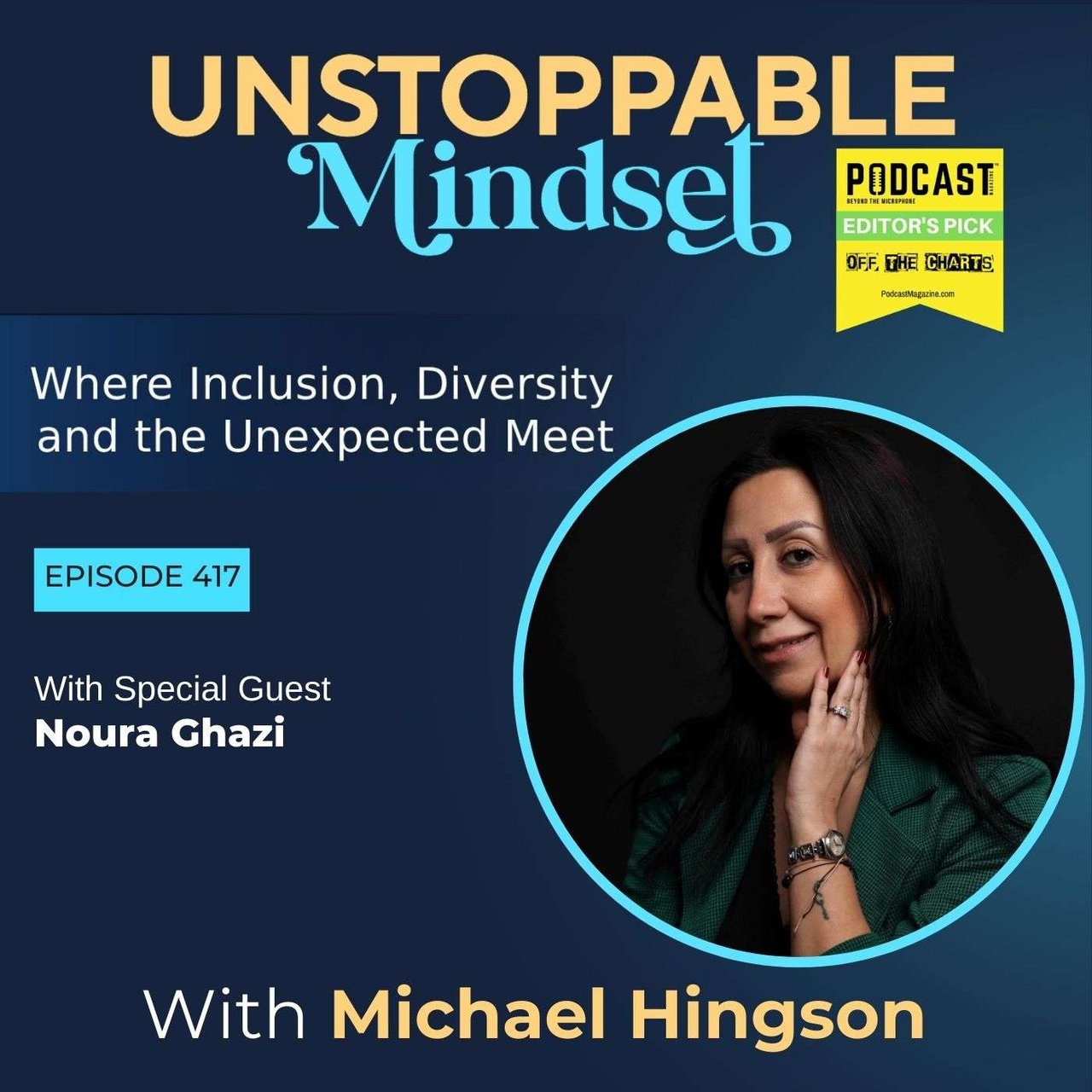
Episode 417 – Unstoppable Resilience in the Face of Political Oppression with Noura Ghazi
Courage is not loud. Sometimes it is a 13-year-old girl standing in a courtroom, promising to defend dignity no matter the cost.
Noura Ghazi’s life was shaped by detention, disappearance, and resistance long before she became a human rights lawyer. Growing up in Damascus with a father repeatedly imprisoned for political opposition, she chose early to confront injustice through law rather than violence. From defending political prisoners during the Syrian revolution to marrying her husband inside a prison and later founding No Photo Zone, Noura has built a life rooted in resilience, civil rights advocacy, and unwavering belief in human dignity.
Now living in France as a political refugee, she continues her work supporting families of detainees, survivors of torture, and the disappeared. Her story is not simply about survival. It is about choosing mindset over fear, purpose over despair, and love even in the shadow of loss. This conversation invites reflection on what it means to remain Unstoppable when freedom, justice, and even safety are uncertain.
Highlights:
00:07:06 – A defining childhood moment reveals how a confrontation in a Syrian courtroom shaped Noura’s lifelong commitment to defending political prisoners.
00:12:51 – The unpredictable nature of Syria’s exceptional courts exposes how justice without standards creates generational instability and fear.
00:17:32 – The emotional aftermath of her father’s release illustrates how imprisonment reshapes entire families, not just the person detained.
00:23:47 – Noura’s pursuit of human rights education demonstrates how intentional learning becomes an act of resistance in restrictive systems.
00:32:10 – The early days of the Syrian revolution clarify how violence escalates when peaceful protest is met with force.
00:37:27 – Her marriage inside a prison and the global advocacy campaign that followed reflect how personal love can fuel public courage.
00:50:59 – A candid reflection on PTSD reveals how trauma can coexist with purpose and even deepen empathy for others.
About the Guest:
Noura Ghazi’s life has been shaped by a single, unwavering mission: to defend dignity, freedom, and justice in the face of dictatorship. Born in Damascus into a family deeply rooted in political resistance, she witnessed firsthand the cost of speaking out when her father was detained, tortured, and disappeared multiple times. That lived experience became her calling. Since 2004, she has defended political prisoners before Syria’s Supreme Security State Court, and when the Syrian revolution began in 2011, she fully committed herself to supporting detainees and the families of the disappeared. Even after her husband, activist Bassel Khartabil Safadi, was detained, disappeared, and ultimately executed, she continued her advocacy with extraordinary resolve.
Forced into exile in 2018 after repeated threats and arrest warrants, Noura founded NoPhotoZone to provide legal aid, psychological support, and international advocacy for victims of detention, torture, enforced disappearance, and displacement across Syria, Lebanon, and Turkey. Her mission is not only to seek justice for the imprisoned and the missing, but to restore agency and hope to families living in uncertainty and trauma. Recognized globally for her courage and leadership, Noura remains committed to amplifying the voices of the silenced and ensuring that even in the darkest systems, human rights and human dignity are never forgotten.
Book – Waiting by Noura Ghazi – https://www.lulu.com/shop/noura-ghazi-safadi/waiting/paperback/product-1jz2kz2j.html?page=1&pageSize=4
About the Host:
Michael Hingson is a New York Times best-selling author, international lecturer, and Chief Vision Officer for accessiBe. Michael, blind since birth, survived the 9/11 attacks with the help of his guide dog Roselle. This story is the subject of his best-selling book, Thunder Dog.
Michael gives over 100 presentations around the world each year speaking to influential groups such as Exxon Mobile, AT&T, Federal Express, Scripps College, Rutgers University, Children’s Hospital, and the American Red Cross just to name a few. He is Ambassador for the National Braille Literacy Campaign for the National Federation of the Blind and also serves as Ambassador for the American Humane Association’s 2012 Hero Dog Awards.
https://www.facebook.com/michael.hingson.author.speaker/
https://www.youtube.com/user/mhingson
https://www.linkedin.com/in/michaelhingson/
Thanks for listening!
Thanks so much for listening to our podcast! If you enjoyed this episode and think that others could benefit from listening, please share it using the social media buttons on this page.
Do you have some feedback or questions about this episode? Leave a comment in the section below!
Subscribe to the podcast If you would like to get automatic updates of new podcast episodes, you can follow the podcast on Apple Podcasts or your favorite podcast app.
Leave us an Apple Podcasts review Ratings and reviews from our listeners are extremely valuable to us and greatly appreciated. They help our podcast rank higher on Apple Podcasts, which exposes our show to more awesome listeners like you. If you are enjoying the show, please leave us a review on Apple Podcasts.
Michael Hingson 00:09
Well, welcome everyone to another episode of unstoppable mindset. Today, we get to chat with Nora Ghazi, who lives in, I believe, France right now. She was born in Syria. She’ll tell us about that, and she has had an interesting life, and I would say, a life that has had lots of challenges and some treachery along the way. But we’ll get to all of that, and I will leave it to her to describe most of that, but I just want to tell you all we really appreciate you being here and hope you enjoy the episode. So Nora, how are you?
Noura Ghazi 00:49
Thank you, Michael, for having me in this great broadcast, doing well.
Michael Hingson 00:57
Well, there you go. Well, why don’t we start? I love to start this way. Why don’t you tell us kind of about the early Nora, growing up and so on, where you grew up, what anything you want to talk about, regarding being a younger person and all of that and and however we want to proceed, we’ll go from there.
Noura Ghazi 01:17
Okay, so since I was a child, my childhood wasn’t like normal, like all the kids at my age, because my father was like a leader in opposition party against the previous Syrian regime.
Michael Hingson 01:34
So you were born in Syria?
Noura Ghazi 01:37
Yes, I work in Damascus. I’m from Damascus, but I have some like multiple origin that I’m proud of. But yes, I’m from Damascus. So since I was five years old, my father was disappeared and because he was wanted with other, like fellows at his party and other, let’s say aliens, parties of opposition against the previous regime. So he disappeared for six years, then he was detained and transferred to what was named the supreme security state court. So it was during my adultness, let’s say so since I was a child like I had at that time, only one sister, which is one year younger than me, we were moving a lot. We had no place to live. So my mother used to take us each few days to stay at some, someone place, let’s say so it caused to us like changing schools all, all the time, which means changing friends. So it was very weird. And at that age, okay, I I knew the words of like cause, the words of leader or dictatorship. I used to say these words, but without knowing what does it mean. Then, when my father detained, it was his ninth detention. Actually, my mother was pregnant with my brother, so my brother was born while my father was in prison. And while he was in prison, the last time he disappeared for one year, three months, he was in like a kind of isolation in security facility. Then he was referred to this court. So in one of the sessions of the trials, I had a fight with the officer who, like who was leading the patrol that bring my father and other prisoners of conscience. So at the end of this fight, I promised my father and the officer that, okay, I will grow up and become a human rights lawyer and defend political prisoners, which I did at the end.
Michael Hingson 04:05
So what? What was the officer doing? He was taking people to the court.
Noura Ghazi 04:12
Yes, because Okay, so there is many kind of prisons now. They became like, more familiar to like public opinion because of, like 15 years of violence in Syria. So there was, like the the central civil prison in Damascus, which we call ADRA prison, and we have said, NIA jail, military prison. So those two prisons, they were like, holding detainees in them. So they they used to bring detainees to the court in busses, like a kind of military busses, with patrol of like civil police and military police. So the officer was like. Heading the patrol that was bringing my fathers from other prison.
Michael Hingson 05:05
So you, so you, what was the fight about with the officer and your father and so on? What? How? Well, yeah, what was the fight?
Noura Ghazi 05:16
It’s very good question, although at that time, it was a very like scary situation, but now I laughed a lot about it. Okay, so they used to to catch all the prisoners in one chain with the handcuffs. So we used to come to hug and kiss my father before entering the court. So I was doing what I used to do during the trials, or just upon the trials, and then one of the policemen, like pushed me away. So I got nervous, and my father got nervous. So the officer provoked me. He was like a kind of insulting that my father is a detainee, and he is like he’s coming to this court. So I, like I replied that I’m proud of my father and his friends what they are doing. So he somehow, he threats me to detain me like my father, and at that time, I was very angry, and I curse the father Assad just in on the like in the door, at the door of the court, and there was people and and Like all the the policemen, like they were just pointing their weapon to me, and there was some moments of silence. Then they took all the detainees into the court. So at this moment, while I’m entering the court behind them, I said, I will grow up and become a human rights lawyer to defend political prisoners.
Michael Hingson 07:02
What did the officers say to that?
Noura Ghazi 07:06
Because they used to look to us as because we are. We were against father Assad and the dictatorship, so they used to see us, even if we are kids, as enemies.
Michael Hingson 07:22
Yeah, so the officer but, but he didn’t detain you. I was
Noura Ghazi 07:27
only 13 years, yeah, okay, they used to to arrest the kids, but they didn’t.
Michael Hingson 07:37
So did the officer react to your comment? You’re going to grow up to become a civil rights lawyer?
Noura Ghazi 07:43
He was shocked, was he? But I don’t know if he knew that I become a human yes, there at the end, yeah.
Michael Hingson 07:54
And meanwhile, what did your father do or say?
Noura Ghazi 07:58
He was shocked also, but he was very proud, and until now, he like every time, because I’m also like, very close to to his friends who I used to visit in prison. Then I become a human rights lawyer, and I was the youngest lawyer in Syria. I was only 22 years old when I started to practice law. So during the the revolution in Syria, which started in 2011 some of his friends were detained, and I was their lawyer also. So I’m very close to them. So until now, they remember this story and laugh about it, because no one could curse or say anything not good about father Assad or or the family, even in secret. So it’s still, like, very funny, and I’m still like, stuck somehow in, like, in this career and the kind of activism I’m doing, because just I got angry of the officer 30 years ago. So at this, at that moment, I’ve decided what I will be in the future. I’m just doing it well.
Michael Hingson 09:20
From everything I’ve read, it sounds like you do a good job.
Noura Ghazi 09:25
I cannot say it’s a job, because usually you you do a job, you get paid for your job, you go at a certain time and come back at a certain time. You do certain tasks. But for me, it’s like a continuing fight, non violent fight, of course, for dignity, for freedom, for justice, right, for reveal the truth of those who were disappeared and got missing. So yes, until now, I’m doing this, so I don’t have that. Are the luxury to to be paid all the time, or to be to have weekends or to work until like certain hour at night. I cannot say I’m enjoying it, but this is the reason why I’m still alive, because I have a motive to help and support other people who are victims to dictatorship and violence.
Michael Hingson 10:25
So your father went into court and what happened?
Noura Ghazi 10:31
He was sentenced. At the end, he was sentenced to three years in prison. And it’s a funny story, another funny story, actually, because, like the other latines at that at that trial, like it was only my father and other two prisoners who sent who were sentenced to three years in prison, while other people, the minimum was seven years in Prison, until 15 years in prison. So my mother and us, we felt like we are embarrassed and shy because, okay, our father will will be released like in few months, but other prisoners will stay much longer. So it’s something very embarrassing to our friends who whom their fathers got sentenced to like more.
Michael Hingson 11:30
Did you ever find out why it was only three years?
Noura Ghazi 11:33
We don’t know because it’s an exceptional court, so it’s up to the judge and the judge at that time, like it’s it’s very similar to what is happening now and what happened after 2011 so it’s a kind of continuing reality in in Syria since like 63 which was the first time my father was detained. It was in 63 just after the what they called the eighth March revolution. So my father was only 11 years old when he was detained the first time because he participated in a protest. So it’s up to the judge. It’s not like a real court with like the the fair trial standards. So it’s it’s only once you know, the judge said the sentences for each one. So two prisoners got confused. They couldn’t differentiate like Which sentence to whom, so they asked like again, so he forgot, so he said them again in different way. So it’s something like, very spontaneously, yeah, very just moody, not any standard.
Michael Hingson 12:51
Well, so Did your father then serve the three years and was released. Or what happened?
Noura Ghazi 12:58
He was released on the day that he should be released, he disappeared for few days. We didn’t know what happened. Then he was released. Finally he came. We used to live with my my grandma, so I was the one who opened the door, and I saw just my father. So we we knew later that okay, he was moved again to a security facility because he refused to sign a paper that say that he will not practice any oppositional action against the authority. So he refused, yeah, yeah.
Michael Hingson 13:43
Well, I mean, I’m sure there’s, there’s a continuing story, what happened to him after that. So he came home,
Noura Ghazi 13:53
he came out to my grandma. It was a big surprise, like full of joy, but full of tears as well.
Michael Hingson 14:01
And you’re you were 16 now, right?
Noura Ghazi 14:04
I was when he was raised. I was 15, yeah, okay, yeah. And my sister was 14. My brother was two years and a half, so for him, okay, the father is this person that we visit behind bars every Monday, not this one who stay with us. So for him, it was weird. For my brother, he was very like little kid to understand. Then my father went to to see his parents as well. Then we came back to our apartment that we couldn’t live more than few months because my father was detained. So at this night, everything was very, very, very new, like because before the three years he he was disappeared for six years, so there was. Nine years. We don’t live with my father, so my brother used to sleep just next to my mom, actually my sister and me, but okay, we were like a teenager, so it’s okay. So my brother couldn’t sleep. Because why he keep, he kept asking why my father is sleeping with us while he’s not with his friend at that place. And he was traumatized for many days. But usually when, like a political prisoner released, usually, like, we have a kind of two, three weeks of people visiting the family to say, Okay, it’s it’s good. We’re happy for you that he was released. So the first two, three weeks were full of people and like, social events, etc. Then the, the real problem started. So my father studied law, but he was fired from university for security reasons at the the last year of his study, and as he was sentenced so he couldn’t work, my mother used to work, and so like suddenly he started to feel that okay, He’s not able to work. He’s not able to fulfill the needs of his family. He’s not able to spend on the family. The problems between him and my mother started. We couldn’t as like my sister and me as teenagers. We couldn’t really accept him. We couldn’t see that. He’s the same person that we used to visit in prison. He was very friendly. We used to talk about everything in life, including the very personal things that usually daughters don’t speak with fathers about it. But then he became a father, which we we we weren’t used to it, and he was shocked also. So I can say that this, this situation, at least on emotional and psychological level, for me, it lasted for 15 years. I couldn’t accept him very well, even my my sister and and the brother and it happens to all like prisoners, political prisoners, especially who spent long time in prison.
Michael Hingson 17:32
So now is your father and well, are your father and your mother still alive? Or are they around?
Noura Ghazi 17:41
They are still alive. They are still in Damascus,
Michael Hingson 17:44
and they’re still in Damascus. Yes, how is I guess I’ll just ask it now, how is Syria different today than it was in the Assad regime,
Noura Ghazi 17:56
like most of Syrians, and now we should differentiate about what Syrians will talk. We’re talking so like those Syrians, like the majority of Syrians, and I’m meaning here, I’m sorry, I shouldn’t be very direct. Now, the Arab Sunni Syrians, most of them, they are very happy. They are calling what happened in in last eight December, that it’s the deliberation of Syria, but for other minorities, like religious or ethnic minorities, of course, it’s almost the same. For me, I feel that okay, we have the same dictatorship now, the same corruption, the same of like lack of freedom of expression. But the the added that we have now is that we have Islamist who control Syria. We have extremists who control Syria. They intervene even in personal freedoms. They they are like, like, they are committing crimes against minorities, like it started last March, against alawed. It started last July, against Druze. Now it is starting against Kurdish, and unfortunately, the international community turning like an attorney, like, okay. They are okay with with it, because they want, like their own interest, their own benefits. They have another crisis in the world to take care and to think about, not Syria. So the most important for the international community is to have a stable situation in Syria, to be like, like, no kind of like, no fight zone in the Middle East, and they don’t care about Syrian people. And this is very frustrating for those who. Who have the same beliefs that I have.
Michael Hingson 20:04
So in a lot of ways, you’re saying it hasn’t, hasn’t really changed, and only the, only the faces and names have changed, but not the actions or the results
Noura Ghazi 20:16
the faces and names, and most important, the sects, has changed. So it was very obvious for me that most of Syrians, they don’t mind to be controlled by dictator. They only mind what is the sect of this dictator?
Michael Hingson 20:35
Unfortunately. Well, yeah. Well, let’s go back to you. So your father was released, and you had already made your decision about what you wanted to be, what how does school work over there? Did you go to a, what we would call a high school? Or how does all that work?
Noura Ghazi 20:58
Yeah, high school, I was among the like the student who got the highest score in Damascus. I was the fourth one on Damascus when I finished. We call it back like Baccalaureate in Syria, which came from French. And I studied law, and I was also very, like, really hard, hard study person. So I was graduated in four years. Actually, nobody in Syria used to finish studying law in Damascus University only in four years. Like some people stayed more than 10 years because it it was very difficult, and it’s different than like law college or law school or university of law, depending on the country, than other countries, because we only like study law. Theoretically, we don’t have any practice because we were 1000s of students, it was the like the maximum university that include students. And I registered immediately in the Bar Association in Damascus, and I started because we have, like, a kind, it’s, it’s similar to stage for two years, like under the supervision of another lawyer who was my uncle at the first and then we we have to choose a topic in certain domain of flow, to write a kind of book which is like, it’s similar to thesis, to apply it, to approve it, and then to have the kind of interactive examination, then we have the the final graduated. So all of them to be like a practice lawyer. It’s around six years, a little bit more. So my specialist was in criminal law, and my thesis, what about what we call the the impossible crime. It was complicated topic. I have to say that in Syria at that time, I’m talking about end of of 90s, beginning of 2000 so we don’t have any kind of study related to human rights. We weren’t allowed even to spell this word like human rights. So then in 2005 and 2006 I started to study human rights under international laws related to human rights in Jordan. So I became like a kind of certified human rights defenders and the trainer also,
Michael Hingson 23:47
okay, and so you said you started practice and you finished school when you started practice, when you were 22 Yes, okay, I’m curious what, what were things like after September 11, of course, you know, we had the terrorist attacks and so on. Did any of that affect anything over in Syria, where you lived,
Noura Ghazi 24:15
of course, like, we stayed talking, watching the news for like four months, like until now we remember, like September 11. But you know, I now when I remember, it was a shock, usually for the Arab world, or Arab people like America is against the Arab world. So everything happened against it was like, this was like, let’s say 2030, years ago. Everything that caused any harm to America, they celebrate it. So that. At that time, I was 19 years old, and okay, it’s the first time we we hear that a person who was terrorist do like is doing this kind in in us, which is like a miracle for us. But then I started to to think, okay, they it’s not an army. They are. There are civilians. Those civilians could be against the the policies of the US government. They could be like, This is not a kind of fight for freedom or for rights or for any like, really, like, fair cause. This is a terrorist action against civilians. And then we started, I’m very lucky because I’m from very educated family. So we started to think about, like, okay, bin Laden. And like, which we have a president from Qaeda now in Syria, like, you can imagine how I feel now. Like, I Okay, all the world is against al Qaeda, and they celebrated that the President in Syria is from al Qaeda. So it’s, it’s very it’s, it’s, really, it’s not logical at all. But the funniest thing that happened, because, like, the name of Usama bin Laden, was keeping on every like, every one tongue. So I have my my oldest uncle. His name is Usama, and he lives in Germany for 40, more than 40 years, actually. So my brother was a child, and he started to cry, and he came to my mother and asked her, I’m afraid, is my uncle the same Usama? So we were laughing all, and we said, No, it’s another Usama. This is the Usama. This is Osama bin Laden, who is like from is like a terrorist group, etc. But like this unfortunate incident started to bring to my mind some like the concept of non violence, the concept of that, okay, no civilian in any place in the world should be harmed for any reason, Because we never been told this in Syria and mostly in most of of countries like the word fight is very linked to armed fights, which I totally disagree with.
Michael Hingson 27:56
Well, the when people ask me about September 11 and and so on. One of the things that I say is this wasn’t a religious war. This wasn’t a religious attack. This was terrorist. This was, I put it in terms of of Americans. These were thugs who decided they wanted to have their way with people. But this is not the way the Muslim the Islamic religion is there is peaceful and peace loving as as anyone, and we really need to understand that. And I realize that there are a lot of people in this country who don’t really understand all about that, and they don’t understand that. In reality, there’s a lot of peace loving people in the Middle East, but hopefully we’ll be able to educate people over time, and that’s one of the reasons I tell the story that I do, because I do believe that what happened is 19 people attacked the World Trade Center and the Pentagon and so on, and they don’t represent the the typical viewpoint of most people, religious wise in the Middle East. And I can understand why a lot of people think that the United States doesn’t like Arabs, and I’m not sure that that’s totally true, but I can appreciate what you’re saying.
Noura Ghazi 29:28
Yeah, I’m talking about specific communities actually, who they are, like totally against Israel, and they believe that you us is supporting Israel. So that’s that’s why they have their like this like attitude towards us and or like that US is trying to invest all the resources in the in the Middle East, etc. But what you were mentioning. Is really very important, because those 19 persons, they like kind of they, they cause the very bad reputation for for Muslims, for Middle Eastern because for for for other people from other countries, other culture or other religion, they will not understand that, okay, that, as you said, they don’t represent Muslims. And in all religions, we have the extremist and we have those peaceful persons who keep their their religion as a kind of direct connection with God. They respect everyone, and normally in in in Syria, most of of the population like this, but now having a terrorist as a President, I’m not able to believe how there is a lot of Syrians that support him. Mm, hmm. Because when Al Qaeda started in Syria at the beginning, under the name of japet Al Nusra, then, which with July, who is now Ahmad Al shara, was the leader, and he’s the leader of the country now most of Syrians, especially the the the Sunni Syrians, were against this, like terrorist groups, because the most harm they cause is for for Sunnis in Syria, because all other minorities, they will think about every Sunni that they, He or she, like, believe and behave like those, which is totally not true.
Michael Hingson 31:47
Yeah, I hear you. Well, so September 11 happened, and then eventually you started doing criminal law. And if we go forward to what 2011 with the Syrian revolution? Yeah, and so what was, what was that revolution about?
Noura Ghazi 32:10
It was okay. It started as a reaction against detaining kids from school. Okay, of course, this like the Syrian people, including me, we were very affected and inspired about what was happening in Egypt and Tunisia. But okay, so the security arrested and tortured those kids in their south of Syria. So people came out in demonstration to ask for their freedom and the security attack those protesters with, like, with weapons, so couple of persons died. So then it was, it started to be like a kind of revolution, let’s say, yeah, the the problem for me, for lot of people like me, that the the previous Syrian regime was very violent against protesters and the previous president, Bashar Assad, he refused to listen to to to those people, he started to, like dissipated from the reality. So this like, much violence that was against us, like, I remember during some protest, there was not like, small weapon toward us. There was a tank that bombing us as protesters, peaceful, non violent, non armed protesters. So this violence led to another violence, like a kind of reaction by those who defected from the army, etc. And here, my father used to say, when the opposition started to to carry weapon in a country that, like the majority of it, is from certain religion, this could lead to a kind of Jihadist methodology. And this is what happened. So for for people like us, which we are very little comparing of like, the other beliefs of other people like we were, we started to be against the Syrian regime, then against the jihadist groups, then against that, like a kind of international, certain International, or, let’s say original intervention, like Iran and Russia. So we were fighting everywhere, and no one. No one wanted us because those like educated, secular, non violent people, they. Form a kind of danger for every one of those parties. But what happened with me is that I met my late husband during a revolution at the very early of 2011 and having the relationship with me was my own revolution. So I was living on parallel like two revolution, a personal one and the public one. And then, like he was detained just two weeks before our our wedding. He was disappeared, actually, for nine months, then he was moved to the same prison that my father was in, to the central prison in Damascus that we got married in prison by coincidence. I don’t know if coincidence is the right word in this situation, but my late husband was a very well known programmer and activist. So we were he was kind of, let’s say, famous, and I was a lawyer and lawyer that defend human rights defenders and political prisoners. And the husband was detained, so I used to visit him in prison and visit other prisoners that I was their lawyers. And because my like, we have this personal aspect that okay, the couple that got married in prison and that, okay, I’m activist as a lawyer, and my late husband was a well known programmer. So we created a very huge campaign, a global campaign. So we invested this campaign to like, to shed the light about detention, torture, disappearance, exceptional courts, then, like also summary execution in Syria. So then, after almost three years of visiting him regularly, he disappeared again in 2015 and in 2017 I knew that he was sentenced to death, and I knew the exact date of his execution, just in 2018 which was two days ago. It was October 5. So this is what happened then. I had to leave Syria in 2018 so I left to Lebanon.
Michael Hingson 37:27
So you left Syria and went to Lebanon?
Noura Ghazi 37:33
Yes, the The plan was to stay only six months in Lebanon because I was wanted and I was threatened like I lived a terrible life, really, like lot of Syrians who were activists also, but the plan was that I will stay in Lebanon for six months, then I will leave to to UK because I had A scholarship to get a master in international law. But only two months after I left to Lebanon, I decided to stay in Lebanon to establish the organization that I’m I’m leading until now, which was a project between my late husband and me. Its name is no photo zone, so it was a very big decision, but I’m not regrets.
Michael Hingson 38:23
You, you practice criminal law, you practiced human rights, you visited your your fiance, as it were, and then, well, then your husband in prison and so on. Wasn’t all of that pretty risky for you?
Noura Ghazi 38:42
Yes, very risky. I, I lived in under like, different kind of risk. Like, okay, I have the risk that, okay, I’m, I’m doing my activism against the previous regime publicly because I also, I was co founder of the First Family or victim Association in Syria families for freedom. So we, we were, like, doing a kind of advocacy in Europe, and I used to come back to Syria, so I was under this risk, but also I was under the risk of the like, going to prison, because the way to prison and the prison itself were under bombing. It was in like a point that separate the opposition militias and the regime militias. So they were bombing each other and bombing the prison and bombing the way to prison. So for three years, and specifically for like, in, let’s say, 2014 specifically, I was among, like, I was almost the only lawyer that visited the prison, and I, I didn’t mind this. I faced death more than 100 time, only on the way to prison, two times the person next to me in the like transportation. It’s a kind of small bus. He died and fell down on me, but I had a strong belief that I will not die,
Michael Hingson 40:21
and then what? Why do you think that they never detained you or or put you in prison? Do you have any thoughts?
Noura Ghazi 40:29
I had many arrests weren’t against me, but each time there was something that solve it somehow. So the first couple of Earths weren’t actually when, when my late husband was detained, he he made a kind of deal with them that, okay, he will give all the information, everything about his activism in return. They, they canceled the arrest warrant against me. Then literally, until now, I don’t know how it was solved. Like I, I had to sleep in garden with my cats for many nights. I i spent couple of months that I cannot go to any like to family, be house or to friend house, because I will cause problem for them, my my parents, my brother and sister, and even, like my sister, ex, until like just three months before the fall of the Syrian regime, they were under like, investigation By the security, lot of harassment against them so, but I don’t know, like, I’m, I’m survive for a reason that I don’t really realize how,
Michael Hingson 41:52
wow, it, it’s, it certainly is pretty amazing. Did you ever write a book or anything about all of this,
Noura Ghazi 42:02
I used to write, always the only book like, let’s say, literature or emotional book. It was about love in prison. Its name is waiting. And I wrote this book in English and basil. My late husband translated it. Sorry. I wrote it in Arabic, and Basset translated it into English in prison. So it was a process of smuggling the poems in Arabic and smuggling the them in English, again out of the prison. And we published the book online just after basil disappearance in 2015 then we created the the hard copies, and I did the signature in in Beirut in, like, early 2018 but like, it’s, it’s online, and it’s a very, like light book, let’s say very romantic. It’s about love in prison. I’m really keen to write again, like maybe a kind of self narrative or about the stories that I lived and i i I heard during my my journey. Unfortunately, like to write needs like this a little stable situation, but I did write many like legal or human rights book or like guides or studies, etc.
Michael Hingson 43:34
Now is waiting still available online?
Noura Ghazi 43:37
Yes, it’s still available online.
Michael Hingson 43:40
Okay? It would be great if you could, if you have a picture of the book cover, if you could send that to me, because I’d like to put that in the notes. I would appreciate it if you would, okay, for sure. But anyway, so the the company you founded, what is it called
Noura Ghazi 44:02
it’s a non government, a non profit organization. Its name is no photo zone.
Michael Hingson 44:07
And how did you come up with that name?
Noura Ghazi 44:12
It was Vasil who come up with this name, because our main focus is on prisoners of conscious and disappeared. So for him, it was that okay, those places that they put disappeared in them. They are they. There is no cameras to show the others what is happening. So we should be the the like in the place of cameras to tell the world what is happening. So that’s why no photos on me, like, means that prisons or like unofficial detention centers, because they’re it’s an all photo zone, right?
Michael Hingson 44:54
And no photo zone is is still operating today.
Noura Ghazi 44:58
It’s still operating. We are extending our work, although, like we have lots of financial challenges because of, like, funds issues, but for us, the main issue, we provide legal services to victims of torture, detention, disappearance and their families. So we operate in Syria, Lebanon and Turkey. We are a French woman led organization, but we have registration in Turkey and Syria, and like in seven years now, almost seven years, we could provide our services to more than 3000 families who most of them are women, and they are responsible about kids who they don’t have fathers. So we defend political prisoners. We search the disappeared. We provide the legal services related to personal and civil status. We provided the services related to identification documents, because it’s a very big issue in Syria. Beside we provide rehabilitation, like full rehabilitation programs for survivors of detention or torture, and also advocacy. Of course, it’s a very important part of our our work, even with the lack of fund, we’ve decided in the team, because most of the team, or all the team, they they were themselves victims of detention, or family members of victims, even the non Syrian because we have many non Syrian member in the team. So for us, it’s a cause. It’s not like a work that we’re doing and getting paid. So we’re, we’re suffering this this year with the fund issues, because there is a lot of change related to the world and Syrian issues, which affected the fund policies. So hopefully we’ll be, we’ll be fine next year, hopefully, and we’re trying to survive with our beneficiaries this year,
Michael Hingson 47:02
yeah, well, you, you started receiving, and I assume no photo zone started receiving awards, and eventually you moved out of Lebanon. Tell me more about all of that.
Noura Ghazi 47:16
During my journey, I I got many international recognition or a word, including two by Amnesty International. But after almost two years, like just after covid, like the start of covid, I was thinking that I should have another residence permit in another country because, like, it became very difficult for Syrians to get a residence in Lebanon. So I I moved to Turkey, and I was between Lebanon and Turkey. Then I got a call from the French Embassy in Turkey telling me that there is a new kind of a word, which is Marianne award, or Marianne program, that initiated by the French president. And they it’s for human rights defenders across the world, and they will give this award for 15 human rights defender from 15 country. And I was listening, I thought they want me to nominate someone. Then they told me that the French government are honored to choose you as a Syrian human rights defender. So it was a program for six months, so I moved to Paris with my cat and dog. Then they extended the program and to become nine months. And at the almost at the end of the program, the both of Lebanese and Turkish authorities refused to renew my residence permit, so I had to stay in France to apply for asylum and a political refugee currently.
Michael Hingson 49:10
And so you’re in France. Are you still in Paris?
Noura Ghazi 49:13
I’m still yes in Paris. I learned French very fast, like in four months. Okay, I’m not perfect, but I learned French.
Michael Hingson 49:25
So what did your dog and cat think about all that? Sorry, what did your dog and cat think about moving to France?
Noura Ghazi 49:33
They are French, actually, originally, they are friends.
Michael Hingson 49:36
Oh, there you go.
Noura Ghazi 49:38
My, my poor dog had like he he was English educated, so we used to communicate in English. Then when I was still in Lebanon, I thought, okay, a lot of Syrians are coming to my place, and they don’t speak English, so I have to teach him Arabic. Then we moved to Turkish. So I had to teach him Turkish. Then we came to. France. So now my dog understand more than four languages,
Michael Hingson 50:06
good for him, and and, of course, your cat is really the boss of the whole thing, right?
Noura Ghazi 50:12
Of course, she is like, the center of the universe,
Michael Hingson 50:16
yeah, yeah, just ask her. She’ll tell you. And she’s
Noura Ghazi 50:20
very white, so she is 14 years. Oh, it’s old, yes.
Michael Hingson 50:29
Well, I have a cat we rescued in 2015 we think she was five then. So we think that my cat is 15 going on 16. So, and she moves around and does very well.
Noura Ghazi 50:46
Yeah, my cat as well.
Michael Hingson 50:49
Yeah. Well, that’s the way it should be. So with all the things that you’ve been dealing with and all the stress, have you had?
Noura Ghazi 50:59
PTSD, yes, I started, of course, like it’s the minimum, actually, I have PTSD and the TSD, and I started to feel, or let’s say, I could know that the what is happening with me is PTSD two years ago. I before, like, couple of months before, I started to feel like something unusual in my body, in my mind. At the beginning, we thought there is a problem in the brain. Then the psychologist and psychiatrist said that it’s a huge level of PTSD, which is like the minimum, and like, we should start the journey of of treatment, which is like the behavior treatment and medical treatment as well. Like, some people could stay 10 years. Some people need to go to hospital. It’s not the best thing, but sometimes I feel I’m grateful that I’m having PTSD because I’m able to deal with people who are in the same situation. I could feel them, understand them, so I could help them more, because I understand and as a human rights defender and like victim of lot of kind of violations, so I’m very aware about the like, let’s call it the first aid, the psychological first aid support. And this is helpful somehow. Okay, I’m suffering, but this suffering is useful for others
Michael Hingson 52:47
well and clearly, you are at a point where you can talk about it, which says a lot, because you’re able to deal with it well enough to be able to talk about it, which I think is probably pretty important, don’t you think?
Noura Ghazi 53:03
Yeah, actually, the last at the first time I talked about it very publicly in a conference in Stockholm, it was last October, and then I thought it’s important to talk about it. And I’m also thinking to do something more about PTSD, especially the PTSD related to to prisons, torture, etc, this kind of violations, because sharing experience is very important. So I’m still thinking about a kind of certain way to to like, to spread my experience with PTSD, especially that I have lot of changes in in my life recently, because I got married again, and even the the good incident that people who have PTSD, even if they have, like good incident, but it cause a kind of escalation with PTSD,
Michael Hingson 54:00
yeah, but you got married again, so you have somebody you can talk with.
Noura Ghazi 54:06
Yes, I got married five months ago. The most important that I could fall in love again. So I met my husband in in Paris. He’s a Lebanese artist who live in Paris. And yeah, I have, I have a family now, like we have now three cats and a dog and us as couple. But it’s very new for me, like this kind of marriage, that a marriage which I live with a partner, because the marriage I used to is that visit the husband in prison. I’m getting used to it.
Michael Hingson 54:43
And just as always, the cat runs everything, right? Yes, of course, of course. So tell me about the freedom prize in Normandy.
Noura Ghazi 54:55
Oh, it was like one of the best thing I had in my life. I. Was nominated for the freedom prize, which is launched by usually they are like young people who who nominate the the nominees for this prize, but it’s launched by the government of Normandy region in France and the International Institute for Human Rights and peace. So among hundreds of files and, like many kind of round of, like short listing, there was me, a Belarusian activist who is detained, and a Palestinian photographer. So like, just knowing that I was nominated among more than 700 person was a privilege for me. The winner was the Palestinian photographer, but it was the first time they invite the other nominee to the celebration, which was on the same date of like liberating Normandy region during the Second World War. So I chose, I thought for my for couple of days about what I will wear, because I need to deliver a message. So I, I I came up with an idea about a white dress with 101 names in blue. Those names are for disappeared and detainees in Syria. So like there was, there was seven persons who worked on this dress, and I had the chance to wear it and to deliver my message and to give a speech in a very important day that even like those fighters during the Second World War who are still alive, they they came from us. They came from lot of countries. I had the privilege to see them directly, to touch them, to tell them thank you, and to deliver my message in front of an audience of 4500 persons. And it’s like I love this dress, and like this event was one of the best thing I had in my life.
Michael Hingson 57:21
Do you have a picture of you in the dress? Yes, I would think you do. Well, if you want, we’d love to put that in the show notes as well, especially because you’re honoring all those people with the names and so on. Kind of cool. Well, okay, so, so Syria, you’re, you’re saying, in a lot of ways, hasn’t, hasn’t really changed a whole lot. It’s, it’s still a lot of dictatorship oriented kinds of things, and they discriminate against certain sex and and so on. And that’s extremely unfortunate, because I don’t think that that’s the impression that people have over here,
Noura Ghazi 58:02
exactly I had a chance to visit Syria, a kind of exceptional visit by the French government, because, as political refugees were not allowed to visit our country of origin. And of course, like after eight years, like out of Syria after six years without seeing my family. Of course, I was very happy, but I was very traumatized, and I I came back to Paris in in July 21 and since that time, I feel I’m not the same person before going to Syria. I’m full of frustration. I feel that, okay, I just wasted 14 years of my life for nothing. But hopefully I’m I’m trying to get better because okay, I know, like much of human rights violations mean that my kind of work and activism is more needed, yeah,
Michael Hingson 59:03
so you’ll so you’ll continue to speak out and and fight for freedom.
Noura Ghazi 59:10
Yes, I continue, and I will continue fighting for freedom, for dignity, for justice, for civil rights, and also raising awareness about PTSD and how we could invest even our pain for the sake of helping others.
Michael Hingson 59:29
Well, I want to tell you that it’s been an honor to have you on the podcast, and I am so glad we we got a chance to talk and to do this because having met you previously, in our introductory conversation, it was very clear that there was a story that needed to be told, and I hope that a lot of people will take an interest, and that it will will allow what you do to continue to grow, if people would like to reach out to you. And and help or learn more. How do they do that?
Noura Ghazi 1:00:05
We you have the the link of my website that people could connect me, because it includes my my email, my personal email, and I always reply. So I’m happy to to talk with the to contact with people, and it also include all the all my social media,
Michael Hingson 1:00:23
right? What? What’s the website for? No photo zone.
Noura Ghazi 1:00:27
It’s no photo zone.org. No photo zone.org.
Michael Hingson 1:00:30
I thought it was, but I just wanted you to say it. I wanted you to say it.
Noura Ghazi 1:00:35
It’s included in my website.
Michael Hingson 1:00:37
Yeah, I’ve got it all and and it will all be in the show notes, but I just thought I would get you to say no photo zone.org Well, I want to thank you for being here. This has been a wonderful time to have a chance to talk, and I appreciate you taking the time to, I hope, educate lots of people. So thank you very much for doing that, and I want to thank all of you for listening and watching. We’d love you to give us a five star rating. Give us a review. We really appreciate ratings and reviews. So wherever you’re watching or listening to this podcast, please give us a five star rating. Please review the podcast for us. We value that, and I know that Nora will will appreciate that as well. Also, if you if you know any guests, and Nora you as well, if you know anyone who you think ought to be a guest on the podcast, we would really appreciate it. If you would let us know you can reach me. At Michael M, I, C, H, A, E, L, H, I at accessibe, A, C, C, E, S, S, i, b, e.com, love to hear from you. Love to hear your thoughts about the podcast. So Nora, very much my I want to thank you again. This has been great. Thank you very much for being here.
Noura Ghazi 1:01:56
Thank you Michael, and thank you for those who are listening, and we’re still in touch.


 Facebook
 Twitter
 Youtube
 Linkedin