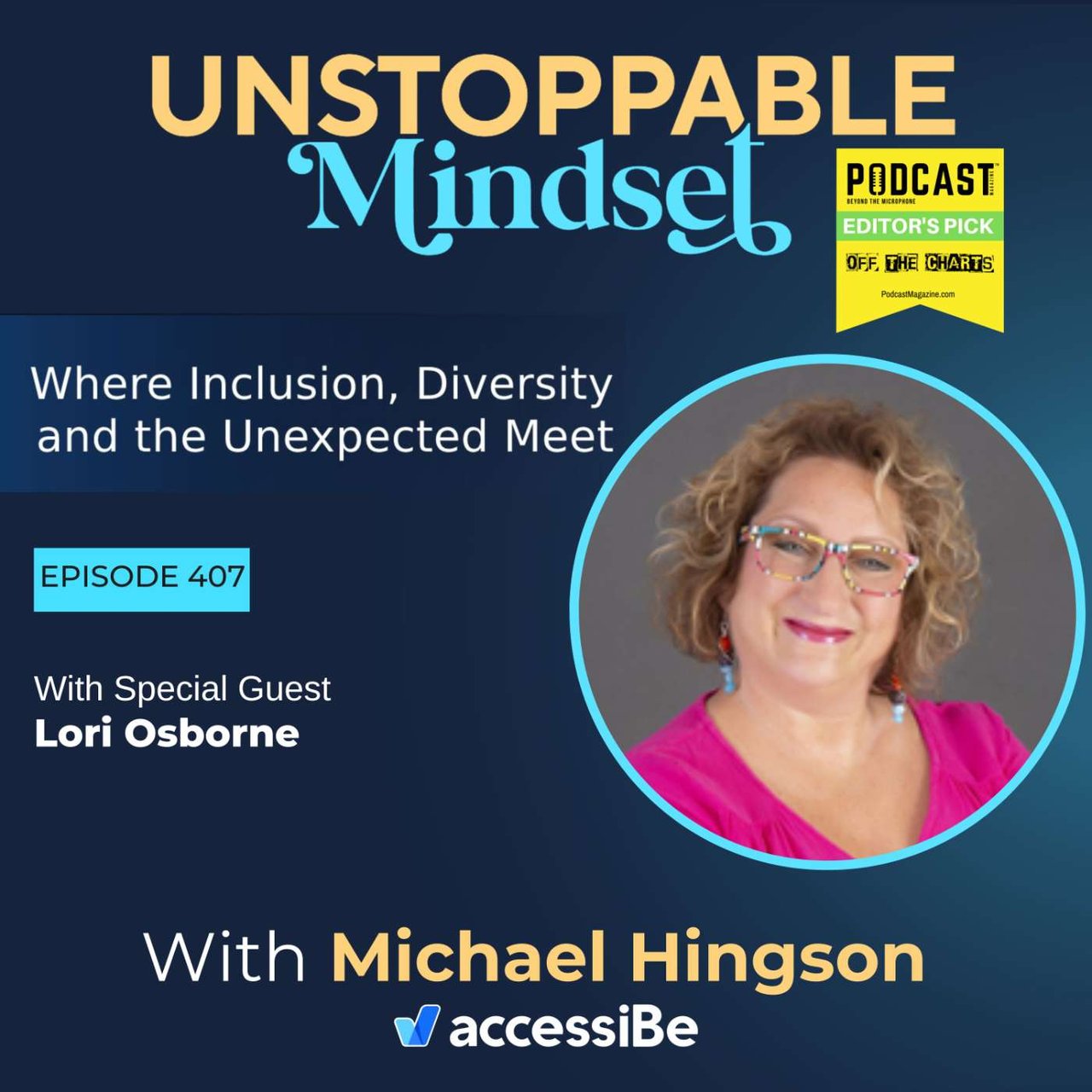
Episode 407 – Why Unstoppable Brands Treat Accessibility as a Growth Strategy with Lori Osbourne
What if your website is quietly turning people away without you ever knowing it? In this episode of Unstoppable Mindset, Michael Hingson talks with Lori Osbourne, a branding strategist and web accessibility advocate whose personal health journey reshaped how she helps businesses show up online. Lori shares how unclear messaging, weak branding, and inaccessible websites block trust, visibility, and growth. Together, they unpack why accessibility is not just about compliance, but about inclusion, credibility, and better SEO, and how simple changes like clearer messaging, alt text, contrast, and video captions can transform both user experience and business results.
Highlights:
00:01 – Understand why disability is often left out of diversity conversations and why that needs to change
13:56 – Learn how a life-altering health crisis forced a complete reset in career and priorities
27:10 – Discover why a website alone is not enough to establish authority or visibility
34:19 – Learn why unclear messaging is the biggest reason websites fail to convert
44:43 – Understand what website accessibility really means and who it impacts
59:42 – Learn the first step to take if your online presence feels overwhelming
About the Guest:
Lori Osborne, affectionately known as The Authority Amplifier, is a Brand Strategist, Website Consultant, and the founder of BizBolster Web Solutions. With over 25 years in technology and nearly a decade of experience helping coaches, consultants, authors, and speakers build a profitable online presence, Lori is the powerhouse behind The Authority Platform™, a complete done-for-you system designed to transform overwhelm into opportunity.
Her signature branding process, The Authority Blueprint™, helps clients clarify their message, define their visual and verbal identity, and identify what truly sets them apart in their field. She then brings that strategy to life with an authority-building website – strategically crafted on the Duda platform to reflect credibility, connect authentically, and convert consistently – without the headaches of WordPress maintenance or tech confusion.
Unlike agencies that offer cookie-cutter sites or developers who disappear after launch, Lori builds long-term relationships by delivering personalized, high-touch service. Through The Authority Platform™, she combines brand clarity, trust-building web design, lead generation funnels, SEO, accessibility, and sales systems into one cohesive, visibility-driving engine.
Lori is known for her warmth, resilience, and insightfulness, and for making her clients feel fully seen and heard. If you’re ready to stop spinning your wheels with digital tools that don’t deliver, and finally create a platform that amplifies your voice, authority, and impact, Lori is your strategic partner.
Ways to connect with Lori**:**
https://www.linkedin.com/in/loriaosborne/
https://www.facebook.com/bizbolster
https://www.instagram.com/bizbolsterlori
Link to Freebie: https://www.bizbolster.com/vip-visibility-audit
About the Host:
Michael Hingson is a New York Times best-selling author, international lecturer, and Chief Vision Officer for accessiBe. Michael, blind since birth, survived the 9/11 attacks with the help of his guide dog Roselle. This story is the subject of his best-selling book, Thunder Dog.
Michael gives over 100 presentations around the world each year speaking to influential groups such as Exxon Mobile, AT&T, Federal Express, Scripps College, Rutgers University, Children’s Hospital, and the American Red Cross just to name a few. He is Ambassador for the National Braille Literacy Campaign for the National Federation of the Blind and also serves as Ambassador for the American Humane Association’s 2012 Hero Dog Awards.
https://www.facebook.com/michael.hingson.author.speaker/
https://www.youtube.com/user/mhingson
https://www.linkedin.com/in/michaelhingson/
accessiBe Links
https://www.youtube.com/c/accessiBe
https://www.linkedin.com/company/accessibe/mycompany/
https://www.facebook.com/accessibe/
Thanks for listening!
Thanks so much for listening to our podcast! If you enjoyed this episode and think that others could benefit from listening, please share it using the social media buttons on this page. Do you have some feedback or questions about this episode? Leave a comment in the section below!
Subscribe to the podcast
If you would like to get automatic updates of new podcast episodes, you can subscribe to the podcast on Apple Podcasts or Stitcher. You can subscribe in your favorite podcast app. You can also support our podcast through our tip jar https://tips.pinecast.com/jar/unstoppable-mindset .
Leave us an Apple Podcasts review
Ratings and reviews from our listeners are extremely valuable to us and greatly appreciated. They help our podcast rank higher on Apple Podcasts, which exposes our show to more awesome listeners like you. If you have a minute, please leave an honest review on Apple Podcasts.
Transcription Notes:
Michael Hingson 00:00
Access Cast and accessiBe Initiative presents Unstoppable Mindset. The podcast where inclusion, diversity and the unexpected meet. Hi, I’m Michael Hingson, Chief Vision Officer for accessiBe and the author of the number one New York Times bestselling book, Thunder dog, the story of a blind man, his guide dog and the triumph of trust. Thanks for joining me on my podcast as we explore our own blinding fears of inclusion unacceptance and our resistance to change. We will discover the idea that no matter the situation, or the people we encounter, our own fears, and prejudices often are our strongest barriers to moving forward. The unstoppable mindset podcast is sponsored by accessiBe, that’s a c c e s s i capital B e. Visit www.accessibe.com to learn how you can make your website accessible for persons with disabilities. And to help make the internet fully inclusive by the year 2025. Glad you dropped by we’re happy to meet you and to have you here with us.
Michael Hingson 01:17
Well, hello everyone. Welcome to unstoppable mindset where inclusion, diversity and the unexpected meet. I am your host, Michael Hingson, or you can call me Mike, it’s fine, and I gave the full title of the podcast for a very specific reason. Where inclusion, diversity and the unexpected meet, typically, diversity people never want to include disabilities in what they discuss or what they do. And if you ask the typical diversity people, what’s diversity? They’ll talk about race, gender, sexual orientation, and they don’t deal with disabilities. But the reality is, and they say that disability isn’t a real mindset. Well, Balderdash, it is. Just asked the 25% of America’s population, according to the CDC, that has a disability, and they’ll tell you that disability is a minority. But the reason I bring it all up is today, we get to talk with Lori Osborne, and she is a person who’s been very deeply involved in website development, in branding and coaching, and she is very concerned about and likes to try to help deal with the issue of accessibility on websites. So we’re going to have a fun time talking about all of that, much less the platform she uses, as opposed to WordPress, and I’m really curious to hear more about that, because I’ve my website is a WordPress website, but, but, you know, I think there are so many different ways to deal with things today. We’ll, we’ll have a fun time. But Lori, welcome to unstoppable mindset. We’re glad you’re here. Thank you
Lori Osbourne 02:56
so much for having me. Mike, I love being here. Cannot wait to talk.
Michael Hingson 03:01
Well, let’s do it. Why don’t we start by you telling us kind about the early Laurie growing up and all that stuff, and kind of how you got started. Okay, start at the beginning.
Lori Osbourne 03:14
At the beginning. All right. I was born in San Diego. More your neck of the woods. San Diego Naval Hospital, but only got to live in California for two years, which I’ve always been disappointed about. My my family had my grandfather built a home in La Jolla. So you know, I was I’ve always been jealous of how my mom got to grow up, but I only got to spend two years there and then I got moved to Norman, Oklahoma, home of the Sooners, never watched football, never went to one football game my entire life.
Michael Hingson 03:51
I’ve never been to a professional or college football game. My wife had, but I never got to go to a football game. I think it’d be kind of fun to do once, as long as I could still pick it up on the radio and know what’s going on.
Lori Osbourne 04:03
There you go. Yeah, I had zero interest in football until I met my current husband in 2011 and he doesn’t miss a professional football game, an NFL game. So I have, I have come to embrace it and enjoy the Pittsburgh Steelers and the Kansas City Chiefs. So there you go.
Michael Hingson 04:24
So you’re in Florida and you don’t root for a Florida team, huh?
Lori Osbourne 04:29
I don’t, we won’t hold it again, you know. Well, you know, I’m one of those. So I moved from Oklahoma to Colorado to Denver area. So I was a Broncos fan when I lived in Colorado, but that was the days of, oh my gosh. Now my mind is going to completely go blank. This is so embarrassing. The the Great, the greatest Broncos player who is now a general manager, John, oh my gosh. Can think of a it’ll come to me. But anyway, he, you know, we. Were actually like, yes, thank you. Thank you very much. Elway. Yes, I was a guest. So we were actually, like, winning Super Bowls when I first moved there, so, you know, and then it went, kind of went. Then I became a Peyton Manning fan, and my husband’s from Pennsylvania, and he’s like, you can’t just change your mind about who you support every time we move. And I’m like, but I can’t, yeah, why not? So when we moved to Florida, I
Michael Hingson 05:26
the Jaguars, jaguars, yeah, yeah, they
Lori Osbourne 05:29
just haven’t been a great team. And I I watched Mahoney, Mahoney play for Kansas City, and I just fell in love with how he plays and just his style and his leadership, and I just became a Kansas City fan, just because I love watching him. And last season was a little disappointing because he didn’t throw as much, but, but, you know, he’s, he’s amazing, so that’s that’s my reasoning.
Michael Hingson 06:03
So So you you didn’t fall in love with Travis Kelsey and try to go steal him away from Taylor Swift before things got serious?
Lori Osbourne 06:12
No, no, I was already in love with my current husband.
Michael Hingson 06:15
So see, tell him that there are some things and some loves that do transcend location.
Lori Osbourne 06:23
There you go. Yes, absolutely. Well, you know, he’s so obsessed with football that we I actually included in our marriage vows that I would support him through his two fantasy football teams and a lifetime of football in my future, because I knew I was marrying football when I married him.
Michael Hingson 06:46
One of the things that spoils me about sports out here, and it’s not so much anymore, but it used to be the case is, I think that here in especially southern California, we had the best sports announcers in the business. We had Vin Scully doing baseball, and I think that it’ll be a long, long time before anyone comes up to the caliber of Vince Scully. And there, there are things that they do now that that really messed that up. But Vinnie was a was was the best. We had Dick Enberg, who did football and and other people. And Chick Hearn did basketball. Chick hurr had talked so fast that I don’t know how he was able to do it, but I learned how to listen fast because I grew up listening to Chick Hearn new basketball. I love it. So, so I got spoiled on sports, listening to those announcers. I keep up with football from a news standpoint, especially when it gets close to the Super Bowl, so I can decide who I’m going to if anybody for for in the Super Bowl when they have it. Yeah, I do kind of like the Rams, because I live out here and I’ve always kind of liked them, although I was mad at them when they moved to St Louis for a while, but, but still, they’re the Rams. I mean, we’ll see what they do this year. I think they’ve got a good coach, but I by no means am a football expert or anything like that. I keep up though.
Lori Osbourne 08:08
Me neither. I, yeah, I kind of joke, you know, my husband will watch like, you know, eight games at once, the red zone or the whatever, and it’s flipping around. And I just can’t, so I just joke I’m a fourth quarter watcher. On Sunday nights, Monday nights, I’ll watch the fourth quarter and because that’s where you know if it’s gonna happen, that’s where it’s gonna happen if it’s gonna be worth watching.
Michael Hingson 08:30
Yeah, well, I’ll be interested to see what happens tomorrow, because the Chargers are playing the chiefs in Brazil.
Lori Osbourne 08:41
Yes, and I don’t, I don’t even know if we’re going to get to watch it, because, you know, the NFL spread out across all these different platforms now, and if you don’t have the platform, you’re out of luck.
Michael Hingson 08:52
I think it’s going to be on TV. It’ll be watchable, but it starts at 530 Pacific Time, and I don’t quite understand that. If they’re doing it live, that would mean it’s going to start at nine. Start at 930 in the evening in San Paulo. So I don’t know how all that’s going to work. We’ll see.
Lori Osbourne 09:07
Yeah, yeah, we shall see. Yeah, we’re I don’t know if we’re watching tomorrow nights, but my husband’s definitely watching tonight, for sure. Well, I
Michael Hingson 09:15
don’t think there are more games on tomorrow other than that one, so maybe he will. And maybe you actually get to focus and just see one game,
Lori Osbourne 09:24
right, right? That’s, that’s, that’s the nice part about the non Sunday games. Usually it’s just,
Michael Hingson 09:31
well, so you, so you grew up and you, you only lived in California for two years, and then where did you go?
Lori Osbourne 09:40
I lived in Norman, that’s right, until I was 29 I actually found my birth father when I was 23 and moved to Colorado to get to know him and his family.
Michael Hingson 09:55
So you were a diamond.
Lori Osbourne 10:00
Not really. I just, he was just never part of my life. Your mom married someone else, yeah, okay, yeah. I always had. My mom just didn’t have my dad. And it’s, you know, it’s been an interesting experience, because, you know, being in my 20s when I met him, and my mom and I were opposite growing up, and I never understood my personality, because she was quiet and passive and wanted to work in the same job her entire life, and I was the opposite. I was vivacious and loud and aggressive and always wanted to be self employed. Then I met my dad and went, Oh, it explained it all, I’m just like him. It’s crazy how the you know the genes work for sure,
Michael Hingson 10:51
but you got to know him, and the relationship was a good one.
Lori Osbourne 10:55
Yeah, yeah, right. We just, he’s in Idaho now. We just got back a couple of weeks ago from visiting. I mean, it’s been interesting, trying to enter a family, you know, in your 20s is is bizarre. I kind of, I kind of equate it to being an in law, like, I’m not quite all the way in, because I, you know, I didn’t grow up with these people. They don’t know me. But, yeah, it’s been interesting. So where in Idaho, near Coeur d’Alene Sand Point near
Michael Hingson 11:25
standpoint, I have a brother in law who lives in Ketchum, in Sun Valley, and who is an avid skier, and has been an avid skier basically his whole life. Now the real big question is, of course, where is your father when it comes to football,
Lori Osbourne 11:46
my father does not sit still. Okay? That is, that is one way that we are different. He I joke that he’ll probably outlive me. I mean, he lives on 14 acres. I think he just, they just sold 40 Acres. But he doesn’t. He never sits still. He He’s always going, going, going, working on, you know, he had, he had his business, which he sort of still does. But he works on fences or helps with the does something with the horses or the hay or the, you know, it’s just it. He works his plan does not I don’t think he the TV when we were there was on music the entire time. Yep.
Michael Hingson 12:30
So hardly a person who tends to watch football. Well, that’s okay. So you, you grew up in Norman? Did you go to college there or in the area?
Lori Osbourne 12:43
I went for a year and then couldn’t figure out how to keep paying for it. I honestly didn’t even realize financial aid was a thing. So I started in the workforce and became a recruiter, technical recruiter, pretty early in my career. I did that for 12 years, and then started my own recruiting business and got my degree during that time. So I got a bachelor’s degree in business administration, 4.0 average while working. Proud of that, but I was in my 30s, and then I got cancer right after that, had colon cancer at 36 which I blame an 18 year abusive, horrible marriage, I think really led to that, but it pushed me To get out of that horrible abuse of marriage. And then a few years later, I met my current husband, and I am the happiest I’ve ever been,
Michael Hingson 13:51
but you also were able to, in one way or another, beat the cancer
Lori Osbourne 13:58
I was, yes, it was actually stage one colon cancer. Only had surgery so that one, yeah, didn’t even have to have chemo or radiation. And actually, what got me into my current business? I was a when I got divorced, I did this is kind of funny to me. I when I got divorced, I decided I no longer wanted to be straight commission, and because I had gotten a job after after the cancer, and now I’m self employed. And so why? I think I wouldn’t want to be straight commission, but it’s okay to be self employed, but it’s a completely different mindset. You know yourself very much a different mindset. But I was in tech. I moved from recruiting into hands on technology. I did project management, software testing, I looked at websites and helped design websites from a business perspective, but I was never, never a coder, never, you know, did the visual design? Nine and in 2015 I we had just moved to the opposite side of Denver. We had just changed, I had just changed jobs, had a brand new home, and then found out I had a brain tumor.
Michael Hingson 15:15
Oh, gosh, yeah, you’re just an attention getting person.
Lori Osbourne 15:19
That’s all you. I know. That’s it. I just walk around going, yep, that’s it. So, yeah. So I, I ended up leaving the job because it was, it was very traumatic. I ended up having two surgeries. They couldn’t remove the tumor. It’s part of my carotid artery. It’s a meningioma. It’s benign, but it’s part of my carotid artery, and it was causing my left eye to droop, so they went in to get it off the optical nerve and nicked the carotid and caused a brain bleed. And that brain bleed caused that drooping eye to become a half blind eye. So I ended up, for about a year and a half, I had double vision. I also had found out I had a stroke from it, I was having problems with words and forming, you know, the right words. And I had no tolerance for stress for a long time, so there was no way I was going back to project management in the IT world, right? This wasn’t so I literally, I spent about a year recovering and just started messing around, going, Okay, well, what can I do with the talents that I have? And I started building a website on Squarespace, and it was called Health Net, like grandma. And it was just talking about my I lost my mother and my grandmother to cancer at 63 both at 63 and then I had gone through what I went through. And I just wanted to share the stories, you know, the what I’ve learned from a health perspective. And in doing that, went, wow. Why have I not been developing websites the last 20 years? This is what I should be doing. I love this, and I bet other business owners could really use some help doing this. And that’s when my business was born.
Michael Hingson 17:20
Wow. How did they discover the brain tumor?
Lori Osbourne 17:26
It started with me falling asleep at my brand new job desk. Was I could not hold my eyes open. I actually thought it was an adrenal reaction to leaving a super high stress job to a very boring job, but it was not. They did all these tests. They put me on thyroid medication, which helped, and then my left eye started drooping, like literally within weeks together and and it was funny, because they they sent me to an eye doctor, and the eye doctor sent me to an eye surgeon, and they wanted to do surgery on it. And I’m like, don’t you want to figure out why this is happening? Like, I don’t want you to touch my eye until you know why my eye is drooping. And my doctor thought that was the craziest thing she’d ever heard. So she goes, Well, have we done an MRI yet? And I said, No, so they sent me for an MRI that day. And lo and behold, not only do you have a brain tumor, but you have had a stroke. Okay. Gosh, you know, she did not want to share that news, those news with me. She was very embarrassed. Probably, well,
Michael Hingson 18:43
but you need to know, yeah, and clearly you already had demonstrated that you had an analytical mind, and it would be valuable for you to know, because it would help you in dealing with making decisions, or thinking about what decisions to make going forward, right? Yeah, so you did. So you went through the surgeries and all of that, and what, what happened to your your left eye,
Lori Osbourne 19:10
it, it’s still mostly blind. I have a sliver of vision that I can’t control. So if I go to the eye doctor, they try to get me to look at the chart, and I can’t focus it on the chart, and I get very frustrated. I blocked it for the first year. Now my eyes are so it’s it’s developed its own way of working, so I can’t even block it anymore without causing worse headaches than I already have. Bad headaches kind of came out of all of this. So I really just live with it. I live with the headaches, and I ignore it as much as I possibly can and and hope it’s improved slightly over. The last 10 years, they told me it would never improve. But, you know, our brains are amazing things, and it’s it’s trying, but it’s still not. I just tell them make the left eye prescription the same as the right eye because it makes no difference. Yeah.
Michael Hingson 20:17
Well, so with, with with all that you’ve you’ve dealt with, with, with this clearly, you figured out a way to go forward, and you’ve, now, I assume, used all that happened to you, and you’ve analyzed it in some way or another, that you have made some decisions about what you want to do with your life, which is namely the whole brand development and web development and dealing with accessibility, which is pretty cool.
Lori Osbourne 20:51
Yeah, yeah, I am. Once I discovered that passion and the I honestly never realized I had the creative side of me. I knew I had the analytical I knew I had the project management and tech, but once I realized I actually have a very strong creative side, then websites were the way to go. And it’s it’s really I can be working on a website for four hours straight and feel no pain, and that that alone tells me I’m doing what I’m supposed to be doing. I love it that much, and I feel like I’m that talented at it.
Michael Hingson 21:30
I think you’ve made a very interesting observation, and one that I relate to very well, which is working commission is one thing, but working for yourself, which, in some senses, is the same, but it’s totally different, and you have to have a different mindset to make it work.
Lori Osbourne 21:48
Oh, absolutely, yes. I mean, I’m I’m not selling a product for someone else. I’m selling myself, and I am the product, and I have to live by my my values and my mission and my why, which is completely different than selling services for someone else, for straight commission.
Michael Hingson 22:12
I have always told my the people who I hired as sales people to analyze and and think about what they do. And one of the things that I did with every person I ever hired was I would say, tell me what you’re going to sell. And literally, all but one person said, Oh, we’re going to sell the product. This is the product we’re selling. This is what it does. But the best sales guy I ever hired, when I asked that question, Said, the only thing I have to sell is myself and my word, and I need you to back me up when I give my word about something,
Michael Hingson 22:50
great answer. It was, it was the actual, it was the answer I was looking for. And I said, well, as long as we communicate, and I know what you’re going to say, and that’s all about trust, I’m going to back you up. And never had an issue. And in fact, he and I worked very well together, because we figured out how my talents in sales and management could augment and accentuate what he did, so that the two of us could work together. And I think that’s that’s so important, but you’re right. The only thing any really good salesperson has to sell is themselves, and you have to be true to your own attitudes. Yes, yes, which is so
Lori Osbourne 23:33
integrity is everything. I mean, if you especially as a small business owner, I mean, and I’m in a very small community, and I this. I only lived here since 2018 and it’s kind of been shocking to me how how a small community works. But if you do it right, everybody knows your name. If you do it wrong, everybody knows your name. Yeah, it’s you know when, every time I get a call because the chamber has referred me again. I just smile, and I’m like, Okay, I’m doing it right, you know? And it’s, to me, it’s all about integrity. If you, if you say you’re going to do something, do it, and if you can’t do it, say you can’t do it, say you can’t do right, or say I’m going to figure it out. Yeah, you know, I didn’t. I charged very little my first few years, and I always my first few years, I told clients, I don’t know what I’m doing yet, so I’m not charging you for the time that I’m learning. I’m going to charge you for the time that I’m actually accomplishing something.
Michael Hingson 24:30
One of the things I always told every again, every salesperson I ever hired is for at least the first year. You’re a student. No matter what you think you know and what you know about sales, when you’re working with customers, you’re a student, ask them questions, really learn from them, because they want you to be successful, even if you don’t think they do. And the reality is that, in general, they do want you to be successful, and the more you encourage them to teach you, the better relationship you’re going to develop.
Lori Osbourne 24:59
Absolutely. And 100% yes.
Michael Hingson 25:02
So how long ago did you end up having the brain tumor?
Lori Osbourne 25:07
I was diagnosed in August of 2015 So wow, I’m, I’m at exactly 10 years. 10 years. Yeah, I didn’t, oh my gosh. September 22 will be my my first surgery dates. There you go. Wow. Right at 10 years
Michael Hingson 25:23
See, I’m glad we we help you remember,
Lori Osbourne 25:27
I can’t, I can’t believe that was, like, not even on my mind. I mean, it was actually September 17. Was the first surgery, that’s right, and it’s the same day as my dog’s birthday. And we were just talking about my dog’s birthday yesterday, but I didn’t even think about the tumor. So well, it’s all good
Michael Hingson 25:47
a week from next Wednesday. But you know, you you obviously are doing well, well, so how did your your business in the the way you do things and what you do? How did all that change after the surgery, or had you already started down the road of branding and being a branding coach and website development and accessibility?
Lori Osbourne 26:10
No, all of this came as a result of all of it. So it literally just grew with me, as I, you know, transitioned into life again, and being able to function mentally and physically, I would just start, you know, working on a little bit of, you know, a couple of websites. The first website I built was from for a realtor that we worked with. We did three different deals with him in two years. He was this great Scottish guy, great personality, and his website was horrific. And I begged him to let me do it. It was a I think we ended up doing 39 pages total, and just read redid the whole thing. He loved it. A lot of it’s still in place 10 years later. But I just, I just started building, and then we moved to the area we are now outside Jacksonville, and I found a local networking group and started meeting people and getting introduced to businesses and just slowly built and learned a little bit at a time, and learned a little bit more. And then it was not actually until last year I realized that I have branding skills and talent that I haven’t been promoting. I was using the skills and I was building on brand websites, but I didn’t say that, and I didn’t recognize it as a separate talent from website development. I kind of thought everybody did that, until I realized that that’s not true. So I’ve been doing it, and a lot of it is just, I the natural, just natural talent for color and almost like designing houses. Like I knew I was really good at designing houses, but I didn’t recognize that that translated to websites. And so for last, like, year to 18 months, I’ve really kind of bought into the brand strategy piece of what I offer.
Michael Hingson 28:19
Well, how did you develop this concept of authority platforms, and what is it?
Lori Osbourne 28:27
So the authority platform is what I’m calling the full package. It kind of started when I got really frustrated with everybody telling me or everybody’s an exaggeration, but so many people saying, Oh, you don’t need a website. You just need landing pages. And I would try to educate people that landing pages are not enough, but I couldn’t put it in the right words, and when I started really looking at it, going, well, landing pages are great, if you have the visibility to get people to the landing page, and if you’ve built a relationship in a different way, if it’s through speaking or through a book or through other types of promotions, then yes, the landing page can help or maybe replace the website. But where that led me was a website alone is also not enough. We need full visibility. We need to be seen in a lot of different ways to establish our authority as experts. So with the authority platform, I’m looking at the brand and understanding the brand, the website, the lead magnet, the funnels, the search engine optimization, and then helping them also have a good CRM to manage all of this, hooking them up with with good speaking coaches or podcast. Opportunities and just looking at it from a full life cycle of being visible and showing that authority online.
Michael Hingson 30:10
And how’s that gone over?
Lori Osbourne 30:14
It’s, I’m still building it honestly, the website’s absolutely I’m I’m really working on building the collaboration pieces for the rest of it to truly say, Yes, I have the authority platform, the branding packages that I’m offering and the branding pieces that I’m doing are making a significant difference in the quality of the websites I’m building, because I come out of it with a custom GPT that they can use, and I can use that really establishes that baseline for the brand and the bringing in their values, bringing in their communication style, and bringing in their ideal client and how to speak to that ideal client. So the GPT is built around all of that, which is perfect when we’re building the content for the website. So I would say, you know, we’re 75% of the way there to having my true authority platform. But I’m still building, you know, authority building websites every day.
Michael Hingson 31:20
Well, I gather that you don’t tend to like to use WordPress. You use Duda as a platform builder and so on. Tell me, I’m curious why and what, and I don’t have any any disagreement or or really knowledge to talk intelligently about it. But tell me why you use Duda and what, what it brings.
Lori Osbourne 31:44
So my my challenges with WordPress started with my first client in Florida. They there was a nonprofit. They had no idea what they were doing, and I’m like, I I’m techie. I can go in, I can figure it out, and I could not figure out WordPress, and I got very frustrated with it going, how in the world does anybody else do this? So I kind of stayed away from it for a little while, and I was building on Squarespace for a time, and then I discovered Duda. I consider Duda to be the best of Wix and Squarespace. It’s very similar. But the things I don’t like about Wix, I don’t like about Squarespace, Duda has resolved. It’s also very customer oriented and SEO oriented and accessibility oriented. So there’s a lot of advantages to the platform. The reason I don’t support WordPress is I’ve had too many, too many people come to me with broken websites. Too many WordPress people do not educate their clients that that you have to update the plugins, and they don’t. They just leave them and don’t offer to do that for them, and it’s it’s an unnecessary addition that I don’t think most people need for their website. There’s plenty of things that we can do and do to that we can do exactly like WordPress without the headaches of that extra tech and plugins breaking and security breaking because the plugins are breaking, and it’s it just it’s too unnecessary, in my opinion. I tried to support WordPress for about a year and a half, and I found that I was not helping my Duda clients because the WordPress was always so much high maintenance. And those were the websites that were going down, and those are the websites that were having issues where my due to clients, their websites were never down, they never had issues.
Michael Hingson 33:51
But don’t need, but don’t you, from time to time need to provide any kind of updates to Duda doesn’t. Aren’t there as the as the whole website evolves, doesn’t, don’t you need to find ways to evolve what they are and what they do
Lori Osbourne 34:05
on the front end, on the front end, absolutely I mean, but from the back end, from a platform perspective, Duda handles all of that. It’s self contained. Got it? I don’t have to worry about that. And they’re also always adding new features, which is another thing I absolutely love about them there, and I have yet to find, let me rephrase that. I’ve probably found a couple of things that if I could not duplicate on Duda to match WordPress, it would require code, and I don’t code, but I can still achieve the goal of what my clients are looking for. There’s nothing that they’ve said I have to have this that I can’t provide. And the offset of not having the worry around the tech is has always been worth it.
Michael Hingson 34:55
So the creators of Duda in the background as. They make updates and changes, they go out to everybody who uses it to create their websites automatically. Is that? Is that what happens?
Lori Osbourne 35:07
Okay, yeah, it’s seamless. Yeah, you don’t even, you have no idea that there’s even updates being done. It’s completely seamless.
Michael Hingson 35:15
Yeah, okay, well, I understand that. That makes a lot of sense. What’s the one mistake that you find that keeps business owners from really progressing and keeping their websites and them invisible? What’s the biggest mistake you see?
Lori Osbourne 35:36
Messaging unclear, messaging which, which really goes back to the brand. If you don’t understand your brand, you don’t understand your why, and you don’t know how to express how you solve problems for your ideal client, let me, let me rephrase. If you don’t even know your ideal client is and you’re trying to speak to them, a lot of people think they sell to everyone, and when you try to sell to everyone, you sell to no one. And if you are trying to speak to the masses from your website, you’re going to lose the people you really want to reach. So it comes down to that, that niching down factor and really understanding your ideal client, so that when they hit your website, they immediately know you understand my problem and you can fix it. And it really comes down to that versus I can fix, you know, I can build a website for anybody. Well, then that makes me no different than a website developer down the street. Then it comes down to a price comparison, and then we’re just bidding against each other. So you’ve gotta, you’ve gotta what makes you special, and what and and your why is a big part of that. Your values are a big part of that. And speaking the right language and that messaging.
Michael Hingson 37:03
Can you tell me a story of maybe one customer that you worked with where you can demonstrate exactly what you’re talking about here and why it made a difference without mentioning customer names, but the story?
Lori Osbourne 37:17
Oh, yeah, um, you know, it’s been a while since I did that realtor, but that realtor is still just such a great example, because you the fact that he was from Scotland doesn’t necessarily seem significant, but it really does, because, you Know that Scottish accent made him endearing. He was a very professional, good looking guy. And you go out to his website, and it was, I can still see it today. It was like green and this old, funky text, and it, it represented him in no way. And I remember the first thing he told me was, you know, I’ve got this video where I introduced myself and I went, why in the world is that not on your homepage, like what people need to hear you speak and see you and experience you. He was phenomenal. And we did three deals with him. He was phenomenal at what he did, and that what, you know, if we had just rebuilt his website and just did the video, it would have that alone would have made a huge difference in people knowing who they were working with and how he was different. And another example I can give more recently, I work with a mentor who mentors seven figure coaches on how to work harder, make more money and and do it in less, less investment of your time. And when I took over her WordPress website for for two years, I just kept repeating and rebuilding the same crap, basically. And finally, when I decided to leave WordPress, I said, you know, I really want to start all over. And I realized in that two years, you know, I had not taken the time to really get to know her brand. And when we sat down and really learned what made her special and different, and we were able to capture that in in the website, that the difference in the experience was night and day, you know, before it was just text, and, you know, a little bit of information. She never referred anybody to her website. And now it, you know, opens with a video. She’s also a professional speaker. Opens with a video of her speaking. She is very she’s a. Ballroom dancer on the side, she’s very elite. So we, you know, pulling in things like gold and video, I have a lot of motion on the website with gold moving because it, it, it’s that brand of that dancer that, you know, that eliteness of it and it, it’s subtle, and it has nothing to do with the messaging side that I just mentioned, but it’s still back to the brand and the representing of who you are, who she is, what we’re selling, you know, we’re selling ourselves.
Michael Hingson 40:33
Yeah, well, websites and website developers put all sorts of things out there and that that’s not necessarily a good thing. But what are some signs that a business’s online presence don’t necessarily match their real life expertise? Because I I believe that people see through people who just sort of talk, and I think that that all too often, you get this reaction, oh, they’re just talking that isn’t what they really believe or that isn’t what they really know. So what are some signs that the online presence doesn’t match what they really know and what they really are?
Lori Osbourne 41:15
Part of it is that that genericness, if you if you can’t even say who you are serving, then you’re obviously the person you’re looking at is obviously not clear about their ideal client. If it’s not clear who they are serving, and if it’s this just generic message of not in these words, but we’re the best use us. You know, there’s, there’s no detail about what makes them different and how they specifically solve your problem. If the website is completely outdated or generic, that may or may not allude to anything but it, it definitely shows that they don’t, are not using their website to show their expertise. The other huge thing, I would say, is testimonials. Every website should have reviews. I mean, what better way to sell ourselves than to have someone else say how we’re different, how we operate and why we’re the why we’re the best. That is huge. If it’s all about them, as in the person’s website you’re looking at, if it’s not, if I’m, if I’m getting on a website and they’re not even acknowledging what’s in it for me and how they’re going to solve my problems, then I’m not going to have any confidence that they have any idea how to solve my problems. They haven’t even they haven’t even talked about my problems. They haven’t even mentioned my problems. They’re just telling me that they’re selling me something, and this is how much it costs, and this is what it’s going to do. But I but do you get me? Do you know? Do you understand me? I think all those are it’s really important that we are speaking to the ideal client in their language about their problem.
Michael Hingson 43:10
I have heard so many times and totally agree with and work to do this myself.
Michael Hingson 43:18
The whole concept of when I’m invited to speak, it’s not about me. Yeah, I’m invited to speak, but my job is to enhance, to help to make life as easy as possible for the event organizer, to help the event organizer make this, the whole conference, even better than they thought it would be. And and I have to do that because it’s not about me, and it should never be about me as such, right?
Lori Osbourne 43:48
It’s also about your audience and your audience, yeah, so that they know you want them to want to know more. Yeah, that’s also the purpose of your website to make people want to know more.
Michael Hingson 44:01
Yeah, very true, and it should be that way. And if you’re doing it right, you’ll also provide more for them to know. Right?
Lori Osbourne 44:15
Absolutely. Well, that would be something else that I would say I I always encourage people to give away as much as possible on their website. It if people know that you really want to help me solve my problems, and you’re willing to give me something for free that starts a relationship. And that’s really, at the end of the day, that’s the point of the website. It’s not to sell, it’s to start a relationship. It’s like the first step of dating. We’re not getting married yet. We’re dating, and if you’re if you’re giving away a piece of yourself through a video or a download or even a free course. Course, that’s it. That’s going to endear the audience to to want to come back for more. And even blogs, great blogs will get people coming back for more. And people always go, Well, you know, if I give everything away, I’m not going to make any money. No, you give away what? What doesn’t cost you time, but is giving some knowledge so that they want more, and they know that you you get them, and they can trust, you know, like and trust so they can build that, that base for a relationship.
Michael Hingson 45:32
Yeah, and it, it makes perfect sense. It is all about building trust. And everything that we do is all about building trust, and the more trust you build, the more loyalty you’ll create.
Lori Osbourne 45:47
Absolutely, yes, absolutely.
Michael Hingson 45:49
So we’ve talked about website accessibility. What is website accessibility and why is it something that people really should focus on? Why is it important?
Lori Osbourne 45:59
That feels weird coming from you, Mike,
Michael Hingson 46:03
because I know you are an expert in this, but I preach it, but I preach it all the time, so I want to hear what somebody else has to say, and I want people who are watching and listening to this hear from somebody else other than me. Okay, that’s the motivation behind it.
Lori Osbourne 46:18
All right. All right. Well, website accessibility is at its core. It’s making the website available and usable for everyone, including those with disabilities. So whether it’s blindness or inability to use a mouse or you said it earlier, dyslexic,
Michael Hingson 46:40
epilepsy, any number of things, right?
Lori Osbourne 46:43
So anybody, just like accessibility for a ramp into a store, it’s allowing me, from my home, as as a disabled person, to be able to function on your website. And as we know, I believe the stat is 20% of people have some kind of disability. It’s also an inclusion. It is a piece of I consider a piece of your marketing, because if you are excluding 20% of the people with your website, why? Why are you doing that? It also builds strong Search Engine Optimization. Because if you look at all of the guidelines for accessibility, they’re very similar to the guidelines you need to have in place for good search engine optimization. Google is looking for the exact same things. Yep. So it’s it’s really just making your website available to everyone
Michael Hingson 47:42
well, and the reality is, well, let me ask this question, rather than me just saying it beyond legal compliance. Why should accessibility be a priority in website design? You’ve kind of alluded to it already.
Lori Osbourne 47:56
Yeah, part of what I just said, it’s including everyone. It’s not excluding 20% of your market, and it’s building trust, inclusivity and credibility. It’s, it’s, and it to me, it’s showing that you care. It’s, it’s very bothersome to me when someone says, Well, I probably won’t get sued, so I’m not going to worry about it. Okay? But why do you want to not do these basic things so that everyone can access your website? Well?
Michael Hingson 48:33
And also, in reality, it does get back to if you’re a website owner, that is, you’re a company that has a website, and you recognize that the job of your website is to help people see why you have something they need. The fact of the matter is, do you really want to not make available to 20 or 25% of the population your website, or to put it another way, don’t you want to make sure that you are making your information available to everyone? And that’s what the real reason for website accessibility is truly all about. The fact of the matter is that it’s good business to make your website accessible.
Lori Osbourne 49:24
Absolutely, yes, absolutely.
Michael Hingson 49:26
What are some high impact changes that you think that website owners can make, to make their websites or to have their websites be more accessible, maybe even just some simple things?
Lori Osbourne 49:38
Oh, there are so many simple things. I mean, the easiest thing that so many people miss is adding alt text to images. I mean, it’s, and it’s one thing I love about Duda, by the way, it they do it with AI and do it for you, and you can edit it. It’s so, so wonderful. But it’s, it’s a simple step. It also is. Great step to even help with SEO, because you can include some keywords there, but that that alt text tells someone that’s using a tool that’s blind exactly what that image is, and what is the point in putting that image on your website if it’s not going to provide any value to those that can’t see. I mean that, in my opinion, another thing is the contrast in colors. A lot of people don’t understand that contrasting colors has a lot to do with readability, and if you are putting two colors together, I mean, think about it even from a scene person, if you’re looking at it and you can’t read it. It’s not accessible, right? So, you know, have high contrast in the colors of text on anything over it. Don’t try to put something over an image that can’t be read that just just, don’t do it. Skip that. I was just doing this on my website today. I was trying to put an image, and I went, you know what? That’s just not going to work. I’m going back to a solid color. It doesn’t it’s it and it, you know, that’s from a business perspective as well. Because even if you’re not thinking about accessibility, if someone can’t read the text or can’t read the button, they’re not going to click it. You’re not going to read it. They’re not going to buy it if they can’t read it. So simple little things like that. Those would be the two biggest things I would say. And then just, you know, little additional things like making sure that your website is converting properly to mobile, if it’s if it’s not, if things are coming off the page, because you didn’t bother to look at the mobile side, which is easy to miss on many platforms that can have a huge impact on the scene and those that need the tools or need accessibility pieces that’s, you know, commonplace design and very easy thing to fix.
Michael Hingson 52:11
It’s been a while since I looked at this website, and I think it’s not quite what it used to be, but for a while, my favorite website, absolutely. My favorite website for accessibility was the website of the National Security Agency, nsa.gov,
Michael Hingson 52:31
of all the websites in the entire world. The reason I liked it is that not only did they have all text on images if you were using a screen reader and you moved your cursor over an image, you suddenly got a very detailed description of that image, like you.
Michael Hingson 52:55
You moved your cursor where you used your screen reader to move over the American flag. It would say the American flag on a flagpole hanging in front of the opening to the building of the National Security Agency. Yada yada yada. I mean, it’s just everything was there. It was the most amazing website. I don’t know that it’s that way anymore. I haven’t looked at it in a little while, but I was very impressed with how much they did and relative and relevantly and appropriately so to make sure that everything on that website was totally usable. And a lot of people could say, Well, why do I have to do that? And the answer is, you have to do it for the same reason that you want to make your website accessible, if you will, for people who don’t happen to have a disability. The reality is, all those things that you put on the website for people who can see them and so on, like pictures and so on, if you don’t make those things accessible, you’re doing a disservice to a significant amount of the population. Whereas, if you do it all, then while you can look at the picture, I can hear all about it, and that’s the way it ought to
Lori Osbourne 54:10
be well. And there’s so much I mean to me that is an opportunity to to even go further with the folks that need the screen reader. Because, I mean, when I’m and I mentioned that dude, it does it with AI, but they, they do it too generically. When I go in, I’m doing exactly what you’re talking about. I want to, I want to build the presence of the picture. This is who they’re doing, who it is from the business, and this is what they’re doing, and this is what you know, this offer is talking about that’s an extra sales opportunity right there. For those that you know, need the alt text, why not use that?
Michael Hingson 54:49
And also, I’m amazed at how many people may look at pictures and so on and look at words and not really pay attention to them very well, because they just kind of skip over it. So the more you can do to attract people’s attention to the right things. Is relevant too. I’m amazed at how many people just gloss over so much.
Lori Osbourne 55:09
Oh, absolutely. Well, you know, this kind of become our society, yeah, short attention span for sure. You know, I want to mention two videos. I really feel like people need videos on their website, especially of themselves, because it helps people get to know you. But you need to have that closed captioning and again, dialog.
Michael Hingson 55:33
You need to have dialog so that a person who can’t see the video will also know what the video shows.
Lori Osbourne 55:41
Explain, explain what you mean by that a little bit more.
Michael Hingson 55:44
So you go to a website, and there’s a video, and you click it, and you start hearing music, and that’s all you hear, even though, on the screen you see a person walking down the street, walking into somebody’s store, finding a product they want and buying it. But if you don’t have a way to make that information audibly accessible to people who can’t see the images and who don’t see the videos, then what good is it you haven’t made it accessible? Yes, closed captioning works for deaf or hard of hearing people, but again, there’s so much more that needs to be done. Wow.
Lori Osbourne 56:25
Thank you for sharing that, Mike. You just gave me more to think about on videos.
Michael Hingson 56:31
One of my favorite commercials to pick on today, and for the longest time, I had no idea at all what it was about. It starts out with music, and somebody says something like, so what do people over 60s show and bring out today? And they talk about love and they talk about something else, and suddenly the sound goes dead, and all you hear for the next 20 seconds or more is this high pitched whistle sound. Ooh, yeah. And I finally got somebody. I finally was in a room with somebody when I heard the beginning of this, and I said, What is it showing? And all it was showing, and what, apparently it is, is a promotion for people getting the RSV vaccination.
Lori Osbourne 57:19
Oh, right. Oh, I do know what commercial you’re talking about, yes, but text just goes on the screen.
Michael Hingson 57:26
RSV, RSV, RSV. But there’s nothing that says what that is at all, period,
Lori Osbourne 57:33
because they’re trying to make the point that you’re that your life shuts down when this hits. But yeah, for someone like you, that’s completely worthless.
Michael Hingson 57:41
Not only does my life not shut down, my life gets very active, and I want to go off and find those commercial designers and show them what true accessibility really ought to be about. But that’s another story. But yeah,
Lori Osbourne 57:53
yeah, exactly, wow. I mean, I think about you every time I see that commercial, those rare times I see commercials,
Michael Hingson 58:05
what’s one of the what’s one of the myths about branding and websites that you could erase, that you really wish you could race forever?
Lori Osbourne 58:18
I probably told you to ask me that question, and now I’m stumped by how I want to answer it. I think, I think I know where I wanted to go with that. Yes, a lot of people think branding is just colors and fonts, and honestly, when I first started doing it, I thought it was just colors and fonts. And I kind of go, I went into Okay, colors and fonts, and then consistency, okay, we want to make sure we got we’re consistent with our colors and fonts across everything that we do that’s that’s branding, that’s visual branding. But real branding is Our Story. Is who we are, what we stand for and who we serve. It’s the package of everything around what we’re selling, back to selling ourselves and really understanding this package and making that consistent across everything. And consistency is huge, in my opinion, when it comes to branding, if you have a different header image or marketing image on every single thing you do and there’s no consistency in the look, then you’re not going to be memorable. You. I can’t help you see this, Mike, but anyone that does go out to anything of mine, I have a very consistent image that was used to build my logo, and it’s on everything that I do. I also wear very bright, colorful glasses. Everything I do is very bright and colorful, and it’s memorable when people see me and they see my glasses, it can be three years later and they go. I don’t remember your name, but boy, I remember those glasses. You know, it’s, it’s, and that’s part of my branding. When people say, I love your your glasses, I go, thank you. It’s part of my branding. Yeah. So it’s a, it’s an overall everything about you. When people describe me, they usually describe me as bright and colorful, like, that’s, that’s one of the first things that comes to their their mind, and then they it translates to energy, because they think bright, colorful energy. So it’s, you know what branding really is, is, what do people say about you when you’re not in the room?
Michael Hingson 1:00:30
Yeah, that’s, that’s a good that’s what it is. Well, if there is a business owner who is in our audience today who feels overwhelmed by their digital presence. What would you suggest is the first step they should take to change that?
Lori Osbourne 1:00:47
Well, the the first thing I would love to see anyone do is sign up for a visibility review or audit with me, so that we can look at your presence and talk about it, and I can give you some very specific suggestions for how to improve your online visibility. If you’re wanting to do something on your own and you’re you’re trying to figure out where to start, sit down and look at first, your your homepage, in your first line of every bit of your marketing and ask yourself, does it say who I serve and how I serve them, and the problems that I solve. Because every ounce of your marketing needs to say that immediately you have less than eight seconds when someone hits your website. And there’s all kinds of some people say three, some people say 10s and 15. I just leave it at eight. Do eight or eight or less seconds on your website. So start there is my messaging clear? And then look at your website overall and does it represent me and the message I want people to see. We can go into a whole lot more about it being up to date and everything else, but that’s where I would start, right there.
Michael Hingson 1:01:58
So how do people reach out to you to get your help to deal with all of this.
Lori Osbourne 1:02:02
Well, you can obviously go to my website, which is biz bolster.com, B, I, Z, B, O, L, S, T, E, r.com and I believe you will be sharing a link to that visibility audit. Just sign up for that or a free strategy session. But I encourage the visibility audit, because it literally takes about an hour of my time to check out everything about you and then share that with you. So this is an investment that I’m willing to give you to help you all understand how you show up online, and then what to do about
Michael Hingson 1:02:45
it, biz, bolster.com, I hope people will do that, and they can reach out and contact you through that website.
Lori Osbourne 1:02:53
Yes, click on, let’s chat, and it gives you all the all the calls that you can sign up for in my calendar, and I would absolutely love to speak to anybody that has questions or wants some direction.
Michael Hingson 1:03:07
Well, cool. Well, I really appreciate you being here today and spending so much time talking about all this, and I hope people will take it to heart. Wherever you are listening. Reach out, biz, bolster.com and get some insights and get some help to improve the website the web world, because only about 3% of all websites are really accessible today, which means there are a whole lot that are not, and there is no real excuse for that being the case. So reach out and
Michael Hingson 1:03:41
you can get all the help that you need. I’d love to hear from you, to hear what you think about today’s podcast. Please feel free to email me at Michael H, I m, I C, H, A, E, L, H, I at accessibe, A, C, C, E, S, S, i, b, e.com, and wherever you’re listening, please give us a five star review. We value your ratings and your reviews a lot, and I but I do want to hear from you. I want to hear what your thoughts are. Also, if you know of anyone who might make a good guest for unstoppable mindset, Lori, including you, would really appreciate you introducing us, because we’re always looking for people who have great stories to tell, and today has certainly been one of my favorite podcast recordings in a long time, and that’s because we really did have fun, and I think we accomplished a lot and we learned a lot. So I want to thank you, Lori, once again, for being here and for being a part of unstoppable mindset.
Lori Osbourne 1:04:35
Thank you, Mike. It has definitely been a pleasure. I’ve enjoyed talking with you a lot.
Michael Hingson 1:04:42
You have been listening to the Unstoppable Mindset podcast. Thanks for dropping by. I hope that you’ll join us again next week, and in future weeks for upcoming episodes. To subscribe to our podcast and to learn about upcoming episodes, please visit www dot Michael hingson.com slash podcast. Michael Hingson is spelled m i c h a e l h i n g s o n. While you’re on the site., please use the form there to recommend people who we ought to interview in upcoming editions of the show. And also, we ask you and urge you to invite your friends to join us in the future. If you know of any one or any organization needing a speaker for an event, please email me at speaker at Michael hingson.com. I appreciate it very much. To learn more about the concept of blinded by fear, please visit www dot Michael hingson.com forward slash blinded by fear and while you’re there, feel free to pick up a copy of my free eBook entitled blinded by fear. The unstoppable mindset podcast is provided by access cast an initiative of accessiBe and is sponsored by accessiBe. Please visit www.accessibe.com . AccessiBe is spelled a c c e s s i b e. There you can learn all about how you can make your website inclusive for all persons with disabilities and how you can help make the internet fully inclusive by 2025. Thanks again for Listening. Please come back and visit us again next week.


 Facebook
 Twitter
 Youtube
 Linkedin