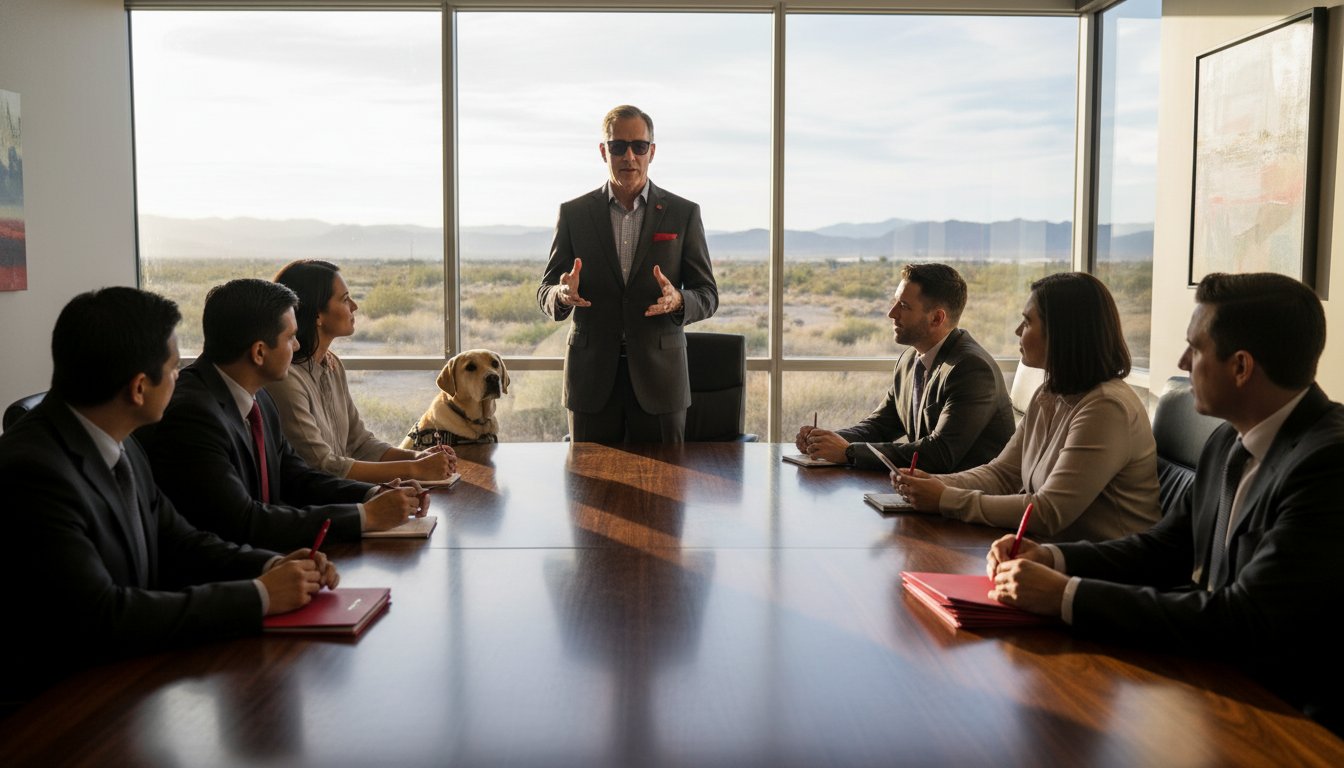
Corporate Accessibility: A Strategic Guide to Inclusive Leadership in 2026
What if the true measure of your leadership isn’t found in your quarterly reports, but in how clearly you see the potential of every person on your team? For many executives, the term corporate accessibility feels like a looming shadow of legal checklists or a 2024 report showing that 97.4 percent of the top one million websites still fail basic WCAG standards. You’ve likely felt the pressure of ADA litigation or struggled to fit inclusive practices into a workflow that’s already stretched thin. It’s common to view these requirements as a hurdle to clear rather than a bridge to build.
I’ve learned through my own journey, walking down 78 flights of stairs in the North Tower with my guide dog Roselle, that trust is built on preparation and mutual interdependence. You can transform your approach from a reactive legal burden into a proactive strategy that sparks innovation and fosters an Unstoppable Mindset. In this guide, we’ll explore a clear framework to lead beyond compliance in 2026. We’ll discover how shifting from mere accommodation to true inclusion builds a culture where diverse talent thrives and every voice is heard.
Key Takeaways
- Shift your perspective from checking legal boxes to proactive design, viewing regulations as a foundation for universal inclusion rather than a final destination.
- Discover how a commitment to corporate accessibility builds deep organizational trust, mirroring the interdependence that saved lives during the descent of the North Tower.
- Move beyond the “handicap” myth by reframing disabilities as unique characteristics that drive innovation and challenge traditional corporate boundaries.
- Learn how to identify hidden barriers through comprehensive audits and the strategic implementation of adaptive tools like JAWS screen readers.
- Gain an “Unstoppable Mindset” by partnering with expert consultants to turn your accessibility strategy into a powerful engine for leadership and growth.
What is Corporate Accessibility? Seeing Beyond the Compliance Checklist
Corporate accessibility isn’t a box to check. It’s a fundamental shift in how we perceive the tools and spaces that define our working lives. When we look at the Americans with Disabilities Act of 1990, we must see it as a floor, not a ceiling. True corporate accessibility means moving past the bare minimum of legal requirements to create a culture where every individual can contribute their best work without friction.
I learned the true meaning of accessible systems on September 11, 2001. As my guide dog, Roselle, and I navigated 1,463 steps down the North Tower, our survival depended on more than just her training. It relied on the physical integrity of the stairwells and the clear communication of emergency protocols. That day reinforced a vital truth: we’re all interdependent. We rely on the systems around us to function, and when those systems are designed for everyone, the entire organization becomes more resilient. This is what I call the Unstoppable Mindset in action.
The Three Pillars of Accessible Organizations
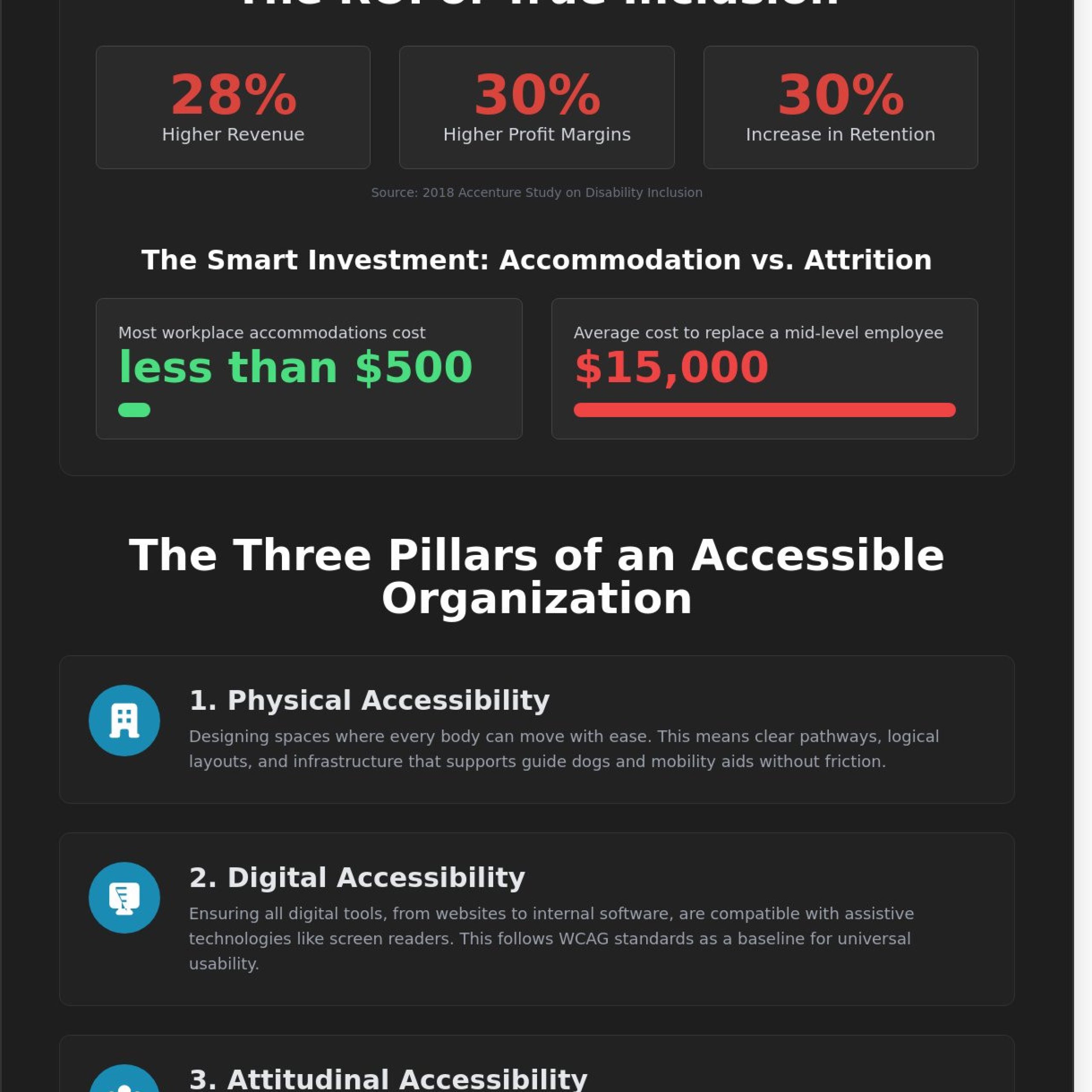
Physical accessibility involves designing spaces that welcome every body and guide dog. It’s about ensuring that a person using a wheelchair or a traveler with a service animal can move through a lobby or office with the same fluid ease as anyone else. Digital accessibility ensures that software and websites are compatible with assistive technology, such as screen readers, following the WCAG 2.2 standards released in October 2023. Attitudinal accessibility is the most critical pillar. It’s the practice of cultivating a mindset that values diverse ways of working and rejects the idea that disability is a deficit.
Accessibility vs. Accommodation
Most companies wait for an employee to ask for help. This reactive approach to accommodation is often five times more expensive than proactive inclusive design. When you build accessibility into the foundation, you trigger the Curb-Cut Effect. First seen in Kalamazoo, Michigan, in 1945, curb cuts were designed for veterans with disabilities but ended up helping parents with strollers and workers with heavy carts. Corporate accessibility works the same way; a captioned video helps a person who’s hard of hearing, but it also helps an employee working in a noisy airport.
- Proactive design reduces the need for costly retrofits and legal interventions.
- Inclusive systems foster a sense of belonging that increases retention by up to 30 percent.
- Universal design principles simplify workflows for the entire workforce.
Corporate accessibility is a commitment to universal human potential.
The Business Case for Inclusion: Trust as the Foundation of Innovation
Trust is the invisible thread that binds a high performing team together. In my experience, true corporate accessibility begins when leadership stops viewing disability as a liability and starts seeing it as a catalyst for innovation. This shift creates a culture where every team member feels safe to bring their full self to work. It’s about moving from a mindset of accommodation to one of genuine interdependence. When employees see that their needs are anticipated, their loyalty to the organization hardens into a powerful competitive advantage.
Leadership Lessons from the World Trade Center
On September 11, 2001, trust was the only thing that mattered. As I stood on the 78th floor of the North Tower, my guide dog, Roselle, sat calmly by my side. We began a descent that would take 78 flights of stairs. I didn’t survive because of luck. I survived because of a deep, practiced trust in my partner and the tools I used daily. Early versions of JAWS screen reading software allowed me to manage my office responsibilities effectively before the crisis; this ensured I was a fully integrated member of the team. This preparation is a masterclass in crisis management. Modern leaders must realize that inclusive infrastructure isn’t a luxury; it’s a fundamental requirement for resilience. When you invest in the Unstoppable Mindset, you’re building a foundation that can weather any storm.
Economic Benefits of Accessible Workplaces
Investing in corporate accessibility pays tangible dividends. Companies that lead in disability inclusion see 28% higher revenue and 30% higher economic profit margins according to a 2018 Accenture study. By supporting employees through life changes, businesses drastically reduce turnover. It costs an average of $15,000 to replace a mid level employee; yet, most workplace accommodations cost less than $500. This fiscal responsibility ensures that institutional knowledge stays within the building rather than walking out the door.
Beyond internal retention, there’s a massive untapped market. The “Purple Pound” represents over £274 billion in spending power in the UK alone. Globally, people with disabilities and their families control $13 trillion in annual disposable income. To understand how these numbers translate to your bottom line, explore The Business Case for Digital Accessibility. True innovation happens when we stop looking at what people can’t do and start focusing on the unique perspectives they bring to the table. Inclusion isn’t just the right thing to do; it’s the smartest way to grow.
Breaking the ‘Handicap’ Myth: Shifting Corporate Mindsets
The biggest hurdle in corporate accessibility isn’t a lack of software or budget. It’s the persistent myth that inclusion is an act of charity. When leaders view accessibility as a moral favor rather than a strategic investment, they miss the massive potential of a diverse workforce. A 2023 study by Accenture revealed that companies championing disability inclusion saw 28% higher revenue and 30% higher profit margins than their peers. Accessibility isn’t about “helping” someone; it’s about unlocking a competitive advantage through varied perspectives.
Corporate DEI training often fails when it leans into a victim narrative. This approach breeds pity, which is the opposite of inclusion. Real progress happens when we replace the “victim” label with one of resilience. Every employee brings a unique toolkit to the table. Some toolkits just look different than others. To build a culture where employees feel safe disclosing their needs, leadership must move away from the “handicap” mindset. Trust is the foundation. If an employee believes their disclosure will lead to a “limitation” label, they’ll stay silent. If they believe it leads to partnership, they’ll thrive.
Language Matters: Characteristic vs. Limitation
I’ve always rejected the label “handicapped.” It implies a brokenness that simply doesn’t exist. Instead, I advocate for the term “adaptive.” This shift in vocabulary is vital for leadership. Blindness is a characteristic, much like the color of one’s hair or their height. It’s not a limitation unless the environment makes it one. When we use sensory-rich, inclusive language, we empower our teams. Stop talking about “helping” employees with disabilities. Start talking about partnering with them to create systems that work for everyone. This isn’t just semantics; it’s a fundamental change in how we perceive human potential.
The Role of Emotional Intelligence in Accessibility
True corporate accessibility requires high emotional intelligence. It’s the ability to develop empathy without falling into the trap of pity. Pity looks down; empathy looks across. The “Art of Living with No Limits” means recognizing that every member of the team has hurdles. Some are visible, like a guide dog, while others are internal. By fostering an Unstoppable Mindset, we teach our teams that obstacles are just data points for innovation. Blindness is not a dark room; it’s just another way of seeing the world’s potential through the lens of trust and interdependence. Leadership must lead this charge by modeling vulnerability and open communication.
Implementing an Accessible Culture: From Digital Tools to Leadership
True corporate accessibility isn’t a checklist you finish on a Friday afternoon. It’s a living, breathing commitment to trust. In my years of working with teams, I’ve seen that the strongest organizations treat inclusion as a core competency. You can’t lead if you leave people behind. Success requires a shift in how we view the tools and the people who use them.
First, conduct a rigorous audit of every physical and digital asset by December 2025. This isn’t just about ramps; it’s about ensuring every PDF and internal portal works for everyone. Second, invest in specialized training for JAWS screen readers. I’ve used JAWS for decades. It’s the lens through which I see the digital world. Third, make accessibility a non-negotiable part of procurement. If a software vendor can’t meet WCAG 2.2 standards, don’t sign the contract. Fourth, appoint Accessibility Champions in every department, not just HR. Finally, listen to employees with lived experience. Their insight is the most valuable data point you’ll ever have.
Mastering Digital Accessibility and JAWS
JAWS stands for Job Access With Speech. It’s the world’s most popular screen reader. It transforms a silent screen into a rich, auditory landscape. For a blind professional, it’s as essential as my guide dog Roselle was for me in the North Tower. Specialized training is vital. Your IT support teams need to understand how JAWS interacts with your specific systems to prevent technical friction. Learn more about how this works in our What is JAWS Training? support article.
Inclusive Recruitment and Retention
Barriers often hide in plain sight. A 2024 survey found that 65% of job application portals are not fully accessible to screen reader users. Such barriers lock out incredible talent. When you interview, adopt an Unstoppable Mindset. Focus on the candidate’s ability to adapt and solve problems. We don’t just want to hire people with disabilities; we want to build long-term career paths. This means providing the tools for growth, not just the entry point. Organizations that lead in disability inclusion see 28% higher revenue according to 2023 Accenture data. Corporate accessibility is simply good business.
Partnering for Progress: How Accessibility Consulting Transforms Organizations
True corporate accessibility often hits a ceiling when viewed strictly through a legal lens. Many leaders believe they’ve reached the summit once they check a compliance box, yet 70% of barriers remain hidden from those without lived experience. These blind spots aren’t failures of intent; they’re gaps in perspective. Michael Hingson’s “No Limits” consulting bridges this gap by shifting the focus from what people can’t do to how environments can be redesigned for everyone. He brings the same trust and preparation he used to lead colleagues down 78 flights of stairs at the World Trade Center to your boardroom. It’s about moving from a mindset of accommodation to a culture of universal design.
Strategic Consulting and Advisory
Michael helps organizations develop long-term diversity and inclusion frameworks that survive leadership changes and market shifts. His approach is grounded in the reality that inclusion is a competitive advantage. Research from 2023 shows that companies prioritizing disability inclusion see 28% higher revenue and 30% higher profit margins. A single keynote speech can ignite this transformation by shifting company-wide morale. When Michael speaks about his journey with his guide dog Roselle, he isn’t just telling a survival story. He’s teaching your team about interdependence and the power of an Unstoppable Mindset. To begin building these frameworks, explore our Disability Inclusion Consulting Services.
Your Next Steps Toward Accessibility
Progress thrives on action rather than perfection. You don’t need a finished roadmap to take the first step. Start where you are, whether that’s auditing your current digital assets or hosting your first inclusive workshop. Sustaining this cultural change requires deep leadership buy-in. Data suggests that 82% of organizational change initiatives fail without active support from the C-suite. When leaders model the way, the entire organization begins to see corporate accessibility as a core value rather than a chore.
The journey toward a more inclusive future is one we take together. By choosing to lead beyond compliance, you’re opening your doors to a wider pool of talent and a more loyal customer base. It’s time to redefine your vision and build a workplace where everyone can thrive. Book Michael Hingson for your next corporate event or consulting project and start your transformation today.
Mastering Vision Beyond Sight for 2026
True leadership requires us to look beyond the mechanics of a compliance checklist. On September 11, 2001, my guide dog Roselle and I navigated 78 floors of the North Tower not just through training, but through a foundation of absolute trust. Your organization’s journey toward corporate accessibility follows a similar path. It’s not about meeting a legal standard; it’s about building a culture where interdependence fuels innovation. We’ve explored how shifting from a “handicap” mindset to an adaptive one unlocks human potential for the 1.3 billion people globally living with disabilities.
When you integrate tools like JAWS and adaptive technology, you don’t just check a box. You open a doorway to new perspectives. As the New York Times Bestselling Author of Thunder Dog and a global keynote speaker, I help organizations move from simple compliance to genuine inclusion. Empower your team with Michael Hingson’s Accessibility Consulting to gain the expert training your leadership needs to thrive. You have the power to turn barriers into bridges. Let’s build a future where every talent is recognized and every team is truly unstoppable.
Frequently Asked Questions
What is the primary goal of corporate accessibility?
The primary goal is to create an environment where every individual can contribute their full potential regardless of physical or sensory characteristics. It moves beyond checking boxes to fostering true interdependence and trust within the workforce. When a company prioritizes corporate accessibility, it ensures that 100% of its talent pool can navigate systems and spaces with dignity. This cultural shift transforms perceived limitations into opportunities for shared growth and innovation.
Is corporate accessibility only about physical ramps and elevators?
No, it encompasses the entire ecosystem of a business, including digital tools, communication styles, and cultural attitudes. While the ADA has mandated physical modifications since 1990, true inclusion requires a shift in mindset. It means ensuring a blind employee can access a digital document as easily as a sighted colleague can use a ramp. We must look past the physical structures to see the human potential waiting for the right tools to be unlocked.
How does digital accessibility impact employees who are blind or low-vision?
Digital accessibility allows blind or low-vision employees to operate with the same efficiency as their peers by using screen readers and braille displays. Without properly tagged HTML or accessible software, these professionals face artificial barriers that hinder their performance. In 2024, the Department of Justice finalized rules requiring web content to meet WCAG 2.1 standards. Implementing these technical requirements ensures that every team member can focus on their expertise rather than fighting with a keyboard.
What are the legal risks of ignoring corporate accessibility in 2026?
Companies face significant financial penalties and litigation risks, including lawsuits under Title III of the ADA which reached a record 4,605 filings in 2023. By 2026, stricter enforcement of digital standards will likely increase these numbers for non-compliant firms. Beyond the courtroom, businesses risk losing the 25% of the adult population in the United States who live with a disability. Ignoring corporate accessibility is not just a legal gamble; it’s a rejection of a massive, talented consumer and talent base.
How can a keynote speaker help improve our company’s inclusion efforts?
A keynote speaker provides the emotional spark and lived experience needed to turn abstract policies into a shared mission. When I share how trust and preparation allowed me and Roselle to escape the North Tower on September 11, 2001, it changes how leaders view their own challenges. These presentations move the needle from compliance to commitment. They help teams adopt an Unstoppable Mindset that sees inclusion as a leadership strategy rather than a simple HR requirement.
What is the first step a company should take to become more accessible?
The first step is conducting a comprehensive audit of both your physical environment and your digital infrastructure. You can’t fix what you haven’t measured, so start by identifying where barriers exist for the 1 in 4 employees who may have a disability. Engage with professional consultants who understand the intersection of technology and human experience. This baseline data allows you to create a roadmap that prioritizes high-impact changes, ensuring your resources are used effectively from day one.
Does accessibility training really improve overall team productivity?
Yes, research shows that inclusive companies see a 28% increase in revenue and 30% higher profit margins than their less inclusive peers. Accessibility training simplifies workflows and improves the user experience for everyone, not just those with disabilities. When you train a team to communicate clearly and use accessible tools, you reduce friction across the entire organization. It fosters a culture of clarity where every employee understands their role and has the tools to succeed without unnecessary obstacles.
How do guide dogs like Roselle fit into an accessible workplace environment?
Guide dogs are highly trained service animals that function as a mobility tool, and they should be welcomed as a vital part of a professional’s life. On September 11, Roselle’s calm focus allowed me to lead my colleagues down 78 flights of stairs in the midst of chaos. In an office, these dogs require very little; they simply need a quiet space to rest while they work. Welcoming a guide dog demonstrates a company’s commitment to adaptive living and the trust that defines a truly inclusive culture.


 Facebook
 Twitter
 Youtube
 Linkedin