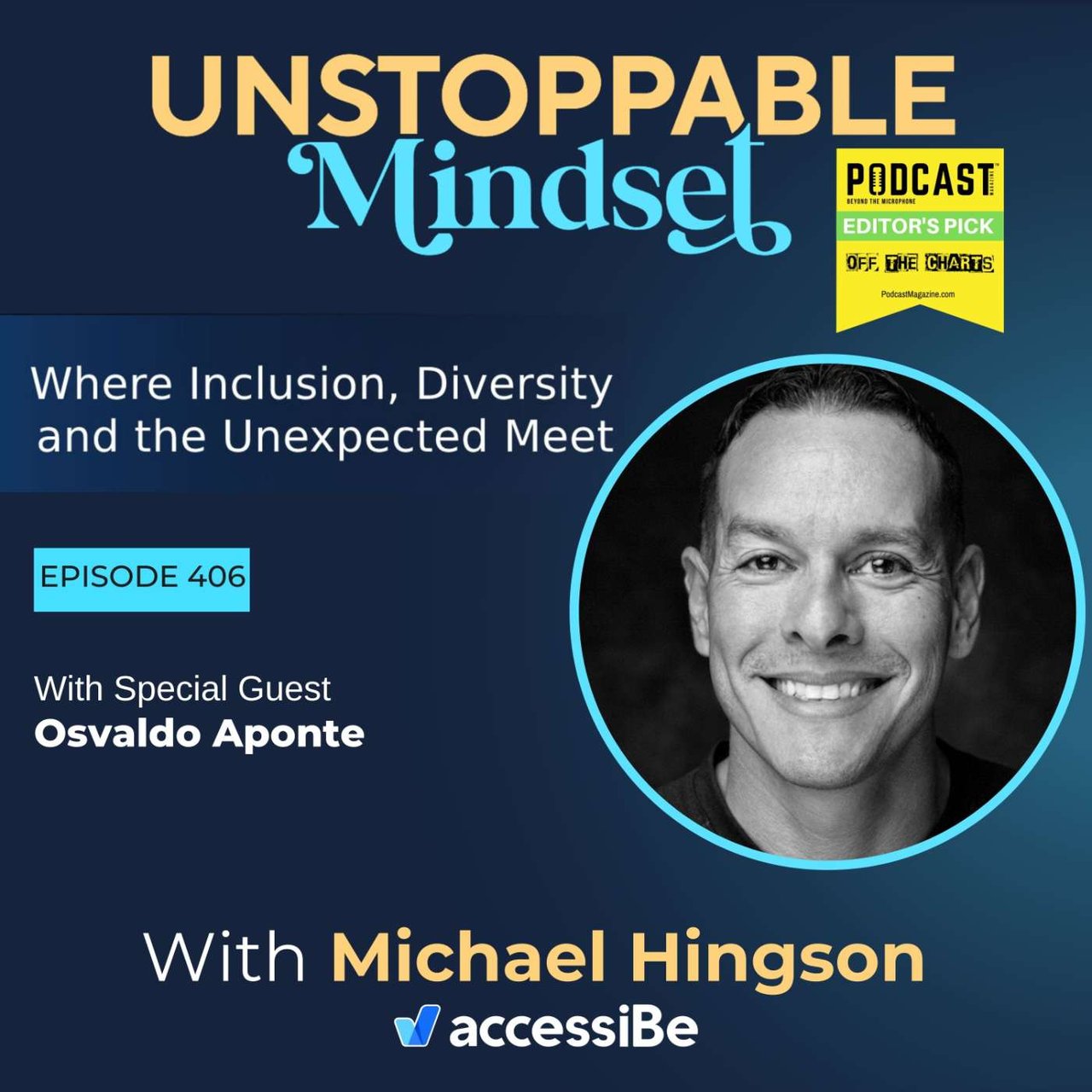
Episode 406 – Building an Unstoppable Body and Mind with Osvaldo Aponte
What happens when physical strength becomes a lifelong tool for service, resilience, and purpose? In this episode of Unstoppable Mindset, I sit down with Osvaldo Aponte, a Puerto Rico–born personal trainer and military veteran whose journey blends discipline, movement, and mental toughness. Osvaldo shares how growing up in a close-knit community shaped his view of strength, how the Army reinforced resilience and leadership, and why fitness must support life rather than control it. From kettlebell training and biomechanics to recovery after a life-altering bike accident, this conversation explores physical capability as a foundation for confidence, service, and long-term well-being. You’ll hear why consistency beats intensity, how strength builds trust in yourself, and what it really means to live with an unstoppable mindset.
Highlights:
00:46 – Learn how growing up in Puerto Rico shaped a lifelong connection to movement, community, and discipline.
08:29 – Hear why joining the military became a gateway to structure, confidence, and opportunity.
14:48 – Discover how early physical preparation made the demands of basic training feel natural.
30:42 – Learn how a near-fatal bike accident forced a clear decision about purpose and priorities.
34:39 – Hear why strength is more than muscle and becomes a mindset for life and service.
53:31 – Discover the long-term habits that make people resilient, adaptable, and truly unstoppable.
About the Guest:
Osvaldo “Os” Aponte is a strength and movement educator, U.S. Army veteran, and lifelong martial artist committed to helping people build resilient bodies and minds through intelligent training. Originally from Puerto Rico and now based in San Diego, Os has worked as a personal trainer since 2005 and currently serves as a Team Leader for StrongFirst, a global school of strength known for its rigorous standards and elite-level instruction. He is also the author of Iron Core Basic Training Pamphlet 10-5**, a deep dive into mastering the one-arm push-up.**
Os blends a rich and diverse background in movement: he’s a former contemporary dancer who toured internationally, a Certified Strength and Conditioning Specialist (CSCS), and a credentialed expert in both Z-Health and functional gait analysis. His training approach fuses the art and science of performance—combining hard-earned grit with cutting-edge neuroscience, and traditional strength methods with precision mobility and assessment tools.
At the heart of Os’s work is a passion for helping others unlock their potential, no matter their age or ability. He has taught and led more than 20 official StrongFirst workshops and certification events, and regularly collaborates on podcast, print, and video content for educational platforms. His approach is deeply client-centered, always focused on real-life application, long-term durability, and purposeful, personalized progress.
Os earned his bachelor’s degree from San Diego State University and begins his Master’s in Kinesiology at Point Loma Nazarene University in the fall of 2025. His journey—shaped by military service, cultural pride, academic drive, and a lifetime of movement—is a testament to resilience and reinvention. From the powerlifting platform to the dance stage, he brings a unique perspective to every room he enters. His mission is to empower others to move better, live stronger, and stay in the game—for life.
Ways to connect with Osvaldo**:**
Link to Os’ website, The Iron Core Way
Link to Os’ StrongFirst Instructor profile
https://www.strongfirst.com/instructors/united-states/osvaldo-aponte.0013700000NZVD3AAP/
Link to Os’ book on the Strong and Fit Website
Link to Os’ Eventbrite workshop schedule
https://www.eventbrite.com/o/osvaldo-aponte-58809282353
Link to New York Times Article
https://www.nytimes.com/2023/04/12/well/move/kettlebells-weight-training.html?smid=url-share
About the Host:
Michael Hingson is a New York Times best-selling author, international lecturer, and Chief Vision Officer for accessiBe. Michael, blind since birth, survived the 9/11 attacks with the help of his guide dog Roselle. This story is the subject of his best-selling book, Thunder Dog.
Michael gives over 100 presentations around the world each year speaking to influential groups such as Exxon Mobile, AT&T, Federal Express, Scripps College, Rutgers University, Children’s Hospital, and the American Red Cross just to name a few. He is Ambassador for the National Braille Literacy Campaign for the National Federation of the Blind and also serves as Ambassador for the American Humane Association’s 2012 Hero Dog Awards.
https://www.facebook.com/michael.hingson.author.speaker/
https://www.youtube.com/user/mhingson
https://www.linkedin.com/in/michaelhingson/
accessiBe Links
https://www.youtube.com/c/accessiBe
https://www.linkedin.com/company/accessibe/mycompany/
https://www.facebook.com/accessibe/
Thanks for listening!
Thanks so much for listening to our podcast! If you enjoyed this episode and think that others could benefit from listening, please share it using the social media buttons on this page. Do you have some feedback or questions about this episode? Leave a comment in the section below!
Subscribe to the podcast
If you would like to get automatic updates of new podcast episodes, you can subscribe to the podcast on Apple Podcasts or Stitcher. You can subscribe in your favorite podcast app. You can also support our podcast through our tip jar https://tips.pinecast.com/jar/unstoppable-mindset .
Leave us an Apple Podcasts review
Ratings and reviews from our listeners are extremely valuable to us and greatly appreciated. They help our podcast rank higher on Apple Podcasts, which exposes our show to more awesome listeners like you. If you have a minute, please leave an honest review on Apple Podcasts.
Transcription Notes:
Michael Hingson 00:00
Access Cast and accessiBe Initiative presents Unstoppable Mindset. The podcast where inclusion, diversity and the unexpected meet. Hi, I’m Michael Hingson, Chief Vision Officer for accessiBe and the author of the number one New York Times bestselling book, Thunder dog, the story of a blind man, his guide dog and the triumph of trust. Thanks for joining me on my podcast as we explore our own blinding fears of inclusion unacceptance and our resistance to change. We will discover the idea that no matter the situation, or the people we encounter, our own fears, and prejudices often are our strongest barriers to moving forward. The unstoppable mindset podcast is sponsored by accessiBe, that’s a c c e s s i capital B e. Visit www.accessibe.com to learn how you can make your website accessible for persons with disabilities. And to help make the internet fully inclusive by the year 2025. Glad you dropped by we’re happy to meet you and to have you here with us.
Michael Hingson 01:17
Well, hello everyone, and I want to welcome you to another episode of unstoppable mindset. We’re glad that you’re here, wherever you happen to be. Hope you’re having a good day. Today, we get to talk to Osvaldo Aponte, who is a personal trainer. He’s a veteran. He offers a lot of, I think, interesting life lessons that we’ll get to talk about as we go through today’s podcast. But he’s a he’s a pretty interesting guy, and I’m not going to give it away. So, Osvaldo, welcome to unstoppable mindset. We’re glad you’re here.
Osvaldo Aponte 01:57
Thank you so much, Michael, it is a pleasure to be here, and I’m looking forward to sharing this conversation with you.
Speaker 1 02:02
Well, I’m glad that that you’re here. I’m looking forward to it. You started out in Puerto Rico, and you’re now what San Diego,
Osvaldo Aponte 02:08
that’s correct, sir. So
Speaker 1 02:12
Osvaldo isn’t all that far from where I live, up in Victorville. So we could, if we really had strong arms, we could throw paper airplanes at each other, but, but I might, I might do better at that, because for me, it’s all downhill. But you know, nevertheless, well, we’re, we’re glad you’re here. Why don’t you tell us a little about the early Osvaldo growing up and all that,
Osvaldo Aponte 02:38
with pleasure. Yeah. See, you know, growing up in Puerto Rico is really special thing, because you really get that small town vibe. And while that’s possible in the United States, one thing that I very quickly realized when I started to visit family that lived in the States as a teenager or when I joined the Army, is that there’s a big difference of being someone who grows up in a small town versus a large city or a very urbanized type of area. And it goes down to, you know, your the way that you dress, the music that you listen to, even like your values can be affected by this stuff. And so Puerto Rico is 100 miles long, 35 miles wide, 3.7 million people live there. It’s pretty dense, and there’s a real sense of, like, brotherhood there, you know, people like, I remember being a child and being able to just go outside and play with my friends until the, you know, the street lights come up, and the other parents would look out for you within, you know, the community, you know, and you your parents always knew where You were, and there was a real sense of wholeness, wholesomeness about that that really allowed you to just be a little bit more free and just embrace life in a different way than my counterparts who grew up, perhaps in like, let’s say New York City. I remember visiting New York City as a teenager and just being like, wow. Like, this is a very different environment. So that was a really cool part about growing up there. In addition to that, you know, the island really lends itself to being physically active, which I guess is that, you know, a lot of what we’re going to talk about today, but you know, one of our favorite things to do was just to start going down the road on a hike and hit a river, you know, hit a swimming hole or something like that. And this was like something that we did on the regular, and it became such a part of our daily lives, you know, like we did it pretty regularly, that as you start to grow up, you maintain this habit of having physical activity be part of your day. So from a very early age, you know, where I was grew up was really already influencing me and pushing me in that direction.
Speaker 1 04:39
Yeah, I I grew up in a small town, actually, about 55 miles west of here, Palmdale, California, and it was pretty rural.
Michael Hingson 04:51
But there, I think people also tended to watch out for each other a fair amount. In my case, I was more of an oddity, so I’m. Um, people didn’t know how to deal with me. I rode a bike around the neighborhood, and my parents got phone calls because I was riding a bike around the neighborhood, and people would call and they say, Well, your kid’s out riding a bike. And my dad would go, Well, yeah, okay, no, no, we’re not talking about the one who can see. We’re talking about the blind one. And my dad said, well, so did he? Did he hit anybody? No. Did anybody hit him. No, did he? Did he get hurt and all that? And finally, the neighbors would just hang up because they couldn’t deal with the fact that my dad wasn’t worried about a blind kid riding a bike. That probably wouldn’t have happened nearly as much in Chicago, where I was born and we lived for five years. But I don’t, you know, I don’t know. I learned to listen, and that’s what it was really about. And my parents were willing to be open and let me,
Speaker 1 05:53
kind of stretch and grow. But I think in overall, people were curious, and I think overall, and my brother had a lot of friends, and so I made friends. It worked out pretty well. So I understand what you’re saying. Yeah, it certainly is different in in New York City or places like that, where it’s such a talk about really dense population, and you may make a few friends, but it’s really a lot different.
Osvaldo Aponte 06:21
I think that if you had been in my town, not only were you ridden that bike, but we would have been encouraging to write a some roller skates, skateboard and a few other things, because people were pretty daring that there,
Speaker 1 06:33
yeah, well, and I did roller skate and and all that, I am not there, but I Did ice skate once, and I ice skated for about an hour and a half, but actually fell and sprained my ankle as we were going off the ice at the end of the day. So haven’t ice skated since. I thought that that was a little bit different, but I roller skated. I had fun with that. My favorite thing to do, especially when I got into college, was playing darts. I used weights. I love, I love weighted darts. I don’t like the little flimsy darts. I like bigger, stronger weighted darts. But my biggest claim to fame is I got three triple 20s on one throw of three darts once. So you know, I know how to play darts.
Osvaldo Aponte 07:18
We have a some darts here that we use. In fact, this last weekend for Labor Day, we had a few friends over, and we use them. We love them. You know, one thing that I like to do with darts, Michael, to share this with you, is to throw both right handed and left handed. And that goes back to my neural training, because it’s really good for your brain to be able to do things like both ways.
Speaker 1 07:36
Yeah, I was right handed. I never really did try left handed. I’m sure I could have learned it, but it’s been a long time since I played Dart so I’m going to have to get a board. Do it again sometime. I had a nice horsehair dart board. It was great. I love it. Yeah. So when you so you how long did you live in Puerto Rico?
Osvaldo Aponte 07:59
I was 21 when I left. I mean, I visited the United States, like for summers and things like that, to go visit my family. I had an aunt that lived in New York City who I adore. Her name is Elsie, and her son, rubinel. He and I share a lot of like things in life, including being part of the military. But no, we were kind of close in age. I was a little older, but we got along really well, and that’s why they would send me to go visit him and, you know, just get the life experience girl, you know, learn a little English and all that stuff. But I was in Puerto Rico until I was 21 and that’s when I joined the Army.
Speaker 1 08:31
So, did you go to college after high school?
Osvaldo Aponte 08:35
No, so I went. I went to the army at 21 I was trying to go to go to college, but it was really difficult for me, you know, with like, just the way that I grew up, in my finances and things like that, yeah, wasn’t easy. So I ended
Speaker 1 08:49
up, like, so after high school, did you work or what?
Osvaldo Aponte 08:52
Yeah, I worked briefly at multiple jobs. I worked at foot Lacher was one job that I had, another job that I had was in a in a factory that they make gowns for graduation and students. That was a really fun one, because this is, this is a cool story. So they had this really high racks. And sometimes, you know, they would look at the inventory sheet and go like, Oh, you know, we have some of those, but they’re all the way up there. And while I was working there, I was like, you know, nimble and good enough with my body where I could climb all the way up and bring this stuff down. And they love that
Speaker 1 09:26
a tall enough person to do that, huh?
Osvaldo Aponte 09:29
Well, more like I could climb like spider man.
Speaker 1 09:32
Okay, so what made you decide to go into the military?
Osvaldo Aponte 09:38
I always had a desire to go because I remember young men that left my town with the military, and then they would come back a few years later, and they just looked so different. They look really fit. They look really sharp. If you were lucky enough to meet one of these guys out of, like, a family party, and they were wearing their, like, Class A uniform, their dress uniform. It was really impressive and cool to see. And then you would sit down and talk to them and start talking to you about, I went to Germany, I went to Korea, I went here, I went there, I went everywhere. And it was just, like, very inviting for a young person to think, like, oh my god, like, I can go and do this, which has a very, you know, kind of like a lot of history to it, you know, my, my my grandfather served in the Korean War. And, you know, there was some history there. And then the recruiters, they would come to school and talk to us, and I always thought, like, man, that would be really cool. And you know, to be honest with you, there are not many ways for a young person from Puerto Rico, at least where I was a young person, to get out of there. You know, it’s not like opportunities were just raining down and being tossed at you, like, Hey, you want to travel the world. Let’s do this. But that was one that was fairly accessible. And so, you know, between the allure, you know, of the potential awesome life that I could have, like those guys that I met, the recruiters, painting a very rosy picture of the military, even, like commercials on TV, because you know how it is, yeah, like the army makes, like, really cool commercials, you know, directed at the Youth so that we would join and, you know, I got to tell you, Michael, I loved it. I’m so glad that I joined the military.
Speaker 1 11:09
Well, so I’m curious, in general, you describe the environment of Puerto Rico and so on. Do you think it’s different today, or is it still pretty much the same for kids growing up there now, I think
Osvaldo Aponte 11:22
it’s probably a little bit harder, because opportunities are even more scarce these days. There are a lot of people down there with bachelor’s degree, master’s degree and even doctor’s degree that can’t find jobs. And this is why you have such a large population of Puerto Ricans in the United States, because there’s just not a whole lot of opportunity. It’s a beautiful land, and this is great environment, but, but economically speaking, there are a lot of limitations and obstacles that people have to jump through and or over, and it makes it challenging to stay there.
Speaker 1 11:50
Yeah, yeah. Well, I guess I can understand that, and certainly there have been a lot of challenges over the last few years. Yep, that that doesn’t help a lot either, so, but I appreciate what you’re saying, and hopefully, over time, things will level out and maybe get a little bit better. But, yeah, it’s, it’s really difficult when you got so many people in such a small area.
Osvaldo Aponte 12:15
Yeah, I think that’s a big part of it, right? Like, just too many people, not enough resources, that’s step one.
Speaker 1 12:20
Yeah. Well, so how has your cultural background affected the way you approach training, discipline and service? You think that’s had an effect from being from Puerto Rico?
Osvaldo Aponte 12:36
I do. I think that there’s a sense of pride in being capable, physically capable, where I come from, in that culture, it starts as even as early and as rudimentary as your uncles, your the male figures, even the male figures in your life, are always encouraging you to stand out for yourself. That’s a big deal in my culture, right? And there’s a certain sense of physicality that goes with that. But it’s not just that, right? It’s, you know, like, when you’re learning to take, like, stand up for yourself, I think it really instills in you respect for others as well, right? Because that’s, there’s, that’s the other side of that, like coin, it’s like, you’re not going to insult anyone, but you also are not going to allow anyone to insult you, and so instills discipline. In that sense, it’s like, I think we’re inclined to act like children, but most of the education that I got from both the male and female figures in my life was to be respectful and to be a figure of strength within the community so that you can be the person that stands between two friends say, Hey guys, like, Let’s not do this right now. We don’t need to fight. Let’s talk it out, or whatever. And that that requires certain level of courage and actual physical presence. If you’re a very weak, weak person, you’re not going to do that very effectively. You can, but it’s probably not the most effective thing. So just from that perspective, is very ingrained in the culture that you know being being a good member of your community means that whenever you have to, you can pick up something heavy and carry it somewhere, or that you can, you know, swim from danger. You know that you can run out of danger, that you can fight your way out of a corner, or something like that. And, you know, crazy as it sounds, it was something that from a very early age would start to get kind of put into us. And then from there, obviously, if you want to maintain that later as you get older, then you must have some kind of like physical practice that will do that. Luckily for us, you know, sports are huge in our in our country, so boxing, baseball, volleyball, basketball, I guess. Now soccer is huge in Puerto Rico. It wasn’t when I was there, but it’s getting bigger all over, I guess, yeah, I guess, right, like that. We’re gonna have it. I think next year, the FIFA World Cup is coming to the United States, which is cool 2026 so you. Yeah, like, you just grow up in a very physical environment no matter what. And then, you know, when you’re talking about this poor, more rural towns, you know, we didn’t have a car forever, so if you wanted to go anywhere, you have to walk. And that, again, it requires that you have a certain level of resilience and determination, and that you’re okay with being sweaty and a little bit tired, you know. And then there’s a lot of hills, so you got to do so, you know, sometimes our environments, right? They shape how we turn out. Right? I mean, they say mountain people tend to be a little tougher, you know, so, so I think there was a whole lot of that going around, you know, that that really shapes you into wanting to be a physically fit person or person that that has discipline in order to to accomplish the daily life. Because, you know, can’t do it without it.
Speaker 1 15:46
How do you think that that upbringing helped or affected you when you joined the military?
Osvaldo Aponte 15:55
Well, it’s almost, it was almost like preparation, right? I remember when I got there, you know, a lot of kids hated doing physical training, where I loved it. I that was my favorite part of basic training, was doing the physical training, the running, the push ups, just all the drills that we learned and when, when we did the obstacle course and basic training, my battle buddy and I ran up after we finished it. We ran up to the drill sergeant and asked him if we could do it again. And he called us crazy and told us that we could.
Speaker 1 16:27
I was gonna say, I’ll bet your drill sergeants thought you guys were crazy.
Osvaldo Aponte 16:31
He was, he was like, You guys are crazy, but go ahead whatever, you know. And so that was kind of like the soldier that I was from, you know, from basic training. I just love the physical part of it, because it was the part that I could feel competent in, right, you know? And the one thing that I didn’t had was, like, I had a really hard time with English, right? Because up to that point, I could read it, I could hear it and understand it to a certain level, but conversational English in a very stressful environment, like basic training with some regional differences, like you have a sergeant from Louisiana or someone from Georgia or someone from Texas, mostly may mean like Southern states here, but those were the harder accents to discern and and so that was a challenge in itself, right? So for me, you know, having grown up so so close and comfortable with physicality in any situation really had prepared me to be a perfect fit to be a soldier.
Speaker 1 17:27
And how long were you in the military?
Osvaldo Aponte 17:30
Six and a half years. Wow, the June of 1997 through I my last was January 15 of 2004 which happened to be my birthday. Happy birthday. You’re out of the military.
Speaker 1 17:47
You said January, 16, 15th, 15th. Okay, well, so what rank Did you exit the military holding I
Osvaldo Aponte 17:56
exited us at e5 promotable, a sergeant. And it was amazing. I loved every minute
Speaker 1 18:02
of it. How come you you left the military?
Osvaldo Aponte 18:07
You know, a lot of the people that I work with, including my superiors, always encouraged me to go to school. They were like, You know what sergeant? You’re great at this. I think you can go on to be a First Sergeant. I think you’d be a great drill sergeant one day, but, but it will be a waste of talent if you didn’t, like give yourself a chance to attend college. And I did while I was in the military. I tried to attend, like every, you know, not every semester, because sometimes the job is, you know, that’s the more important part. So you got to do that. But if I could swing it, I would attend community college and take class there. But it became clear to me that if I really wanted to get a degree, I was going to have to get out and just do that, you know, just go full head head on into that. And so that was part of it. My first, like, four years were awesome. When I did my first re enlistment for another two and a half and I knew that I was going to Korea. I was really excited, because of, you know, Korea is the home of Taekwondo, who is martial art that I grew up practicing. It was, in fact, the first martial art that I ever did. And so the prospect of going there and studying there was, like, pretty cool. And just, you know, going to Asia in general, as a kid from Puerto Rico, that sounded amazing. And then I went there, and I did the assignment. And it was my favorite assignment of all the ones that I had. Korea was my favorite. And then when I came back, I went to Fort Bragg, North Carolina, the home of the airborne. And that was a different beast altogether. It was, it was a very different army that I came back from Korea too, and something just, you know, kind of clicked in me and said, like, it’s time, it’s time to go ahead, if you, you know, it’s also a matter of time. You know, if you hit 10 years in the Army, basically, you have a choice to make. Like at that point, it’s like, and one more enlisted for me would have been about that time, right? Three or four enlistment. And then at that. Point you better stay for life. So it was like, if I’m gonna do it, this is the time to do it. So I did.
Speaker 1 20:06
So you went back to college.
Osvaldo Aponte 20:09
So at that point, when I came home, I came back to California. I didn’t know if I was gonna be able to stay here or not, but I ended up staying here and attending San Diego City College, and then they had a transfer program that took me to San Diego State. And you know how that goes? I bought a house, bought a car, met a girl, and now it’s, you know, all those years later.
Speaker 1 20:31
So what made you co decide to stay or move to California?
Osvaldo Aponte 20:36
So San Diego was my very first duty station, which is really weird, because San Diego is known to be a naval base, yeah. However, the job that I had in the army that was, it was the designation was 91 Romeo, which is veterinary food inspector. And that job supports all the other branches. They support the Air Force, the Marines, the Navy, the Coast Guard, and we didn’t have Space Force back then, no, and, and so I was stationed at Naval base because we were supporting their mission. And you know, one of my loves growing up was skateboarding. And I remember being here and somebody seeing a poster or something I had in the barracks, and somebody was like, Dude, you like skateboarding? I’m like, Dude, I love it. And he goes, like, do you know that? And he started to name off names of all these old skateboarding legends, and they all live, like, up the street in Encinitas, you know, yeah. And so I ended up going to one of my childhood idols shop, Mike McGill, and, you know, bought the board, and I have it framed somewhere in my house. And, you know, he signed a poster for me and bought the shirt, and it was really cool. You know, I just never even imagined that that would be possible. But after spending so much time here, I made a lot of friends. Kind of, you grow a little bit of roots in the community, and then it just seems like an organic and normal thing to just kind of, yeah. Why not? You know.
Speaker 1 21:56
And there you are. Yeah. Yeah. Cool. So what did you get your degree in?
Osvaldo Aponte 22:03
So I got my degree in accounting. Everyone always asked me, like, Oh, so you’re a numbers guy. And I’m like, Well, not exactly, like, honestly, Michael, the reason why I got an accounting degree was because I remember thinking, you know, like, if you really want to understand the nuts and bolts of business, like study accounting, and I read that in many articles over two years, you know, Wall Street Journal, New York Times and things like that. But there was one article that I read, and it may have been in a fitness magazine, and it was talking about the longevity of coaches, or personal trainers, which was an emerging field at the time. There were some that were very, very successful, but, you know, the average lifespan for a personal trainer, it’s like two years, and I have not been in the industry for 20 so I am a survivor. And you know, I think the advice that I got from the article that said, if you if you want to understand how to be successful with your gym, that you need to have some level of understanding of business, some education in it. And so there is that. There was that angle, right? Like say, Okay, so I’m really good at this stuff. I know it well. You know, nobody has to force me to open up a anatomy book and read it. But am I really going to open up a financial accounting book and learn how to do the books or whatever? So I went that route. That’s That was one reason. The other reason was that I really, truly believe that to live a full life, you got to challenge yourself and do things that maybe they’re not like the ideal fit for you, but that they would be a good challenge that’s attainable, right? Nothing like it’s impossible, right? But something that you can do and accomplish, but that will truly challenge you. And I found that that was going to be it, and I was correct. Attending the Charles W landam School of Accountancy at San Diego State was one of the hardest things I’ve ever done, and I’m so proud of it. I just remember I lived in the library. We were always there, which you’re probably familiar with from some of our other conversations so you told me what, what you studied, and, you know, I just remember Friday nights, everybody was like, hey, Ozzy, going out. I’m like, No, I’ll be in the library studying, you know, but that’s good. I think that kind of, like, that kind of discipline and like, really, like tough kind of, like, environment of learning really shapes you, and it gives you that. It gives you the discipline that’s necessary to succeed in life. I feel, you know what I mean. So that was a value added to me in addition to the degree. And so I’m glad that I went that route. It was really hard, but
Speaker 1 24:34
I did it. So what did you do once you got the degree?
Osvaldo Aponte 24:38
Well, the logical thing, at least in my head, was like, Well, you got to get some experience. You can’t just have this degree. You can’t just have this degree up on the wall. And the truth is, I enjoyed it. I really did, you know, I went out in the field and I applied for so many jobs, and I graduated in 2011 which is was a really bad year to graduate, because there’s a economic. Downturn, but jobs were not as really readily available as they had been in even like the last two years. And so finding a job was really hard. And finally, landed a tax internship, which was fantastic. I worked for this very nice gentleman named Charles W Kelly, and he was from West Virginia, and he lived in San Diego most of his life, CPA guy, and just wonderful experience. It was really, really cool. Then I ended up getting a job for a a leasing company. And if you know anything about leases is that they have this very interesting accounting that goes along with it. So I was all excited about that, because I just learned all about lease accounting in school. I wanted to put it to good use, so I went there for a little bit. They ended up joining the Office of the Inspector General, and I got sent to Texas to do that because of the if you’re going to travel the country and do inspections, being in Dallas is convenient for flying, right? It’s like a big hub. So I went to Dallas for that job, which, you know, I never thought I would, but I really love Dallas. And, you know, that Job was super cool. Then I got recruited to come back to San Diego. Did property accounting here for a little bit. Did construction accounting, did Public Company Accounting, that was with a big insurance broker. That was my favorite one, because from my window in the building, I could see my barracks room that I used to stay at when I was stationed. And I remember when I was at 32nd looking downtown and seeing that building is the Merrill Lynch building. It used to be the Bank of America. Oh no, I’m sorry. It was the Merrill Lynch now it’s the Bank of America, and thinking, one day I’m gonna have my accounting degree and I’ll be over there working. And you know what? It happened, and
Speaker 1 26:41
that was pretty cool. Yeah, that’s pretty cool. Now, when you moved to Texas, were you married by then?
Osvaldo Aponte 26:48
I wasn’t, but I was in a very serious relationship, but my wife had gone to grad school, also in West Virginia, in a place called Roanoke. Roanoke, yeah. What is the name of that school? Hollins. Hollins Hollins University. Okay, so there was a really fantastic master’s program there that my wife kind of came across. And, you know, I was about to graduate San Diego State, and she was like, you know, what should we do? And I was like, You should totally do it. I was so supportive in her going to grad school, and that meant that we’re going to be a part for quite a while, but, but she went, and we know, we didn’t put anything on it. We were like, listen, let’s, let’s just you go, you do your thing, and if you come back and work together again, great. It’s not, you know, we’re not going to be upset about it. But turns out, she went, came back, met me in Dallas, and then we came to San Diego together.
Speaker 1 27:37
What did she get? Her Master’s in
Osvaldo Aponte 27:40
Fine Arts dance, ah, yeah. So she also went to San Diego State, actually, for her undergrad, and when we first met, that’s where she was going. And then she went to Hollins for her Master’s in Fine Arts with dance, dance concentration.
Speaker 1 27:52
Now, you’ve done some dancing, right?
27:54
I have,
Speaker 1 27:57
but you don’t have it. You don’t have a degree in it, but that’s okay.
Osvaldo Aponte 28:00
No, I don’t Well, I met Erica, who’s my wife, in in in the dance company that I dance for, which was called module, a dance collective. And, yeah, I was always impressed with her skills. She was she’s such a fine and like, precise mover, and she moves with this the strength and this weight and this precision that I don’t see a lot of artists, and I always loved it. And so, you know, at first it was just like, hey, can you teach me this and that? And just always trying to pick her brain on technical things about dancing, because that was a beginner dancer. What the only reason why I got to do this, Michael, to give you a better picture, is because of my martial arts training. So you know, if you’re flexible and you can lift girls at that time, at least, you pretty much in the company, as long as you’re willing to go do all the rehearsals and all that stuff, which I was and, you know. And to my credit, I trained very hard for those years that I dance. I was taking class all the time. I rehearsed religiously, and everyone laughed at me because I never called it rehearsal. I called it practice. And, you know, it was like the sports terminology and art world, and people were like, What are you doing? I’m like, I’m practicing. I’m like, okay, okay, buddy, but, but, yeah, I really enjoyed it, and that’s where I met her.
Speaker 1 29:17
Wow. Well, that’s cool. So how long you guys been married now?
Osvaldo Aponte 29:20
So we’ve been married for nine years, but together for 1919, years, we went together.
Speaker 1 29:25
Yeah, yeah. Well, that’s cool. And what does she do now? Does she dance?
Osvaldo Aponte 29:30
She’s a dance teacher. Okay, that’s cool here in San Diego, and she produces shows. Every once in a while, she’ll produce a show and bring it to San Diego. And now we’re all, like, international connections and all that. I always give her a hard time about that, like all your fancy friends, but yeah, she’s produced some really awesome shows here, like things that have been presented all over the world. And she from time to time, she doesn’t have a dance company, per se, but she will put a group together and. Percent work with grants and things like that. So she stays pretty active in the community.
Speaker 1 30:04
Well, somewhere along the line, you switch from doing accounting, I gather, to becoming a full time personal trainer.
Osvaldo Aponte 30:13
So I never really stopped. I was doing personal training while I was going to school, between when I getting out of the army and then getting my degree right. That’s how I like, basically work my way through school. And once I went into industry to get that experience that we talked about, I had a very limited practice, but I kept it so I continued to program for a few very special friends, and we affectionately call it the the Herman street fitness club, because that’s where we lived when we started the gathering. And we had a lot of equipment. We dedicated our garage space to just be in a gym instead of putting our cars in there. And so we had the small group. It was, you know, my wife and a few of her dance friends, and they also kept going. So I kept programming, getting certifications, always with the thought that one day I’m going to have my own gym, right? I’m going to, when I get out of this accounting thing, go have my own gym. And so I always did it. It wasn’t like I had this break and then my personal practice, right? Both an instructor and a practitioner, really blew up during that time, because I had a lot of time on my hands to be able to do what I wanted and finesse my my practice, and so that’s what I did. I really just invested a lot of time into and money into education. You know, that’s where I got my functional neurology, education, my strength and conditioning stuff. Like, it was really all a plan all along to eventually be a gym owner and do what I’m doing now.
Speaker 1 31:40
So was there a defining moment or something that specifically made the made you take the leap to do it full time?
Osvaldo Aponte 31:48
Yes, and it was actually almost like a leap. So, so I used to have this beautiful bike that I rode all the time, and I rode it with always this intent of getting better. It’s like a skill. I’m going to go out there. I’m going to be really good with it. And on one fateful morning, I was almost about to hop back on the highway and head back home, I was almost done with my ride, and I got cut off by a trailer. And so my options were, hit the truck, hit the trailer, potentially hit another biker that I cannot see because I had a blind spot on the oncoming traffic, so I hit the trailer, flew over it, so the leap, there’s the LEAP flew over the trailer, landed on my back and bounced off the ground like a ball got thrown into a hospital, I mean, to into an ambulance, because, you know, they were like, you may have internal bleeding. We got to do all kinds of scans and all that stuff. And that was in 2017 and I walked into my boss’s office at the time, where I was accounting manager for a construction company, and I just turned in my resignation. And I never went back, because at that point, I was like, All right, like I could have just died, like, a week ago. So if I’m going to do this fitness thing, like full on, have my gym and all that stuff, I better do it now.
Speaker 1 33:06
Well, and obviously I would think the physical conditioning that you had helped you survive and deal with all of that. When the accident happened,
Osvaldo Aponte 33:18
every medical professional that I saw said the same thing. They said, if you weren’t as fit as you are, you would have a shattered pelvis and probably a broken spine. Yeah. So, yeah.
Speaker 1 33:33
So talk to me about strength, because clearly you’re being in personal trainer and all the things that you’ve done. You’re a very strong guy. What does strength mean to you, not just physically, but emotionally and in your whole makeup?
Osvaldo Aponte 33:48
So I belong to this organization. It’s an educational organization that issues kettlebell, barbell and body weight certification. It’s called strong first, and they have a really beautiful saying. They’re a maxim saying. They said that strength has a higher purpose, and I agree with that wholeheartedly, and it’s part of the reason why I feel such pride and purpose by being part of this organization, because that’s how we sell the lifestyle, if you will, right? So we know, just from the story that I just shared, that being physically strong can help you during illness. There’s a beloved coach within our organization. His name is Brett Jones, and a few years back, he was diagnosed with cancer, and he lost so much weight during the treatment that if he hadn’t been as sturdy as he was, he probably wouldn’t have made it. So, you know, that’s just a, you know, a personal, both personal, right, because my own experience and then somebody that I care deeply about and admire and has been like a mentor to me, and someone that I look up to, but all around I can, I can look and see people that, when afflicted with illness, relied on their fitness in order to just have a little bit of a better quality of life. And. Some case, outright survive these things. So from that perspective, you know, it’s hard not to see how fundamental it is. How, let me put it to this. I do not understand how somebody wouldn’t be interested in at least a little bit of strength in their own life, with the myriad examples that are out there about people overcoming obstacles because of the strength that they have cultivated over the years, you know? So I think that that’s a good starting point for me.
Speaker 1 35:26
So you, you, you clearly take that very seriously. It isn’t just physical strength, it is mental strength. It is really a whole mindset that you adopt.
Osvaldo Aponte 35:42
I do believe so. I mean, I can relate this to every major experience, right? So I said, I said the army was really hard, but you know, one thing that made it easy was my my physical fitness. And here’s, here’s another, when you talk about purpose, right? And what else be beyond just you, but what else can we do for others? So very early on, while I was in the army, people started to pick up on the fact that I really liked fitness. And they were like, hey, private Ponte, would you like to lead PT, which just means, like, you know, you kind of run the physical training session. And I was like, oh my god, I would love that. So they would allow me to do it. And you start to get experience. You need to do more. And they take on more, and they gave you greater groups to work with. But at some point, one of my superiors came to me and said, Hey, at that point, I was a corporal. I said, Corporal Ponte, we have this soldier. They are really great at their job. We love them. They’re respectful, they honor the army, but they’re having a hard time with their physical fitness, and they’re about to get booted out if they don’t pass this PT test. Can you help them out? And so that was one of the first, like, real life challenges for me, because it was like, in terms of fitness, because it was like, it’s not like, Oh, if I don’t lose 10 pounds by my wedding day, I’m not going to feel as great. Okay, that’s a good goal, too, but you’re talking about somebody that’s been over 10 years in the Army, and they’re about to get booted because they can’t pass a PT test. If you can help that person stay in the army, that’s huge. And so I did. And then another one came, and the other one was like, Oh, they need to pass their weight and height standards. Help them do that as well. And so I became, I developed a reputation for being able to being able to do that for other soldiers, and when you do that again, it’s just more meaningful, because it’s not just that you feel good about what you’re doing, but somebody else’s life is going to be significantly changed because of the help that you were able to provide in that realm, you know. And how many times in life do we get to do that? I don’t know. You know. Like, I don’t, I can’t tell you a single time when any of my accounting assignments did that for anyone you know, you know, like, they’re kind of meaningless in a lot of ways. You know. Like, okay, well, you know, the financials are in you know. But it wasn’t like somebody’s not going to come and hug you and thank you, you know, because you did the financials well. But if you can help someone stay in the Army because they pass their PD test, or they pass their height and weight standards, that’s significant. That’s another example that I can share with you in that realm.
Speaker 1 38:15
Yeah, well, and it shows also that you care.
Osvaldo Aponte 38:19
I always have. And I think, you know, earlier, you were asking me about my upbringing, and I think it goes back to that and that small town, you know, just being together, looking out for each other, you know, like when, when I was in the far away from my house, but then my friend’s mom would know where I was, and she would look out for me. It’s kind of like that, you know, just you help what you can, because it’s the right thing to do,
Speaker 1 38:42
yeah, well, and that’s that’s important. Well, you so when you went into becoming a personal trainer and becoming a trainer and dealing with physical therapy, physical training, not therapy, but physical training, one of the areas that you went into was kettlebell training. What is a kettlebell?
Osvaldo Aponte 39:05
So the kettlebells originated as a counterweight to balance the scales in the markets in Russia, and in between selling produce or other items, the farmers will start to play with them and discover that they could do all these cool little moves. But over time, the moves turned out to be actually kind of beneficial to, you know, maintaining good health, especially like a strong spine, a strong core, just being able to be athletic and strong and things that are not so easily developed. Fast forward many years, and the Russian military had developed a system that combined using the carabell but applying a very specific type of technique that can be compared to hostile Japanese corruption. Karate, okay? So when you think about, you know, something that is very external in nature, in martial arts, right? Because you can make the distinction between, like an internal martial art, like Tai Chi, versus an external martial art, which should be like hostile karate, taekwondo, Muay Thai, all of these arts are more external driven. I It gives you the perfect combination of movement and breath control, which is the very core of what martial arts is. And this is why, in the strength world, people often refer to hostile, credible training as the martial art of strength training, because the focus on the precision of the movement and the combination of the breathing pattern to make it a very powerful, efficient technique that’s not just doesn’t just do the job, but it also keeps you safe as a practitioner, and it builds your body with all kinds of resilience and Things that we all need and want. And so a little bit of a long winded that’s okay to me. That’s what the kettlebell is.
Speaker 1 41:07
So what is a kettlebell? What does it look like? So it
Osvaldo Aponte 41:10
looks like a cannon bundle with a handle on, if you think like a cannonball, and then a handle on it. That’s basically what it looks like, yep. And so when you here’s a really interesting thing, and you’ll like this because of your educational background. So when you pick up a dumbbell and you hold it, let’s say in front of us, if you were going to press it overhead in the military press, right, the dumbbell is kind of, not kind of, but it is. It sits in the palm of your hand right, somewhat balanced from side to side, right. And then you go overhead, and you can balance it with your center of mass, and you’re good to go the cat. To go the kettlebell the way that the technique calls for the grabbing. It sits on your forearm on the outside, so that off center of gravity, it continuously rotates, creating torque in the movement, and you got to fight against that. So it creates an extra challenge for the body that you now have to deal with, and if you can successfully do that, then you get a whole bunch of benefits that the dumbbell just won’t give you.
Speaker 1 42:08
How heavy are they kettlebell? Well, traditionally, they
Osvaldo Aponte 42:11
used to be 1624, and 32 kilos, but now they go from eight kilos all the way up to like 5660 kilos.
Speaker 1 42:20
That’s pretty heavy, I know.
Osvaldo Aponte 42:24
And I have all of them, Michael, all of them.
Speaker 1 42:27
Well, I wouldn’t want a 60 kilo kettlebell dropping on my foot.
Osvaldo Aponte 42:31
No, we just use that for a show. We just put it in the corner. Never use it.
Speaker 1 42:36
Yeah. I mean, that’s what, 132 pounds. So that’s pretty heavy.
Osvaldo Aponte 42:43
Yeah, yeah, no, sometimes, but you know, practically gentlemen, work with 1624, and 32 kilo. That’s pretty, pretty normal. Females usually work 1216, and 20 around that, although nowadays, I mean, I have colleagues within the strong first world that are pressing 32 kilos, no problem. So there’s a lot of very strong women out there that can do a lot more. But just generally speaking, general population, that’s about the range. And then somewhere like myself, who does this for a living and teaches it and all that, I work between like 16 all the way up to like 40 kilos, regularly. Anything above that. It’s a little bit too much for me. Yeah, but, yeah, yeah, but it’s fun.
Speaker 1 43:26
I was, I was afraid you were gonna say the the men do 16 and 20 and 32 and the women do 60 and 64 but that’s just saying.
Osvaldo Aponte 43:39
I’m sure somewhere out there, somebody’s doing, I’m sure
Speaker 1 43:41
there is well. So tell me more about strong. First, what makes you so committed to to being a part of it and staying with it?
Osvaldo Aponte 43:52
So earlier, I shared with you that though you know, they have that maxim that said that strength has a greater purpose. The other aspect of strong first, that I really, really like, because it connects deeply with my martial arts roots and my commitment to discipline and all these things, is that they call themselves the school of strength. So when you’re a student and you come through the curriculum, what we’re trying to teach you is the the tools, the fundamentals that you can go ahead and apply to any tool, whether that tool may be your own body weight, a kettlebell or a barbell, if you learn the techniques, the principles, excuse me, that we teach within strong first, then you will be able to apply that to anything that requires you to exert yourself, You know, from a strength standpoint, and that’s really valuable, versus just, you know, you know, showing you some moves that you know may or may not help you in a different situation, right? Because what you learn is like, what constitute proper posture under load, what is safe, you know? How do you breathe under. Load. I think that’s a really important part the breath, just as in dance, as in the martial arts, and then in strength training is paramount. Like it really should be the first thing that we talk about when you get a new student, it’s like, let’s talk about how we breathe under load. And so with strong first, we are very committed to teaching these principles to the students. And it’s very everything is very fundamental in nature. So for example, if you wanted to get certified as a strong first cut about level one instructor, you’re required to show us six movements, six movements, and we take three days to teach you those six movements in the certification. Okay, really, it’s really too because the last day you’re mostly testing, but still, like, that’s a lot of time and energy that we’re putting towards what seems to be a very simple thing. I mean, how hard is it? Michael, it’s just a squat, it’s just the press, it’s just this, just that. But what I like about our organization is that we take care to go what we like to say, an inch wide but a mile deep in knowledge. We’re not concerned with the superficial fancy. Let’s get all fancy out there and like, Listen, if you have the fundamentals down, there’s always a time and a place for that. You can get super fancy. But what the at the core of it, what we really want to do is share with the student something that they can apply to almost anything. And to do that, it has to be principles based. It has to be digestible in a short amount of time, focusing on very few things that you do really, really well. And that’s another part that I really like about it,
Speaker 1 46:37
isn’t that, to an extent, also the same sort of concept that people learn in martial arts. I mean, you know, it’s all about learning to to control your mind, learning how to use your mind, learning how to be introspective, learning how to to focus. And it sounds like you’re doing the same sort of things that people typically will learn in karate or Judo or any of the other martial arts.
Osvaldo Aponte 47:06
I agree with you, and this is, you know, not everyone has the time to go. You know, martial arts, I think, takes a little bit more time, and it might be a little more intimidating, but with this system that we teach in strong first, we can bring that to the table for someone who’s short on time. And you know, you ask me things that I like about strong first, let me. Let me give you another angle. So our training protocols oftentimes call for a minimal, minimal time investment out of your day. Because what we want to see more than intensity, it’s frequency. We would like to see our students do this thing more regularly, even on a daily basis, to cultivate mobility, strength, endurance, power, right? These physical characteristics that are all very important in life. But when you think about this, like man, like, how am I going to do all that? Well, the answer is very simply, okay, if you make it into digestible little pieces, which we do with our training. And perhaps I should give a more concrete example. We have a program that only calls for two kettlebell movements. In this program, you will do kettlebell swings, which is a ballistic movement, where you project the kettlebell with such force that you make it weightless against gravity, and then we have the grind movement, which is, you’re just moving against the weight of the bell. And you know, the complexity of the movements themselves, through a series of I was almost very like, like a martial art, like you’ve been, you’ve been referring to, it’s very precise and just very defined. And if you’re a very busy parent. You know, you’re 35 years old, you are about to hit that stretch of career where you’re really going to crush it and be the most productive, make the most money. You have kids, you still need to make time to you know, be a good husband, be a good father, be a good brother, a good son, a good all these things. I want fitness to serve you, not the other way, or I don’t want you to be a slave to fitness and be in the gym, you know, ridiculous amounts of time. I want to empower you. I want to give you something that you can do minimally, three times a week, four times a week, five times a week, but that allows you to do all those other things that are really important too. Like, you know, enjoy and live your life and cultivate these things in your life. And so that’s another ace out of the pocket, if you will. That the strong first school of strength system brings to the table is that the investment that you have to make in it can be quite small. You can make it very complex, right? Like, as this being my job, my routines tend to be a little bit more fancy, but they don’t have to be, you know, I can always tap into that simplicity to maintain my health, and I’m not leaving any any money on the table. I’m still getting all the benefits, and that’s yet another aspect of it that I absolutely love.
Michael Hingson 49:55
So another thing that I know in reading the. Things that you sent me, that you seem to be pretty knowledgeable about, is the one arm push up. Tell me about that. What heck? That sounds kind of scary, but what the heck is a one arm push up? And you even wrote a book about it, right?
Osvaldo Aponte 50:12
I did. I did. So you know one of our big time instructors, his name is Brett Jones. He’s called this exercise. He said that the one arm, one leg, push up is an exercise in full body tension. Now it’s, it’s, it can be really boring to some people. I can absolutely see why it’s such a big deal to me, having grown up with a couple of uncles, one of which did martial arts. And he would show this to me when I was a very young man. And I was just like, wow. Like, how do you do that? Uncle, please show me. Deal Jimmy, please show me. And he went on to teach it to me. And so here’s the cool thing. I was, like, eight years old when I did my first one arm push up, you know? And so this is something that as very, very young we can do and then, if we just maintain it through the rest of our life, we all have that skill in order to do it. Michael, it requires an exceptional amount of body control, breath control, and the things that we talked about right that martial arts like discipline and focus and it, it is a great base if you want to build more strength with other tools, like, for example, you want to go and do some dead lifting or overhead pressing, or maybe some more fancy skills, like inverted push ups with no support from the wall, you know, like a gymnast would do, or that kind of skill, you know. But it’s a really good test for any young person, or even, you know, adult to see if they can conquer that movement because it’s it’s quite attainable. It’s not impossible. Anybody can do it. It takes a little bit of work and discipline. But therein lies the benefit. This is going to test your your spirit and your your resolve and your patience more than it will test you physically, honestly, because it just takes time. And that’s just one of the reasons why I like it so much. But in general, I know that if I can do a one arm, one arm, one leg, push up at any moment, both sides, I know that I am doing a really good job of connecting my lower and upper body with the strength of, you know, my center, you know, my abdominals, my pelvic floor, my diaphragm, my all of that. So it’s a very useful move, even though it may seem a little bit like a little bit like a party trick, although it is a party trick, I have to say, I’m not gonna deny that anytime I do it at a party, people are like, that’s pretty cool, but, but, but, you know, it really does have a lot of strength benefits that perhaps are not so discernible just at a glance.
Speaker 1 52:37
Well, I can appreciate that. I mean, yeah, I I’m sure you can call it a party trick, because you can do it at parties, and you’re going to amaze people. And I assume it is exactly what what you say. It’s pushing up with one arm and one leg.
Osvaldo Aponte 52:53
The setup is a little different. So if you can imagine somebody in a push up position, Michael, and then you’ll take their legs and split them out a little bit more. Think about one and a half to two times shoulder width. Okay, so you have a broad base now in your legs. From there, you proceed to remove one hand from the ground, and the hand can be placed at the side of the body. The hand can be placed behind the back. You can extend your hand out in front of you. That’s a really hard version to do. You take a nice stiff breath into your abdomen, and you brace your abs like drill sergeant hopper is about to come over and kick you in the gut. And then you lower yourself with control and with a forceful exhale, you press into the ground, not breaking that nice line that the body has, and it’s vertical to the deck, and you press yourself up, and now you just displace incredible core strength, upper body strength, and just breath control, which is always beautiful to see.
Speaker 1 53:47
So you’re doing that with one hand, one hand, and because the other hand is not braced, helping,
Osvaldo Aponte 53:53
no, it’s not and then this can also be done with one hand and one leg. So now you have a leg and an arm that are up in the air, and you are only doing it on one on one leg, and that’s, that’s my favorite variation. That’s what’s really cool one, wow.
Michael Hingson 54:07
Well, tell me a little bit about resilience and unstoppability from the military and everything that you’ve done, you’ve seen a lot of different aspects of resilience. What are the sort of the common threads that you would say people have, that, that you’ve experienced that have made them resilient or unstoppable, or what are some of the common threads that you see in people who are resilient and unstoppable?
Osvaldo Aponte 54:30
I think that a commitment to learning and growing is something that I see in people that I would describe as resilience. They don’t stay put. They’re not complacent. They learn one thing, and they devote some time to it, which takes discipline and courage, and then they move on to something else, and they do that, and they continue this throughout life. They’re lifelong, lifelong learners. Is one thing that. I would say, and they have a commitment to this growth mentality, where everything it can be treated as a as an opportunity for becoming better. And it’s not even always like just, oh, I’m better, but rather, what is the thing that makes us be valuable to those around us? And so for me, and this is not my own idea, this has been said by many people, but whenever you can make yourself useful to others, then that’s a good thing. Yes, you never know when you’re going to have to tap into this knowledge, right? And so to that, to that extent, you know, maintaining good physical health, which, incidentally, can be a benefit to not just your family but society, because you’re a lower cost to people right with the health, you know, cost and things like that. But it’s just that having that, that vision, that it’s not about next week or next month, I want my efforts to be sustainable for the rest of my life. So it’s that mentality of being in a marathon rather than a sprint. While it is occasionally important to be able to sprint, we all know that that’s really not a feasible way to go through life. You’re going to burn out and crash. Yeah. And so the most resilient of folks that I truly admire have this long term view of life and a commitment to be the best that they can be, not just for themselves or their communities as well, right? Well?
Speaker 1 56:30
And that makes sense. I think that the reality is that all too often people rush into things they don’t
Michael Hingson 56:38
look at things in the long run, and that is a problem, because they’ll burn out. So So tell me you are going off this fall and starting a master’s degree program.
Osvaldo Aponte 56:51
I am this is really funny, but today will be like our our big welcoming, you know, presentation where we get go see, meet the professors, and they’ll take us through, you know, an overview of the course and everything else This happened in like, a few hours from this conversation that we’re having. So I’m super excited.
Speaker 1 57:10
What’s the degree in? It’s
Osvaldo Aponte 57:13
biomechanics, kinesiology. Master’s in kinesiology with an infant in biomechanics from the Point Loma Nazarian University, which is, at the moment, one of, you know, a very prestigious school. Sounds exciting, Michael, I feel so fortunate to be part of this. I really, really, I feel like, my goodness, especially this late in my life, like it’s people don’t get these kind of chances. And I’m gonna, I’m gonna honor the opportunity by giving my absolute best and just really bringing all that good knowledge back to the community and helping you know the people that I serve and work with.
Speaker 1 57:45
Yeah, well, we have been going at this for about an hour. Can you believe it? I know. So tell me in is we kind of wind down what’s one lesson or one thing that you would like to leave people with one practice or one mindset or one goal. What would you what would you advise people?
Osvaldo Aponte 58:08
Yeah, I would, I would advise anyone out there listening to to consider that best case scenario. We’re going to be doing this for a long time. So, you know, have your short term goals, yeah, for sure. But really think whenever you feel like, oh my god, working out every day is overwhelming. Don’t put it that way. Just think that this is something that you need to do to be healthy and on a regular and if you’re going to do it until you know you’re 60 or 70 or 80 or 90, then it’s okay to take a day off here and there. It’s okay to go on that vacation and whatever, you know, like, don’t be yourself, like, Oh my God. Like, I feel so guilty because I didn’t do this. It’s okay. You have a whole lifetime to do this, but do be committed to those goals. Like, you know, I think it’s a lot easier to manage when the intensity is lower and the forecast is longer than the opposite of that, right? It’s like, I’m going to go really hard for three months, and then you get injured. Things happen. It’s not as enjoyable. But if you just spread this out, you know, over a long enough timeline, you really can see that it’s manageable and so very valuable for all the things that we talked about today. So please, please, please, please, please, look at the long term. Do not be obsessed with the intensity right now. Just do something daily and give your best, and you’re going to be in great
Speaker 1 59:25
shape as a personal trainer. Do you just work with people locally and in person, or do you do virtual work as well?
Osvaldo Aponte 59:32
I only do in person. I used to do virtual but I stopped doing it a while ago.
Speaker 1 59:38
Well, but if people want to learn more from you or contact you. How will they do that?
Osvaldo Aponte 59:44
So they can visit my website, the iron core way, iron core way.com, and there you can find links for my workshops. That’s another way, even though I you know, not everybody’s going to be able to do personal training with me, but if they visit, they come to my workshops through strong first. Because they’re going to be able to learn all of the concepts that we talked about today, and they’re all listed on the website, and I have a few of those coming up in the into the end of the year and into next year. So please look at that, and you’ll be able to see all my events, some here in San Diego, and a few of them are going to be going to Los Angeles pretty soon here. So what’s the website? Again? Iron core way.com.
Michael Hingson 1:00:21
Iron core way.com. Great. Well, I hope people will reach out. I like the things that you’ve said. I appreciate the things that you’ve advised. And it makes sense that goals are things to work on and achieve and and strive to make happen, but it isn’t something that you just do instantaneously, and it’s done, and you got to look at it in the long haul and over a long period of time. And I think that makes perfect sense. So I want to thank you for being here, and I want to thank all of you for listening. I hope that you’ve enjoyed this today. Love to hear your thoughts. Please email me at Michael H i@accessibe.com
Speaker 1 1:01:02
mic, C, H, A, E, L, H, I at, A, C, C, E, S, S, I B, e.com, or go to our podcast page. Michael hingson, H, I N, G, s, O, n.com/podcast, wherever you’re watching or listening to us today, please, please give us a five star rating. We value your rating very highly, and also for all of you and esvaldo, including you, if you know of anyone else who you think ought to be a guest on the podcast, love it. If you’d give us an introduction, we’re always looking for more people and more stories to talk about. So once again, I want to thank you. This has been great. Thank you very much for being here.
Osvaldo Aponte 1:01:40
Thank you, Michael, it’s been lovely talking to you today.
Speaker 1 1:02:08
You have been listening to the Unstoppable Mindset podcast. Thanks for dropping by. I hope that you’ll join us again next week, and in future weeks for upcoming episodes. To subscribe to our podcast and to learn about upcoming episodes, please visit www dot Michael hingson.com slash podcast. Michael Hingson is spelled m i c h a e l h i n g s o n. While you’re on the site., please use the form there to recommend people who we ought to interview in upcoming editions of the show. And also, we ask you and urge you to invite your friends to join us in the future. If you know of any one or any organization needing a speaker for an event, please email me at speaker at Michael hingson.com. I appreciate it very much. To learn more about the concept of blinded by fear, please visit www dot Michael hingson.com forward slash blinded by fear and while you’re there, feel free to pick up a copy of my free eBook entitled blinded by fear. The unstoppable mindset podcast is provided by access cast an initiative of accessiBe and is sponsored by accessiBe. Please visit www.accessibe.com . AccessiBe is spelled a c c e s s i b e. There you can learn all about how you can make your website inclusive for all persons with disabilities and how you can help make the internet fully inclusive by 2025. Thanks again for Listening. Please come back and visit us again next week.


 Facebook
 Twitter
 Youtube
 Linkedin