Building a Resilient Mindset: Lessons in Trust and Adaptability
On the morning of September 11, 2001, at exactly 8:46 a.m., I sat in my office on the 78th floor of the North Tower when the world suddenly shifted. I didn’t need physical sight to feel the building sway or hear the roar of the impact above us. Instead, I relied on a deep sense of trust in my guide dog, Roselle, and the preparation we’d practiced for years. That moment wasn’t just about survival; it was the ultimate test of a resilient mindset. We didn’t panic because we had a bond built on interdependence and a clear vision of our path forward.
You’ve likely felt the ground shift beneath your feet, even if the stakes weren’t a collapsing skyscraper. It’s exhausting to face constant pivots, and it’s natural to feel paralyzed when you aren’t sure if you can handle the next crisis. I promise that you can transform this fear into a source of quiet strength. By learning from the lessons of that day, you’ll discover how to build an unstoppable perspective that thrives on adaptability rather than just enduring it. We’re going to walk through a practical framework designed to restore your confidence in leadership and give you the mental flexibility to navigate any storm.
Key Takeaways
- Learn how to redefine your vision of strength by shifting from a fixed perspective to an unstoppable, resilient mindset that thrives on adaptation.
- Discover the mechanics of staying calm under pressure through cognitive reappraisal techniques used to navigate the high-stakes descent of the North Tower.
- Challenge the myth of the “lone survivor” and master the concept of “Bonded Trust” to leverage the power of interdependence in your leadership.
- Implement a practical framework to audit your perceived limitations and build mental muscle through intentional, small-scale adaptive living exercises.
- Explore how to transition from a survival-based perspective to a life of significance by using your personal growth to guide and inspire others.
What is a Resilient Mindset? Redefining Vision and Strength
A resilient mindset isn’t a gift you’re born with; it’s a discipline you forge through consistent practice and experience. On September 11, 2001, when the first plane struck the North Tower, the world changed in an instant. For Michael Hingson, that moment required more than just a quick reaction. It demanded a deep connection to a core purpose that remained unshaken by the smoke and chaos. True psychological resilience allows a person to adapt to severe adversity without losing sight of their ultimate goal. It’s the mental flexibility to navigate 78 floors of stairs while leading others to safety. This mindset isn’t about being bulletproof. It’s about being adaptable.

To better understand the power of mental strength during a crisis, watch this helpful video:
The difference between a Fixed Mindset and the Unstoppable Mindset lies in how we perceive barriers. A fixed view suggests that our abilities are static and that a crisis is a permanent stop sign. Michael Hingson’s life proves the opposite. Since his birth in 1950, he’s treated obstacles as variables to be solved rather than reasons to quit. Resilience is a practiced skill rather than an innate personality trait. You don’t wait for a storm to learn how to sail; you practice the maneuvers during every small challenge you face. By focusing on potential instead of limitations, we learn to see beyond the immediate darkness of any crisis.
The Difference Between Motivation and Resilience
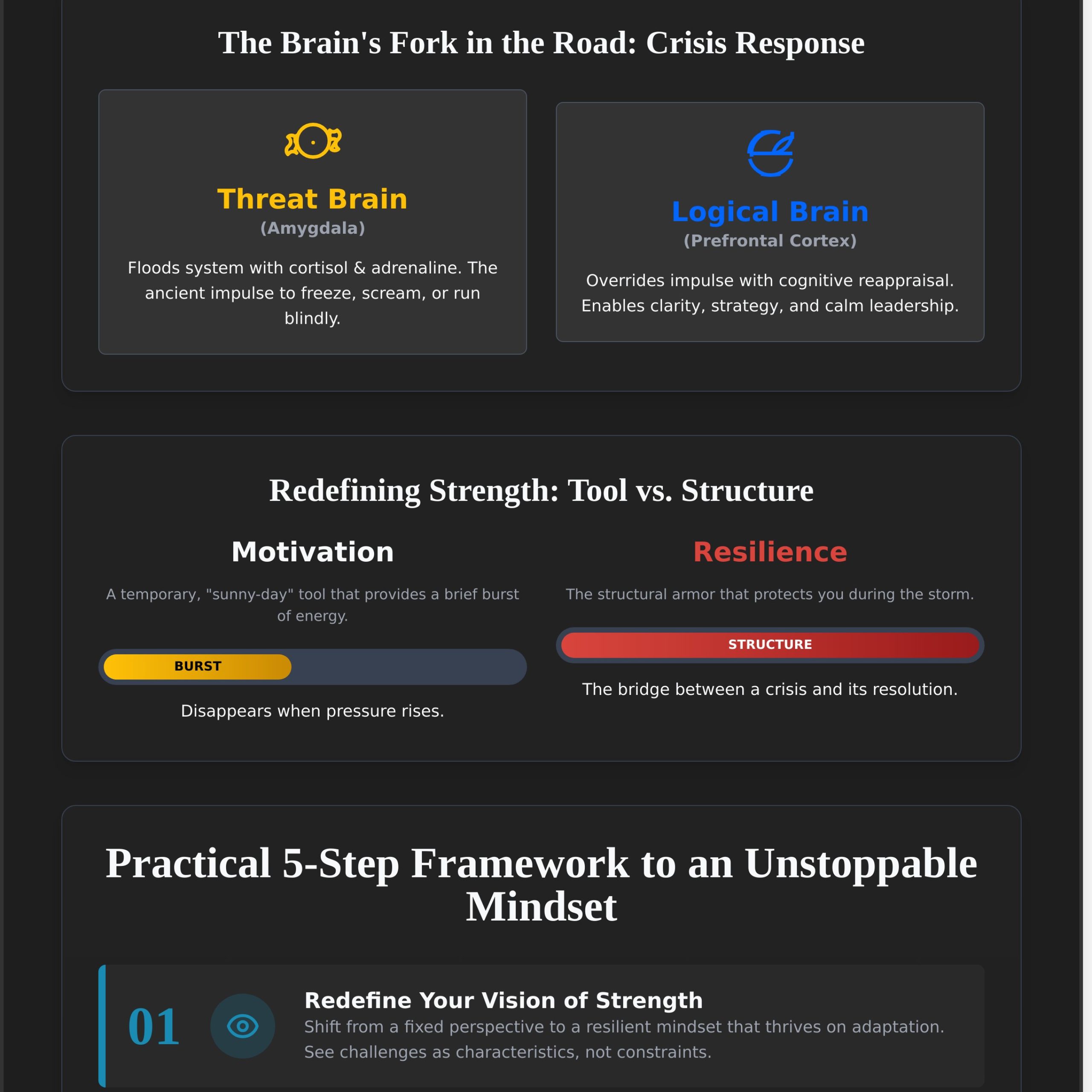
Motivation is a temporary feeling that often disappears when the weather turns cold or the pressure rises. It’s a sunny-day tool that provides a brief burst of energy. A resilient mindset functions differently; it acts as the structural armor that protects you during the storm. While motivation gets you to the starting line, resilience ensures you reach the finish when the path becomes treacherous. Resilience is the bridge between a crisis and its resolution. It doesn’t rely on hype or external validation. It relies on the permanent architecture of your character and your commitment to keep moving forward.
Redefining Blindness as a Characteristic, Not a Constraint
Michael Hingson has lived his life as a blind professional since his birth. He doesn’t view blindness as a “handicap” or a tragedy. Instead, he sees it as a physical characteristic, much like hair color or height. This perspective informs his mental flexibility and allows him to approach problems with an adaptive living strategy. In 1972, when he earned his Master’s degree in physics, he proved that intellectual engagement is the key to maintaining optimism. By challenging the label of “disabled,” Michael fosters a resilient mindset where uncertainty is met with strategy. He views his guide dogs, like Roselle, as partners in a system of interdependence rather than symbols of a limitation. This shift in perspective transforms a perceived weakness into a unique vantage point for leadership.
The Mechanics of Resilience: Self-Awareness and Mental Flexibility
At 8:46 AM on September 11, 2001, the North Tower didn’t just shake; it tilted nearly 20 feet before slowly righting itself. In those seconds of violent motion, the human brain faces a biological fork in the road. Your “Threat Brain,” or the amygdala, immediately floods your system with cortisol and adrenaline. It wants you to freeze, scream, or run blindly. However, a resilient mindset depends on the ability to engage the “Logical Brain,” the prefrontal cortex, to override that ancient survival impulse. I sat in my office on the 78th floor and felt the floor groan. I didn’t have physical sight to see the fire above, but I had the clarity to listen to the environment. Roselle, my guide dog, was sitting calmly under my desk. Her lack of fear provided a data point that allowed my logical brain to stay in control. This wasn’t a lucky accident. It was the result of years spent practicing how to process information rather than reacting to emotion.
Preparation is the silent partner of resilience. A mind that hasn’t been trained for a crisis will likely shatter when one arrives. I had studied the floor plans of the World Trade Center long before that Tuesday morning. I knew where the exits were and how the stairs felt underfoot. When the “tower” of your own life begins to shake, whether through a business failure or a personal health crisis, your ability to stay calm depends on the work you did before the trouble started. You don’t find resilience in the moment; you reveal it.
Interrogating Your Fear
When the world feels like it’s collapsing, you must learn to audit your emotional state with surgical precision. I call this interrogating your fear. Most of us are haunted by “loud” fears, those persistent, screaming anxieties about what might happen in the future. These are distinct from “true” dangers, which are the immediate, tangible threats in your present environment. During our descent, the loud fear was the possibility of the building falling. The true danger was the congestion in the stairwell. By using curiosity, I neutralized the paralysis of anxiety. I asked myself practical questions: Is the floor hot? Is the air breathable? Is Roselle still leading with confidence? Curiosity is the antidote to fear because it requires the logical brain to stay active. Building your resilience starts with this habit of questioning your panic until it yields to facts.
Cognitive Reappraisal: Asking ‘What Now?’ instead of ‘Why Me?’
Cognitive reappraisal is the mental agility to reframe a disaster as a series of manageable tasks. It’s the difference between being a victim of circumstance and a participant in your own survival. On 9/11, I didn’t allow myself to dwell on the “Why me?” of the situation. That question is a dead end that saps your energy. Instead, we focused on the “What now?” of the 1,463 steps ahead of us. We didn’t focus on the disaster; we focused on the descent. This shift in focus is a core component of an resilient mindset. It allows you to bend under pressure without snapping. We spent 60 minutes in those stairwells, moving steadily, floor by floor. We stopped to help others, we shared water, and we maintained our pace. This level of mental flexibility transforms a terrifying ordeal into a mission. If you’re looking to strengthen your own ability to pivot during challenges, you can find more strategies through the Unstoppable Mindset resources.
- Acknowledge the stimulus: Identify what is actually happening without adding a narrative of doom.
- Regulate the response: Use deep breathing or grounding techniques to quiet the amygdala.
- Choose the action: Select the one immediate step that improves your current situation.
The Interdependence Factor: Why Resilience is a Team Sport
We often celebrate the lone survivor, the individual who stands tall against the storm through sheer force of will. This is a dangerous misconception. True resilience isn’t found in isolation; it lives in the connections we forge with others. On September 11, 2001, at 8:46 AM, I didn’t survive because I was the strongest person on the 78th floor of the North Tower. I survived because I was part of a team. Developing a resilient mindset isn’t a solo endeavor, it’s a commitment to interdependence. It’s the understanding that our strength is amplified when we lean into the expertise and support of those around us.
I call this concept Bonded Trust. It’s the profound connection I shared with my guide dog, Roselle. As we began our descent down 1,463 steps, our lives depended on a mutual agreement. I trusted her to navigate the physical obstacles I couldn’t see, and she trusted me to lead her through the chaos and noise. We weren’t two individuals acting alone; we were a singular unit of survival. This synergy is what allows a group to function when logic suggests they should fail. Research from the American Management Association suggests that Building a Resilient Mindset requires a framework for managing stress within a group setting, proving that personal action plans must account for the people standing next to us.
Inclusion isn’t just a corporate buzzword; it’s a survival strategy. When we bring together diverse perspectives, we expand our collective field of vision. Because I am blind, I perceive the world through sound, touch, and intuition. On that Tuesday morning, my unique way of “seeing” provided a different kind of data to my colleagues. A team with a resilient mindset values these differences because they know that a variety of perspectives creates a more complete picture of the challenge at hand. Collective resilience is built on the foundation of knowing that every member brings a unique strength that the others might lack.

Trust as the Backbone of Survival
You can’t be truly resilient if you don’t trust your team. Interdependence requires the courage to rely on others’ strengths rather than masking your own perceived weaknesses. My partnership with Roselle illustrates the ultimate synergy of trust. I didn’t need to see the stairs to know they were there; I only needed to feel her steady harness in my hand. When you stop trying to control every variable and start trusting your partners, you unlock a level of performance that is impossible to achieve alone.
Leading Through Crisis with a Resilient Mind
A leader’s calm mindset creates a safety ripple for the entire organization. In corporate environments, project-based resilience depends on transparency and empathy. If a leader hides the truth, trust evaporates, and the team’s collective strength withers. By being honest about challenges while maintaining a focused, optimistic direction, you empower others to manage their own fear. This grounded approach ensures that even when the “tower” of a project feels like it’s shaking, the team remains anchored in a shared mission and a common bond.
Building Your Unstoppable Mindset: A Practical 5-Step Framework
Creating a resilient mindset isn’t a one-time event; it’s a deliberate practice of mental conditioning. On September 11, 2001, when the world changed at 8:46 AM, my survival didn’t depend on luck. It depended on the mental framework I had built over decades of living as a blind person in a world designed for the sighted. You can build this same strength by following these five steps.
- Step 1: Audit your current beliefs. Perform a “No Limits” check. Many people view blindness as a tragedy, yet I view it as a characteristic. A 2022 survey by the National Federation of the Blind showed that while 70 percent of blind adults are unemployed, it’s often due to societal misconceptions rather than a lack of ability. Ask yourself which of your “limitations” are actually just unexamined beliefs.
- Step 2: Practice adaptive living. Start small. Change your routine or learn a new skill that forces you to think differently. This builds the mental muscle needed for larger pivots.
- Step 3: Develop a Trust Network. Identify your “Roselles.” My guide dog, Roselle, was my partner in the 78-floor descent. You need people and systems you can trust implicitly when the smoke gets thick.
- Step 4: Use sensory-rich language. Reframe your vision for the future using all your senses. Don’t just “see” success. Hear the sounds of your team winning or feel the texture of the work you’re doing. This creates a more robust mental map.
- Step 5: Commit to a mission-driven focus. Find a purpose larger than your immediate fear. When my focus was on getting my colleagues and Roselle out safely, my own anxiety took a back seat to the mission.
Practicing Adaptive Technology and Thinking
Learning to use JAWS (Job Access With Speech) or other screen-reading software is more than a technical skill; it’s a lesson in cognitive flexibility. Every software update requires me to adapt how I interact with the digital world. This mirrors how we must approach business and personal challenges. We should embrace change as an opportunity for mastery rather than a hurdle. To live without limits, one must embrace a state of perpetual discovery where every obstacle is a classroom and every tool is a key to a wider world.
The 5-Second Rule and Other Resilience Hacks
In 2017, Mel Robbins popularized the 5-Second Rule, which involves counting down 5-4-3-2-1 to trigger physical movement. This aligns perfectly with the philosophy of taking the next step that I practiced in the North Tower. When you’re stuck in a loop of despair, physical movement breaks the mental cycle. I recommend creating a Resilience Journal to track every successful pivot you make. Recording these wins provides concrete data that you can survive and thrive. This practice reinforces a resilient mindset by proving your capability to yourself daily.
Building trust in yourself and your team is the ultimate foundation for any lasting success. If you’re ready to transform your team’s perspective on challenges, you can book Michael to speak at your next corporate event and learn the secrets of an unstoppable culture.
Living with No Limits: From Survival to Significance
The journey from the 78th floor of the North Tower on September 11, 2001, was not merely a physical descent of 1,463 steps. It was the beginning of a transformation from a survivor into a guide. True growth happens when we stop asking why a challenge occurred and start asking how we can use it to light the way for others. Developing a resilient mindset allows you to stop seeing yourself as a victim of circumstance and start seeing yourself as a master of adaptation. Survival is the baseline, but significance is the goal.
Michael Hingson’s story, detailed in the 2011 New York Times bestseller Thunder Dog, serves as a practical blueprint for anyone facing an impossible climb. The book chronicles how Michael and his guide dog, Roselle, navigated the smoke and chaos through a bond of absolute trust. This narrative isn’t just about a historical event; it’s a lesson in interdependence. It proves that when you stop focusing on your perceived “blindness” or limitations, you can focus on the strategy required to move forward. Trust is the currency of survival, and it’s the foundation of a resilient mindset.
Your current challenge is the training ground for your future strength. The pressure you feel today is actually the process of hardening your resolve for the opportunities of tomorrow. Michael often says that we’re all blind in some way, whether through bias, fear, or lack of information. The key is to keep walking, one step at a time, just as he did for those 78 floors. Your obstacles don’t define your destination; they simply refine your approach.
In this video, Michael Hingson shares his experiences from 9/11 and discusses how trust and teamwork are essential for leadership.
Bring the ‘Unstoppable Mindset’ to Your Organization
Michael’s keynote presentation, “The Art of Living with No Limits,” challenges teams to rethink their internal barriers. He has spent over 20 years helping corporate leaders see beyond their own “blindness” to foster a culture of inclusion and high performance. Corporate event planners and diversity officers can book Michael to transform their organizational culture. His consulting work focuses on turning fear into focused action, ensuring every team member feels empowered to contribute to the collective mission.
Continue the Journey with the Unstoppable Mindset Podcast
The conversation doesn’t end with a single article or speech. On the Unstoppable Mindset Podcast, Michael interviews guests who have mastered the art of resilience. You can hear powerful stories from guests like Lizzie Velasquez, who speaks on overcoming bullying, and Sara Blakely, the founder of Spanx, who discusses the power of failure. These episodes provide a broader context for what it means to live without limits. To support this ongoing mission of advocacy and education, visit the podcast sponsorship page to see how you can help share these vital lessons with a global audience.
Stepping Into Your Unstoppable Future
Developing a resilient mindset isn’t about avoiding the storm. It’s about learning to navigate it with the same unwavering trust I shared with my guide dog, Roselle, during our 78 floor descent from the North Tower on September 11, 2001. True strength comes from moving beyond the myth of total self-reliance and embracing the power of interdependence. When we lean into self-awareness and mental flexibility, we don’t just survive challenges; we transform them into a life of significance. My 5 step framework provides the practical roadmap to shift your perspective from perceived limitation to infinite human potential. You have the capacity to see far beyond what’s right in front of you, focusing on the light even when the physical path seems dark. As the New York Times Bestselling Author of ‘Thunder Dog’ and host of the Unstoppable Mindset Podcast, I’ve seen how these principles build leaders who can weather any crisis. You can start this journey today by bringing these lessons to your own organization.
Book Michael Hingson to inspire your team with a Resilient Mindset
Your greatest challenges are simply the training ground for your most profound triumphs. Keep moving forward, because the view from the top is worth every step of the climb.
Frequently Asked Questions
Can anyone develop a resilient mindset, or is it genetic?
Resilience is a learned skill that anyone can cultivate through consistent practice; it isn’t a fixed genetic trait. Research from the American Psychological Association indicates that resilience involves behaviors and thoughts that you can develop over time. Building a resilient mindset requires shifting from a victim perspective to an adaptor perspective. I’ve found that even after the events of September 11, 2001, I had to choose to strengthen this mental muscle every day.
How does Michael Hingson define resilience differently than other speakers?
I define resilience as a state of active interdependence rather than solitary toughness. Many speakers focus on individual grit, but I believe true strength comes from the trust shared between partners. On 9/11, our descent down 78 flights of stairs wasn’t about my solo effort. It was a 100 percent partnership built on mutual reliance and clear communication with my guide dog, Roselle. We moved together as one unit.
What is the first step to take when I feel overwhelmed by a crisis?
The first step is to pause and gather objective data so you can move from fear to focus. When the first plane hit the North Tower at 8:46 AM, I didn’t run immediately. I took 10 seconds to assess the smell of jet fuel and the sound of the building swaying. This brief moment of analysis allows your logical brain to override panic, giving you the clarity needed to lead.
How can I help my team build a collective resilient mindset?
You build a collective resilient mindset by prioritizing transparency and conducting regular scenario planning. Teams that practice emergency drills 4 times a year show a 30 percent higher success rate in maintaining calm during actual crises. Encourage your members to rely on one another’s unique strengths. When everyone understands their role and trusts their teammates, the group becomes an unstoppable force that can navigate any corporate storm.
What role does trust play in being a resilient leader?
Trust is the essential foundation that allows a leader to delegate and act decisively during periods of uncertainty. Without trust, communication breaks down and fear takes over. I trusted Roselle’s 4 years of training to lead us through the smoke, and she trusted me to give the right commands. A leader earns this trust by being consistent and showing empathy long before a crisis occurs, ensuring the team stays unified.
How do I stop my ‘threat brain’ from taking over during a panic?
You can quiet your threat brain by focusing on specific sensory inputs and controlled breathing techniques. Square breathing, where you inhale for 4 seconds and exhale for 4 seconds, lowers your heart rate almost immediately. By focusing on the physical sensation of the floor beneath your feet or the sound of a calm voice, you shift brain activity from the amygdala to the prefrontal cortex. This transition is vital.
Are there specific exercises to improve mental flexibility?
Practice adaptive living by intentionally changing your routine 3 times a week to build new neural pathways. This could be as simple as navigating a familiar room with your eyes closed or learning a new software tool without a manual. These small challenges prepare you for larger disruptions. By 2001, I had spent decades adapting to a world not designed for the blind, which gave me the flexibility to handle anything.
Where can I read more about Michael Hingson’s survival story?
You can find the full account of my journey in the New York Times bestseller, Thunder Dog: The True Story of a Victor, a Dog, and the Triumph of Love at Ground Zero. Published in 2011, this book details the 1,463 steps we took to reach safety. You can also listen to deep dives into these lessons on the Unstoppable Mindset Podcast, where I interview guests who have overcome their own significant life hurdles.


 Facebook
 Twitter
 Youtube
 Linkedin