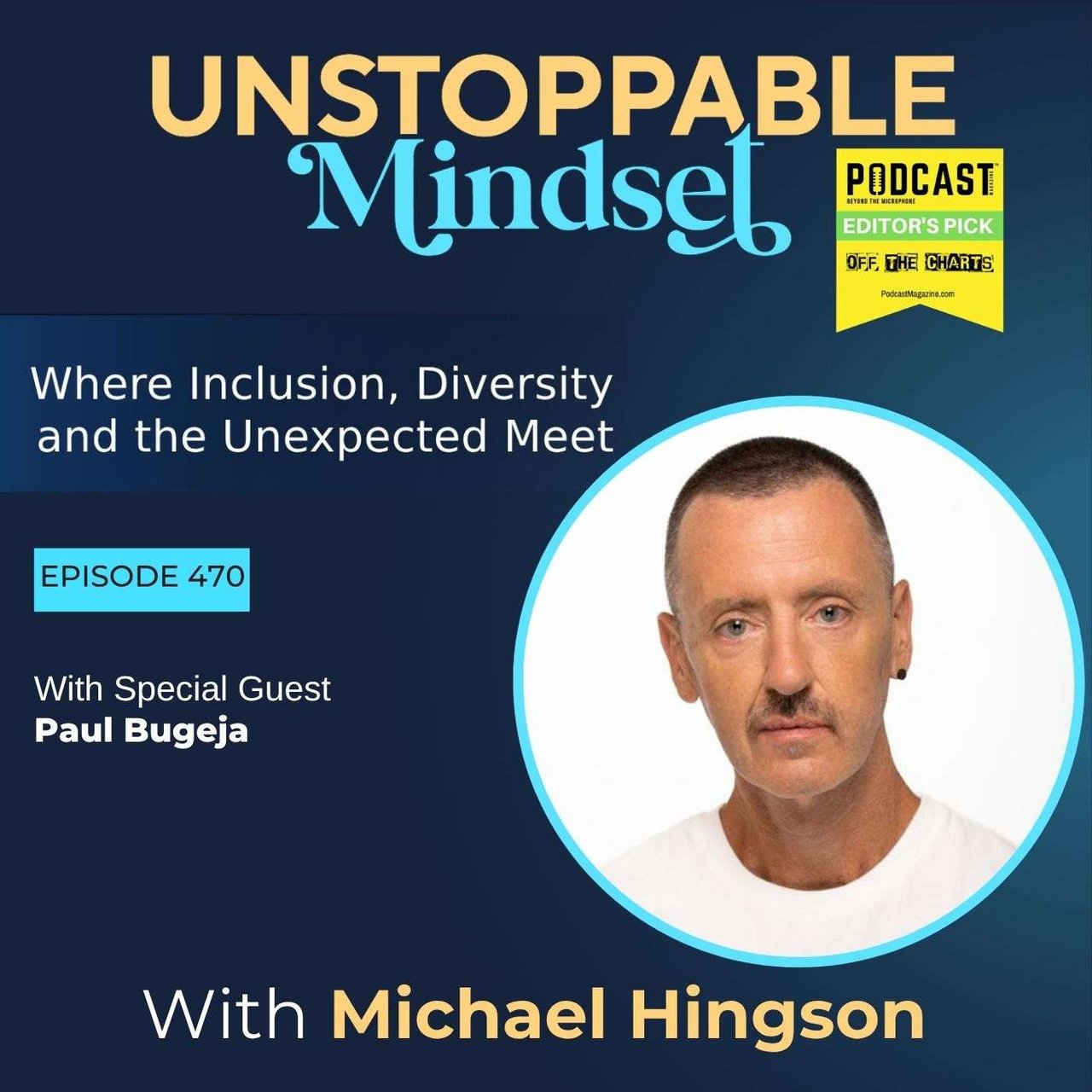
Episode 470 – Living With FSHD and Building an Unstoppable Life with Paul Bugeja
A diagnosis can change your life, but it does not have to decide what comes next.
My guest Paul Bugeja has built a life shaped by curiosity, career change, travel, creativity, and a determination to keep moving forward. Paul lives with facioscapulohumeral muscular dystrophy, or FSHD, a condition he calls his “dark angel.” We talk about how disability has influenced his choices without defining them, why staying active matters to him, and how personal agency has helped him face uncertainty without becoming trapped by fear. Paul also shares his path from acting and writing into journalism and digital media, where he now works as a quizmaster. We explore disability advocacy, media accessibility, the role of AI in journalism, and the danger of losing critical thinking. Paul’s story reminds us that resilience is not about denying challenges. It is about understanding them while continuing to choose how we live.
Highlights:
01:10 – How moving often helped Paul learn to adapt.
12:15 – How a gym visit led to his FSHD diagnosis.
20:39 – Why disability gave Paul a stronger drive to live fully.
22:53 – How knowledge of his condition gave him more agency.
38:35 – Why accessible media still has room to improve.
45:57 – How staying present helps Paul manage worry and fear.
About the Guest:
Working as a quizmaster for a major media organisation isn’t somewhere I could have predicted I’d end up professionally, but, then again, life has taken so many twists and turns it doesn’t surprise me this is where I currently find myself.
Despite early aspirations to be an actor, I completed a double degree in Arts and Commerce at the University of Melbourne, with the final year spent on exchange at UC Berkeley, California.
On my return to Australia, not to be denied, the ever-persistent actor in me got me admission to the prestigious Victorian College of the Arts Drama School: the decade or so following saw me immersed in the challenging but exciting life of the struggling actor.
This period was also the launching pad into studies in writing, editing, journalism and screenwriting, which I did as I worked in book publishing and wrote half a dozen books, even as I edged into the rapidly evolving professional world of content, digital marketing and journalism.
Throughout this entire time, I’ve lived alongside and managed my “dark angel”—a diagnosis of facioscapulohumeral muscular dystrophy—which has only served to galvanise me further to live a life less ordinary along the road less travelled …
And that has made all the difference.
Ways to connect with Paul**:**
https://www.linkedin.com/in/peebee/
About the Host:
Michael Hingson is a New York Times best-selling author, international lecturer, and Chief Vision Officer for accessiBe. Michael, blind since birth, survived the 9/11 attacks with the help of his guide dog Roselle. This story is the subject of his best-selling book, Thunder Dog.
Michael gives over 100 presentations around the world each year speaking to influential groups such as Exxon Mobile, AT&T, Federal Express, Scripps College, Rutgers University, Children’s Hospital, and the American Red Cross just to name a few. He is Ambassador for the National Braille Literacy Campaign for the National Federation of the Blind and also serves as Ambassador for the American Humane Association’s 2012 Hero Dog Awards.
https://www.facebook.com/michael.hingson.author.speaker/
https://www.youtube.com/user/mhingson
https://www.linkedin.com/in/michaelhingson/
Thanks for listening!
Thanks so much for listening to our podcast! If you enjoyed this episode and think that others could benefit from listening, please share it using the social media buttons on this page. Do you have some feedback or questions about this episode? Leave a comment in the section below!
Subscribe to the podcast
If you would like to get automatic updates of new podcast episodes, you can subscribe to the podcast on Apple Podcasts or Stitcher. You can subscribe in your favorite podcast app. You can also support our podcast through our tip jar https://tips.pinecast.com/jar/unstoppable-mindset .
Leave us an Apple Podcasts review
Ratings and reviews from our listeners are extremely valuable to us and greatly appreciated. They help our podcast rank higher on Apple Podcasts, which exposes our show to more awesome listeners like you. If you have a minute, please leave an honest review on Apple Podcasts.
Transcription Notes:
Michael Hingson 00:04
What if the biggest thing holding you back isn’t what’s in front of you, but rather what you believe? Welcome to Unstoppable Mindset, where inclusion, diversity, and the unexpected meet. I’m your host, Michael Hingston, speaker, author, and advocate for inclusion and possibilities. This podcast explores how the beliefs we carry shape the way we live, lead, and connect with others. Each week, I talk with people who challenge assumptions, face adversity head-on, and show what’s possible when we choose curiosity over fear. Together, we focus on mindset, resilience, and the small shifts that lead to meaningful change. Let’s get started. Hi, everyone. I’d like to thank you once again for coming to another episode of Unstoppable Mindset. And if you’re new to the podcast, we hope you enjoy our episode today. We’re glad you’re here wherever you may happen to be. Today we are communicating a long way away. We’re communicating with Melbourne, Australia, to Paul Bugeja, and Paul is fondly known as a quizmaster. We’re going to have to find out more about that, but he’s had a lot of interest in acting and media and such things as that, and has had clearly a pretty adventurous life. And again, I’m sure we’re going to hear a lot about a lot of that today. So, Paul, welcome to Unstoppable Mindset. We’re really glad you’re here.
Paul Bugeja 01:44
Thank you for having me, Michael.
Michael Hingson 01:46
So why don’t we start? I love to do this with the early Paul, kind of growing up and how things all got started. If you remember back that far, or at least as far back as you remember, or what you were told anyway.
Paul Bugeja 01:59
You know, pretty standard like childhood story for me. Grew up in the green leafy sort of suburbs of Melbourne. You know, did all the things that kids do in their growing up years. My my mother actually divorced my father quite young for me, so that was a little bit of a a critical sort of point for a child to sort of, you know, have to grapple with, but um, it was pretty smooth, and you know, um, it didn’t really disrupt my childhood, except it meant that I moved around a lot when I was quite young. So I probably moved about seven or eight times by the time I was maybe eight years old. Um, but I think, in a way, that that that sort of has worked for me because it meant that even as a young child, I had to learn to adapt and change and evolve very quickly. Particularly when it came to meeting people, and you know, as a child, obviously making friends-that’s one of the trickiest parts as a kid sometimes. So I think that actually stood me in good stead in in that regard, yeah.
Michael Hingson 03:04
Well, I I didn’t have to move a whole lot growing up. We moved from Chicago to California when I was five and stayed in the same house since college. I have moved a bunch of times, but those things happen. I understand what you’re saying. I’m I’m used to it, but am am of the opinion that I’d rather not move again. It is a lot of work to move, and now also it’s just me. My wife passed away two almost two and a half years ago, so I don’t want to pack and move again. But yeah, well, we’re in a house that we built, and and so we built it really around her because she’s in a wheelchair her whole life. So it’s an accessible house, but it’s a very comfortable house. So I I have no complaints, and and the dog and the cat seem to like it as well. So we’re here.
Paul Bugeja 04:01
It’s a win for everyone, and I think look, that’s that’s a really interesting. I had this very similar conversation with a friend yesterday about there’s a time to put down roots and there’s a time to be a you know a rolling stone, and and for some people that’s at different times in their life, you know. So I I can understand why you would have chosen to find your comfy spot to settle into and enjoy.
Michael Hingson 04:23
Well, and I have a good mortgage rate and all that, so yeah, we’re happy with with things the way they are. And as long as the dog and the cat are happy, I can’t complain a bit.
Paul Bugeja 04:33
Excellent, excellent.
Michael Hingson 04:34
But but now you’re and and you you’re not moving as much around anymore.
Paul Bugeja 04:40
Sort of the opposite, actually. I think, like, to to go back to what we were originally discussing. Like, I think having moved so much as a younger person has meant I’ve lived a life that’s almost constantly moving. Like, there certainly have been periods where I’ve lived for reasonably long periods in the one place, but particularly over the past. We maybe 10 to 12 years or so. I’ve moved like literally maybe 10 to 12 times. Like it’s becoming,
Michael Hingson 05:09
it
Paul Bugeja 05:10
almost becomes a bit addictive. Sort of the ability to to be transportable when your professional life allows you and your personal life allows you as well.
Michael Hingson 05:18
Yeah, I can understand that. For me, I don’t want to go through all the rigors of packing and finding a new home and all that, so we’re good. But but it it’s okay because I can go anywhere from here, and so that works out pretty well. So I’m I’m content, and that that’s the way it it should be. So we’ll see how it all goes. But I’m glad that you did well, so you grew up, had kind of a normal life, even though you moved around a lot. Yeah, did all the things that that that kids do growing up, and so on. And where did you go to college, or did you?
Paul Bugeja 05:53
Yeah, so I my original, I’ve I was a bit of a perpetual student for probably you know the first several decades as an adult, my original degree was from the University of Melbourne, which is one of the sort of larger universities in both Melbourne and Australia, and I did a double degree in arts and commerce. But you know, I had long wanted to be an actor, and so originally, like when I finished high school, my my intention was to audition for drama school. But my mother very wisely convinced me to go to university first, and then check that out. And if I didn’t like it, then maybe audition for drama school a bit later on. And it was, as mothers can be on most occasions, very sagely advice from her, because the thing that she wasn’t aware of was that even though I I definitely enjoyed the academic aspect of my studies at MLB Uni, it has a very strong theater department as well, and very big names have actually been through there and gone on to bigger and better things, namely Kate Blanchett. She was one of my colleagues back in the day. So you know, it was a it was a proving ground for talent. And so I did a lot of theater during my my studies at the University of Melbourne while completing the academic side as well. So I never quite lost that sort of underlying desire to maybe go on and and study acting and maybe do some acting. I actually completed the final year of my degree at Cal at UC Berkeley, which was an amazing experience, and sort of also launched me into the next part of my life. So that that was at a time when you know, like I think in a lot of ways, more and more students were traveling between countries to study. It was becoming a real thing to study overseas, so it was such an amazing experience to finish at Cal.
Michael Hingson 07:48
So, do you keep in touch with Kate at
Paul Bugeja 07:52
all? Haven’t seen Kate in probably maybe 20 years or so. We kept in contact during the beginning of her career, of course, and then you know that life has taken her to such places that it’s almost impossible to keep
Michael Hingson 08:07
touch, right?
Paul Bugeja 08:08
That’s right. But you know, I dare say, if I think she’s probably maintained the sort of personality and character that she had when I knew her, which would mean that if I bumped into her on the street and I said hello and gave her a bit of a nudge about where we knew each other from. She’d be the first one to lean into that and and you know be quite happy to reminisce on old times as you know she’s not an aloof sort of person. I think that’s my feel about her, even given her amazing success.
Michael Hingson 08:37
I’ve never had that impression of her either, so I I’m with you. Well, that’s pretty cool. What What took you to Berkeley for your last year?
Paul Bugeja 08:45
Yeah, so I actually started working during my studies on campus at the university, and I worked in the international student office. So I was dealing with a lot of incoming study abroad and exchange students, which meant I began to have a real desire to do the same thing myself, and initially I was looking at a couple of other universities like Georgetown. I think NYU was one of the options, and I actually met a guy from Cal who was like, "You should come to Berkeley and study. It’s an amazing institution. You’ll love California. It’s so similar to Australia, and I’d I’d I’d actually been to California before my first overseas trip when I was 19, and so I had a taste of California already. So initially, I was looking at the whole sort of Cal system, the whole you know UC system. So I looked at UCLA, UC San UCSJ maybe and anyway yeah and and then I fell and I fell in Berkeley as the final one just because what a great city to live outside of you know San Francisco’s such a beautiful city and and yeah so I ended up spending an entire year there which was just like you know life defining.
Michael Hingson 09:57
What’d your mom think of that?
Paul Bugeja 10:00
Yeah, typical of mum’s. There was a lot of tears at the airport, but you know, and this was you know like at a time when social media was really not even happening, so it was all about the phone calls regularly. But she was happy. She’s I’m very lucky in that, even though I’m an only child, mum’s not a clingy a clingy mum, you know, she has always encouraged me to just go out and do everything that I possibly can, and and she would never, she would rarely, you know, get get in the way of me living out my life and my dreams.
Michael Hingson 10:33
Do you still? Is she still here?
Paul Bugeja 10:35
She is. Yep, she’s um 78, so she’s you know I’m still a youngish older person, and even though we don’t, we sort of you know like see each other as much as maybe I’d like because we don’t live in the same place. You know, we we talk every two days or so on the phone, and I stay in regular contact. And yeah, it’s it’s still a very very strong relationship.
Michael Hingson 10:56
That’s cool. That that’s a good thing though. So you you went to Berkeley. You were here. You were out here in California for a year, and then what happened?
Paul Bugeja 11:05
Well, I actually I bounced back to Australia, feeling very encouraged to to follow my acting pursuits because I I did a couple of shows at when I was at Cal. I did one drama class as well in the drama department, you know, made some lifetime friendships and and felt very connected to myself as an actor again. And so, even though originally my plans were to apply to become a diplomat through the Department of Foreign Affairs and Trade, the acting thing was a bit too strong. So I came back and and felt a little not torn, but certainly I had to I had to weigh up the competing desire to want to be an actor against the fact that I had a great degree that I could maybe go on and do something completely different with. So in fact, I spent a year thinking about that and ended up quite on a different track and enrolled in a master’s of environmental studies, which you know was something that interested me definitely. And but decided that I would, in addition to drama school as well, which I did do, and I got into. So I did one year of that master’s, and then I went on to study at the Victorian College of the Arts, which is one of the big three drama schools in Australia, and so I finally got to that took that circuitous route to drama school, despite my mum’s earlier advice, and she was happy because you know I got there under my own auspices in terms of I’d made a decision as an adult to finally get there, rather than maybe as an excited teenager who you know could obviously do so many things, and so I had both the academic degree, and now I was into a program that I’d always wanted to sort of be involved with.
Michael Hingson 12:49
Right. Well, and and that that’s fine. That makes sense. Yes. So I’m not sure when to bring this up. So I’ll bring it up now. Sure. Tell us about your dark angel.
Paul Bugeja 13:01
Yeah, absolutely. So probably in my in my in my late 20s, I started working at a university in back at University of Melbourne. Actually, my old alma mater, and by then, you know, I was actually you know sort of I I was doing some acting, you know, some professional acting, not a lot of it, but enough to sort of be remain interested. So I needed a part time job on the side, you know, to to keep it going as most actors do. And when I started working at the university, I became very interested in fitness as well. I joined a gym and started going to the gym there and made some sort of friends with the local personal trainers. And one day I was doing some training and on one of the big, big sort of bouncy medicine balls that you can sit on for balance and training work, and one of the instructors came up to me and said, "Do you realize that your scapular wings? And I was firstly thinking, "Well, what the hell is my scapular? And then I sort of made sense that it was my shoulders, you know. And and I said, "What do you mean? He said, "Well, when you do upper body workouts, your scapula has quite a lot of movement in it, and it’s quite visible. Now, I’ve always been a very thin person, like I’ve always sort of been. We’ve joked about being a tall, skinny dude, you know, and and so I I’d never thought anything about maybe the fact that my my shoulder blades were a bit more prominent. I figured that was because I was a slim person, you know. Of course, so he recommended I see a physiotherapist, and I did. I saw a sports physio in case I’d injured myself or there was some underlying issue. After a couple of sessions with a sports physio. I was referred to a neurologist because the sports physio had some inklings about it may be being a neurological condition potentially of some kind, but had no idea what it might be. And this is when I guess my dark angel first really. Began alerting me to its presence in the background of my life, and I’ll explain why I call it my dark angel in a moment. Yeah, the neurologist and I did some tests, and I went in for a biopsy, a muscle biopsy, and I was diagnosed with one of the variants of muscular dystrophy, which is fascioscapiohumeral muscular dystrophy, so it affects the face, the humerus, and the scapula, but in general affects the muscles across the body. It’s a degenerative neuromuscular disease. It’s not that common; about one in 8000 have it. So you know, enough people have it that it’s out there. Some people live with live with it their entire lives and don’t know they have it for the reasons that I’ve just sort of elaborated on, which are it can it can be there but be so minor that you just think it’s because you’re a slim person or you don’t have much you don’t go to the gym so you don’t work out so your muscles aren’t growing or whatever. So yeah, and I was not that thrown by it at the time. It was it was in our family, so it wasn’t that much of a surprise to me that maybe I had it. Given that another family member, even though they’re quite distant on the family tree for me, also had it, and yeah, I began to just think about you know like what life would be like with this condition, and you know began to have regular sort of checks with the neurologist and you know other sort of allied health professionals around how to manage that. Luckily, it was very my and still is very mild in terms of how severe that it can be. But as I sort of began thinking more about my professional life. I I actually took on a an editing and writing degree and a screenwriting degree as I started to move away from acting because I figured I am a creative person. I love writing and I want to improve my craft. I was interested in journalism as well and I could do that as part of this degree.
Paul Bugeja 16:58
So I started studying and that then led to me actually writing a couple of books, four or five books, working as an editor, and then at one point I began thinking, I think I need to write my own book about my journey with this condition, or you know, disability, whatever you want to call it. And I had watched the TV show Dexter, which you may or may not have watched. Yep, and Dexter talks about his dark passenger. You know, as and that’s the the sort of I mean, it’s a weird correlation. I know in some ways, but that’s the serial killer in him. That’s his dark passenger. But it really resonated as um this idea of there being this sort of passenger in your life. You know, for whatever reason, whatever it is, and I didn’t obviously want to steal that sort of figurative term, but I began thinking about a dark angel instead because, for me, it’s a double thing. I mean, I was whatever Catholic. I’m not a practicing Catholic anymore, but you know, the notions of angels around us is something you know we all sort of think about, I guess. But the notion of my scapular wing and those being wings as well was very sort of resonated with me, and so I began feeling that for me my entire life this dark angel had been somewhere in the background, very very far in the background to the point where I wasn’t even really aware of that dark angel, and then of course when the diagnosis came along, the dark angel began to make its presence more known, and yeah, and and then over time, I’m very, I live with, you know, like anyone with any sort of disability or chronic medical condition, like you live with it 24/7, and some days it’s more of a burden, other days you don’t not even aware of it, but you have to learn to live with it, and and so I now feel like I have this sort of dance with the dark angel, I like to call it, who sometimes is more present in my life and sometimes much more in the background.
Michael Hingson 18:53
So, what kinds of things does it sort of limit you, or what what do you have to do to to make sure you don’t let it get too much of a control over you.
Paul Bugeja 19:04
Sure. So for me, the biggest thing I ever did was start going to the gym. You know, I did that just out of pure practicality because there was a gym on campus. It was very easy to join it. It was very close to go to on my lunch break, and so I’ve now maintained a really rigorous gym schedule, even though my upper body strength is quite weak and limited. I’ve been able to, I think, the my GP and say allied healthcare professionals like physios and exercise physiologists and occupational therapists have all commented that my gym program is one of the things that may you know this it’s a may but may have prevented the condition progressing more severely than it has. So staying fit has been really important. I think by nature, I like to call myself a pragmatic optimist or optimistic pragmatist. By nature, I’m a practical person. I sort of feel as though, unlike I mean, look, everyone manages the news of some sort of health situation differently. You know, some people it can lay low, and I understand why because it can be very confronting, and every condition has a different set of limitations, like you know, it can be quite severe for some people. Like my my cousin had a different form of muscular dystrophy, Duchenne muscular dystrophy, which meant that he was in a wheelchair from the age of five and died at the age of 28. So you know, like like in my case, I feel blessed on some level that my condition is slowly deteriorating, but I do think that I’m lucky that I have enough of a practical and positive attitude about not letting it. I don’t call, I never ignore it or or deny it, but I call about. I just resist it. The resistance is there. Like I I push back against it. So mentally, I try to stay positive physically. I try to stay healthy, but you know it does limit me. I have part of the condition. I have something called foot drop, which means that my feet catch a lot as I walk. So I trip a lot. So I I have damaged elbows and knees a lot because of that. So as a consequence, I have to be conscious when I walk. It’s not just a. It’s not like for most people, walking is an unconscious action. Of course, for me, it’s a conscious action to ensure that I trip less. And of course, as I get older, tripping becomes a thing as you get older anyway, because you know your muscle tone changes and you know all kinds of things. So you know, it’s about almost in a way you have to become. You do have to be aware of it all the time, and you have to manage it all the time. But that doesn’t mean it has to become a burden. I think in many ways it’s pushed me the other way, which is it’s made me have a lust for life. It’s made me want to do more. It’s it’s probably pushed me to be more nomadic while I can be, just in case there’s a point where I can’t be, and that sounds a little bit sad, and I mean probably in some ways, but I see that as a positive. Like a really small example I can give you is whenever I visit my mum, like I don’t drive, so I use public transport like trains and busses and and the like. And if I catch a train to to go visit my mum, she always insists I’ll come and pick you up at the at the train station, rather than you walk to my place, and I insist every time I’m going to walk because while I can walk, I want to walk. You know, so I don’t. It’s not. I reject. I don’t reject her kindness, and I understand it. But it’s me saying to the dark angel, "No, I will. Does she?
Michael Hingson 22:36
Does she understand
Paul Bugeja 22:38
it? I think so on some level, but she still
Michael Hingson 22:41
wants to come and get you. Of course,
Paul Bugeja 22:43
she does. Of course, there can be the tiniest trickle of rain, and she’s like, "Oh, you can’t walk in that rain. You know, I’ve got an umbrella, mum. No, no, no. You know, it’s all that stuff. Um, it’s it’s delightful of her, and I’m glad, and I’ll always expect the offer in those situations. But um, yeah, no, she um, you know, unfortunately, and I think a lot of parents will who pass on genetic conditions because this is a genetically passed on condition for me. She feels a sense of guilt about you know having passed on through her line, and so I think she we’ve talked about it a few times, and it’s not a heavy weight on her shoulders, but she has a sense of it. Yeah.
Michael Hingson 23:20
Well, I I appreciate that. What was it like when you first got the diagnosis? Though, did it did did it depress you? Did it kind of knock you on your ear in in any way, or did you really decide almost right from the beginning? Okay, this is here, but I can deal with
Paul Bugeja 23:37
it. Yeah, it look, you know. So I’m writing a book about this, as I was saying at the moment, and in the in the chapter of the book that I’m writing, I think I wrote something along the lines of life just moved on. You know, like there was no discernible difference. Like I didn’t feel physically any difference because there was no physical difference. But for me, I mean, you know, I I work in the media and I’ve worked in the knowledge industries of any kind for quite some time. Knowledge is power, you know. And and I would rather know about something and then be able to to to have some agency about how to act on it than to bury my head in the sand. Or, but by the same token, I can understand that knowledge can really throw some people. And you know, I have a friend, for example, who I was diagnosed with MS, and that can be an awful condition to be diagnosed with because it can progress very quickly. And for her, the knowledge wasn’t great. You know, it’s it’s been a very big challenge for her. But you know, five years on, now that she has much more knowledge about it because she’s had to live with it, she’s going the opposite way. So you know, everyone is different, but for me, the knowledge actually catapulted me forward rather than weighed me down.
Michael Hingson 24:46
Well, that was a choice that you had to make, or that you got to make, and you made it. And you’re you’re choosing to move forward with life, which is great.
Paul Bugeja 24:55
Yeah, yeah. I feel lucky. As I said, I know. Everyone can can make that choice because of their own set of circumstances, and I do feel lucky about some of my circumstances. And you know, so I don’t think everyone can necessarily be that practical or optimistic about things. But I encourage people to you know take a breath and and try and sit with whatever it is that they have to manage at any particular time, because you know people. A lot of people have a lot heavier challenges than I do, and they meet them as well. So it’s possible to meet your challenges, I think, even if it limits you still.
Michael Hingson 25:36
Well, so it’s something that you live with, and so on. And I appreciate that. What what makes you get out of bed every day and and move forward, or is that what what you’ve been describing?
Paul Bugeja 25:48
Look, I think I mean you know I’m I’m an I’m a lark, so I’m at about 430 in the morning, and I’m a Monday person, and I had this conversation with someone just this past Monday at the gym who you know dragged herself into the gym, and she was you know can’t be bothered. I hate Mondays so much, you know, blah blah blah. And I get all that, you know. People love their weekends and a break. I love, I love the beginning of a day, and I and I have no problems getting up because I love the thought of there being so much in front of me, you know. And and even as as I grow older, and and you know, life obviously begins to go into a different phase. I still feel there’s so much ahead, and and and it sounds a little bit Pollyanna of me, maybe, and a little bit overly optimistic, and a little bit Hollywood. But you know, I feel so hungry for life, and and even though that doesn’t mean my life is perfect by any means, and that every day is perfect, and that there are some days that are are challenging. I face that all the time, as do we all in our different ways. But I I just feel so eager for the things that I mean. I have a great professional life, I have a great personal life, I have great friends, I have a good family. You know, my health is fine given the situation. Doesn’t mean it’s perfect, like I just said. But I don’t have much to complain about, really. So, really, getting up is each day is is not a hard thing for me. It’s it’s it’s a joy most days.
Michael Hingson 27:15
So, are you married?
Paul Bugeja 27:17
No, single. And this is, and I often frame conversations with this because sometimes my friends say to me, "Gosh, you have a great life, and I say, "Yeah, but I chose to be single, to not have children, and to not have pets-the three big things that change the course of your life sometimes in a good way, quite often. But also, I have more choices ahead of me because I am single and childless and petless, you know.
Michael Hingson 27:42
Yep.
Paul Bugeja 27:43
But you know, I don’t. I’m not. I don’t. I don’t feel. I feel like I could have made other choices around this, of course. And I don’t think there is a right or a wrong choice. It’s just you have to find the right choice for you, especially when it comes to these big life choices.
Michael Hingson 27:59
Well, you know, and when I got married, my wife and I had discussions about children, and she felt that she didn’t want to have a child because she was in a wheelchair, and she felt in her specific situation, it would have been a lot harder on the body, and she would have been in bed a whole lot during a pregnancy, and she was afraid she would lose a lot of the the upper body strength and so on that she had. And my belief was that was her choice to make, and so we we both decided that we didn’t want children. We would very happily entertain our nieces and nephews and throw them out of the house at the end of the day and send them home, which worked out really well.
Paul Bugeja 28:49
I can I can understand that choice, and I I certainly I always thought I would be a father to be to be honest about that. When I was in my late teens and early 20s, it was forefront of my mind. Even though I had all these other adventures planned, and I had a couple of opportunities, actually, probably in my 30s, where I could have chosen to go down that road. And yeah, around the time I was diagnosed, I began thinking what that might mean. Like, and I began to not fear passing on my my FSHD to my potential children, but because often it passes through the female to the male, so it’s less likely to pass through me. But if I had a female child, I might have passed it on genetically to her, who then passed it on to my grandchild. And not that that should stop anyone ever wanting children, but to your point and and the way you and your wife discuss the situation, I I made a conscious decision that probably given the life choices I was making around my career as well and other and personal life, it might not be the best choice. So yeah, I can understand where where. If
Speaker 1 30:04
you enjoy Unstoppable Mindset and would like to help us continue bringing these conversations to you each week, we’ve created a way for you to support the show. Your contribution helps us cover production costs and continue sharing stories, insights, and ideas that inspire people to live with purpose and possibility. If supporting the podcast feels right for you, you’ll find the link in the show notes. Thank you for being part of the Unstoppable Mindset Community.
Michael Hingson 30:36
So, in in your life, what is one of the well? What would be the greatest thing in your life, personal or professional, that you’ve experienced so far?
Paul Bugeja 30:47
The greatest thing, yeah, it’s a it’s a great question. That’s a
Michael Hingson 30:52
toughie because there are probably several.
Paul Bugeja 30:54
Yeah, no, there are, there are. I mean, you know, I think, and this will seem a little sort of not so great. I mean, as in not great. Sorry, but I think the the first job in journalism that I got, which was working for the Guardian, the Australian Mars said version of the Guardian, that was pretty amazing for me because I had I had thought, and it wasn’t as a journalist. It was as a like a community sort of an audience sort of person, basically. So I wasn’t writing and I wasn’t generating content, but just to be finally in a media organization after probably 10 or 15 years of always thinking, God, I’d love to work in the media. I’m a real news hound. I love news. I love current affairs, and even though for some it was just getting a job, for me it was taking a step into something that I had thought about for a while, and finally, and you know, working for a really reputable and very well known masthead as well, that had a lot of credibility. So that was pretty exciting, and and that sort of set me on the path of, I think this is where I will stay now if I can. Even though, as you would know, the media is under a lot of pressure to sort of evolve with a lot of external threats to the way it works and and you know staying financially viable. So I’ve sort of put myself into a very hot pot, and I hope I’m not the frog that jumps out. But I don’t think I will be. I think I’ve managed to forge a bit of a career now that will keep me going. So yeah, it’s not a a life like sort of fireworks sort of moment, but it was a it was certainly the day that I got the phone call saying we’d we’d love you to come and join us was was you know very similar to that? I got the phone call from drama school saying you got into drama school. It was a real like everything felt lifted. You know the whole I felt like I was floating that day.
Michael Hingson 32:52
Yeah, I’m with you. So what other kinds of jobs then did you progress to over time?
Paul Bugeja 32:59
Yeah, so because because I was pursuing acting for for quite some time, probably for about 10 to 15 years, really. You know, I had to do what most actors do, which is work a lot of other jobs. You know, like you just have to. The work is never constant, even for the for the biggest actors in the world. You know, I mean, most of them obviously work constantly, but you know, like to be a working actor is is never let anyone say that being an actor is not a real job. It’s a really hard job, you know. And so, I I worked for a long time in casual jobs. I worked in a lot of theaters in in like the sort of the ticketing sort of area of of theaters. So I worked at both the Sydney Opera House and the Victorian Art Center, two big theater. You would know the Sydney Opera House, obviously, but yeah, Victoria Arts Center is another big theater organization in Australia. And while I was doing that, I began doing some freelance editing as a book editor. This was where I really began getting interested in content and copy, and and I had the part-time job at the university while I was studying and sort of doing all these other casual things and acting, and a role came up working in digital sort of content with a large betting agency. So you know, sports betting, which is very big in Australia, and it was managing their blog, their sports blog. So lots of content about what’s happening in all the different sports, but you know, sort of a marketing slash copy role. But it was my first foray into digital content, you know, and this was at a time when it was really starting to amp up, and that therefore, you know, made me really think much more about journalism and and wanting to pursue that. So that was sort of the springboard into working in digital marketing, working as a sub editor, and then sort of finally landing this role at the Guardian, which didn’t last super long, unfortunately, because I was completing a master’s in publishing and communications at the time, and discovered that I. I’d left I’d left Melbourne to move to Sydney to work in the role and had two subjects left and I’d been told by the university that I could complete them in Sydney, and then I was told by an administrator that that was not possible, so I had to leave my job at the Guardian to go back to Melbourne to finish the masters, which was fine to do, and I kept doing other casual kind of jobs and you know contract roles. Well, I did that, but it meant leaving the Guardian, which was a bit disappointing. But it meant I got my masters, which was really critical because again, that was more of a springboard onwards. In fact, I, as part of my masters, I went to China and did a an intensive class in Shanghai, and from that, got offered a role in China, in Shanghai, with a with a Chinese media company that that produced content for for the very big expat community in Shanghai, and I was about to leave to go to Shanghai to take up the role, and you’ll you’ll probably will have a wry smile, which was February 2020, and fortunately, not long after that, everything kind of went pear-shaped with COVID, and so had to. I mean, it’s sort of lucky in a way because Shanghai had a pretty awful time during COVID, where it was a very strict lockdown. So I probably dodged a bit of a COVID bullet in that regard, even though Australia had its own share of lockdowns. But yeah, so that sort of threw a bit of a spanner in the works of what looked like the next part of my media career. But then, of course, you know, I’m a I’m a fatalist. I I run with fate. I I don’t push back against the things that sort of maybe look like negatives or or take us off our path.
Paul Bugeja 36:38
And I just feel like it’s another another fork in the path that takes us on a on a route that will hopefully get us to where we were meant to be, and not taking that role meant, of course, about a year later, I saw the job with Stuff, which is the New Zealand media company that I currently work for, and that was the middle of 2021. It was based in Auckland. We were still in the middle of COVID, but I applied anyway because why not? And yeah, they offered me the role pending the borders opening, effectively. And luckily for me, there was a two-week window where New Zealand and Australia thought things were going to go okay, and the borders opened, and I jumped on the first flight out and got myself to Auckland, and then I started my current job, or actually a different version of my current job with stuff.
Michael Hingson 37:27
And what is your your current job?
Paul Bugeja 37:30
So I am currently I create digital content for stuff for stuff digital, as we’re called now. I mostly create trivia quizzes, so fun daily quizzes that we have a very very dedicated audience for. People love a quiz. I also create a word puzzle called the Hard Word, which is an anagram kind of puzzle. I create that every day. I create a news quiz for them. I also help manage the community, the online community that interacts with with us as another part of my role, which is the role that I originally went to New Zealand for, but as a full time gig, and now it’s just sort of part of my my role. So yeah, I am a quizmaster. I love it. I had previously worked in television quiz shows during my time in Australia when I was juggling other stuff, so I had a bit of a background in in quiz question writing and quiz research and verifying, and so I’m now really in such a wonderful job. But I always like to be very clear about this to people because it sounds like the best job in the world. Wow, sitting and making cool quizzes every day-it’s a really involved job, and it it takes a lot of kind of like time to research and put together these quizzes because you know you’re trying to please a very broad audience of from you know 15 year olds to 75 year olds. So you know, it’s it’s a it’s a very involved job, even if it’s a fun job, and so it does, you know, it it does still have a very critical kind of like professional aspect to it, even though it sounds like to some of my friends and and people who learn about it the best job in the world.
Michael Hingson 39:17
Well, I’m sure it’s a great job, but it is a clearly a challenging job. Have you ever encountered people who talk to you about making your your quizzes or trying to work with staff to make quizzes and some of the things they do more accessible? So, like people who are blind can solve the quizzes or work the quizzes and use screen readers and so on to do the same things that others do.
Paul Bugeja 39:45
Excellent point. So yeah, I feel quite often when I’m making my quizzes that clearly they are for an audience that can access them very easily. You know, as opposed to an audience that might need assistance to access. Them and you know we do the the the basic stuff as we you know you must you know um like you know putting an alt tag so that um you know people who maybe are but are able to to use to access the quiz as a as a an audio rather than a video rather than a written um quiz but you know, I think you’re right. And look, to be fair, I think you know the way that the media is going. The media is going very video oriented now, anyway. I think, which is a brilliant thing for people who do need have some access, because you know, with the video, of course, a video quiz, there’ll be audio as well as visual, as well as the written word potentially. So there’s a way that covers off all the bases, you know, or you know, many of the bases anyway. At the moment, you know, we are starting to bring in some minor changes, but I think going forward, it’s pretty critical because you know the world is very aware that people do have some limitations in the way that they can access, especially digital content, and even though there are a lot of great forms of software that you can use to to make like your your life less limited by whatever you know sort of limitation you may have, it still isn’t as good as it can be. And and I think certainly as someone with a disability, I’m an advocate for disability. You know, I’m on the board of a major disability organization in Australia. I’m on an engagement advisory committee for the same organization. I’m very pro and very much an advocate for ensuring that anyone with any form of disability can access and have as as great a life as possible, as untrammeled. I’m not untrammeled. That’s the wrong word. As as as you know, as a life that has no barricades to them, basically.
Michael Hingson 41:49
Well, the the reality is that crossword puzzles, for example, can be made accessible. Yep. And of course, I wouldn’t expect the organization to suddenly produce Braille puzzles, but there are there are still ways
Speaker 2 42:11
to do it
Michael Hingson 42:11
to create audio, for example, kinds of things. And you mentioned the the value of video that only works if people truly put the appropriate descriptions in in audio form, the video, which a lot of people don’t do, which is unfortunate, but it is possible to make to make them more accessible than they are.
Paul Bugeja 42:36
Yeah, but it is a but it is a it is
Michael Hingson 42:38
a challenge, and I hope that over time more more kinds of things will be accessible. I get the New York Times online, and a lot of what they do isn’t nearly as accessible as it should be, and I can see how it it could be made more Accessible, but they haven’t just been really willing to do it. And and ironically, a lot of the media has been one of the places where access has has truly not been addressed nearly like it it should be. And and the the result of that is that there are problems, and of course they say, well, things change so fast. They they do, except that it’s all about coding and it’s all about understanding programming and coding. And if you do it right, and if you know it, you can keep up either way. But you know, people don’t necessarily do that.
Paul Bugeja 43:38
Yeah, look, I agree, and I think you know. Look, without I’m not going to become a defender of the media, even though I’m part of it. But I think they definitely can do better as a as an entire sort of profession. I think that the tricky thing for the media at the moment is, I mean, you look at what happened this week. You know, 300 reporters, you know, sacked at the Washington Post. You know the media is under a lot of pressure to be financial, and that’s not a great defense against not being accessible, mind you. But their mind is on survival at the moment, and that’s an unfortunate thing because it means that they can’t do the stuff that would actually benefit everyone, you know, their entire audience. So, not to defend it, but that’s that’s the only sort of rationale I can think of as to why they’re not doing more. But that shouldn’t stop them trying. That shouldn’t stop them trying.
Michael Hingson 44:32
Well, and I think that’s really the issue: is that people do need to try, and people need to make an effort. And if they would, it would help a lot more than than it does today.
Paul Bugeja 44:43
Agreed.
Michael Hingson 44:44
So, if you could change one thing about your life, what would it be?
Paul Bugeja 44:47
Not very much. Like I really love my life. You know, I I I even and this will sound quite odd. I even probably wouldn’t change having a disability. You know, like it it who I am. It’s it’s in my. You know, it’s it’s so it’s in my DNA. Like you can’t get any deeper into someone than their DNA. You know, like of course I’d rather not have this, but it’s it it it doesn’t as we’ve discussed. It doesn’t stop me. It doesn’t limit me. It just modifies my life on the edges. It’s
Michael Hingson 45:16
just it’s just part of you.
Paul Bugeja 45:18
That’s exactly right. And so I have to embrace that. You know, as you know, does anyone with any sort of situation that is slightly left of you know what people might call you know normal or ordinary, you know? And I, I always say I try to live my life less ordinary, you know, and and I think it’s that attitude which really stands me in good stead because when you choose like I like as we discussed earlier, I’m in a position where I can make different choices to people who do have a partner, or do have kids, or do have a massive mortgage, or do have whatever you know job that keeps them in one place. But you know, you know the old saying about you make your own luck, right? And circumstance does change things definitely, and some circumstances are outside of our control. For example, getting having a genetic disability is outside of my control, but you know you do make your own luck as well. And I sort of feel that I am so about agency, and I’m so about you know like taking responsibility for your actions that I feel that everything about my life is because of the choices that I’ve made, and I want to own that. So you know why would I want to change any of that? In terms of, if I want to change it, then I will change it. So I think I have a great life. I’m healthy. I’m happy. I’ve got a you know like I was saying earlier, I have great friends, a good family, a great job. I’m able to you know like talk to people like this about things and and and like it’s yeah life’s pretty life’s pretty good for me. Um, you know, there are things about the world I’d like to change, like as would we all, you know, like, um, but those things we can only sort of change on the edges, and I do that as much as I can as well. So, well, there are things that we don’t
Michael Hingson 46:54
have control over, and and if we worry about them, that’s just going to cause us grief. It’s not going to bother others.
Paul Bugeja 47:01
No, no worries. Worry. I mean, I worry about something. Of course, I do. We all do. But you know, eventually, I manage to bat most of my worries away because I realize, as you said, it’s usually something that is out of my control. It’s funny when I talk to my actor friends, and speaking for myself, of course, you know, actors have to rehearse. You know, we rehearse favorite. You know, you rehearse for roles and whatever, and that sometimes for me has meant that I tend to rehearse things prior to you know the situation. So it means that my mind goes at 100 miles an hour about a lot of things, and that can lead to anxiety and worry. You know because you overthink, you worry about a situation that hasn’t even occurred yet. You’re thinking, not over. Well, that’s exactly right. That’s exactly right. So, you know, I think the the biggest lesson I’ve probably taken as well from my diagnosis and and the the thing I committed to this year a little bit as a part of my New Year’s resolution or whatever you want to call it is to just be as present as I can. You know, like to live in this moment right now. That doesn’t mean I don’t have an eye to the future, and and I don’t make plans, and I don’t am not excited about the future. But I’m I’m trying to be as present as I can because if you’re present, then all then all this worry disappears in a way because you just can only deal with with with what’s right in front of you.
Michael Hingson 48:18
Right. Do you have any regrets?
Paul Bugeja 48:22
Um, not really. I mean, you know, like there’ve been a few moments in my life. So, for example, I can I can name a few things. Like when I was in my early 30s, I entered the the diversity visa program, which is the green card lottery in America. Yeah, and I I got it. I got a green card, you know, and so I was all ready to move to the states back in the late 90. Oh no, when was it? Yeah, the late 90s. Yeah, yeah, um, early noughties, and I got into the writing editing course in Australia. So I was really enjoying that. I was doing some acting and some paid acting work, and so I had to. I had a moment where I was like, "Well, do I really want to take up this green card off and become a resident of America? I have lived there before when I studied. I travel there regularly to see my friends, you know. And so I had this crunch time. It was a sliding doors moment. I I did visit a few times. I spent a bit of time in the states, and then I eventually dropped the green card. Now, occasionally, I look back on that and think, "Was that a silly thing to do with what would have opened up to me had I moved to the states? You know, like would my acting career have taken off? Would I have ended up working for the New York Times? Look, whatever it is. So there’s a sense of regret about it, but it’s such a faint shade of regret that it doesn’t it doesn’t hold me back. You know, I don’t want to be held back by anything in my life. And I think, for me, regrets can hold you back too much. You know, oh yeah,
Michael Hingson 49:49
yeah. Oh, absolutely. Well, and and it seems to me that that it’s one of those things that could have gone either way, as you said, a sliding door moment. I think that’s a really interesting way to put it. But but the fact of the matter is, you made a choice. You’re happy with the choice, and you may or may not have been as happy with the choice if you had moved to America. But you wouldn’t have experienced a lot of the things that you have experienced. So it’s okay.
Paul Bugeja 50:14
That’s exactly right. That’s exactly right. So even you know occasional relationships that went awry, or you know what else? Gosh, what if I stay pursue my career as an actor? There are always going to be what ifs with life, you know, and it’s the what ifs that tend to cause us regret. I think, and
Michael Hingson 50:29
well, and and cause us so much fear.
Paul Bugeja 50:32
That’s exactly right. And regret and fear should be the same word, effectively, because that’s all that’s playing. And if you can find a way to manage that as best you can, and and look. I always say I try to to look down at my feet on the ground to see where I am, and to look forward to see where I’m going, rather than look back where I’ve come from. And look, we can learn a lot from where we’ve come from. And in fact, the book that I’m writing is almost like a detective novel, where I track back through my life to see if I can see moments where I might have known that I had FSHD much earlier, so in that regard, I do look backwards. You know, I’m happy to to to have a critical eye on the past and to learn from it. You know, but I don’t ever want it to drag me back to it. I’m always looking to be pulled forward.
Michael Hingson 51:18
Well, that’s the operative part, right? There’s nothing wrong with looking back and and learning from what you’ve experienced, and and more people should should do more of that. It seems to me, but
Paul Bugeja 51:29
oh yeah, let’s. That’s a much longer conversation, isn’t it? It
Michael Hingson 51:32
is. Who’s been the most most influential person in your life, and why?
Paul Bugeja 51:38
Yep.
Michael Hingson 51:40
Besides Kate Blanchett, but that’s another yeah,
Paul Bugeja 51:42
of course, very influential, Kate. If you’re listening, if she is, I hope she’ll
Michael Hingson 51:47
reach out. I’d love to have her on the podcast. But anyway, you
Paul Bugeja 51:50
never know, my friend. You never know. Look, I mean, it’s it’s a hard question because, but it’s a good question. I mean, there have been so many influences in my life, you know, and and I don’t want to step on toes by not naming people in a way, but you know, for one one really influential person who has given me, you know, I have a friend who’s a film journalist actually, and has written, you know, a lot mostly about the production side of the industry rather than film reviews, and I feel she only came into my life about maybe 10 or 12 years ago. So she’s a relatively new friend, but a very dear friend. And I think I did an internship at a magazine that she worked for, and she was the the editor of at the time, and I think she had a really great influence on my life because she made me realize that I definitely wanted to pursue a career in the media. That I was done with journalism. That working in the media was exciting and interesting. You know, she made sure she pushed me in a lot of ways that I might not have been pushed otherwise, and she’s remained a really dear and constant president in my life ever since. So yeah, I really feel like her coming into my life at that particular moment really was like critical in a lot of ways. But you know, she was one of many that have that have definitely given me great advice, or have been very supportive, or have just been there for me. So, yeah, big call out to her. She’s she was being wonderful.
Michael Hingson 53:29
Do you think that if you had never been diagnosed with or ever had FSHD, that your your job and your careers would have gone differently, or do you think that this was just a natural progression and FSHD is there, but it didn’t really dictate what you did.
Paul Bugeja 53:46
I think because of my approach to this situation, which is it’s there, but it’s not going to stop me. I think that look clearly, it’s a physical condition, so it does limit me a little bit physically. So, like, I was never going to be like for for instance even with acting you know it did limit me a little bit with acting like there were certain things that like I can’t do a headstand you know and I know that’s a really a small thing but like in in drama classes there was I remember one class particularly always asked to do a headstand and I couldn’t do it and this was pre diagnosis and I had I just thought it was because I was clumsy or uncoordinated or not muscular enough, so like certainly the diagnosis probably gets in the way of some some some kinds of careers that I might have pursued. But generally, you know, I’m a I’m a computer based person. I’m a knowledge and and and and content based person, and I was already going that way pre-diagnosis, so you know I don’t think it really intervened in where I would have gone, whether it helped me or not, or whether you know it was part of the reason why I’m where I am. Look, I think it’s it’s part of the reason of everything that I do. You know, even if it’s not all. That the defining reason, but it’s it’s a consideration definitely.
Michael Hingson 55:04
Well, it is, and and it’s helped build your resilience, and there’s nothing wrong with that.
Paul Bugeja 55:10
Yep, and that’s right. And I’m in a career that requires resilience, and so it definitely, in that regard, yes, it’s it’s helped me build that further resilience.
Michael Hingson 55:18
So there you go. Has AI helped you in terms of any of the things that you do on your job? Do you use it to to help in finding out information about quizzes or or that you put in quizzes or any of that? Has AI been a useful tool for you?
Paul Bugeja 55:35
So again, this we could talk about this for 12 hours a time. Topics right, especially working in the media. I am. I love the fact that I’m an early adopter. Right, I love technology. I I embrace it. I’m you know I’m that guy who gets the new iPhone not every year but every other year. You know, I I’m really I embrace the new. You know, I was doing digital content well the beginning like not at the beginning of it all but you know I was I was I jump in quickly with AI I have reservations I certainly you know I tend to still use standard search but of course now with Google search AI is built into that Google search so I am using it in that regard as a media organization, we have a very strict policy about AI, as one must. You know, we have to be very careful because while it’s definitely the next big revolution for everyone, whoever you are, from you know like a dog walker to a you know president, like it’s going to affect everyone’s lives, you know. I feel as though, so you know, for example, as a media organization, we’re encouraged. We are looking at improving the way we work with AI, but there always needs to be a human oversight. Yeah,
Michael Hingson 56:57
absolutely.
Paul Bugeja 56:58
Yep, yep. And you would appreciate that, of course. So I don’t use it in the way I think. I I think over time I will have to use it because I won’t have any choice. But you know, we in the media, I think we’re looking at. I don’t think this is giving anything away, but we’re looking at agentic AI more than generative AI because agentic AI is really useful. If I can ask an AI bot to put together the the not the quiz itself, but the the actual article the quiz will appear in that goes on the site. Well, that’s just a practical like role you’ve given a system if you had one anyway, right? So I definitely think the media and me in in my role will will more and more embrace agentic AI as we’re able to build it into our systems to help us with mundane practical tasks that you’d give the intern, that you’d give the the first year journal student out or whatever. Right? In terms of generative AI, I I’ve used it a bit just to see what it will throw back at me, and for example, I do a lot of quizzes as a quizmaster because I love to just do quizzes. I can tell a quiz that’s been made with AI. It’s very clear. I did a quiz the other day, and I kid you not. The first question was, "If I’m a Bolivian, what country might I come from? Now, I mean, for an editor or the actual person who put together that quiz, not to realize that a that’s a pretty awful quiz question, but but it’s such an obviously AI generated quiz question, you know. So yeah, I think we I think, and I’m also very aware that the amount of money that’s being poured into AI at the moment is looking like a big bubble that will burst at some point, you know, because they can’t keep plowing all this money in and expect big returns because it’s not returning anything at the moment to them. Really, that doesn’t mean it’s not going to continue. That doesn’t mean that we shouldn’t embrace it. That doesn’t mean that it’s not going to maybe find a cure for cancer. Like I feel like there is a lot of positive that can come from it, so long as the humans stay in control.
Michael Hingson 59:03
Well, I think that’s the the real issue in the operative part of it. I have used AI in in writing articles, and the way I’ve used AI is I’ve I’ve asked it to give me give me your thoughts on or write an article about, and I’ll do that like about six or seven times, and I will go through all of the things that that are created, and it gives me ideas. But I would never let it write the article, and I I would never do that because I want it to be me. And even if it could get to the point where it truly emulates me, it’s not me, and I wouldn’t want to do that. I so I’m I’m with what you’re saying.
Paul Bugeja 59:44
Yeah, yeah, and I think that’s the trick. My, I think probably like with all you know, sort of new ages of technology, whether it was just the internet, and then it was sort of probably social media was the next big you know sort of critical juncture, and now it’s AI. You know, it it means that the a younger. Generation that comes along that only knows this. So my my probably biggest concern would be, and I don’t have children, but you know for my friends’ children and the children that are going to grow up with AI, that they come to rely on it so heavily that they lose the ability to critically think, that they that they believe everything that AI says, and it will get better and it will get more accurate, but it’s still throwing back. So I’ll give you one quick example. When I was playing around with it back in 2022, I think, or whatever year the Queen died, Queen Elizabeth II died. I asked it, "Who’s the current monarch of England? And I kept bringing Queen Elizabeth II back, and I kept arguing with it, and it kept saying no, and I started feeding it New York Times articles, Guardian articles, you know the Telegraph articles, and I kept saying these aren’t reliable sources. Now this was you know back three or four years ago now, but that really concerned me, and I fear that that’s the only fear for me is that people will lose their curiosity and their own ability to critically think and and and rely on it so heavily that they forget how to do really simple tasks that we should still be able to do.
Michael Hingson 1:01:04
If you could change one thing about the world, whether it’s big or small or whatever, what would
Paul Bugeja 1:01:10
it be? I actually, so this will reveal me as a like a bit of a almost a communist. But I wish that people’s obsession with money would change. I would love to change that. Like I love that people want to be comfortable and they want good lives and that we want our creature comforts and that we want to travel and have a great TV and all that somewhere to live. But I do feel like greed and and the desire to be more than just comfortable is is creating half of the problems in the world right now, and if I could magically get rid of the whatever part of the brain has you know is stuck is caught up with that, I would love to change that.
Michael Hingson 1:01:49
Yeah. Well, if someone came up to you who had a disability or who has some sort of challenge in their life and asked you what should they do, what would you say?
Paul Bugeja 1:02:01
I would say to them to take a breath with it, to sit with it, to try and not let the fear of this challenge overtake them, to try and understand what it really means, and and to seek as much like advice as they can from the people who understand their situation to talk to others in the same situation as them who’ve lived that life because those people completely understand and to try and embrace it in a way that is not threatening to them, but which can hopefully allow them to move forward with it and not let it become something that holds them back. But as we’ve talked about earlier, that something that can still let them live their best life. You know,
Michael Hingson 1:02:55
there you go.
Paul Bugeja 1:02:57
Yep.
Michael Hingson 1:02:57
Well, Paul, if people want to reach out to you, how can they do that?
Paul Bugeja 1:03:01
So I am one of these. Even though I talk about being an early adopter and grabbing a hold of all new tech, I’m not on social media. I decided to give that up a few years ago when I felt it was going a way I didn’t like. I am on LinkedIn though, so people can just you know like Google my name on LinkedIn and oh sorry I search my name on LinkedIn and find me.
Michael Hingson 1:03:20
Can you spell?
Paul Bugeja 1:03:20
Sorry,
Michael Hingson 1:03:22
spell your name if you would.
Paul Bugeja 1:03:23
Yeah, sure. So it’s Paul, as in P A U L, and the surname is B U G E J A. Okay. I do have a website which I don’t really use so much anymore. It was more for when I was a contractor and you know like looking for work on an ongoing basis, and it’s but it is there, and there is a contact page on it, and it’s just www dot shipof fools, so s h i p o f f o o l s.com dot a u, and you know I’m actually about to revamp that site again because I feel like I should have a digital footprint that you know has things like this podcast on it, that has articles I’ve written. You know, I write a lot of travel content, or quite a bit of travel content, and that’s all just out there. But it should be in one place, and also just a place of my own, a little spot on the net. So there
Speaker 1 1:04:15
you go. That
Paul Bugeja 1:04:16
hopefully get vamped up, amped up in the next couple of months.
Michael Hingson 1:04:19
So you’re writing a book. Have you written other books?
Paul Bugeja 1:04:22
I have. I’ve written a few. I like to call them airport books because they’re certainly not Nobel, you know, literature prize-winning books. I’ve written a great book on stories about famous Australian dogs, for example, called Aussie Dog Tales. I’ve written a book about crimes of passion that sort of rocked Australia. I’ve written a dream dictionary. I’ve written a book on Aussie slang. So they’re kind of fun, you know, like easy reads. Most of them are probably out of print now because I wrote most of those back in the late noughties, early teens. But some of them are still available out there. I guess. Yeah, like I, I’m sure a couple of swim prints. So, yeah, yeah.
Michael Hingson 1:05:04
Well, I want to thank you for being here with us. We’ve been doing this for over an hour. Can you believe it?
Paul Bugeja 1:05:09
I know. Well, that went like a flash, my friend. Thank you so much. It was great talk.
Michael Hingson 1:05:12
And and now we do need to let you go get breakfast. But I want to thank you again for being here, and I want to thank all of you for listening. I’d love to hear from you. Please feel free to email me and love to hear your thoughts on our podcast episode today. You can email me at speaker@michaelhinkson.com. Michaelhinkson is m i c h a e l h i n g s o n.com. Love it if you’d give us a five star rating wherever you’re monitoring our podcast today. But also, more important than a rating, give us a review. I’m sure Paul would love to hear and see good reviews. We would as well. So please give us reviews because people who are interested in the podcast are more interested if they find that people give reviews that that say we like this. You should come and listen to it or watch it too. If you know anyone who ought to be a guest, let us know. Paul, you as well, and we’d love to have them come on because I want everyone who wants to tell a story to come and tell their stories. But for now, thanks again, Paul. This has been absolutely fun. I really appreciate you taking the time to be here today.
Paul Bugeja 1:06:14
No worries. Thanks a lot, Michael.
Michael Hingson 1:06:18
Thank you for being here with me on Unstoppable Mindset. I hope today’s conversation left you with a fresh perspective, a new insight, or at least something worth thinking about. If you’re ready to go deeper into the ideas that shape how we see ourselves and others, I have a free gift for you. Head over to michaelhingson.com and download my free ebook, Blinded by Fear. It explores the invisible beliefs that hold us back and shows you how to reframe them so you can move forward with clarity and confidence. Be sure to subscribe to our podcast, leave a review, and share this show with someone who can use a reminder that growth starts with mindset. When people think differently, we all move forward together. Thanks again for listening. Keep learning, keep questioning, and keep choosing to live with an unstoppable mindset.