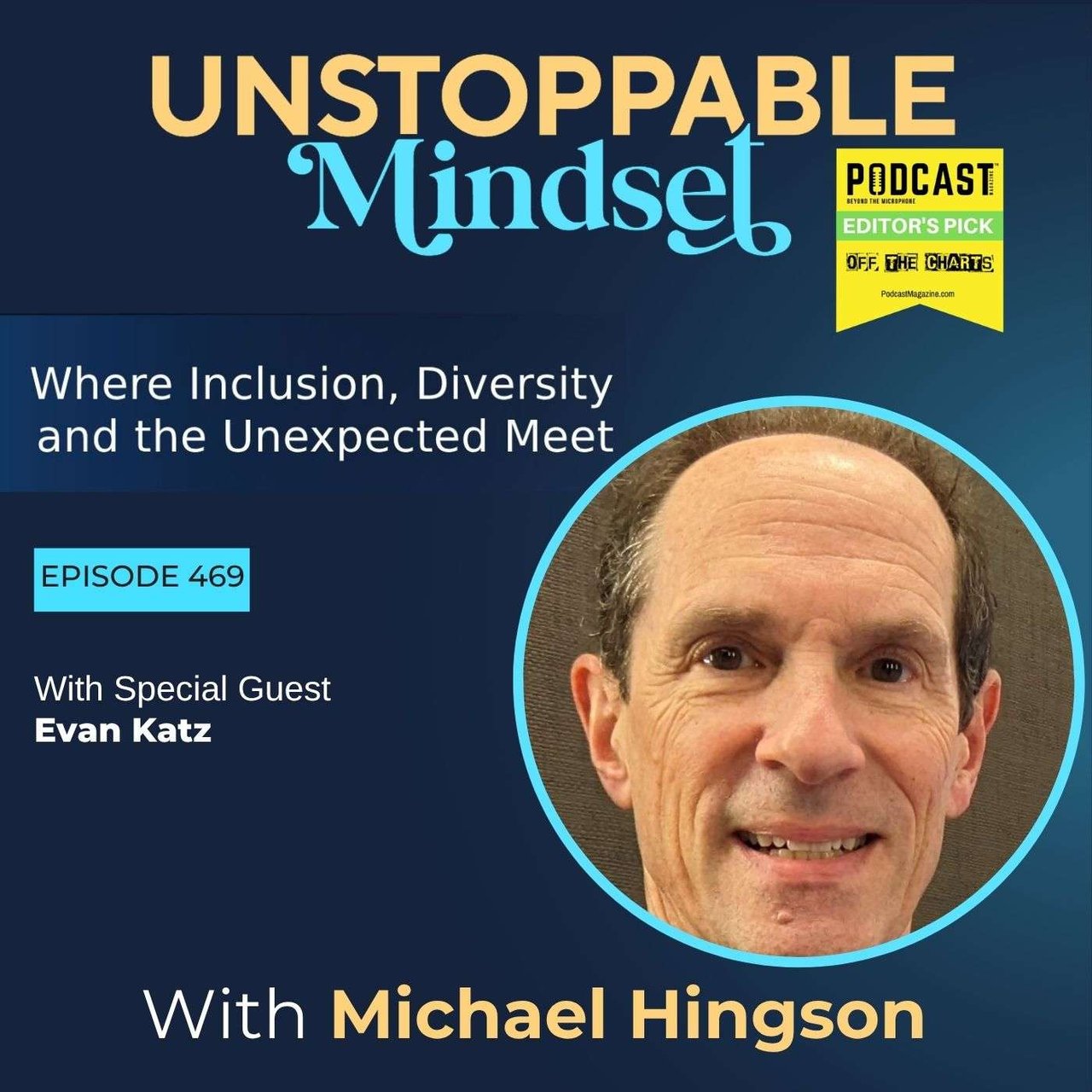
Episode 469 – Becoming Unstoppable Through Fear, Failure and Baseball with Evan Katz
It is never too late to chase a dream, even one that has waited decades for its turn. My guest, Evan Katz, built a career in journalism, public finance, and local government before taking an unexpected path into professional baseball. After first playing organized baseball at age 45, Evan became a professional player at 61 and later coached professional baseball at 69. We talk about how fear can become motivation, why setbacks can be powerful learning opportunities, and how skills gained across a lifetime can prepare us for challenges we never expected to face. Evan also shares what he learned from calling himself the “least qualified coach in professional baseball,” and how listening, mentoring, and supporting others became some of his greatest strengths. His story is a wonderful reminder that personal growth, career change, and lifelong learning do not come with an expiration date.
Highlights:
02:47 – How family work ethic shaped Evan’s drive.
11:26 – How fear can become motivation.
13:08 – Why setbacks can become learning opportunities.
35:06 – What local government taught Evan about growth.
42:29 – Why he started playing baseball at 45.
53:37 – How he became a professional baseball coach at 69
About the Guest:
Evan grew up in Brookline, Massachusetts two miles from Fenway Park in the 1960s and quickly learned the emotional highs and lows of being a Red Sox fan. When the Red Sox won the World Series in 2004, after an 86-year championship drought, he rang church bells to celebrate.
After a long award-winning career in municipal and public school finance in Massachusetts, and raising a family of four with his wife Liz, Evan began his late-life baseball career in earnest at age 65. He was an assistant high school coach for three years, and documented the team’s Massachusetts state championship in the story “No Earbuds in the Outfield.”
Evan Katz’s pro baseball career began at age 61 when he pitched for the White Sands Pupfish of the independent Pecos League in 2017.
When euphoria subsided and his infinity ERA began to sting, Evan returned to the Pecos League at age 67. With the Austin Weirdos he became one of the oldest pitchers ever to start a minor league game and lowered his ERA to 29.25
After an aborted stint as pitching coach with the Roswell Invaders in 2024, Evan returned to the Pecos League in 2025 as bullpen coach of the North Platte 80s.
As the 80’s scout he recruited players for the second-year Nebraska team. As bullpen coach he supported the North Platte pitching staff which anchored the team’s 27-21 record and helped the team reach the second round of the playoffs.
And this despite just three years as a high school coach, and no college coaching experience. There were more than 2000 coaches among nearly 300 major, minor and independent pro baseball teams and Evan was the least qualified.
To share his second career in baseball and other inspiring baseball stories, Evan manages his baseball website “Baseball by the Sea Media.” It includes exclusive feature stories plus biographies and game stories published by the Society for American Baseball Research. It also links to the 2024 award-winning two-season podcast he co-hosted with Bruce McClure, “Baseball’s Last Frontier: Stories from the Pecos League.”
Ways to connect with Evan**:**
https://sites.google.com/view/baseballbythesea/home
https://www.linkedin.com/in/evan-katz-351554b/
About the Host:
Michael Hingson is a New York Times best-selling author, international lecturer, and Chief Vision Officer for accessiBe. Michael, blind since birth, survived the 9/11 attacks with the help of his guide dog Roselle. This story is the subject of his best-selling book, Thunder Dog.
Michael gives over 100 presentations around the world each year speaking to influential groups such as Exxon Mobile, AT&T, Federal Express, Scripps College, Rutgers University, Children’s Hospital, and the American Red Cross just to name a few. He is Ambassador for the National Braille Literacy Campaign for the National Federation of the Blind and also serves as Ambassador for the American Humane Association’s 2012 Hero Dog Awards.
https://www.facebook.com/michael.hingson.author.speaker/
https://www.youtube.com/user/mhingson
https://www.linkedin.com/in/michaelhingson/
Thanks for listening!
Thanks so much for listening to our podcast! If you enjoyed this episode and think that others could benefit from listening, please share it using the social media buttons on this page. Do you have some feedback or questions about this episode? Leave a comment in the section below!
Subscribe to the podcast
If you would like to get automatic updates of new podcast episodes, you can subscribe to the podcast on Apple Podcasts or Stitcher. You can subscribe in your favorite podcast app. You can also support our podcast through our tip jar https://tips.pinecast.com/jar/unstoppable-mindset .
Leave us an Apple Podcasts review
Ratings and reviews from our listeners are extremely valuable to us and greatly appreciated. They help our podcast rank higher on Apple Podcasts, which exposes our show to more awesome listeners like you. If you have a minute, please leave an honest review on Apple Podcasts.
Transcription Notes:
Michael Hingson 00:04
What if the biggest thing holding you back isn’t what’s in front of you, but rather what you believe? Welcome to Unstoppable Mindset, where inclusion, diversity, and the unexpected meet. I’m your host, Michael Hingston, speaker, author, and advocate for inclusion and possibilities. This podcast explores how the beliefs we carry shape the way we live, lead, and connect with others. Each week, I talk with people who challenge assumptions, face adversity head-on, and show what’s possible when we choose curiosity over fear. Together, we focus on mindset, resilience, and the small shifts that lead to meaningful change. Let’s get started. Hi, everyone, and welcome to another Unstoppable Mindset podcast episode today. We get to chat with Evan Katz, and Evan’s got an interesting life, especially since, if you will, he started the second part of his life, or maybe it’s not the second, maybe it’s later, of being a professional baseball coach at the age of 61. Well, we’re going to hear about that. Evan lives in Massachusetts, in Swampscott, grew up in Brookline, which was very close to where the Red Sox play. I’m sure he’s got lots of stories that we get to talk about with that. But anyway, Evan, I want to welcome you to Unstoppable Mindset. We’re really glad you’re here.
Evan Katz 01:42
Thanks, Michael. I really appreciate the invitation. I I think that I’m excited to be part of a show with with with the theme that that you emphasize because I think that that when you reached out to me to ask if I was interested in in sharing some of my life experiences, I realize that there’s a there’s an unstoppable part of my mindset that has allowed me to achieve some things I didn’t think were going to be possible.
Michael Hingson 02:10
There you go. Well, you know, a lot of times we plan, and what we plan doesn’t always necessarily go exactly the way we thought. But that’s okay. It’s it’s a question what we do with it and what we learn from it. I suppose why don’t we start by you telling us a little bit maybe about the early Evan growing up and and all that. And I know that you had mentioned that you think you actually got your kind of unstoppable mindset attitude from your parents and all that. So if you want to talk about that as as we go, you’re welcome to. But anyway, why don’t you start by telling us a little bit about the early Evan, if you will.
Evan Katz 02:42
Sure. Well, you know, as you mentioned, I grew up outside of Boston in the town of Brookline, which is about two miles from Fenway Park. I’m a baby boomer. My my parents worked really hard, and they they worked hard to get their first house. They worked hard to fix it up. My mother was at home. My father worked in his parents’ hardware store and was always fixing up the house. We ended up upgrading houses because of all the work that he did. And my mother, although she wasn’t working, you know, she was involved in local politics, trying to improve the schools. And one of the stories I told when she passed away a number of years ago that she was so effective about mobilizing people to make changes in the school system. One of the school principals said to somebody else, "Get that Pawnee cats off the phone,
Michael Hingson 03:34
because of course
Evan Katz 03:35
at the time telephone was the only way to connect with people. But you know she had her unstoppable mindset in terms of making changes in public education in Brookline, my dad in terms of living the dream that he had for his family, and I really think that that in my own way I picked up that same hard worth it work ethic, and it’s popped up along the way throughout my my life and my career. I
Michael Hingson 04:00
I know what you mean. I know my parents were somewhat the same way. My dad worked at. Well, we moved to California when I was five, and before we moved, we were in Chicago. And he and my uncle owned a TV repair shop, and my dad left that to move to California. Wanted to do that anyway, but he began working at a government installation, was called Plant 42, and then later transferred to Edwards Air Force Base. My mom stayed home for a while. She actually helped sell real estate, helped sell some of the houses on the street where we moved because they were they were brand new, and the real estate people trusted her, so she she did some of that. Don’t know what she earned or how all that worked, but but she did okay. But my dad worked, and I I feel very blessed. They they clearly taught me a lot, and I value very much their work ethic. I know what you’re talking about.
Evan Katz 05:01
Well, family is a great resource, whether it’s your immediate family or extended family. And also, again, at the time that that I was growing up, most of our extended family lived right in the area, so there was a lot of connecting with cousins and uncles and grandparents. And I think that had its own way of shaping because we had a pretty hardworking, determined family, and I think that got passed on again, not just in my parents, but from my extended family as well. We
Michael Hingson 05:28
had aunts and uncles and cousins. A lot of them were in Chicago. Then aunt and uncle and their two boys and our cousins moved out to California, but it was long after we moved. And then our next closest relative was actually up in the San Francisco area. Aunt Bella and Uncle Oscar owned a shoe store, and but and there were some other people who we called aunts. I’m not sure that they actually were, but aunts and uncles. But they they lived in the L.A. area. But most of our relatives were not very close by. Well, that’s that’s fine, but value the relationships nonetheless. So what was what was school like for you? Well, elementary school and high school and so on.
Evan Katz 06:22
Well, I went to the local elementary school, and as I think, as I as I suggested, it was one of the schools that was being neglected by the town. My mother and her friends advocated for equal resources. It was also during the time where Christmas carols were being sung in school, and it was not something that my parents thought was appropriate. I was Jewish. There were other Jewish kids in school, not very many, and just didn’t seem like this was the thing that should be happening, given where our country was at the time. And so I did well in elementary school. I mean, the interesting thing was I skipped kindergarten, so I was always the youngest and the slowest on the playground, and it actually contributed to my not participating in sports through my early years and into into high school, which we will we’ll hear more about that later. But I got a good education. I loved numbers. I learned in high school after I had horrible year my sophomore year writing. I was determined to learn. I took a couple of English classes from mr. Carey at Newton South High School. Learned to become a good writer, and ultimately that led to my writing on college newspapers and becoming a newspaper reporter. My first job out of college. So, you know, the kind of thing when you go through school, you try to figure out, you know, what are the things that that that sing to you. And first, it was numbers for me, and I ended up going into a career in public finance, and then the writing, which I ended up becoming a newspaper reporter, put that on hold. And about 10 years ago, or eight years ago, I started a baseball social media website, and I ended up writing baseball stories. So, so here I am in my my my formative years in school, taming numbers, becoming a CFO in the public sector, and becoming a good writer-they got me through life.
Michael Hingson 08:33
How did you end up being able to skip kindergarten?
Evan Katz 08:37
That was back in the day. They didn’t have minimum age requirements. If you pass the test, you you got to go right to first grade.
Michael Hingson 08:44
Ah, well, I know I went to kindergarten in Chicago, and you started in Chicago at age four. Then we moved to California, and the problem is in California you couldn’t start kindergarten till age five, but I had had a year of kindergarten already, but they wouldn’t let me just go to first grade because I was only five, so I ended up with two years of kindergarten. And I’m not sure that second year was all that exciting for me, because kids were drawing and doing all sorts of stuff that I wouldn’t do being blind. But we coped, and we got through it. I also did love numbers and so on, and my dad taught me how to do math in my head, so I was really doing well with math. And my my mother helped me with spelling tests and reading other material to me, and so on. So we got through it, and again, they took that on without any remorse at all, which, as I think back on it, was just part of their gutsiness and their unstoppability. Because the doctors told them that no blind child could ever amount to anything, and they were going to prove the doctors wrong. And I would like to think that they did, but we. We went through it, and I didn’t actually. I learned Braille when I was in kindergarten in Chicago, but then didn’t have access to Braille till the fourth grade out here in California. Yep. Yeah. Well, but my my parents read and kept me up with everything, but still it was a problem. But then I got Braille again, and so it all worked out, but I, but I, but I know what you’re saying. It still gets back to the work ethic, and our parents were gonna do everything they could to make sure we all succeeded, didn’t they?
Evan Katz 10:32
Well, and I think also, Michael, you’ve touched on it, and I did as well. You know, there are things, there are areas we go into, whether it’s school or work or relationships, we’re blessed with certain talents and traits, but we also have areas that are not our strengths, and we’re always having to work to figure out how to how to compensate for our areas of call it weakness or limitations, and also how to allow our strengths to to overcome those and and then to help generate success.
Michael Hingson 11:05
Yeah, and and we do need to do that. And and the reality is that we’re all generally better at some things than we are at other things, but we can make it work if we if we try. I wrote and published with a colleague, Carrie Wagg Kent, two years ago a book called *Live Like a Guide Dog* which is all about learning to control fear and its life lessons that that tell us that fear doesn’t need to overwhelm us or, as I put it, blind us. That that we can use fear as a very powerful tool to help us, and I mention that because there are so many things that we fear in the world, and most of them we don’t have any control over. I mean, I know that there are things that that I don’t get to do right now that other people do because they can see different things. But at the same time, I have gifts that most of those people never either learn to use or choose to use or can use, and so we all have to work together to make the world successful. And I think that’s the big issue.
Evan Katz 12:11
Well, I think your point about fear is really important because we we all have fears, we all have worries, and fear can be paralyzing, and but it can also be motivating, and I think it’s important that if you get into a situation that that you’re concerned about or worried about, you should acknowledge that you’re in something. Maybe you’re over your head, and we’ll talk about my coaching a professional team at age 69 without ever having coached college baseball, going right from high school coaching to professional coaching, that was the hardest job of my life, and that fear motivated me to figure out how am I going to come up with those compensating skills? How am I going to be able to succeed? Because I want this to succeed not just for me, but for the players around me. So, so fear. It’s important to to recognize it, and so that you know that it’s there, but also be able to take advantage of what fear can motivate you to do.
Michael Hingson 13:13
Well, and fear doesn’t need to paralyze you unless you let it. And that’s the the big issue: is that we don’t learn generally how to control fear and to use fear in a positive way. We worry about so many things over which we’ll never have control because we just don’t, and we let all of that worry us, and that that certainly adds so much to the fear levels that we face, and if we would only learn to just focus on what we can control, that doesn’t mean you don’t be aware of other things. But don’t worry about the things over which you don’t have control. It will help your life a whole lot.
Evan Katz 13:53
And another aspect to that is, and I and I learned this, and as I mentioned, I worked in the public sector for for for almost 40 years, and I came up with the phrase at one point, and I I don’t remember the circumstances. And somebody said, "I don’t know if this is going to work. I don’t know if we have the money. I don’t know we have the people. This may not be a good solution, or the operation may not work. And I said, "Well, I think we have to see if it fails because if it fails, then we’re going to learn something. Obviously, we didn’t want anyone to lose a job or to get hurt. It wasn’t failing in that regard, but but the you have to have enough courage so that if something isn’t going to work, you can use that as as a learning opportunity as well, so you can’t have fear of failure either. Because then we can all look back. You’re old enough. I’m old enough to look back on our lives and see those learning moments. Many of them came from times that didn’t work out so well,
Michael Hingson 14:55
which doesn’t mean that we failed. And I think that’s the big issue. I think we have to deal with. Failure is is something that we have to really get over thinking about because failure isn’t really it. What what it is is that things didn’t work out the way we planned, but that doesn’t mean that we failed, which means we just can’t go on. We’re we’re stuck. It’s it’s a learning experience, and that is part of what dealing with fear is all about. Is rather than worrying about it. All right, so this didn’t work. Don’t fret. Don’t worry. Don’t panic. What did you learn from it? How do we get beyond that? And that’s the thing that we generally tend not to do very much: is to do a lot of self-analysis in our own lives. Take time at night to step back and look at what worked during the day, what didn’t work, and the what didn’t works weren’t failures, but they were learning opportunities if we take advantage of our own skills to develop our mind muscle to do that.
Evan Katz 15:57
Absolutely, I
Michael Hingson 15:58
think that’s that’s so important. Well, so for you, you you where did you go to college?
Evan Katz 16:08
I graduated from Newton South High School. We went from Brookline to Newton in the 70s. I went to a small college in Western New York, Alfred University, for two years, and ultimately graduated from Colby College in Maine in 1977. As I mentioned, I wrote for both the newspapers at Alford and Colby, and that’s where I got my my my journalistic experience back then. Writing for college newspapers was was a big deal back then,
Michael Hingson 16:39
yeah,
Evan Katz 16:39
and that worked out really well. I was going to go into teaching. That was my original plan. I did some internships in college. I even, when I was at Colby, I took a semester and helped out at a small fourth grade class in neighboring Oakland, Maine, helping out kids doing lessons in the in the corridor and in the back of the room to help them with their math, but when I left college, I had done enough writing, primarily sports, that I decided to to follow journalism. But the college years were really an eye opener for me. As I mentioned, I was a year young. You know, I was the drinking age was 18, and I was still only 17 and a half when I went to college, but somehow my IDs got me through into the pub. But it was a really eye-opening experience going to college in New York. I’d been in Massachusetts my whole life and was in a small town in Western New York, and it was just so eye-opening to see a part of the country and people that were very unlike where I lived in terms of Alfred. Most of the kids were from New York, and then going to Maine, they were more from New England. But it was just a real eye-opening experience. I think we all go through that in our late teens and early 20s, really beginning to discover, you know, who we are, what situations are we comfortable in? We test ourselves. We do crazy things, and it all turned out okay because I was able to get a job right out of college.
Michael Hingson 18:11
So teaching was your plan, but it didn’t go that way.
Evan Katz 18:16
No, it didn’t. And interestingly enough, I was looking back through my father’s memorabilia when he died, and I think I knew this, but I was reminded that he wanted to teach originally, and he actually was a mentor to many people during his working career. And he took great pride and went to the Peace Corps actually for a number of years in his 60s, and so you know the whole teaching mentoring thing ran in our family, so I guess it’s kind of ironic that I ended up coaching baseball at age 65 as a as a teacher and a mentor. But but the college experience, you know, I still think about it. I just sold my vinyl records. It was it was a little traumatic, but I did sell my vinyl records recently because I can listen to everything over the internet now, and but that was a water watershed moment selling my vinyl that I listened to in college for all those years.
Michael Hingson 19:14
I still have mine from working at the campus radio station. I got a lot of records back here, and I I am somewhat of the opinion of the I don’t know whether I would call them snobs, but I still think the best quality is still vinyl.
Evan Katz 19:30
Well, as you know, Michael, one of the best attributes of vinyl records is when they were originally the songs were compiled and sequenced. It was they were designed to listen through the whole side of an album.
Michael Hingson 19:44
Yeah,
Evan Katz 19:44
and I mean obviously Pink Floyd was classic, and I’m sure that there were others that come to mind that I can’t think of. And I was a big fan of the Doobie Brothers, and to this day I’ll still turn off my radio in the car and put on a couple of Doobie Brothers albums and listen to them straight. Same with Chicago. It just the music was meant to be arranged, you know, for half an hour or 35 minutes, not just three and a half minutes. And I think a little bit of that has been has been lost with today’s music.
Michael Hingson 20:13
Yeah. Well, I think there’s there’s truth to that. And I even go back further. I’ve been a fan for many many years of big bands, primarily Swing, Benny Goodman, and and so on, but also doop and early rock. But I and I like some of the other rock. But I’ve never been a great heavy metal fan. But that’s okay. Some people like it, and then that’s fine too. But I really enjoy my records as well, which is a lot of fun. Yeah, I
Evan Katz 20:42
did listen to Van Halen cassettes driving. Somehow, a Van Halen arrangement wasn’t quite the same as Chicago. No,
Michael Hingson 20:50
no, it is a little bit different. There’s no doubt about that. So, what was your job that you ended up getting out of college?
Evan Katz 20:57
I ended up worked as a stringer, which I don’t even know if there are any anymore, but I think I got paid 10 cents an inch for covering soccer for the Newton graphic. I covered the Newton South soccer team, and also I I don’t know how much an hour I got. I covered the Westin Wildcats. That’s a small town west of Boston for the Westin Town Crier. That’s how I got started in journalism, and I ultimately was hired as a part-time reporter by the Walpole Times, which is small town southwest of Boston. And I eventually became a full-time reporter there, covering town government, writing feature stories, learned how to use a 35 millimeter camera. We we had our own darkroom there, and I thought it was so much fun going out to meetings, interviewing people, compiling stories. It was just it wasn’t like work. It was it was it was exciting, and it paid the bills, and I was living on my own for the first time.
Michael Hingson 22:06
That didn’t get you to graduate to things like going into television on WEEI and doing sports for them, huh?
Evan Katz 22:13
No, the the the written word at the time, and even today still is is where I am. Although, as I joke with my friends, just put a microphone in front of me, and I’ll start talking.
Michael Hingson 22:26
So that’s okay. Well, so how long did you write? And then what happened
Evan Katz 22:32
was, so as I mentioned, my mother was very involved in local government, and I grew up in Brookline. And the interesting thing was, I was covering the planning board and the school committee in Walpole, and I’m I’m going to the meetings and I’m listening to them talking about the issues that they’re dealing with, and I’m thinking to myself, so this is what 1979. I’m 23 years old, and I’m thinking, I mean, I can do better than this. I mean, listening to these these people talk about how they’re going to solve problems, and I said, I think I can really help. So, the local legislator from Walpole, his name was Frank Woodward, had an opening in his office, and I started working as a legislative aide for him, working in the state house. It was very exciting. My mother was so proud. When some one morning in March, I don’t know if it was 1979 or 1980, and I walked up the steps of the State House. Big blue sky in Boston. It was a big golden dome. I’ll never forget. I walked up the front steps, looked up at the golden dome and the big blue sky in March of whatever year that was, so excited. My mother was so proud. My dad was too, obviously. And then I got involved in government, and that’s where it all started. Working in the state house to really begin to understand the importance of issues. You know, it wasn’t just local government, but how the state government intersected with the federal government, and how much how how important government is to making people’s lives safe and protected.
Michael Hingson 24:07
Yeah, and I think that is that is something that although there is certainly a lot going on today that is not necessarily the the model of what government ought to be, probably, but still, government and what the House of Representatives and the Senate do at the federal level, and what happens at the at the state house and in the state government is really important. And I wish more people would seriously get involved with it, and and do it from an ethical standpoint. But you know, we, I guess, we go through through different kinds of eras of how things work.
Evan Katz 24:54
Well, it’s interesting in the tumult that we’re going through here. I recently had a chance. Last month to go to England with my wife. I hadn’t been there for a while, and and I was really struck by how the history dates back centuries and centuries and centuries prior. You know, to 1066, I guess is one of the lines in the sand or the dirt in England. But when they started the more modern era, and what I was really struck by when you think about a country like England and all the difficulties, all the changes, all the times that they were under threat from external forces, internal forces, all the chaos, and somehow they’ve survived. And I think this is one of the real attributes of Great Britain. And I just began to think about what we’re going through here, and I think I have to be hopeful in the same way.
Michael Hingson 25:56
Yeah, I agree that
Evan Katz 25:57
that that we’ve been here for 250 years. I know it’s short compared to England. Supposedly, one author says that republics die after 250 years. I don’t know if I buy that necessarily, but but the point is that that that I think somehow, some way, we’re going to survive this because other countries have been through much more over much longer periods of time, and here they are. And 2026 is stable, viable countries.
Michael Hingson 26:25
Yeah, and they’re still there, and they’re going to be there. And I agree with you. I think that we’re we’re going to continue, and maybe republics die after 250 years, but it doesn’t mean they have to. And I think that’s that’s part of it. So what did you what did you do in terms of you you went to work in the state house or what did you do?
Evan Katz 26:48
And I was a legislative aide, so we would get information on legislation, take a lot of constituent phone calls because at the time the only time only way you got a hold of your legislator was either make a phone call. Of course, I think from Walpole to Boston, it might have been a toll call at that time. So maybe we got more letters from Walpole. I don’t know, but constituent constituent concerns, working with state agencies to resolve things, and and it just got me acquainted with with with how government works, and it just gave me an appreciation for what it takes to make government work for for the the residents of Walpole and a couple other nearby towns, and also you get to see the the leaders of the state at that time the the Senate President and the the Speaker of the House, and you get to understand a little bit more how they show leadership and what skills and attributes work well, and what ones in your mind don’t work well. But the whole bottom line is, you know, how is it working for the constituents? And to me, that became more and more important. Is what’s the bottom line here? It’s not about power. It’s not about success at the legislator. The bottom line is the impact on people.
Michael Hingson 28:13
Well, I remember that when I lived in Winthrop, every year I would go with people from the National Federation of the Blind, we went to Washington every year. Five, 600 of us descended on Washington and visited all of our legislators. And I remember actually once having the opportunity to set up an appointment and meet with Tip O’Neill. What an amazing guy he was! Yeah. But then also there was a new congressman who had just joined, Ed Markey.
Evan Katz 28:45
Oh sure.
Michael Hingson 28:46
Now look where he is. He’s but but it was it was so much fun seeing Congress in action and actually being a part of it, talking about different kinds of issues, and of course it got to meet Ted Kennedy and also Paul Songas along the way as well. And I and I also was involved in things in in Massachusetts because one of the problems we had in the early ’80s in Massachusetts and around the country was that blind people couldn’t buy life insurance because the life insurance companies said we’re a higher risk, we’ll have a higher mortality rate, and finally, to keep the story short, we discovered that unlike what insurance companies say they do, which is they make their determinations always based on actuarial statistics, evidentiary data, and they create mathematical models based on evidence. They had absolutely not one single solitary thing to show that blind people or other people with disabilities were a higher risk than anyone else. So I worked back in the late 70s, early 80s with I don’t you may. I’ve known him, Al
Evan Katz 30:02
Sagasi. I recognize the name.
Michael Hingson 30:03
Yeah, and so he he helped us shepherd a bill through that eventually eliminated discrimination in dealing with life insurance in Massachusetts, and and actually was something that passed in every state that all all the states dealt with that because the insurance companies were just playing games, which was so unfortunate. So when I was growing up, my parents couldn’t insure me. When I was in college, I couldn’t buy life insurance, and and eventually it got addressed. But it was, and it still is fascinating to think back and be a part of making a difference and really working to help constituents and help the legislature.
Evan Katz 30:48
Well, there’s a great example of numbers not being in action. You know, they’re hiding behind perceived numbers, and then you do do a little bit of digging, and you find out that it’s not quite as fact-based as they made it sound,
Michael Hingson 31:02
yeah, and in fact there was no fact, and but still we worked through it, but the process was, I think, and still is for me one of the most fascinating things to to be able to go and be a part of dealing with things and and hopefully getting legislators to deal with issues and I’m not sure that there’s as much of that that’s happening today with everything going on but it’ll come back.
Evan Katz 31:34
Not not in Washington anyway. I think you’ve got to look to the states more than Washington. Washington’s an anomaly right now.
Michael Hingson 31:42
Yeah, Washington is really a big problem, and and but it’ll it’ll it’ll switch at some point. I hope. I think it’s going to have to, but but we’ll see how it goes. If
Speaker 1 31:55
you enjoy Unstoppable Mindset and would like to help us continue bringing these conversations to you each week, we’ve created a way for you to support the show. Your contribution helps us cover production costs and continue sharing stories, insights, and ideas that inspire people to live with purpose and possibility. If supporting the podcast feels right for you, you’ll find the link in the show notes, thank you for being part of the Unstoppable Mindset Community.
Michael Hingson 32:27
So you you went to work and you were legislative aide. How long did you do that?
Evan Katz 32:32
Actually, not not. I think it was a little over a year because I ended up working on a referendum campaign. There’s a thing in Massachusetts to limit property taxes, that’s called Prop Two and a Half, that passed in 1980. I ended up working for Representative Woodward and a couple of other reps. There was an alternative on the tried to get on the ballot as an alternative to Two and a Half that wouldn’t be quite as dramatic. Although I think, looking back as someone in the public sector, I think it’s a good thing that Prop two and a half passed, but I got involved in working on a referendum campaign as an alternative to Prop two and a half. It didn’t pass, and then at that point, I decided needed to get some professional training, and I went to get my graduate degree in public administration from the Kennedy School at Harvard, so I would have more credentials and I could really get into local government, and that really opened the door. Once I got my master’s degree, I ended up working for the state. I think I mentioned my mother and family were from were from Brookline. We were acquainted with Governor Dukakis, and my mother worked actually very close with Govern was very close with Governor Dukakis, and he really encouraged me to go to graduate school, and I ended up going to the Kennedy School. And from there, I went and worked for his administration. The Massachusetts Department of Revenue started a division to support local government finance. It was really very innovative at the time in the early ’80s. You know, cities and towns were separate. The state was just a regulatory reagency, and Governor Dukakis wanted to create an agency that could be a resource to local government to help them make better decisions. We created a municipal data bank to try to gather information to get to gather statistical information and ultimately help guide cities and towns to budget better, to plan their capital budgets better. And I was involved in the formation of that bureau in the Mass Department of Revenue. It was called the Division of Local Services, and I ended up working there in the early ’80s, to really get a feel for how state government worked, state aid, and all that sort of thing, and then I learned enough there and decided to go out and see what it was like myself to work in a city or town, and that that’s was around 1980. So I got my training at is in graduate school, learned more in state government, and then in the mid ’80s went out to work in town halls and and city halls, and that that talk about fear, that that was frightening.
Michael Hingson 35:18
It was a new experience.
Evan Katz 35:20
Absolutely, you know, you you you you’re in the state house, and there’s there’s 240 state reps and 40 senators, I think, all kinds of legislative aides. You’re working in a state agency, and it’s a whole bunch of 20 something and 30 something colleagues and bosses and this and that. There’s always someone you can ask, always someone that can support you. You go to a town hall, and there’s there’s three clerks and a bunch of select board members. In Massachusetts, there are boards of selectmen in the small towns, or the select board now. Back then, it was select men, but you’re on your own out there, and it’s very, very different. You know, having a bunch of colleagues to support you in the big city when you’re out in the small town of Groton, 40 miles from Boston, with 7000 people, and you’re the resource in town hall. It’s a lot different.
Michael Hingson 36:18
I was just going to say that you you became the resource that people look to.
Evan Katz 36:24
Yeah, and and so you take your professional training and you begin to develop some of those personal skills. And how do you relate to people? How do you gather information? How do you recover from from your mistakes? How do you make sure you have enough successes so that you got a good success to mistake ratio? But it’s it it is very scary. I mean, I was what how old in 1986? So I was 30 years old, and it never. And I wanted to work in a small town, and I did, but it was a real, real eye-opening experience. But by the same token, you know, one of our biggest fears-you’re the only person. One of the greatest attributes to the situation was you’re immersed in everything. You learn everything. You learn about the police department, the fire department, which was a call department at that time. You know, if there was a fire, all the firemen, there might have been a couple of women as well, went to some went to the station to get the truck, and some drove in their cars to the scene of the fire, and and and you get a small town with one police officer on duty, you know, from from 11 to seven, you got a water department with two employees. You really get a feel for what’s important and what isn’t, and how do you make the system go, and what do you do in an emergency, and how do you plan for the future? And so it was it was it was frightening at one level because you’re on your own and you’re learning a brand new thing, but at the same time you’re immersing yourself so deeply, and you’re learning so much that that that that you’re growing, you know, professionally and personally at a very very fast rate.
Michael Hingson 38:16
And although you may or may not realize it at the time, those fears that that you started with slowly would be dissolving away because you were learning how to deal with things, and you were discovering that you had the ability to deal with things, and so you became less afraid in a positive way.
Evan Katz 38:37
Right. Well, you know, you all know that the cycles in in businesses and cities and towns, and it’s all in an annual cycle, the budget cycle, and you know you get through the first year and you start doing it again, and you’re doing it again, and you really then you begin to expand your knowledge base. You’re willing to to to experiment a little bit more, and and you’re growing again at a very fast rate because you’re able to do more and more that you weren’t able to do when you first got there.
Michael Hingson 39:10
Did you ever run for any office?
Evan Katz 39:13
Actually, I did. When I left Groton, I finance was my area of interest, as as I mentioned earlier. I was hired by the city of Medford, which is just north of Boston, up Route 93, probably I don’t maybe 810 miles north. And when I was working there, I was the city’s finance director. You talk about culture shock, so I go from the small town of Groton with seven people to a to a 50,000 the city of 50,000 with a with a palatial city hall right off Route 93 and but I was chosen for because of my background in finance. And when I was working there, I decided that the town of Groton might benefit from my experience as an elected official. So I was working in Medford as finance director, and I ran for assessor in Groton to get started. Elected assessors to value properties and administered the taxes, and then ultimately I ran for select board a couple years after that.
Michael Hingson 40:27
Were you elected?
Evan Katz 40:29
I did. Yeah, I won. Okay. And here’s another thing that I learned. You know, I haven’t always seen elected boards, whether it was the select board or city councils or legislators, you see elected officials in action at meetings and talking about problems and making phone calls, but you forget there’s a lot of other work that goes on behind the scenes when you’re at home at night and when you run into somebody on the street. And so I was I was very prepared for the for the technical aspects of it, the problem solving, but I forgot about the time that it takes when people call you or have a have a have a problem with a nearby dog, or someone put up a fence, or the traffic on my street is going too fast. You have to call people. You got to follow up. You got to again. Back in the old days, it’s all by telephone. So the amount of time that it took to resolve problems and have meetings, I forgot about the the the extra time that it takes when you’re an elected official to do that behind the scenes stuff. But but I enjoy doing that as well.
Michael Hingson 41:41
Yeah, I’ll bet. And you know, it it is just it it you figure out that that’s part of what you have to do. And again, I think the big issue is in figuring all that out is learning to recognize that’s part of what you have to do, and accepting that that’s definitely part of the job, and not trying to blow it off, not trying to get angry at people, which all too often happens today, I think more than it than it needs to. But it is part of the job. It’s all part of the job, and no matter what, that hasn’t really changed.
Evan Katz 42:19
And I think it’s I think it’s in any job, and I think people have perceptions about certain types of jobs, whether it’s you’re you’re you’re a plumber, a truck driver, a lawyer. You know, people understand the responsibilities at the surface level and the visible level, but they’re they’re not as aware of what goes on behind the scenes, what it takes to to get things going, and and I think that’s probably not and maybe underappreciated in some situations about what it takes to to to do things behind the scenes that are not as exciting, where there’s more drudgery, and and and the amount of time that it takes to get you into the seat of the truck, to get you to have a meeting with clients, if you’re some kind of professional, if you’re a doctor, there’s there’s there’s a lot more to any job, and I think that that that it’s important to recognize it for ourselves. You know, it’s not just the let’s call it the glamorous part of the job.
Michael Hingson 43:29
Yeah,
Evan Katz 43:30
there’s the behind the scenes part of the job, and the same goes for all jobs. And I think it’s important to remember that.
Michael Hingson 43:36
I agree. Well, you did all this work, and you kept doing it for quite a while. So, what got you into baseball, other than being a fan? But you know,
Evan Katz 43:46
well, loyal Red Sox fan, been to Fenway hundreds of times, as I mentioned earlier. Was started school a year early, so I never played sports, and my kids in my 40s had finished little league, and they were all done with their sports careers at that point. And I decided I wanted to play baseball at age 45.
Michael Hingson 44:14
There you go. I had
Evan Katz 44:15
never played. I had never played little league. I never played high school. Never played college. And at age 45, a friend of mine who I grew up with in Brookline, he encouraged me to go to a baseball camp in Florida in 2002, and at that point, my my interest in baseball and my fandom in baseball expanded to becoming a a player and having to learn about the game as a player, not just as someone watching the game.
Michael Hingson 44:47
And what did your wife think of that?
Evan Katz 44:49
Well, my my wife will mention that my my wife Liz, our first date was on march 30, 2002, and that was the date. Of my first baseball practice in Massachusetts, so she has been there from the beginning of my baseball career. And if it wasn’t for her one acceptance of it and her support of it, I never would have been able to achieve and enjoy all that all that I have, but she she is is is my biggest fan and supporter.
Michael Hingson 45:29
That’s great. She’s a Red Sox fan, I would presume.
Evan Katz 45:33
Yeah, Red Sox fan. Yep, and you know we watched them clinch it in 2004. We’ve been to Fenway together, and you know she, you know, like I played adult baseball, and and you know the when guys join, their spouses or girlfriends come the first for a bunch of games in the beginning, but then they just lose interest. Understandably, it’s you know it’s old man baseball. It’s not like it is on TV. She she comes from time to time, but but she she’s got her own life to live now. So that’s okay.
Michael Hingson 46:05
Well, so so tell me how baseball progressed for you. So you you started working at playing.
Evan Katz 46:15
Yeah. So I went to this baseball camp in Florida, which I actually just came back from. It’s called the Ponstellion Baseball Camp, and it’s from a league in Washington, and they started going down for a week of what they call spring training. Well, for Washington, baseball starts a little earlier, Washington D.C. So we go down the end of January, and you know, getting on the field isn’t too far away as long as there’s no snow on the ground in the DC metro area. But I started going to that camp in 2002, and there was a group of professional coaches at this camp who were major league and minor league affiliated, and they have been coming to this camp since the beginning. This is now 2026. They’ve been going to the camp as long as as the longtime players, and so what happened was, you know, I was playing adult baseball, and there was a year where it rained a lot, and we had games postponed, and I’m driving around Fort Myers, and I think I was 60 years old at the time, so this would be 2016. And I said to myself, you know, what would be the chances that I could find a minor league team that would let me play, so I could live my dream of being a professional baseball player? And I grew up around in Brookline. I collected baseball cards. I played imaginary baseball games in my yard. Played wiffle ball with my friends. Watched the Red Sox on TV. You know, it’s been in my blood since I was a little kid. And of course, many little kids want to be professional basketball players, hockey players, football players. Well, for me, it was baseball. So here I am, 60 years old, and I asked a couple of people at the camp. One of them was Stan Clyburn, played for the Angels in the 80s, and he’s managed in the minor leagues for 1000s of games. He’s still managing to this day. And Steve Little, who was a coach at the time with the Twins, I asked them, "Do you think I could find a minor league team that would allow me to play for them, so I could live my dream, play professional baseball? And they said, "Sure. Oh yeah, you you should give it a shot. And they gave me a couple names. Ultimately, it took me a year and a half, and I found the Pecos League, which is a low level of independent baseball. I got a hold of the commissioner. His name is Andrew Dunn, and I called him up in March. It turned out this would be March of 2017. I went out to my car at a lunch break from school. I had his phone number, and he answers the phone, "Hello, baseball. And I explain the situation, and he said, "You want to get in a game? We’ll get you in a game. And that was that was in 2017.
Michael Hingson 49:15
Wow!
Evan Katz 49:16
And way it the way it turned out, he invited me out to play for the White Sands Pupfish the last weekend of the season, it had to be with teams that it wouldn’t affect the playoffs. And I went out to White Sands, New Mexico, White Sands National Park is there. Alamogordo and the the White Sands Pupfish. I I pitched to two batters, walked one and hit one. I had one plate appearance and was called out on strikes. Didn’t lift the bat off my shoulder. Too much fear, as I look back on it. But I became a professional baseball player at age 61.
Michael Hingson 49:57
Well, so you got to live your dream.
Evan Katz 50:00
Yep,
Michael Hingson 50:00
and so after you pitched, what did you do?
Evan Katz 50:04
Well, it was all very exciting, and I I actually was interviewed by Bill Littlefield on the NPR radio show Only a Game, talking about playing baseball at age 61, and my friends thought it was really neat and cool, and I had some pictures made, and I gave a lot of graph pictures to Stan Clyburn and Steve Little to thank them for inspiration, and it was all fun. But you know, in baseball, if you’re a pitcher and you give up a run without getting anybody anybody out, you have an ERA, which is an earned run average. How many runs you give up in nine innings?
Michael Hingson 50:43
Right.
Evan Katz 50:43
I had an ERA of infinity. I’m in baseball reference with all these big known baseball players. I’m there with my my my stat line with an ERA of INF infinity, and I’m 65 years old, and I’m saying, man, I don’t want to have an ERA of infinity. I don’t want to retire with an ERA of infinity, so I got a hold of of Andrew Dunn again, and I said, Andrew, can I come out and pitch again? I want to get my ERA below infinity. I want to get somebody out. So it turns out in 2023, he assigned me to pitch for the Austin weirdos keep Austin weird, right? Keep Portland weird. Keep Burlington weird. You know, keep but whatever weird city you know they have their slogans of keeping the city weird. So Austin weirdos. And the interesting thing was that the weirdos that year in 2023, they had a home field in Austin, but it got burned out. They didn’t they didn’t have enough water, so they lost their home field. They turned into an all road team, and no player likes to drive through the Pecos League through the desert Southwest from Texas to Arizona,
Michael Hingson 52:00
right
Evan Katz 52:01
up to Kansas and Colorado for weeks on end. I get to the end of the season, the last weekend of the season in Alpine, Texas, to play the Alpine Cowboys, of course, in Texas, and the Austin Weirdos only have 11 players, and I can pitch. It’s a Friday night, and there’s a doubleheader on Saturday, and the manager decides, well, we got a guy here who hasn’t pitched recently. He should start the game on Friday night. I get a text from the manager in the middle of the day. Evan, you’re starting tonight, Derek Dominguez. Talk about no fear. Yeah, starting a 67-year-old pitcher against a lineup of 20-year, 25-year-olds, and I I started against the Alpine Cowboys, and talk about managing your fear. They have it’s an old baseball stadium was built in the 1940s. It’s got a grandstand behind home plate. You know, a couple things happen there. First of all, I get to the park early because the team was driving. They had to drive. This is the amazing thing. 1111, players. They had to drive 700 miles from the night before from Blackwell, Oklahoma, to Alpine.
Michael Hingson 53:20
Wow.
Evan Katz 53:22
The catcher comes in the dugout. Wonderful young man. You know, pitchers always worry who is going to catch them. Who’s my catcher? And I’m in the dugout waiting, and a young man comes up to me, and he knows who I am, and he says, "I’m Marcus Bracy, and I’m catching you tonight. And the way he said that to me made me feel like he was going to take care of me, and we warmed up. I didn’t have any fear. And one thing I did though, when I went out to the mound in the bottom of the first inning, and every inning after that, I made it to the fifth. By the way, I never looked up into the stands. I never wanted to see the crowd. I wanted to keep my eyes focused on this catcher, and that is what helped me get through. And I gave up two runs an inning into the fifth inning. And the interesting thing was that that that was about the team’s average. The earned run average for the Austin Weirdos that year was 18 because they had lost so many players, they didn’t have many pitchers, and I ended up for that game with an ERA of about 18. So I pitched the same as all the 25-year-old pitchers that pitched for Austin that year.
Michael Hingson 54:39
There you go. That certainly is. That certainly is pretty cool. So, what year was that?
Evan Katz 54:48
That was 2023.
Michael Hingson 54:49
Okay. So, what’s happened since?
Evan Katz 54:52
Well, I was so taken by the Pecos League and some of the players there, and I had been coaching high school for three years. You know, I had. I had coached at Manchester Essex High School, just north of Boston. I had coached the pitchers and the catchers there. We won the state championship in 2022, and yeah, I saw I’d done a little bit of coaching. And I knew the Pecos League didn’t have a lot of money. It didn’t pay the players anything hardly. Players make less than $1,000 for most of the teams, and many of the coaches are volunteer coaches. And I asked one of the players; his name was Alex Westman, really nice, nice fellow. I met him for breakfast actually in the fall after the season. I was out visiting my my son in Arkansas. Met him in Missouri for breakfast, and I said, think, think the Pecos League could use a coach like me, and Alex is always an upbeat guy. And unfortunately, Alex was passed away a couple years ago in a tragic motorcycle accident. But I’ll always be thankful for Alex for him saying to me, "Oh yeah, you should coach. So I got a hold of the commissioner. I I did coach for a few games for Roswell in 2024, but my mother-in-law took ill, and I had to come home. So last season I ended up teaming up with Todd Everleth, the manager of the North Platte ’80s, who I had connected with during 2024 and introduced him to the league. He managed in North Platte, and I asked Todd if he could use a coach, and Todd invited me out to North Platte, Nebraska. And last summer, I was the bullpen coach. One of the hardest things I’ve ever done, if not the hardest, going from high school coaching to professional coaching at age 69, but somehow it was successful. I helped the pitchers. We ended up going to the the second round of the playoffs. We had a couple of guys called up to higher level leagues, and and it was a success. But but it was again one of the hardest things I’ve ever done, but at the same time, one of the most rewarding.
Michael Hingson 57:04
That’s pretty cool. You you did you did so much of that. So you also you’ve been coaching. So you’ve been coaching a fair amount over the last few years. You said I think at one point, you were the worst coach in 2025.
Evan Katz 57:23
Oh right, not not the worst, close, the least qualified. Oh, the
Michael Hingson 57:28
least qualified. Okay, right. Yeah, this is a good story.
Evan Katz 57:31
So, so, so Todd and I, you know, Todd Everleth, we’re driving his truck around the Midwest. I don’t know, it’s probably the second second or third road trip, but I’m I’m sitting there, and I’m really beginning to understand the credentials, my new Todd’s credentials, and the credentials of the other coaches in in in the Pecos League, which, as I mentioned, is the lowest level of independent baseball. It’s not connected to Major League Baseball, and I’m thinking to myself, there’s got to be 1000s and 1000s of coaches in professional baseball, major leagues, minor leagues, other independent leagues. Here I am. I’m a coach in the Pecos League. I I have three years of high school coaching experience. I have got to be the least qualified coach in professional baseball. So I said, Todd, I think I’m the least qualified coach in professional baseball, and he he got a real kick out of that.
Michael Hingson 58:30
Well, so the real question is, what’s going to happen this year? What are you doing now?
Evan Katz 58:35
Well, this year, you know, I I am definitely retiring from coaching, as I mentioned, you know, at my age, 69, coaching in professional baseball, you know, your your days start early. They go till late at night. You’re traveling a lot in the Pecos League. We drove our own cars, so we drove over 7000 miles last summer.
Michael Hingson 58:57
Wow!
Evan Katz 58:57
And that that was on top of driving out to Nebraska and coming home, so over 10,000 miles over the course of the summer, way way too demanding. So, but what I’m what I’m doing, Michael, is I think that that I really have some some lessons to share and some experiences to share. And as I as I joked with Todd and some of the other players, the the pitchers out in the bullpen. We were sitting out in the bullpen one night, and the pitchers knew that I wasn’t didn’t have a lot of experience. And once we all got used to each other, we had a really good time out there. And I’d said to them, I said, I think I’m going to write a book, and the book is going to be the least qualified coach in professional baseball, a survival guide, basically telling the story of how somebody with the least credentials of all the professional coaches was able to figure out how to cope with the challenges and ultimately support the pitching staff. And contribute to the teams going 27 wins and 21 losses, making it the second round of the playoffs, and having players called up to higher level leagues. I think there’s some lessons there to share to inspire other people, and so that that’s my plan. I’m hoping to do a little bit of motivational speaking. I’m planning to write a book and tell the story of the least qualified coach in professional baseball.
Michael Hingson 1:00:28
But you brought a lot of life experience to coaching.
Evan Katz 1:00:31
Absolutely, absolutely. I mean, this is one of the things I had to figure out. I knew my technical background was limited, so I had to figure out how can I support these players, how can I be available, and I figured out where to where to sit in the bullpen, so I could listen to their conversations and chime in when needed, and still see what’s going on in the game, where to where to be in the outfield during batting practice to have casual conversations, and then I also-I don’t think I mentioned this earlier-I had a podcast that I did, and so the podcast, which had a weekly episode and a guest from the Pecos League, I was always looking for stories from the team to interject into the podcast, and that was a great conversation starter. I also took a lot of pictures of the players, candid shots that they would never have been able to take on their own, and then also provide some baseball lessons along the way. You know, there was one pitcher who was very dissatisfied with his outing one night. He said, "I didn’t, I don’t, I didn’t strike out as many guys as I wanted, or I gave up too many runs. And I said, "You left the game when we were ahead here in the Pecos League, where the team score a lot of runs. It’s not the absolute results; it’s the relative results. Yeah, you did your job. You left the game with the ’80s in the lead, and you did great. So I figured out ways to support these guys because they had their own challenges, being away from college, being away from home. Try to figure out how I could support them to bring out their best.
Michael Hingson 1:02:12
What a great story, and what a a great insightful thing you said to that pitcher. Well, if people want to reach out to you, how can they do that?
Evan Katz 1:02:21
Well, I have a website called Baseball by the Sea Media, where I have some of my writing that I talked about. I’ve done some baseball biographies and some baseball game stories and some exclusive stories. Baseball by the Sea Media. I’m also on LinkedIn. Those are probably the two easiest ways to find me.
Michael Hingson 1:02:44
How do they find you on LinkedIn?
Evan Katz 1:02:46
Evan Katz, just I don’t think least qualified as a search parameter on LinkedIn. No, it’s probably blocked. So,
Michael Hingson 1:02:55
so Evan Katz is spelled
Evan Katz 1:02:57
E V A N K A T Z.
Michael Hingson 1:03:00
So there you go. Well, I want to tell you that when that book comes out, we have to to do another one of these because I want to really have a chance to feature the book and all that. So keep us posted.
Evan Katz 1:03:13
Absolutely, I’m I’m I’m looking forward to to working on it, Michael. And I appreciate you having me on today.
Michael Hingson 1:03:18
Well, I want to thank you, and I want to thank all of you for watching and listening, and I’d love to hear from you. Feel free to email me at speaker at michaelhinkson m i c h a e l h i n g s o n.com. Love it if you’d give us a five star rating, but more important than a rating, please give us a great review. Review the podcast and say nice things about Evan. That’s a that’s a beautiful thing to do. If anyone knows anyone who ought to be a guest on our podcast, Evan, including you, feel free to introduce us. We’re always looking for people to come on and tell their stories. But for now, I want to thank you for being here, and I want to thank you for spending an hour with us and and making it a very enjoyable and an unstoppable day.
Evan Katz 1:04:03
Absolutely, Michael, it’s my pleasure.
Michael Hingson 1:04:08
Thank you for being here with me on Unstoppable Mindset. I hope today’s conversation left you with a fresh perspective, a new insight, or at least something worth thinking about. If you’re ready to go deeper into the ideas that shape how we see ourselves and others, I have a free gift for you. Head over to michaelhingson.com and download my free ebook, Blinded by Fear. It explores the invisible beliefs that hold us back and shows you how to reframe them so you can move forward with clarity and confidence. Be sure to subscribe to our podcast, leave a review, and share this show with someone who can use a reminder that growth starts with mindset. When people think differently, we all move forward. Together, thanks again for listening. Keep learning, keep questioning, and keep choosing to live with an unstoppable mindset.