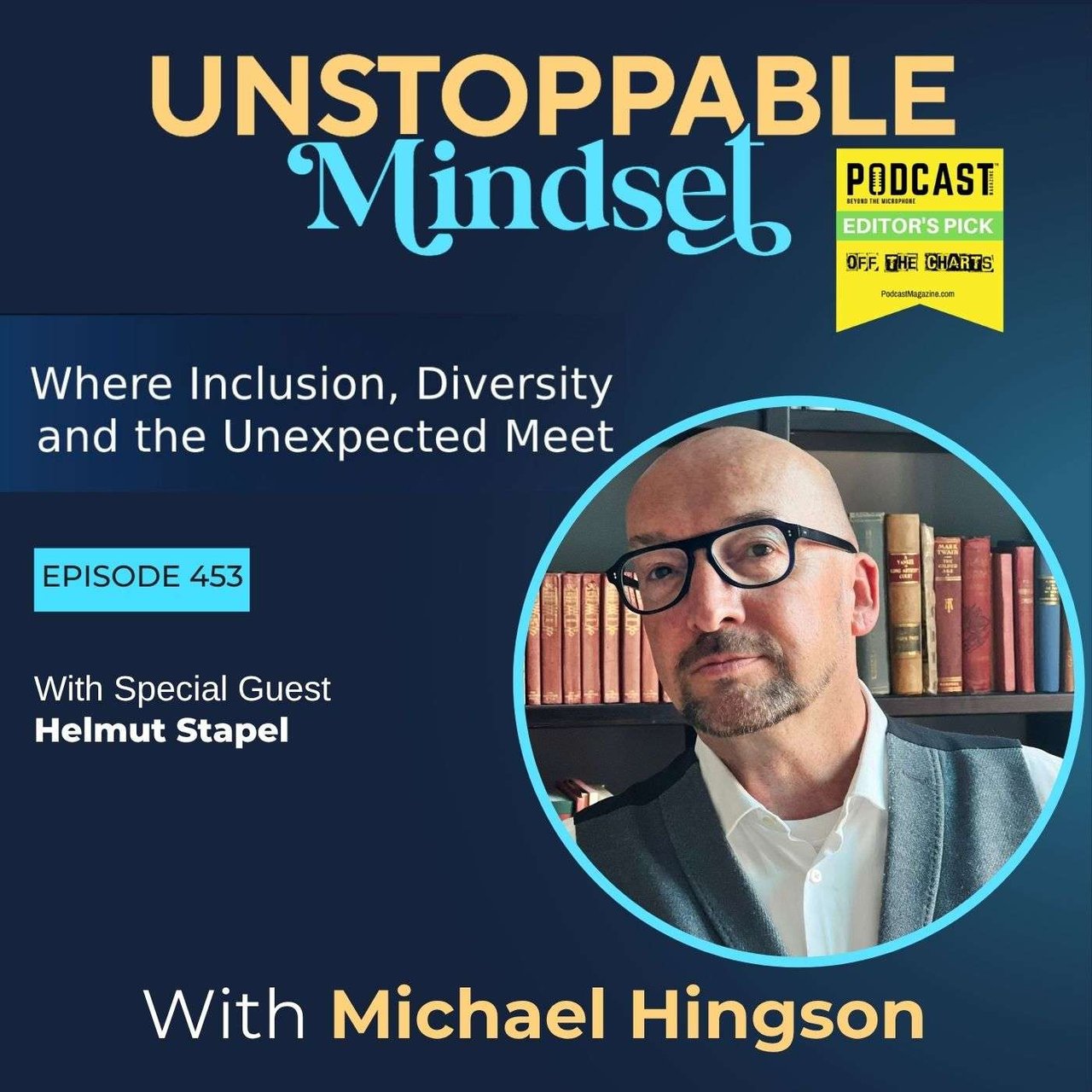
Episode 453 – Why Open-Minded People Build Unstoppable Lives with Helmut Stapel
A life filled with curiosity can take you further than you ever imagined. I sit down with German journalist, author, entrepreneur and media expert Helmut Stapel to explore how childhood curiosity, world travel, creativity and a willingness to take risks shaped an unstoppable life. From growing up in a village of just 700 people to building an international media company, writing books, producing films and launching a global leadership initiative called The Center, Helmut shares why open-mindedness, passion and persistence matter more than fear. You will hear why he believes every idea deserves a chance, how meaningful relationships create opportunity, and why making the world better begins with each of us. I believe you will enjoy Helmut’s thoughtful outlook and practical lessons on creating a life with purpose.
Highlights:
· 03:05 – Early childhood curiosity becomes the foundation for a lifetime of creativity.
· 09:18 – Choosing passion over convention leads to a career that never feels like work.
· 17:33 – Building a business with almost nothing proves resourcefulness beats fear.
· 25:13 – The vision for The Center offers a new way to bring leaders together.
· 43:15 – A humorous book about the pandemic delivers a powerful lesson on questioning information.
· 54:31 – Every great achievement begins by protecting an idea instead of doubting it.
About the Guest:
After completing my training as a media designer, I finished my editorial traineeship at the Nordsee-Zeitung in Bremerhaven/Germany in 1997 and founded successful my media agency, “Stop press & public”, based in Bremerhaven.
Through various trainings across all media sectors, I had the opportunity to build up my client base both nationally and internationally. These include contributions for the BBC as well as film work alongside the well-known producer Stratton Leopold (Mission Impossible, Captain America). My journalistic repertoire ranges from short news reports and podcasts to features in words and images.
For over ten years, I have been sharing my expertise on the successful construction of narratives, stories and storylines in seminars at colleges and universities worldwide like the University of Cancún in Mexico and German Universities. The range of course content spans storytelling, digital marketing and social media strategies, journalism, photography and PR, as well as scriptwriting for novels and films. All seminars are held in English and German.
As author I write fiction, travel, culture, fitness and business book. My works include the novel ‘The Day a Chinese Man Ate a Bat’, lighthouse stories, the fitness guide ‘Couch Coach’ and the international port book ‘Port City’. In 2024 I started my career as artist with my first internationally recognised concept series WorLds, which was curated for the exhibitions at ArtExpo Paris 2025 and the 24 International Art Fair Venice in 2026.
The renowned Magazine FineArtNews published a multi-page feature about my new artistic approach in concept art. In autumn 2026 I will open my first solo exhibition in London with the aim, to let people benefit from the proceeds of my art. As part of the European Group “Speakers Excellence” I give keynote speeches at official events and charity events.
With the project THE CENTER I have started together with my wife Daja a worldwide initiative, which will create a new basis of respect and a generation of leaders, with a new understanding of global interconnections in the spirit of a united humanity which takes responsibility for working together rather than against each other. The first events will be held in 2027 in Tuscany/Italy and Switzerland.
Ways to connect with Helmut**:**
Social Media:
http://linkedin.com/in/helmut-stapel-5b3a60b6
https://stoppress.contently.com/
www.facebook.com/helmut.stapel #5000
Homepage:
Article FineArtsNews:
From Journalism to the Canvas of Conceptual Art – FineArtsNews
About the Host:
Michael Hingson is a New York Times best-selling author, international lecturer, and Chief Vision Officer for accessiBe. Michael, blind since birth, survived the 9/11 attacks with the help of his guide dog Roselle. This story is the subject of his best-selling book, Thunder Dog.
Michael gives over 100 presentations around the world each year speaking to influential groups such as Exxon Mobile, AT&T, Federal Express, Scripps College, Rutgers University, Children’s Hospital, and the American Red Cross just to name a few. He is Ambassador for the National Braille Literacy Campaign for the National Federation of the Blind and also serves as Ambassador for the American Humane Association’s 2012 Hero Dog Awards.
https://www.facebook.com/michael.hingson.author.speaker/
https://www.youtube.com/user/mhingson
https://www.linkedin.com/in/michaelhingson/
Thanks for listening!
Thanks so much for listening to our podcast! If you enjoyed this episode and think that others could benefit from listening, please share it using the social media buttons on this page. Do you have some feedback or questions about this episode? Leave a comment in the section below!
Subscribe to the podcast
If you would like to get automatic updates of new podcast episodes, you can subscribe to the podcast on Apple Podcasts or Stitcher. You can subscribe in your favorite podcast app. You can also support our podcast through our tip jar https://tips.pinecast.com/jar/unstoppable-mindset .
Leave us an Apple Podcasts review
Ratings and reviews from our listeners are extremely valuable to us and greatly appreciated. They help our podcast rank higher on Apple Podcasts, which exposes our show to more awesome listeners like you. If you have a minute, please leave an honest review on Apple Podcasts.
Transcription Notes:
Michael Hingson 00:03
One of the biggest things holding you back isn’t what’s in front of you, but rather what you believe. Welcome to Unstoppable Mindset, where inclusion, diversity, and the unexpected meet. I’m your host, Michael Hingson, speaker, author, and advocate for inclusion and possibilities. This podcast explores how the beliefs we carry shape the way we live, lead, and connect with others. Each week, I talk with people who challenge assumptions, face adversity head on, and show what’s possible when we choose curiosity over fear. Together we focus on mindset, resilience, and the small shifts that lead to meaningful change. Let’s get started. Well, hello everyone, wherever you happen to be in the world today, I want you to feel welcome at Unstoppable Mindset, that’s our podcast name, and I’m your host, Michael Hingson, or if you want, you can call me Mike Hingson. Our guest today is Helmut Steppel, who is a media person, he’s an author, he’s an artist, he’s a lot of different things, he’s an entrepreneur, he started his own company. My gosh, I’m jealous, he’s done a lot of different things, and I think we’re going to have a great conversation over the next hour or so. So, Helmut, I want to welcome you to Unstoppable Mindset. We’re glad you’re here.
Helmut Stapel 01:39
Thank you so much. Thank you so much, dear Mike, and thanks for having me. It’s an honor to be here, because as your invitation popped up suddenly, I was a bit surprised about, I think oneself never looks at its own way of living or where we are in the way other people maybe do, and so thank you for having me and your podcast.
Michael Hingson 02:02
Well, thank you. I think we’ll, we’ll have a lot of fun. We have a lot of things to talk about. I appreciate all the information that you sent me, and, and we’ll, we got to keep it interesting because it’s late where you are. It’s after 9o’clock now in the evening over there, so we gotta, gotta make sure it, it stays interesting, so that you don’t fall asleep.
Helmut Stapel 02:24
Definitely, I try, I try to, I try to. Sorry, in another part of Germany, it’s cold outside, it’s not dark already, but it’s getting to be dark, so it’s bad time to say so. But I’m happy to be with you.
Michael Hingson 02:39
How cold
Helmut Stapel 02:41
is it 14 degrees, something like that. Should, should be more. Everybody’s talking about El Nino, and looking at the guy in Mexico, showing pictures of red things. And we have some prognosis regarding summertime coming, some big heat from whatever it is at the moment. I must say it’s quite normal and a bit too cold for this year of the time.
Michael Hingson 03:05
Well, we’ll see what happens. Well, why don’t we start? I love to start this way. I ask people to start by telling me a little bit about, in your case, the early helmet growing up, and so on. Let’s start with that.
Helmut Stapel 03:18
Okay, we can do that question from my side, when does early helmet start, at which age? Because for me, for most fascinating is that for some reason I can remember, at least I can go back to, I think, as when I was one year old.
Michael Hingson 03:35
Well, I’ll let you start wherever you’d like to start, that certainly is early enough, but you, you tell us what it was like growing up, and all that, and if you remember back to one year old, that’s great.
Helmut Stapel 03:46
Okay, I grew up in a very, very beautiful landscape, a small village, 700 people living there, called Stuben in Germany, and what I remember is laying as a small child, not be able to walk, and just in a wagon, and staying at the blue sky, the clouds, tree leaves, sometimes people coming big faces. It was my aunt Helga would have figured out later on, and so I remember sounds of bees and hums and roses, the smell of roses. My mother loved roses about all around the houses, and as you see, in this way I grew up in a way where I got used to use all my senses, and I think that was some of the basis for all what followed up, because I started then to have a closer look at my environmental. When I was seven or eight years old in school, I wrote my first text. Later on, I became a journalist, but in this very moment, then I realized, and that, and also the grown-ups, that is maybe some kind of talent because. My first text got a one with a plus, so I think it was eight years old, and so I grew up in a very, very good surrounding. My father was a captain. He took me with his ship to Portugal, to Norway, to Russia in the summer time when we were out of school, so in this way somehow I got in touch with the world very early, very early. I was seven when I went the first time to Portugal, and so I think this was the basis for all what came afterwards till today. You know, I’m 60.
Michael Hingson 05:35
What did you think of traveling, and how has that kind of shaped the way you look at life today,
Helmut Stapel 05:44
and a lot of ways, and in a positive way, because to say so, I was not aware of how many prejudices I had in my head regarding society, media, whatever it is, since I met the people for real in the countries they were living in, and this is from the USA to Arabian countries to Asia, whatever it is, and suddenly all these influences came to my head regarding the fact, and also then the knowledge that we are all different, we all look different, and we come from different cultures, but at the end, we have all the same needs, and so there’s no country where I have ever been to where I felt unsure. There is no country where I didn’t met friends, for example, and it was always about being open-minded, and then meeting people who have been open-minded in the same way as I was, and so that’s how everything developed.
Michael Hingson 06:52
Do you have any countries that you haven’t been to that you’d like to go to?
Helmut Stapel 06:57
Yes, to turn upside down, where I have been to is from Alaska to Cape Horn, to go to then the Caribbean, the Atlantic, European countries, from Norway to South Africa, then to the Maldives, and go on to the beginning of India to say so. Australia is on my map. I was asked to go there, but then when the war with Ireland and USA popped up, that was so dangerous to go by Dubai by plane to go to Australia. So I will do this next spring, and somehow China is a bit too big for me, I would say, means that I would love to go inside the country to meet people that takes a lot of time, and travel journalism is a lot of people think travel journalism is something where you just stay for six months in the country, or whatever it is, it’s different because of money and time, because it’s all organized, and that means a big country like China would be great regarding culture, but it’s would be a long part in before to have a closer look at where the stories and the people are, so I would be Australia and Japan, I think, and to say so the fastest thing I’ve ever had to do with Cape Horn, surrounding by zodiac with a dingy seriously, and I made 30,000 kilometers in six days coming from Germany, and I was on three continents and in six or seven different countries, and so this is travel journalism to say, so,
Michael Hingson 08:43
wow. Well, I went to New Zealand in 2003 but I never got to Australia. But earlier this year, kind of, my, my wish was granted, and I’ll be traveling to Australia later this year. Wow, to speak. It’s the first time that I will have been to Australia. I’ve been to Japan, and I’ve been to South Korea. I’ve not been to China either. I think it would be fascinating to go if someday that will happen. I’ve not been to Germany, I’ve been to Spain. I’d love to come. Well, all I need are some speaking engagements to get me over there, so you know, if you know anybody who needs a speaker, we’re always looking for opportunities to come and speak, but I
Helmut Stapel 09:28
can have a closer look for that. Definitely,
Michael Hingson 09:30
that would be fun. But anyway, I enjoy traveling. I appreciate that in reality we’re all really the same. We may be raised in different cultures, and we think we’re a lot more different than I think we really are, and in so many ways, but you, so you went, and you grew up, you went to school, then you went to university, right?
Helmut Stapel 09:54
Yes, but in a way that I realized that in that I. Way, and at that time I was about worth 30 years old, because I did my A level at the evening school, while I was working at the same time, and then I figured out that I’m more the practical type of human being, I was not able to sit and to listen to someone and to analyze texts of other people, for I figured out that my brain was, as I was telling you, when I grew up and saw all these things with the sky and the clouds and whatever it was that my brain was meant to produce things by itself, and that it was full of ideas and pictures, and it all had to come out, and so in that way I stopped studying and made a, I was a volunteer, I made an apprenticeship at a newspaper, and became an editor, and so in that way I found my job 30 years ago, which I self employed now for 30 years due, and it’s I’m blessed to do that, because since that time I don’t work, I have spare time all the time. It’s just doing something which I love.
Michael Hingson 11:07
Well, and that’s kind of important to do, and that that makes it so much more fun when you can do something that you love doing. It doesn’t seem like a job anymore. It doesn’t seem nearly so difficult to do, because you enjoy it,
Helmut Stapel 11:22
definitely, definitely. Also, regarding writing novels, which I started then a few years ago, because sometimes my wife has to hold me back for sitting and writing, because I always love to do that. I do other things as well, but it’s something which is really in my mind and my heart.
Michael Hingson 11:47
Well, and you mentioned earlier that you and Daddy are getting into a new house. I hope she likes the house.
Helmut Stapel 11:54
Definitely, it’s our.. it’s our.. thank you for asking. It’s our dream house, because it’s not too big. It’s 160 square meters with a cellar and the roof and things like that, and there’s enough space, and we have a fireplace, we have a garden, we will have a dog, and so it’s like, like a dream came true, because it’s a place which is silent, and for me the best thing is that we will have a fireplace in the working room as well, so I love to stay there in winter time, and then suggest to do my work, and she loves that, really, because she also says this is the house she was always looking for, and so we will then have our own home, and this is a dream. Also,
Michael Hingson 12:36
do you have any children?
Helmut Stapel 12:39
No, personally not. I grew up some children with the women I cared for for 12 or 15 years, but as it is sometimes when the when the young birds have grown up, the mother birds and the grown-up birds are leaving the nest without asking the father bird if he wants to fly with them, and so they flew away, and I stayed a bit concerned, but then I meet Daya, and so I knew where that comes from and what was the sense behind that, because since that time I’m absolutely happy, and I’ve never been that happy before in my life.
Michael Hingson 13:20
Good for you and Daya, that’ll, that’s great. Well, it’s exciting. I have lived in a number of homes. My wife and I got married in 1982 and then she passed away in 2022 And so we, we lived in various places, and we always figured out how to make it work. We had challenges because she was in a wheelchair her whole life, but we, we love to build houses when we could. There were, there were a couple times that we couldn’t, but we love to build houses because that way we build accessibility into it, and it doesn’t cost to do that. So,
Helmut Stapel 13:54
yes,
Michael Hingson 13:55
so we, we had a lot of fun with, with that. So, I, I, I can’t complain a whole lot. It’s worked out pretty well, but I’m glad you guys are getting into a house that’ll be pretty exciting. That’ll keep you busy, and while you’re moving from one house to another, you’ll probably find all sorts of treasures that you forgot you even had.
Helmut Stapel 14:15
Can can be also some things in some cartoons or in wardrobes or whatever it is, all things I have books of my father as well, instance he was a captain, as I said, and some things are maybe hidden somewhere. Really keen on doing that, for example, as I have a past as a musician as well. When I was 23 I had a record contract with Sony Records, and somehow, regarding private things, this did not come out on the way I wanted it to be. It was for three or four years, but all this musician past is also in some draws line with things or songs. I, I started to compose and. Maybe I start this in our new home next to the fireplace again. There
Michael Hingson 15:04
you go. Well, that’ll be kind of fun,
Helmut Stapel 15:07
definitely.
Michael Hingson 15:08
So, when did you found, when did you start your own company?
Helmut Stapel 15:12
Ah, that was almost 30 years ago, was in 1997 right? Directly after my apprenticeship as an editor, because I figured out that it’s somehow my spirit to be more on my own track. This is also maybe founded because of my father being a captain, because when I was a young boy standing on the bridge, and he asked me if I like to be the captain of the ship, I was seven years old, and I was then asked to guide and to lead this big freight ship to the Biscaya near to Portugal in a stormy day, and I was this feeling of I can go everywhere, I could go everywhere, and so from this moment on, I had the feeling that the chances I create for myself are endless when I give them the chance to appear, and so this is why I decided to become self-employed.
Michael Hingson 16:11
Wow, so that, well, it’s kind of fun. So, do you, you’ve decided, though, you don’t want to be a captain anymore?
Helmut Stapel 16:18
Yes, I’ve became, I’ve become a sailor. I had a sailing boat, but I was not about to make this my profession to say so. Right, I’m a seaman as well. I do a lot of cruises, I write about cruises, I work for several magazines. I’ve just come back from the middle ocean with a nice trip, Explorer One from MSC, it’s the Italian shipping company. I visited Sting, the international position, on his vineyard in Tuscany, which was quite an honor. And so there is a lot of connection to being a seafarer. I like cruising, and
Michael Hingson 17:00
I’ve had had fun doing it, and would like to do more of it, even though it’s just me now, but I, and I will, I think cruising for me is a great way to take a vacation, because I only have to unpack once, but, but more important than that, you know, unlike being in a timeshare where you, you go and visit places and drive, you know, I’m not going to drive or anything like that. So, I, I like cruising. I think that’ll be kind of fun, and I’m looking forward to doing that in the next few years again. But, in the meanwhile, in the meanwhile, as I speak, I get to travel around and meet lots of different people, and that’s kind of fun too.
Helmut Stapel 17:40
Definitely, I think you’re the same as I am regarding that the exchange with people is something which makes oneself feeling alive, because there are so many impulses and things one maybe has never been thinking about, and suddenly some ideas pop up out of this conversation, which is, which is quite great.
Michael Hingson 18:06
Well, so tell me about your company that you started 30 years ago. It’s been a been going a long time. Tell me about that.
Helmut Stapel 18:14
My pleasure, because at it’s also about thinking positive about life and not building your own barriers, because at that time I was, I was not a rich man, I’m not today as well, but I had so less money that I was not able to, at that time they were the starting time of computer, I was not able to have an old fax, so I had to ask some friends in the company if I could just creep in the, in the midday break into the office of their chef to send a fax to a company in Munich I wanted to work for, and so it was a bit adventurous, I really had not a lot of money. I found him affirming it in a two room apartment, and the financial department wanted not to give me the tax back, because I said it’s not, it’s not possible to live in a two room apartment, and in the same way found a firm, and I said, yeah, but I did it, I did it, and so in this way I worked on then working for radio because it did an apprenticeship as well then why I founded my firm and in this way it grew and grew and I did during the time all the work and apprenticeship and all kind of media you can imagine so I can work today for print for radio, I’m doing reportages for online, for TV, and in this way I ended up at the university at the end. Now, after 30 years, again, I think after 20, because since 10 years I work as a teacher as a lecturer at different university on German and English internationally as well. From South America to Japan, because online is a fascinating world where even there are no borderlines, and so I’m really happy that I was able to fulfill this dream, starting as I said, without fear. I always said I just try and never fail, I do it some other way. That’s the point.
Michael Hingson 20:24
You figure out a way to make it work,
Helmut Stapel 20:27
absolutely, with the help of people. For example, that’s always important that you meet people which feel some sympathy for you. That’s right, just to help you, or they have some contacts. Most important is I think that the passion you feel for your work is readable, is hearable, whatever your media you work for, that people enjoy to follow you. And then the people who just are your employers say, ‘Wow, we want to have more of that. So I think this is the point. How it works. So, what’s the name of your company? It’s Stop Press and Public, and it has a has a history behind that, because the part of Germany where I come from, as you see, my last name is Staple, S T A P E L, and we speak here flat German, which name means that staple is called Stoppel with an O instead of an A, right? And so I took the short form of Stoopel with an S T O P. It’s like a stop sign you have in traffic, and so I said, okay, if I have stop, this is cool internationally seen for a marketing point, and I needed some things because I always, in the beginning, also as well thought, and I was sure that I wanted to work internationally, and so I thought that I need something which is short, which is international, and so I said I do it press, and there’s something I do which is public, and then it will stop press and public, which is quite great, because I had no idea when I went the first time to the USA. I gave someone my business card. He said, "Whoa, this is the cool agency name, and say, "Why? And he said, "Yeah, regarding that, stop press as a synonym for latest news, stop the printing, stop the
Michael Hingson 22:21
presses. Yeah.
Helmut Stapel 22:22
Yes, I wasn’t aware of that. And so there’s really funny, yeah. And this is how that, how that figures out.
Michael Hingson 22:30
And what do.. and what does the company do?
Helmut Stapel 22:34
I do everything from all topics apart from ice hockey and soccer, because I, to say so, I could write or do some reports about that, but I have, you know, passion for this kind of sports, so I do everything apart from soccer and ice hockey, but also then I’m a photographer as well, so I do reportages all around the world regarding traveling as scientific journalists, as well. I do write for scientific magazines, which gives me a deep insight into topics I had never any idea before, which keeps my brain moving on and moving on, and also connecting different topics, which are maybe normally are not connected, and I do cultural reports as well. I do videos. I work for social media, and I develop social media and marketing companies as well, for big companies all around the wall, for example, the Q, not line England. I did some marketing, and there are others. So, everything which is connected with communication in what way ever is what I do.
Michael Hingson 23:54
So, it’s a marketing and communications company, which, which keeps you busy. How is it just you, or do you have other people in the company?
Helmut Stapel 24:03
No, it’s just me, and this is fascinating as well, because after I think 10 years, when I founded the firm, I was at a point from the mass of work, which came from all sides to me, to decide if I stay on my own or if I grew my firm, my company with some clerks regarding Dan becoming bigger, and when I was thinking about that, I had a closer look at my dog, which was a shepherd dog, a German Shepherd dog, and we were close friends, and he was my partner in triathlon, I did 10 years triathlon, and he was my running and my swimming partner as well, and so I looked at him, and at that time, at the day we wanted to go into the forest as we always did, and suddenly I was aware that if I have all this responsibility regarding all the people and getting all the work that they get their money at the. End of the month, and can feed their families, and things like that, that will be such a pressure for me and my small family as well. That I said, now, okay, I don’t do that, because I will just lose my freedom, and so I decided to keep it small, and the way that I can normally live, and I’m not a poor man, but I’m not a rich man as well. But I have all the time of the world to organize myself. I can go to for a forest walk whenever I want. I can sleep midday on my couch whenever I want, and that was the point why I’m just on my own.
Michael Hingson 25:38
And you can do podcast interviews whenever you want, and podcast conversations whenever you want.
Helmut Stapel 25:43
Yes, definitely,
Michael Hingson 25:44
that works out pretty well. Well, that’s great. So, so what you have a project I think you’re working on called The Center. Tell me about that.
Helmut Stapel 25:54
Yes, thanks for asking, because this is something which is really on my mind and my heart, because dear Mike, as you asked before, regarding traveling the world, making experiences, meeting people over the years, it came to me and to my mind there are so many things where the world is not going in a direction where it should go just to be a good place for all the people that live on this planet, including all the nature which is on this planet, because without nature we cannot live on this planet, and so I developed the idea, and I’m working on this project, and I think in 2027 we will have the first, the first events is to found a place, which is called the center, because all the structures we were used to for decades, politically, naturally seen society, whatever it is, they are all breaking down, there are no, no, no roots anymore, and people are anxious that everything falls apart, and there’s no center anymore, and so the idea was just to create a center where leading people from all kinds of areas, like it’s economy, it’s philosophy, it’s a technical scene, it’s astronomy, it’s a religious whatever it is, just to take all this knowledge and all these different opinions and to make events for people which are in leading positions to create a feeling of that we are all in a network, because the earth is round, we cannot flee from here. We have to stay here, and we have to work with that. And the point is, when we all take something from the cookie plate and never give back anything on the plate, it will be empty, and if it’s empty, no one is a winner, no one is a winner, and so the center is about then giving people the idea when they try to live a life where they give something, and it means not that they should give all their money, which they make to other people, it’s about friendliness, it’s about health, it’s about clean water. It’s about giving a warm word, and it’s also giving more money as well. If someone’s doing a good job, and so making the places where they live a better place, and the way they could do, and in this way giving more space for this message, because people have been treated better, they treat other people better, and it’s like you throw a stone in the water, and small waves are coming, and just go. And this is the point. What the center is going to be about. If
Speaker 1 28:54
you enjoy Unstoppable Mindset, and would like to help us continue bringing these conversations to you each week, we’ve created a way for you to support the show. Your contribution helps us cover production costs and continue sharing stories, insights, and ideas that inspire people to live with purpose and possibility. If supporting the podcast feels right for you, you’ll find the link in the show notes. Thank you for being part of the unstoppable mindset community.
Michael Hingson 29:28
Well, and when you throw a pebble into the water, the waves go out to the end, and then they come back, and, and it’s a process. It’s a process. You’re
Helmut Stapel 29:37
right, definitely.
Michael Hingson 29:38
So, how far along are you with with this? You said in 2027 you think you’re going to have the first event, and what, what, what kind of preparations are you making, and how is that going
Helmut Stapel 29:50
from the first steps, writing an expose, getting my, and Daya is with me as well, because we like to found this together, just. Putting the first thoughts on paper, writing an expose, getting clear about what should it be about, having the first contacts, meeting people was like creating some kind of magnetic field, because suddenly when we started with that, things came by itself to us, that was fascinating regarding people offering sponsoring the website, for example, I have been to Zurich to an event where I met people I was not aware about, which fit to, for example, than the event character to other people, which one is the former director, the technical director of the NASA, the space agency, there’s some kind of neurologist, we would say something, some people who work on brain artificial intelligence, whatever it is, and so I meet a lot of people since then who future researchers, whatever, who will be able, and would love to have events and a speech at the events of the center to be part of creating a horizon for all the people who come there to make sure and clear that in which position we are in the moment we look at earth in the space, because not many people are aware of that, how, how fragile this is, and so with all the knowledge and all the things like philosophy, which, as I said, we will try to implement a feeling of we have an at the people I have to do something, and in this way we are on the way. We have two places where we love to make the events. We came across that in the beginning we would think to concentrate on one place, but then we figured out it’s better to have different places, just to have more atmosphere. One is in Switzerland, and the other is in Italy. And we are about to create, then, the program to make sure, as people have to pay for that. This is quite a point. We cannot do it for free, because there are some costs, but to create the program and sending invitations, making advertisements on Instagram, social media, whatever it is, and have a closer look on LinkedIn, how the feedback is, and the point is that without, as I work all my life like that, even if I write a novel or whatever it is, without setting a deadline for something, you will never reach your aim, because you say, yeah, maybe sometime someday. No, we do it in 2027 in summer, and in this way we have some time to move into a new home and our house, and in the same moment, just working with the people who already have said that they want to have a speech there, for example, we also are in touch with Laura Chaplin, which is a niece, you say, so from Charlie Chaplin. She lives in Switzerland. She, she loves to come there too, because she, she’s a person who thinks that humor is an important point in life to create some kind of life feeling, and so in that way we are on the way to have then the first event in June or July 2027 and it will be in Switzerland at the Lake of Your Walsh Stetter Zie, near to Lucerne, or in Tuscany near to Lawrence Fierense,
Michael Hingson 33:48
that sounds exciting. How large do you think the event will be?
Helmut Stapel 33:52
We think about two events in the beginning in a year with maximum of 15 participants, maybe 10, because it will be very intensive, and it’s not something to say so, which can be in Germany. We say inflation, inflation, or maybe this is the word in English. It’s something that has to grow, as to say so. I have a friend. When I talked to him about that, he said that’s too big. You will never, never see and realize how this will work. And I said, no, this is not the idea behind it, because someone has to start the process. All the things which can be big in history of humanity started at one point, and over if it takes centuries, I don’t care. Someone has to start it, and if the idea works, it will work inside the people, which carry the idea to other people. And so we start with, I think, two events in a year, and maybe then 10 up to 15 people, max. Simon,
Michael Hingson 35:01
well, so 10 to 15 people will be speaking. Is there an audience in addition to that, or it’s just going to be an event with those people, and they’re going to then take the message elsewhere?
Helmut Stapel 35:13
No, the audience will be 10 to 15 people. Got it? Because the idea behind this, that also, because they were thinking about that every every change in society, if you look at human history, started on an unhealthy basis, which means that we’re all people who were hungry, they were poor, whatever it is, and they were just fed up with the lives they were living, and said we have to change something, and this always meant war, this meant revolution, whatever it is, and at the end, most of the time, exactly those people became like the people they were talking about before, that they are the vicious people, so we thought about if we want to change something, the best thing is to talk to the people who are able, in their actual, in their current positions, to change something, which is their advantage as well. This is the concept of the center. It doesn’t mean that you change when you change your mindset in this way that you lose something. No, it’s about the advantage for everyone, and this is the idea behind the center.
Michael Hingson 36:23
How did this come to your, to your mind? How do you, how did you create it? What, what caused you to think about doing this?
Helmut Stapel 36:32
I have not really an exact idea. It was, it was a, it was a fusion of all the things I was talking about. There was one moment where suddenly all the things I mentioned in the beginning, regarding there’s no center, everything is falling apart. I witnessed that, as everyone does on the TV and the radio, on social media, and when this witness, I talk to people, to friends, and also in other countries, and I figured out that this kind of anxiety creeps into the minds and souls of so many people that they got stuck in their lives, and that somehow all this beauty, which is around us, is not seen anymore, and it’s just something that it’s like the world is going to be getting dark, whatever it is, and we can stop that. And that was the point when that this, when I said someone has to stop that. And then I said, okay, then I’m the one, together with Daya.
Michael Hingson 37:39
Well, that’ll keep you and I are busy, you know, gives you, gives you something to do, and, and, and I’m sure you’ll, you’ll create an environment where there’ll be a lot of good ideas that will come out of it, which is, of course, what it’s all about, right?
Helmut Stapel 37:53
Yes, yeah, definitely, because the way we treat each other is the basis for all that, regarding that we both have have an eye on each other, a closer look, that the other one feels good, just asking, do you need something, can I do something, and things like that, and that way we created a process which brings us with the positive energy forward in a very, very exciting and powerful way.
Michael Hingson 38:23
Well, and that’s, you know, that’s always exciting, and it’ll be interesting to see where, where this goes, and how the center grows, and how you can use that to influence people. We need to have more of that, I think the whole idea of helping to create and change, well, to change the world and make it a better place, there’s always a good thing to do.
Helmut Stapel 38:49
Yeah, I think you’re definitely right, Mike. Also, then based on the idea that when we start with that in this on the small scale, it doesn’t mean that not other people can do the same in other countries, you know. I registered the trademark just to, and the logo, and the and the and the sign, because it makes sense to have something which is steady, and if other people, then, for example, think that they are convinced by this idea, there’s, there’s nothing which is against the idea, then, that they do is in the country with the same concept as well. So, this is what we hope, that it’s for example, I think there’s always fascinating friend of mine, he, he’s a scientist in mushrooms, and he’s so keen on mushrooms, and he’s telling about mushroom stories all day long, but the point is, this is the most fascinating living being, because it’s under the ground, and it’s just no one is seeing how it moves, and it’s getting bigger and bigger, and what we eat is just what pops. Up right, and but but it’s invisible, and when it comes out, everybody says I had no idea that it’s that big, and I think this is the idea about sorry, the center creating a network which grows by itself and has more and more points where the idea pops up, that’s the point,
Michael Hingson 40:18
yeah, which, which makes sense. Tell me about some of the books that you’ve written, if you would.
Helmut Stapel 40:25
I love to love to, because as I said, when I was eight, I wrote my first essay, which somehow astonished the teacher, and then I wrote my first poems, and short stories was 1312 or 13 years, and then I was aware of the fact that I want to become a writer. What happened was I became a writer in the way that I became a journalist, which took a lot of time, because I’m self-employed, but in the same way I was always keen on writing books, and I wrote several books, I think. Meanwhile, it’s seven or eight. The first novel and short story thing, the first novel was 2024 and the short story mixed with with pictures. I’m doing pictures as well. I’m a painter as well, and so this was then 20 years ago, and so this is just the process of developing things. There’s a poem book as well, it’s called Lemon Land, which is quite interesting with funny poems, and as I’m interested in so many things, there are people asked me to write tourism things about lighthouses, for example. There were people, they asked me to write economic books about how a harbor works. For example, in Germany, we have one of the biggest, or some of the biggest container harbors of the world, the city where I live, Bremerhaven, for example, which is very connected to the USA. We had, I think, 6 million containers a year, and now we are somehow about 3.8 3.6 or whatever it is, and so this is some logistical thing, I wrote a fitness book as well, since I did triathlon 10 years and it was a vegetarian at that time, and so I figured out how that works, and suddenly I started to eat meat again, because then from one day to another it tastes good again for me, and so I wrote a fitness book, as well. It’s called The Couch Coach, because I figured out that so many people sitting in front of the TV saying, "Ah, I would like to go to a studio, but it costs so much energy, and I would love to stay in front of my TV. And so I thought to develop a fitness program for people just laying on the couch and making sports, so it works with some, it’s not a lot of weight, it’s for your food and for your hands, and so within 15 or 20 minutes, you can just exercise your body from the food while you, while you eat pizza and eat Coca Cola. So I also have some diet program in the book, but you’re not forced to do this, is this is not this. If you want to become a better man, just have a diet and do sport. No, a lot of people just stop them doing that, because it’s exhausting. And so you can decide to change your life, but you can keep on lying on the couch, just having pizza and drinking Coke. It’s just about bringing people into the mood of movement, and so I think this is the mixture. Actually, I wrote a travel guide, which maybe can now will come out this year, and it’s the first travel guide one has written in this style on this planet. Honestly, there’s no book like that. I’m very proud on this, and while I’m looking for someone that publishes it, I already work on my next novel with Willy, a criminal story, which plays on a lighthouse. Daya is very excited hearing the next things I have written, and so these are the writing projects I do work on.
Michael Hingson 44:16
So, what’s the name of the travel book?
Helmut Stapel 44:19
I cannot say this is a secret, it’s
Michael Hingson 44:23
not out yet. So, yeah, you can’t say what’s the last book. Oh, go ahead.
Helmut Stapel 44:28
The last book is also quite exciting, because it will be published next week on English, and will be available worldwide. It’s called The Day a Chinese Ate a Bet, and so, as you can imagine, it’s about Corona, and it’s the very first book on a journalism basis written in a comedian style, apart from the fact that Corona was not really funny, that that takes all the things which has happened based. Based on a two year research on press releases from US government, the World Health Health Organization, whatever it is, articles, just to make an overview, what happened at what time, and who did say what, because of blaming whom, to bring some light into this chaos in a very funny way, regarding that, the theory and the rumor that Chinese eat beds are just based on one video from an influencer from Thailand who pretended to eat a bed, and so that was an ah, all Chinese eat bats, they produce corona, and so this is why it’s called like the day Chinese ate a bad and the main point is the message in this book is not to believe everything people are telling you because they want to influence you and not to ask the question where’s the source where’s the basis for that and so yeah and it’s in one day in Wuhan, a taxi driver who has all the people, there’s a billionaire called Phil Bates, you can assume who I mean, and other people who are driving in this taxi one after another, and all this taxi driver gets all the stories and infos, and so he gets more confused and confused and nervous, and so it’s a day in Wuhan where it pops up all the people who are connected, maybe with the with the existing of the coronavirus, and they all meet at the end in a final place to say so. And then we have the conclusion, but I won’t, I won’t spoil that. Oh, you don’t want to do
Michael Hingson 46:42
that? No, by no means. So, it’ll be published in English next week, huh?
Helmut Stapel 46:47
Yes, exciting! Wow,
Michael Hingson 46:48
that’s pretty cool.
Helmut Stapel 46:51
I’m really proud on that.
Michael Hingson 46:54
Well, so what publisher is publishing it, or how’s that working?
Helmut Stapel 47:00
I did this by myself. Okay,
Helmut Stapel 47:03
yeah, with this book, for example, and have chosen the soil name Arthur Block because it was my grandpa, and I thought Arthur Block is more international than Helmut Staple. It’s more, there’s more speed behind it. Arthur Block, yay. And as I did my first apprenticeship as graphic designer, I decided, because I’m familiar with books and publishing with the newspaper, I have all the knowledge to publish my book by myself, and I try to, and it’s working out good, because I have a lot of five star five five-star ratings on Amazon, and there are some kind of.. we have in Germany, for example, companies like Books on Demand, which then bring this with an ISBN number into all bookshops in the world, and so it was a kind of adventure. I still work on that. Regarding also, thank you for naming this in your podcast, doing some marketing on Google, and things like that. Normal, just have a closer look, how that that works. And so, with the with the travel guide, I’m in touch with Lonely Planet, which is quite known as travel guide, which young people love all around the world, and they are interested, and so looking forward if they really want to. If not, and if no one likes to, I publish it by myself again
Michael Hingson 48:35
now. So, will the day the Chinese ate a bat, when that comes out in English form, will that also be available in places like Amazon?
Helmut Stapel 48:45
Definitely, I figured out, and this is the exciting part of, at first I had no idea how that works with Amazon and Kindle, and whatever it is, and then I figured out, by it was incidentally, when I created this book at first in German, then I published it on Amazon, and they have an ISBN number as well. And I thought, okay, now I’m in business internationally, and a friend of mine said, okay, I like to buy your book, I go to a bookshop, and he had the title and asked for the book, and they looked into the PC and said there is no book like that, and there is no author like that, and he called me, and I said this is not possible, because I have the ISBN number here from Amazon, and then I figured out that Amazon has an own ISBN number, which doesn’t pop up in the international catalogs of bookshops, you need a different ISBN number from the first three numbers,
Michael Hingson 49:41
yeah.
Helmut Stapel 49:42
Yes, and so I always have to use two channels, it’s Amazon with Kindle and things like that, and also the normal book shops who like books on demand, as I said, with the international normal ISBN number.
Michael Hingson 49:55
Will there be a an audio version of the book?
Helmut Stapel 49:58
Yes, I work. That since I’m a radio moderator as well, and we have a studio at home, and we will have a really pretty studio, and on your house, I love it. I will produce the books as audio versions as well.
Michael Hingson 50:13
Well, that’ll be exciting. You’ll have to let us know when, when the audio version, especially, comes, comes out. That’ll be,
Helmut Stapel 50:20
I will,
Michael Hingson 50:20
that’ll be easier for me to read. I mean, I can buy a print book, and I can use optical character recognition to read it, but I’m lazy. I’d rather have an audio version, and I know other people would too. So, that’ll be, that’ll be exciting when it, when it does come out.
Helmut Stapel 50:34
I’ll let you know, it’s more personally somehow, if you just see the voice of than the author just reading something.
Michael Hingson 50:40
Yeah, well, whether it’s you reading it or someone, it’ll still be good to have an audio version. Now, you have also made a movie. Tell me about the movie.
Helmut Stapel 50:49
Yes, I work on that. It’s not in the cinema, it’s the process I’m still working on, and I’m really proud on that too. Yeah, because it’s also, yeah. yeah, realizing what chance you can take to do whatever it is, and as I said, the borderlines you have are the borderlines you put by yourself, and when I figured out that I was going to go to Savannah, USA, and had the chance to have an interview with Stratton Leopold, who is the very, very well-known producer in the USA. He made movies like Mission Impossible, Star Trek. He was involved in Captain America, and things like that. I thought, when I have so many ideas in my head, I just can write two pages down and just ask him if he thinks it’s a good story, and so when we had this interview, we’re sitting on our own in an old cinema in Savannah, next to the ice shop he’s running, he has taken that from his father, Leopold’s ice cream, it’s really cool because you have all the things from his movies into the ice shop, all the things from Mission Impossible, and this is really cool. And so I was asking him if you could maybe have a closer look at this two page, no, I think it was four pages, and what he thinks about the story, and he said, yeah, for sure, and was quite great a moment in my life, because in the interview he before mentioned how many people give him short things, manuscripts or text, and hope that he’s doing something with that, and there, and he said there’s so many things he’s sorry to say that, but they are not good, and then he was reading my text, and at the end he was looking at me and was like one second, two seconds, three seconds, and then he said this is a good story, and I say, thank you. And then he asked me if he could take it home with him, just have a closer look. He asked me if I had already saved it. I said, no, I didn’t. He said, just do. For example, now I’m a member of the American Writers Guild East, so that my text and my scripts are protected and I shifted all my dates behind with the travel journalism because he asked me if I can come back next day and we had a closer tour in Savannah to look for locations where we can just have this movie we were looking for people with money then for script writers and things like that but unfortunately in between, then Corona popped up, and it was then this 2021 22 and 23 in the middle, I think we started to work again on that, but unfortunately, the people who was were before able to give the money, they were gone, and so we are start, we have started from some new point, but with the same energy, and suddenly, because our movie should be named Wish, like the Wish, because it’s about wishing something, and it’s a mixture between the digital world and the fairy tale world and the reality, to say so, which is quite interesting, and suddenly I walked beneath a cinema in Germany, and I saw this Walt Disney movie, Wish, and I said no, impossible. So there was this title, and we had a conference as well. So we renamed the movie. I cannot tell you how it is named, but we found people with money. Again, we have a script writer, and so we’re going in the next process. Then I’m going to contact different companies like Netflix, Walt Disney, and Paramount. At first, the three is enough. And we have in Germany an institution, it’s called a Deutsche Film Ferderung. They give money by the state to people who create movies. I’m in touch with them.
Helmut Stapel 54:45
The only point is that if you get money from the state of Germany, you have to integrate parts of Germany visual into the movie, so, and this is this is the reason why in Mission Impossible films. Tom Cruise starts from Berlin with a plane or a factory in Hamburg is going to explode, or whatever it is, because they got money from the German state for the production, and we worked on that already, and so this is the point I think. Also, 22 seven will be a very, very fascinating year for me, because we think about having the movie then on the market, it’s
Michael Hingson 55:27
exciting. Absolutely, well, so what, what, what would you say to someone to help them get motivated to achieve their goal, whatever that might be.
Helmut Stapel 55:44
Whoa, as I also teach script writing, there’s one point where we start in how this movie script starts. It always starts with an idea, and the idea is only there because you realize something, which has happened, and then you, you stuck to that, and you go on with that, and don’t stop developing it till the script and the movie is done, and so it’s the same in reaching your life goals. If you have an idea, maybe you have it by itself in your brain, or you are motivated by people, or you want to copy or cover whatever it is, but there are two chances, two channels to say, so you can go. The one is to demotivate yourself, because you say, ‘Oh no, I don’t think this is quite good. It could be better. There may be some people who might say it could be better, or they think about things what I think, and so then you lose your energy. The other channel is to realize that every everything you’re thinking, everything you figure out is unique in the world and the universe, and if you just blow it away, it’s gone. And this is such a waste, this is such a waste, and so just take the channel, keep the idea like a treasure, get energy, money, whatever it is, and think about that. Also, a tree is not a tree because it’s grown up in 10 seconds, it starts small, and so start small, like I said, with the Savannah cinema thing with Stratton, have a closer look at my script. What do you think? And so then maybe in one and a half year, this movie will then be into the cinema, and also it doesn’t matter what other things that are, if you stay to your idea, don’t block yourself, and don’t forbid you anything regarding thinking how something could work. Test it, as I said, and if it doesn’t work, test another way. Thomas Alpha Edison, for example, before he, he was able to have electric light, I think he destroyed 1000 of the gluing, whatever, glooming, whatever, bomb, because the material wasn’t right. And then he was asked by some journalist, wasn’t that frustrating? And he said no, because then in this way I figured 1000 way out, how it does not work. You find 1000
Michael Hingson 58:36
things that didn’t work, you don’t have to worry about them anymore.
Helmut Stapel 58:39
Yeah, and as I always say, even if you are going to be self-employed, looking for clients, whatever it is, if you are disappointed by yourself or by someone else, take it as a motivation. It’s a motivation. It’s not the end of the world, it’s the start of doing something else.
Michael Hingson 58:59
What do you think is the most important thing that you’ve ever
Helmut Stapel 59:04
done. Meeting Daya, of course, I think that’s
Michael Hingson 59:08
a good answer.
Helmut Stapel 59:09
This is one, and during my lifetime, I saved the life of seven people for real, biologically, financially, emotionally, so this is something I’m very proud on, regarding cost, cost a lot of energy to do that, but they are on their way, and they’re still here, which is quite great. This is something I wrote, my first novel. Yeah, I saved my mother’s life, which is quite a good thing, because she brought me to the world. This is something, and what else? Let me think, because it’s such an important question. I think that this is something. Okay, and there was a day when I figured out that it’s an important thing to love myself and. That I like myself, and even if there are things which are maybe not quite content with, but that I realized that I’m a worthwhile person in that way. When I give something to other people, and this way I have grown, because I don’t expect people to give something to me back. If they do it, it’s fine. Then I’m grateful, but in that way I can give a lot of things to other people, and this is, I think, a bit – this is a big gift.
Michael Hingson 1:00:30
That’s great. Well, if people want to reach out to you, how do they do that?
Helmut Stapel 1:00:35
It could be on my homepage, as it maybe appears. Then, after our podcast it’s www stop press, what could it be.de stop press or
Michael Hingson 1:00:48
de, okay,
Helmut Stapel 1:00:49
or even also on on WhatsApp on my mobile phone would work because I love fast conversation and writing emails as well, yeah. Instagram would be a good idea. It’s also stop press on Instagram. There are a lot of channels, but I think these are the most important. LinkedIn, for example, also
Michael Hingson 1:01:12
stop press again.
Helmut Stapel 1:01:14
Yes,
Michael Hingson 1:01:15
okay. Well, I hope people will reach out. This has been absolutely fascinating. I have enjoyed it. I hope you have, and absolutely. And it’s time for you to go to bed. It’s getting late there. It’s 10 o’clock. Yeah, I
Helmut Stapel 1:01:27
think I will not go to bed. I asked my wife if we have an hour TV watching from the couch and having couch coach training. Well, there you go. Well,
Michael Hingson 1:01:36
maybe now she can watch TV again, since we keep the internet free. But I want to thank you for being here, and I want to thank all of you for listening and watching us today. If you’d like, if you’d like to talk to me, any of you, feel free to email me at speaker at Michael hinkson.com that’s s p e a k e r at m i c h a e l h i n g s o n.com Hopefully, you will also reach out to Helmut, love to get a review from you, so wherever you’re observing the podcast, please give us a review, and if you know of anyone who ought to be a guest, we’d love it if you’d introduce us. We’re always looking for people to tell their stories, but Helmut, I want to thank you again for being here. This has been absolutely wonderful.
Helmut Stapel 1:02:20
Thank you so much, Mike. It was my pleasure. Comes from the heart, and it was a very, very interesting and great time. And I hope we stay in touch to start some common projects that would be wonderful.
Michael Hingson 1:02:30
Let’s do it. But I really thank you for being here.
Helmut Stapel 1:02:34
My pleasure, Mike.
Michael Hingson 1:02:38
Thank you for being here with me on Unstoppable Mindset. I hope today’s conversation left you with a fresh perspective, a new insight, or at least something worth thinking about. If you’re ready to go deeper into the ideas that shape how we see ourselves and others, I have a free gift for you. Head over to Michael hingson.com and download my free ebook, Blinded by Fear. It explores the invisible beliefs that hold us back and shows you how to reframe them, so you can move forward with clarity and confidence. Be sure to subscribe to our podcast, leave a review, and share this show with someone who can use a reminder that growth starts with mindset. When people think differently, we all move forward together. Thanks again for listening. Keep learning, keep questioning, and keep choosing to live with an unstoppable mindset.
1:03:40
Thank