
The Strategic Role of a Disability Inclusion Consultant in 2026: Moving Beyond Compliance
What if the very checklists you use to ensure compliance are actually the barriers preventing your team from reaching its full potential? By 2026, the landscape of work will demand more than just meeting legal minimums for the 27 percent of adults in the United States who live with a disability. You likely feel the frustration of siloed accessibility efforts or the quiet fear of saying the wrong thing. It’s a weight many leaders carry. Engaging a disability inclusion consultant allows you to stop reacting to mandates and start building a culture of interdependence where everyone can thrive.
We agree that measuring the true impact of DEI initiatives often feels like grasping at shadows when you lack the right framework. This article promises to show you how to transform that checklist-driven burden into a high-performance environment built on trust and innovation. We’ll explore the strategic shift from basic compliance to a future where you attract and retain top talent through seamless, universal design.
Key Takeaways
- Move beyond the limitations of legal compliance to build a high-performance culture rooted in true belonging and innovation.
- Discover how the lived experience of a disability inclusion consultant transforms leadership by replacing sympathy with the power of interdependence.
- Learn to identify and dismantle the invisible barriers to trust that often hinder effective teamwork during high-stakes crises.
- Master a strategic framework for selecting an expert partner who balances technical accessibility with a visionary cultural strategy.
- Shift your organizational perspective from seeing limitations to seeing possibilities through the lens of an Unstoppable Mindset.
Beyond ADA Compliance: Why Your Organization Needs a Disability Inclusion Consultant
For years, leadership teams viewed accessibility as a series of architectural hurdles to clear. In 2026, the role of a modern disability inclusion consultant has shifted from checking boxes to architecting a culture of interdependence. It’s about moving far beyond the physical ramps and automatic doors required by the Americans with Disabilities Act of 1990. True leadership requires an Unstoppable Mindset that sees blindness or mobility differences as mere characteristics rather than limitations. When Roselle and I descended 1,463 steps in the North Tower on September 11th, our success didn’t come from a compliance manual. It came from a foundation of trust and preparation that transcended basic safety protocols. If your organization only focuses on what’s legally required, you’re missing the human potential waiting to be unlocked.
Relying on a checklist creates a false sense of security. Many businesses assume they are inclusive because they have a Braille sign on a restroom door, yet their internal software remains incompatible with screen readers. This gap between physical access and digital belonging creates friction that slows down your entire workforce. We must stop viewing disability through the lens of a “handicap” and start seeing it as a catalyst for adaptive brilliance. A consultant helps you bridge this divide by identifying hidden barriers in your recruitment, onboarding, and daily operations that a standard audit would completely overlook.
The Compliance Trap vs. The Inclusion Opportunity
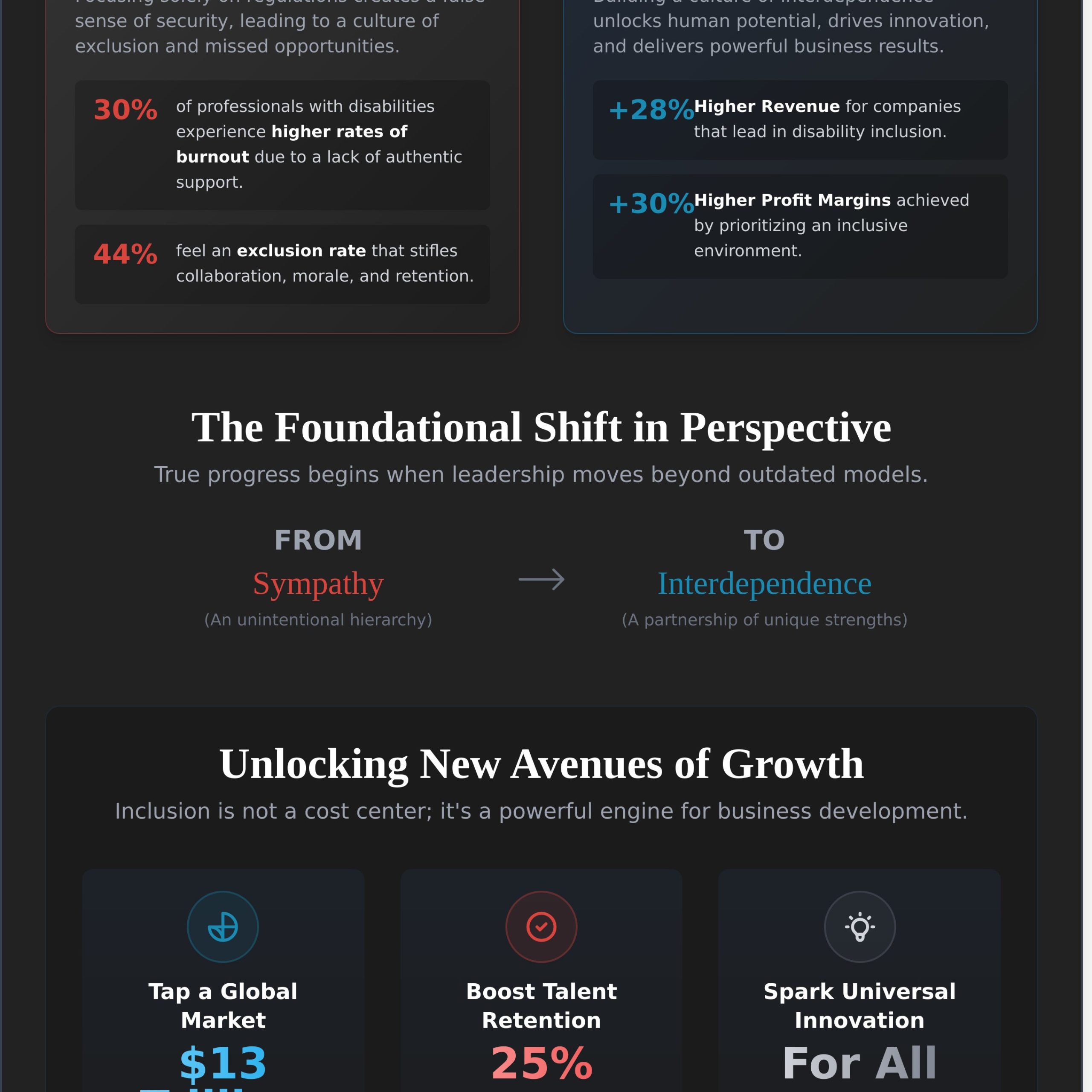
Focusing solely on regulations limits what your team can achieve. Legal compliance provides the floor, but it never provides the ceiling for innovation. As disability rights advocates define true inclusion, the focus must shift toward full societal and professional integration. The Inclusion Gap is the distance between policy and lived experience. Performative inclusion destroys morale, especially when 30 percent of professionals with disabilities experience higher rates of burnout due to lack of authentic support.
Economic and Social ROI of Expert Consulting
The global disability community includes 1.3 billion people with an annual disposable income of $13 trillion according to the 2022 Return on Disability Group report. A 2023 Accenture study found that companies prioritizing disability inclusion achieved 28 percent higher revenue and 30 percent higher profit margins. By hiring a disability inclusion consultant, you ensure your products reach the widest possible market. Authentic accessibility support also lowers turnover rates by 25 percent, saving significant costs in recruitment and training.
Inclusive design leads to better products for every single user, not just those with specific needs. Think of how closed captioning helps people in loud environments or how curb cuts assist parents with strollers. These innovations didn’t happen by accident; they happened because someone looked at a challenge and found a universal solution. When you partner with an expert, you aren’t just doing the “right thing” for a minority group. You’re refining your entire business model to be more resilient, flexible, and profitable. Organizations that embrace this shift find that they don’t just retain employees with disabilities; they attract top-tier talent from all backgrounds who value a culture of genuine belonging and trust.
- Innovation: Adaptive strategies often lead to breakthrough product features.
- Market Reach: Tapping into a $13 trillion market that is often ignored by competitors.
- Retention: Creating a supportive environment that reduces the 44 percent exclusion rate felt by many disabled professionals.
- Brand Authority: Moving from performative gestures to being a recognized leader in social responsibility.
The Power of Lived Experience: What a Consultant Brings to the Boardroom
Theoretical knowledge is a map, but lived experience is the actual journey. A professional disability inclusion consultant brings a perspective that no textbook or HR manual can replicate. Most leaders approach disability with sympathy, yet sympathy creates an unintentional hierarchy where one person is viewed as “lesser” than the other. Real progress happens when we move toward interdependence. This concept recognizes that every person in an organization relies on the unique strengths of others to succeed. When I speak to a board of directors, I’m not looking for pity; I’m looking for a partnership that acknowledges the untapped potential of 25% of the American population.
In 2024, data from the Office of Disability Employment Policy (ODEP) shows that inclusive workplaces see a 28% increase in revenue. Despite these numbers, 67% of hiring managers admit to feeling uncomfortable during interviews with disabled candidates. This discomfort stems from a lack of exposure. A consultant identifies these strategic blind spots by sharing stories that illuminate the path forward. We don’t just point out what’s wrong. We use storytelling to break down the psychological barriers that keep talent locked outside the door. By humanizing the data, we turn a corporate requirement into a shared mission.
Seeing Beyond the Surface
I’ve lived as a blind person for over 70 years, and I’ve learned that blindness is merely a characteristic. It’s no more a limitation than the color of your hair. When a business hires a disability inclusion consultant, they gain access to a specific brand of innovative problem solving. Adaptive living requires constant creativity. If a digital tool is inaccessible, we find a workaround. In a corporate setting, this translates directly to business resilience. We call this the Unstoppable Mindset. It’s a framework that teaches teams to view every obstacle as a prompt for innovation rather than a reason to stop.
- Redefining blindness as a neutral characteristic rather than a tragic deficit.
- Applying adaptive problem-solving techniques to complex corporate logistics.
- Building a culture where resilience is a measurable asset.
Authentic Advocacy in Action
Trust is the fundamental currency of any successful leadership team. On September 11, 2001, trust was the only thing that mattered as I navigated 1,463 steps down the North Tower with my guide dog, Roselle. That experience wasn’t just about survival; it was a masterclass in the bond between a leader and a partner. A consultant acts as a vital bridge between management and disabled employees. We help leaders navigate sensitive conversations with confidence rather than fear. When you explore my keynote and consulting options, you’ll see how these lessons in trust can transform your internal culture. We move past the surface-level talk and get to the heart of how people actually work together. This creates an environment where every employee feels safe enough to contribute their best work.
By focusing on these authentic connections, organizations can reduce turnover by up to 30% among employees with disabilities. This isn’t just a moral choice. It’s a calculated strategy for long-term stability. When we build trust, we build an unstoppable organization.
Navigating the Invisible Barriers: Trust, Teamwork, and Leadership
On September 11, 2001, trust wasn’t a corporate theory discussed in a boardroom. It was the literal bridge between the 78th floor of the North Tower and the safety of the street below. When Roselle and I began our descent, we weren’t just moving through a building; we were demonstrating the power of interdependence in its purest form. This intersection of disability awareness and high-stakes crisis management reveals that the most resilient teams aren’t those made of solitary heroes. They’re teams that understand how to lean on one another. A disability inclusion consultant helps organizations realize that the skills used to navigate a world not built for you are the same skills required for elite leadership.
Trust functions as the foundational element of any inclusive workplace. It’s the quiet confidence that your team has your back, regardless of how you perceive or move through your environment. By working with a disability inclusion consultant, organizations move beyond simple compliance. They begin to build a culture where everyone feels safe to bring their full selves to work. This level of psychological safety isn’t just about empathy. It’s about performance. When employees don’t have to hide their needs or compensate for “invisible” barriers, they can focus their energy on innovation and problem-solving.
The World Health Organization’s role of a Disability Inclusion Consultant emphasizes that this work involves strategic policy development that promotes a rights-based approach. Identifying and dismantling systemic ableism in promotion cycles is a critical part of this strategy. Often, leadership criteria are built on narrow definitions of “presence” or “stamina” that unfairly exclude talented individuals. In 2023, the U.S. Bureau of Labor Statistics reported that only 22.5 percent of people with a disability were employed. This gap isn’t caused by a lack of talent. It’s caused by systems that haven’t been audited for accessibility. When we redesign these cycles to focus on outcomes rather than traditional methods of working, we open the door for a wider pool of experts.
Inclusion also strengthens general teamwork and communication across the board. When a team learns to communicate effectively with a colleague who uses a screen reader or requires captions, they become more precise in their language overall. They stop making assumptions. They start asking better questions. This clarity benefits every single employee, reducing misunderstandings and streamlining workflows. It turns a group of individuals into a synchronized unit that can handle any crisis.
Trust as a Survival Skill
Lessons from the World Trade Center teach us that interdependence isn’t a weakness; it’s our greatest asset. Building psychological safety through inclusive practices ensures that every team member feels supported during high-pressure situations. You can learn more about these leadership and trust lessons from 9/11 to see how trust transforms obstacles into opportunities for growth. In that stairwell, we didn’t survive because we were independent. We survived because we were a team.
Dismantling “The Handicap Label”
The term “handicapped” is outdated and counterproductive. It carries the weight of a “cap in hand” mentality that doesn’t reflect the empowerment of the modern disability community. Language shifts that focus on “accessibility” and “inclusion” empower rather than diminish. Creating a roadmap for an inclusive workplace culture requires us to replace these old labels with language that honors the dignity and agency of every professional. It’s about seeing the person, not the limitation.
A Framework for Action: How to Evaluate and Partner with an Expert
Choosing a disability inclusion consultant is a decision that shapes the future of your organization’s culture. It’s about finding a guide who understands that true inclusion is built on a foundation of trust and meticulous preparation. When I navigated the descent of the North Tower on September 11, 2001, my trust in Roselle was total because we had trained for the unexpected. Your partnership with an expert should offer that same sense of security. You aren’t just looking for a consultant; you’re looking for a visionary partner who can help your team see beyond the physical limitations often associated with disability.
Effective evaluation starts with looking at a consultant’s track record in both strategy and execution. Ask for specific examples of how they’ve moved the needle. A 2023 study by Accenture found that companies leading in disability inclusion saw 28% higher revenue than their peers. Your consultant should be able to articulate a path toward these results. They must demonstrate a balance between technical proficiency and the ability to inspire a cultural shift across all levels of your organization. This dual focus ensures that your inclusion efforts are sustainable and impactful.
The Technical Pillar: Adaptive Technology and Accessibility
Digital accessibility is the frontline of modern inclusion. If your internal systems or customer-facing platforms aren’t compatible with assistive technology, you’re creating invisible walls. A qualified disability inclusion consultant must possess deep expertise in tools like JAWS and other screen readers. This isn’t just about compliance; it’s about empowerment. Providing JAWS training ensures that your visually impaired employees have the tools they need to be high-performing contributors. You can learn more about what is a screen reader and why it matters to understand how these tools bridge the gap between exclusion and participation. According to the 2024 WebAIM Million report, 95.9% of the top one million homepages still have detectable WCAG 2 failures. An expert will help you ensure your company isn’t part of that statistic.
The Cultural Pillar: Training and Advocacy
Technical tools are only half of the equation. Effective consulting must address both the software on the computer and the software in the human mind. This requires customized workshops that speak directly to the unique challenges of different departments. Your marketing team needs to understand inclusive design, while your management team needs to learn how to foster an environment of interdependence. This message must cascade from the C-Suite to the front line to be truly effective. When leadership champions these values, it creates a ripple effect that transforms the entire workplace. We move from a mindset of “accommodation” to one of genuine “belonging” where every person is seen for their potential.
Integration is the final step in this framework. The insights gained from a consulting engagement shouldn’t sit in a report on a shelf. They must be woven into your long-term DEI roadmaps. Set measurable goals, such as achieving a 100% accessibility score on all new digital assets or increasing disability representation in leadership roles by 15% over the next 24 months. These metrics provide the accountability needed to sustain progress. By treating inclusion as a core business strategy rather than a peripheral project, you build an unstoppable organization that values every individual’s unique contribution.
Ready to transform your workplace culture through expert guidance? Partner with Michael Hingson to build your Unstoppable Mindset today.
The Unstoppable Mindset: Partnering with Michael Hingson
Michael Hingson doesn’t just discuss inclusion; he lived its most profound application on September 11, 2001. When the North Tower was struck, Michael and his guide dog, Roselle, successfully navigated 78 floors. Those 1,463 steps weren’t just a descent toward safety. They were a masterclass in interdependence, trust, and the rejection of fear. Today, Michael translates that harrowing experience into a strategic framework for global organizations. As a seasoned disability inclusion consultant, he moves beyond the surface level of compliance to help leaders foster a culture where every individual’s unique perspective is seen as a competitive edge.
The legacy of Roselle serves as the heartbeat of this consulting practice. It teaches teams that partnership isn’t about one person leading and another following. It’s about a synchronized movement toward a shared goal. In the corporate world, this translates to creating environments where employees feel safe to bring their whole selves to work. Michael’s approach combines the high impact of keynote inspiration with the granular detail of actionable advisory services. He challenges the traditional “handicap” label, replacing it with a “No Limits” philosophy that empowers teams to rethink their perceived boundaries.
Building an inclusive organization requires more than a one-time seminar. It demands a shift in vision. Statistics from the 2023 Accenture “Accessibility Advantage” report show that companies leading in disability inclusion see 28 percent higher revenue and double the net income of their peers. Michael helps businesses capture this value by identifying the “blind spots” in their current DEI strategies. He provides the tools to transform these gaps into opportunities for innovation and growth.
Consulting Services Offered
- Accessibility Audits and Strategic DEI Planning: Michael conducts deep dives into organizational structures to ensure that both physical and digital environments are welcoming to the 27 percent of American adults who live with a disability according to 2024 CDC data.
- Adaptive Technology Training (JAWS): He provides specialized training for professionals using Job Access With Speech (JAWS), ensuring that blind and low-vision employees have the technical proficiency to excel in high-stakes roles.
- Executive Coaching: This service targets C-suite leaders, teaching them how to model inclusive leadership that trickles down to every level of the company.
Booking and Next Steps
Transforming your corporate culture starts with a single conversation. You can bring Michael’s decades of expertise to your next leadership retreat to spark a genuine mindset shift among your executive team. For those seeking ongoing education, the Unstoppable Mindset Podcast offers weekly insights into resilience and human potential, featuring guests who have overcome significant odds through innovation and grit. The path to a truly inclusive workplace is a journey of 1,463 steps, and it begins by choosing a guide who has walked the path before. Your first step is to book a consultation with Michael Hingson today to evaluate your current inclusion roadmap.
Cultivating a Vision for an Unstoppable 2026
True leadership looks beyond the physical sense of sight to recognize the untapped potential within every individual. By 2026, the most successful organizations will move past the 1990 ADA mandates to embrace a culture of genuine interdependence. You’ve learned that lived experience transforms a boardroom, turning invisible barriers into bridges of trust. A dedicated disability inclusion consultant provides the strategic roadmap to shift your perspective from mere compliance to competitive advantage.
Michael Hingson brings over 20 years of keynote and consulting expertise to this journey. As the New York Times Bestselling Author of Thunder Dog and a 9/11 survivor, he understands that resilience isn’t a solo act; it’s a collaborative one. He navigated 1,463 steps down the North Tower on September 11, 2001, by trusting his guide dog, Roselle. This same spirit of trust can redefine your corporate culture. It’s time to stop viewing disability as a limitation and start seeing it as a unique characteristic that drives innovation.
Partner with Michael Hingson to build an inclusive, unstoppable workforce today
Your organization’s brightest days are ahead when you choose to see the world differently.
Frequently Asked Questions
What exactly does a disability inclusion consultant do?
A disability inclusion consultant partners with your leadership team to identify and remove the physical, digital, and attitudinal barriers that limit human potential. They perform detailed audits, design training programs, and help your organization move from simple compliance to a culture of true interdependence. Michael Hingson uses his experience from September 11th to teach teams how trust and preparation create a resilient workforce. This work ensures that 100% of your employees feel empowered to contribute their best work.
How is disability inclusion different from general diversity and inclusion (DEI)?
Disability inclusion focuses specifically on the unique adaptive skills and accessibility needs of the 1.3 billion people globally living with disabilities. While general DEI programs often address race or gender, a disability inclusion consultant ensures that your infrastructure and mindset are accessible to everyone. It isn’t just a subset of diversity; it’s a fundamental shift in how we perceive capability. We move beyond the “handicap” label to recognize the profound resilience and innovation that disabled professionals bring to the table.
Can a consultant help with ADA compliance and legal risks?
Yes, a consultant provides the strategic framework to meet and exceed the standards set by the 1990 Americans with Disabilities Act. By implementing proactive strategies, companies can reduce their risk of litigation, which saw a 12% increase in digital accessibility lawsuits in 2023. We focus on building a sustainable culture of trust so you aren’t just checking a legal box. This approach ensures your organization is genuinely welcoming, protecting you from risks while opening doors to new talent.
How long does a typical disability inclusion consulting project take?
A standard engagement typically spans 3 to 6 months depending on the size of your organization and the depth of the initial assessment. Short-term training sessions might last 2 days, while full cultural transformations require a longer commitment to ensure lasting change. We start with a baseline audit to establish clear milestones for your team. This timeline allows everyone to move through the stages of awareness, strategy, and implementation without feeling rushed or losing focus on their daily operations.
What is the “Unstoppable Mindset” in a corporate context?
The Unstoppable Mindset is a leadership philosophy that views every challenge as an opportunity for innovation through trust and teamwork. Michael Hingson developed this framework after navigating 78 flights of stairs in the North Tower with his guide dog, Roselle. In a business setting, it means rejecting perceived limitations and focusing on adaptive living. It empowers your team to perform with clarity and resilience even when the path forward isn’t visible, turning obstacles into stepping stones for growth.
How do we measure the success of an inclusion consulting engagement?
Success is measured through concrete metrics like a 20% increase in employee engagement scores or a significant reduction in turnover among staff with disabilities. We also track the implementation of 100% of the recommended accessibility features in your workplace policies and digital assets. Beyond the numbers, success is evident when your team treats inclusion as a natural reflex rather than a forced initiative. It’s about seeing the tangible growth in your collective resilience and ability to innovate.
Does Michael Hingson offer virtual consulting and training?
Michael Hingson provides comprehensive virtual consulting and keynote sessions to reach global teams regardless of their physical location. These digital sessions use accessible platforms to ensure every participant can engage with the message of trust and leadership. Since 2020, virtual training has become a core part of his mission to foster inclusion worldwide. It’s an effective way to bring the Unstoppable Mindset directly to your screen, allowing for impactful learning without the need for travel or logistical delays.
Is website accessibility part of disability inclusion consulting?
Website accessibility is a critical component of modern consulting because your digital presence is the front door to your business. A disability inclusion consultant helps you align your site with WCAG 2.1 standards to serve the 25% of adults in the U.S. who live with a disability. We look at how technology can either bridge gaps or create new barriers for your customers. Ensuring your digital space is accessible is a vital step in building a brand that truly values every person.
Article by
Michael Hingson
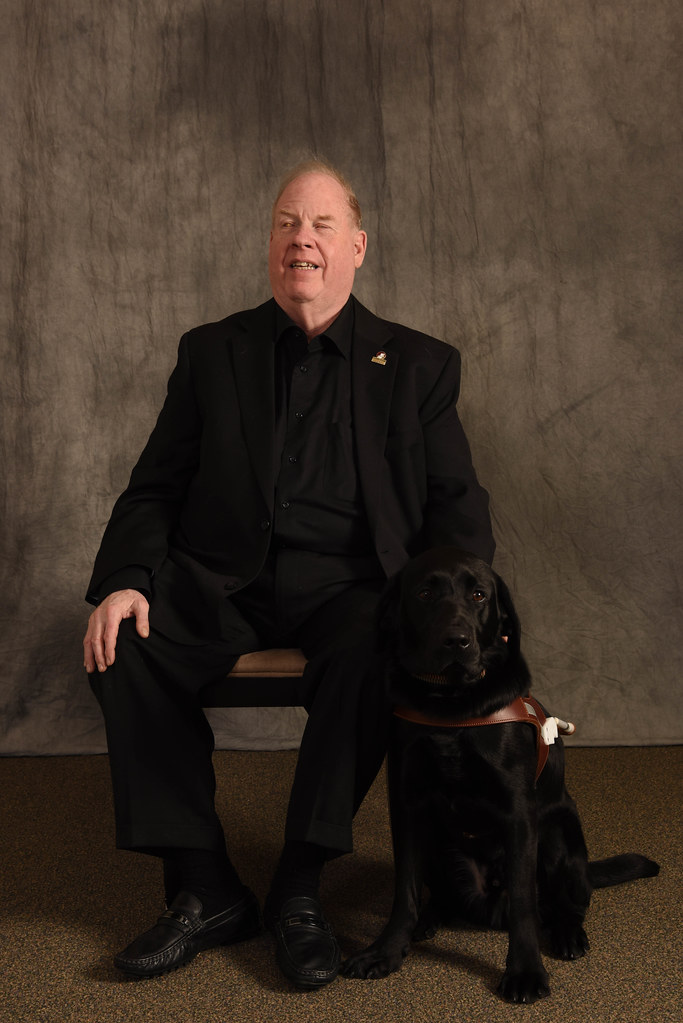
Michael Hingson is a keynote speaker, bestselling author of Thunder Dog, and a survivor of the September 11 World Trade Center attacks. Blind since birth, he brings a powerful and unique perspective on leadership, trust, and resilience in times of uncertainty.
He has spoken to organizations around the world, helping leaders and teams navigate change, build trust, and perform under pressure. His message combines real-world experience with practical insight that audiences remember long after the event ends.
👉 Book Michael Hingson for your next event.